Ask people which technologies changed warfare and you get different lists. Still, if you line up the public record by year, a few moments stand out where the basic math of fighting changed.
This article follows six of them: radar, the proximity fuze, missiles, precision guidance, stealth and drones. For each one, it looks at what changed and also at what new burdens came along.
Each technology has its own article that explains how it works. Links sit at the matching places, so you can jump over whenever a part catches your interest.
What counts as a turning point
On December 2, 2014, a subcommittee of the U.S. House Armed Services Committee held a hearing on a "third offset strategy." To offset is to make up for an opponent's advantage with something else. The way one witness described earlier offsets makes a useful frame for turning points.
A witness, researcher Shawn Brimley, said the first offset strategy was built around atomic weapons. The second came as guided conventional weapons that keep correcting their own path after they are fired, dropped or launched. It cut the need to mass large forces on the battlefield. In his words, guided weapons opened a new way of fighting in which "accuracy became independent of range."
That is one witness's view. It still shows what a turning point is. It is not a moment when one number got a little better. It is a moment when what you can do, and what you no longer have to do, changed.
Radar: seeing with radio waves
The idea of sending out radio waves and catching the echo from a distant object is old. In 1904 the German inventor Christian Hülsmeyer patented a way to do it, but it drew very little interest.
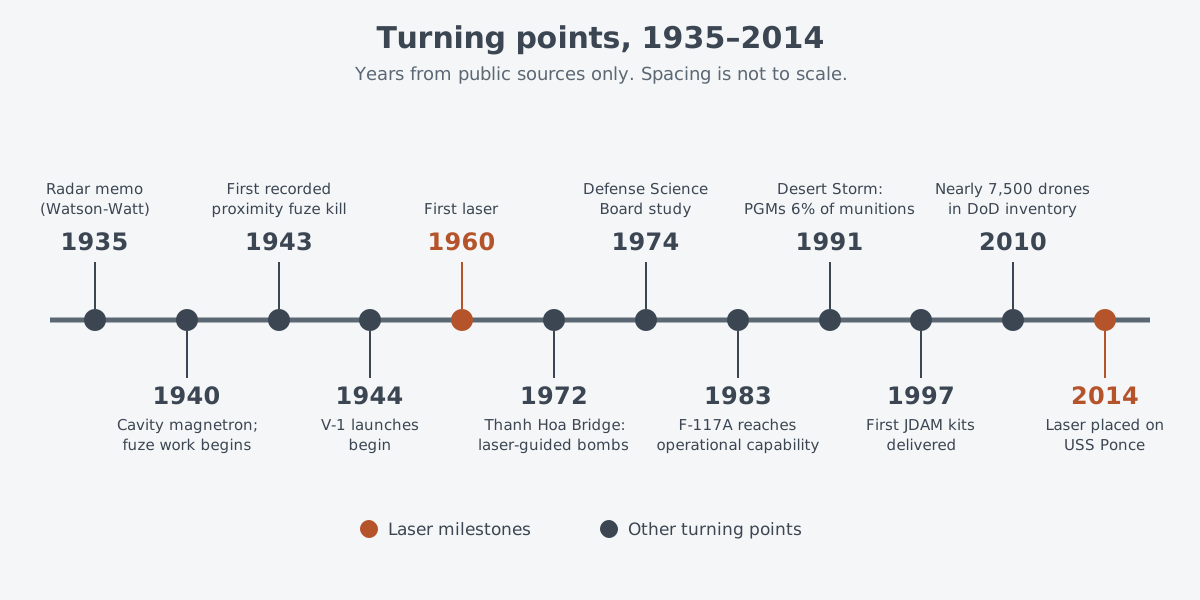
Things changed in the late 1930s. Fear of air raids pushed research forward, and teams in no fewer than eight countries developed radar on their own. On February 12, 1935, Robert Watson-Watt in Britain sent a memo titled "Detection of aircraft by radio methods." One researcher later called it "the birth certificate of radar."
In 1940, while the Battle of Britain was fought, the Chain Home radar network warned of German air raids ahead of time. In the same year, two researchers at the University of Birmingham, Randall and Boot, invented the cavity magnetron. That invention was the key technical step that moved radar into microwaves. A shorter wavelength is easier to squeeze into a tight beam, and a higher frequency gives finer resolution.
How did Chain Home know how far away an aircraft was? The way returning radio waves give distance and motion is in Radar: measuring distance and motion with radio waves.
The proximity fuze: no direct hit needed
Hitting a flying aircraft squarely with a shell is hard. A history published by NIST, the U.S. standards agency, explains that a direct hit was far beyond 1940s technology. It adds that a burst some distance from the target often did more damage.
The answer was the proximity fuze, also called the VT fuze. It sets off a shell once the target is close enough to be destroyed. For a long time, such a device was thought to be impossible.
Development moved fast. The U.S. National Defense Research Committee (NDRC) was founded in June 1940, and in mid-August of that year a project began to study three approaches: photoelectric, acoustic and radio. A record from January 5, 1943, notes a Japanese aircraft brought down by a proximity fuze.
By August 14, 1945, 22,073,481 fuzes had been made. Even so, how they were developed and built remained among the most closely guarded secrets of the whole war. A single volume that NBS (now NIST) staff wrote at the end of the war was classified Secret and was not declassified until 1960.
In its own history, the Johns Hopkins Applied Physics Laboratory (APL) says the work was later judged one of the war's three most valuable technology developments. The other two were the atomic bomb and radar. It does not say who made that judgment. How the device senses a target is explained in Proximity fuzes: working without a direct hit.
Weapons that fly without a pilot
From June 1944 to March 1945, the V-1 was launched more than 20,000 times toward Britain and the European mainland. The Smithsonian National Air and Space Museum describes the V-1 as the first cruise missile anywhere to enter operational use. It flew on a simple, noisy pulsejet and was very inaccurate.
Missiles fall into two broad groups by how they fly. Under a definition quoted in a 2005 Congressional Research Service (CRS) report, a ballistic missile is guided only while its motor burns, then coasts under gravity and air drag alone. A cruise missile is a guided missile that flies low over long distances and can be launched from the air, the sea or the land.
The V-1 shows that sending a weapon far and sending it accurately are two different problems.
Precision guidance: a marked spot and satellite signals
Guided weapons go back to the First World War. In the Second World War, Germany used a guided bomb called Fritz X on Allied ships in the Mediterranean. After release, an operator steered it with a joystick and a radio transmitter, and the aircraft had to fly slowly and level the whole time. The U.S. Army Air Corps also tested radio-guided glide bombs using television signals in the 1940s, but they never fully entered service during the war.
In the 1960s, laser guidance, semiconductors and other advances raised accuracy. A laser-guided bomb homes on the bright spot a laser paints on the target, and it first appeared in the Vietnam War. An article from Johns Hopkins APL points to the Thanh Hoa Bridge. Over six years the United States dropped hundreds of bombs on it and lost aircraft and pilots, until a handful of laser-guided bombs brought it down in April 1972.
Even so, the change did not happen all at once. Laser-guided bombs were prominent in Operation Desert Storm in 1991, yet precision-guided munitions (PGMs) made up only 6% of all munitions used.
The next step was satellite signals. JDAM is a kit that adds GPS guidance to a bomb that has no guidance of its own. Study of such weapons began in the 1980s, the first kits were delivered in 1997, and the U.S. Air Force first used them in Operation Allied Force in 1999.
Today the U.S. Department of Defense defines a PGM as a guided weapon meant to destroy a point target while keeping collateral damage as low as possible. A guided weapon can change its path to correct aiming errors, weather effects and similar problems. What gets added to a bomb is in Precision-guided bombs: what gets added to a plain bomb. Finding position with satellites and inertial sensors is in Inertial and satellite navigation, and the "eye" at the front is in Missile seekers.
Stealth: being seen later
In 1974, a Defense Science Board (DSB) study hosted by the U.S. Department of Defense saw the spread of advanced, networked air defenses as a major threat to U.S. aircraft. Building on it, the Defense Advanced Research Projects Agency (DARPA) began developing technology for aircraft with a far smaller radar cross section, meaning they return much less radar energy.
The program was called the Experimental Survivable Testbed (XST), and it became Have Blue when the Air Force took it over. Have Blue first flew in testing before the end of 1977 and led straight to the F-117. The F-117A first flew in 1981 and reached operational capability in October 1983. Its first combat mission came in 1989.
DARPA describes military stealth as cutting an asset's "signature," its visible presence, and compares it to a moth that vanishes against tree bark. The real task is harder. A moth only has to escape the eye, but the XST program grew technologies for radar cross section, infrared, visual signature and exhaust as well.
From the 1974 study, it took three years for Have Blue to fly and close to ten years for the F-117A to become operational.
At the same hearing, subcommittee chairman Representative J. Randy Forbes raised the question of money. He said the 1970s offset drew heavy research and development investment, but the resources to pay for it never arrived. In his account, stealth, sensors and precision-guided munitions were fielded in a way that made real use of them only during the military buildup of the early 1980s.
Whether "invisible aircraft" is the right phrase is discussed in Stealth aircraft: truly invisible?, and how size relates to echoes is in Radar cross section and Radar-absorbing materials and structures.
Uncrewed systems: aircraft with no one aboard
Uncrewed aircraft were first tested in the First World War, though the United States did not use them in combat then. The Firebee first flew in the 1950s as a target for aerial gunnery practice and in the 1960s it gathered intelligence as a drone. In the 1960s, self-flying drones also carried out reconnaissance in the Vietnam War.
The Predator first saw use in the Balkans conflict, watching roads for weapons movements. According to a 2012 CRS report, the U.S. Department of Defense's drone inventory grew from 167 aircraft in 2002 to nearly 7,500 in 2010.
Two advantages are usually named. No pilot's life is at risk, and abilities such as endurance are not tied to human limits. That is why drones take on dull, dirty and dangerous missions that need no one in the cockpit.
Why staying aloft matters for reconnaissance is in ISR drones: why endurance matters. The line between drone and missile is in Loitering munitions: between missile and drone, and groups of drones flying together are in Drone swarms.
What came with each turning point
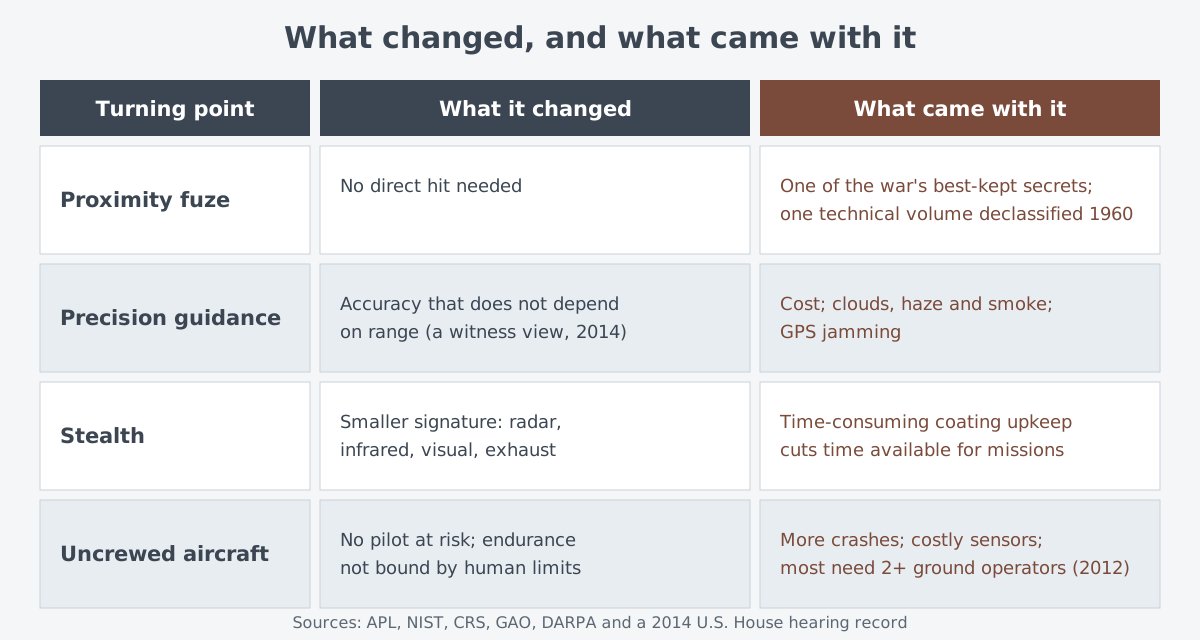
A timeline can make it look as if each new technology simply solved one more problem. Reading the public records alongside it gives a different picture. Each turning point came with new burdens.
The first is time. Stealth went from a 1974 study to operational capability in 1983, and precision-guided munitions were still only 6% of munitions used in 1991, long after they stood out in Vietnam.
The second is secrecy. More than 20 million proximity fuzes were made, yet the fuze stayed one of the most closely guarded secrets of the war. A single volume summing up that work was not declassified until 1960.
The third is cost and upkeep. CRS names cost as the main drawback of precision-guided munitions, especially long-range missiles. In a 2018 report, the U.S. Government Accountability Office (GAO) cited Air Force officials on the F-22. Keeping up its stealth coating takes a lot of time and sharply cuts the time the aircraft are available for missions.
The fourth is weather and interference. In the 1991 Gulf War air campaign, aircraft flying at medium and high altitude met more clouds, haze, smoke and humid air. This got in the way of the laser designators used for laser-guided bombs.
Most missiles today correct their inertial navigation with GPS, and during parts of a flight an opponent may jam the GPS. This kind of struggle over radio signals is one part of a wider contest called electronic warfare.
The fifth is people. Drones may cost less to buy and run than crewed aircraft, but they crash more often, and the sensors they carry are too expensive to treat as expendable. Around 2012, most drones needed at least two ground operators. No one rides aboard, but people have not left the system.
Where this meets lasers
The first laser was invented in 1960. In that same decade, laser guidance became one of the advances that raised the accuracy of guided weapons. So the laser entered a turning point early, not as a weapon itself but as the "spot" that marks a target for a bomb to find. How laser light differs from ordinary light is in What is a laser?.
Work on using energy such as light itself as a weapon started around the same time. The United States has researched directed-energy weapons (DEW) since the 1960s, but some experts say the Department of Defense spent billions on programs that never matured and were cancelled. The summary of a CRS report calls the laser placed on USS Ponce in 2014 the first operational U.S. directed-energy weapon.
The record of missed forecasts is long too. Skeptics have half-jokingly said that "lasers are X years in the future—and always will be." Whether laser weapons will take a place beside the earlier turning points is still an open question.
The six technologies above give a way to read that question. Look for long-term fielding rather than a single demonstration, and look at how the burdens of cost, upkeep and weather are carried. The path from chemical to electric lasers is in A history of laser weapons: from chemical to electric lasers. The known strengths and limits are in Strengths and limits of laser weapons.
What to read next
- A history of laser weapons: from chemical to electric lasers: how laser weapons got to where they are now.
- How to read laser weapon news: "kW-class", "range" and "cost per shot": how to read reports on a new technology with care.
- Proximity fuzes: working without a direct hit: the first turning point in this article, from the principle up.
- Stealth aircraft: truly invisible?: what "invisible" really means.