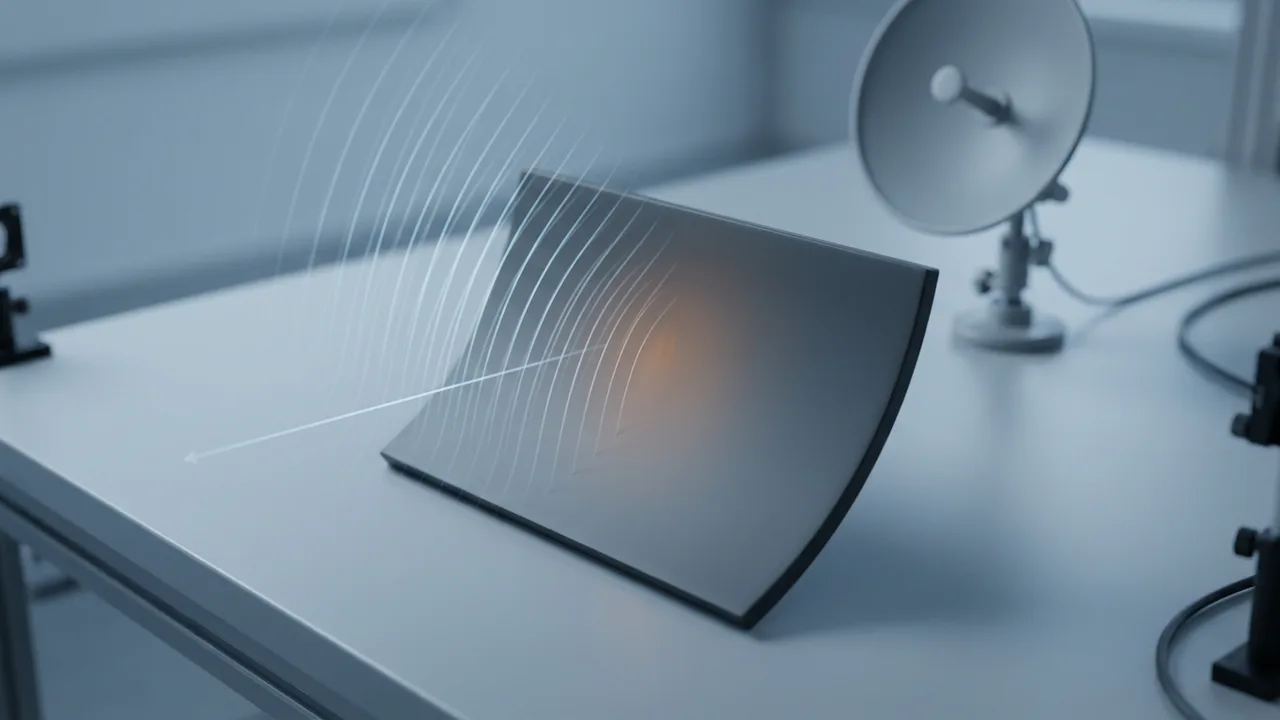
"Paint it with a special coating and radar can't see it." That line comes up whenever stealth aircraft do. If a coating that soaks up radar waves really exists, is a thick layer of it all you need?
A material that absorbs radar waves, a radar-absorbing material, is a real technology. Its job, though, is narrower than people expect, and it cannot do the whole job alone. This article starts at the moment a radio wave hits an object and looks at the two ways an absorber shrinks the echo. It ends with why keeping that coating in good shape is so demanding.
When a radio wave meets a surface
A radar sends out microwaves and times the echoes that come back to find how far away things are. Clouds, aircraft, anything that sends back an echo can be picked up. The basics of radar are in Radar: measuring distance and motion with radio waves.
When an electromagnetic wave reaches a material, it splits into three broad parts. Some bounces off the surface, and some disappears inside the material through absorption. The rest passes through. All three often happen in the same material at once.
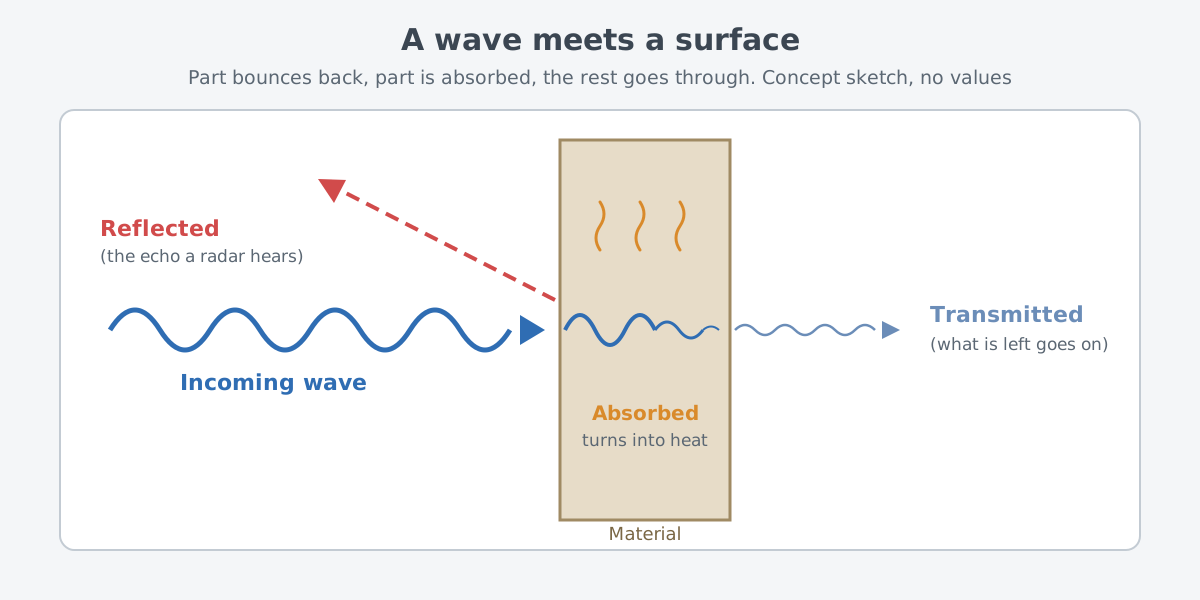
Where does the absorbed energy go? A kitchen microwave oven shows the answer. When the water in food absorbs microwaves, that energy becomes the thermal motion of molecules and the food warms up; a plate with no water stays much cooler. Salt water conducts electricity well, so it also absorbs radio waves strongly.
From the radar's point of view, only one of the three parts matters: the reflection. The radar hears nothing but the share that comes back. An absorber is meant to shrink that share and shift it over to absorption.
Two jobs of an absorber
A 2021 open review paper on microwave absorbers, published in Nano-Micro Letters, describes how these materials turn electromagnetic waves into heat or other forms of energy that then dissipate. Absorbers are also used for radar stealth, and the review lists coating military equipment with them as one anti-detection measure.
A good absorber has two conditions to meet. The first is to let as much of the incoming wave inside as possible. In other words, less of it should bounce off the surface, and this condition is called impedance matching. The second is to weaken strongly the wave that does get in, which is called attenuation.
The two conditions pull against each other. The more of the wave a material lets in, the harder it tends to be to weaken it inside. A material that conducts electricity too well cannot let the wave in and reflects much of it instead. Matching then breaks down, and attenuation suffers too.
The ways of weakening the wave inside are grouped by the kind of loss. Dielectric loss comes from a material's electrical properties, magnetic loss from its magnetic properties, and some materials use both. In magnetic loss, the work the outside wave does on a magnetic material turns into heat as the material is magnetized and demagnetized.
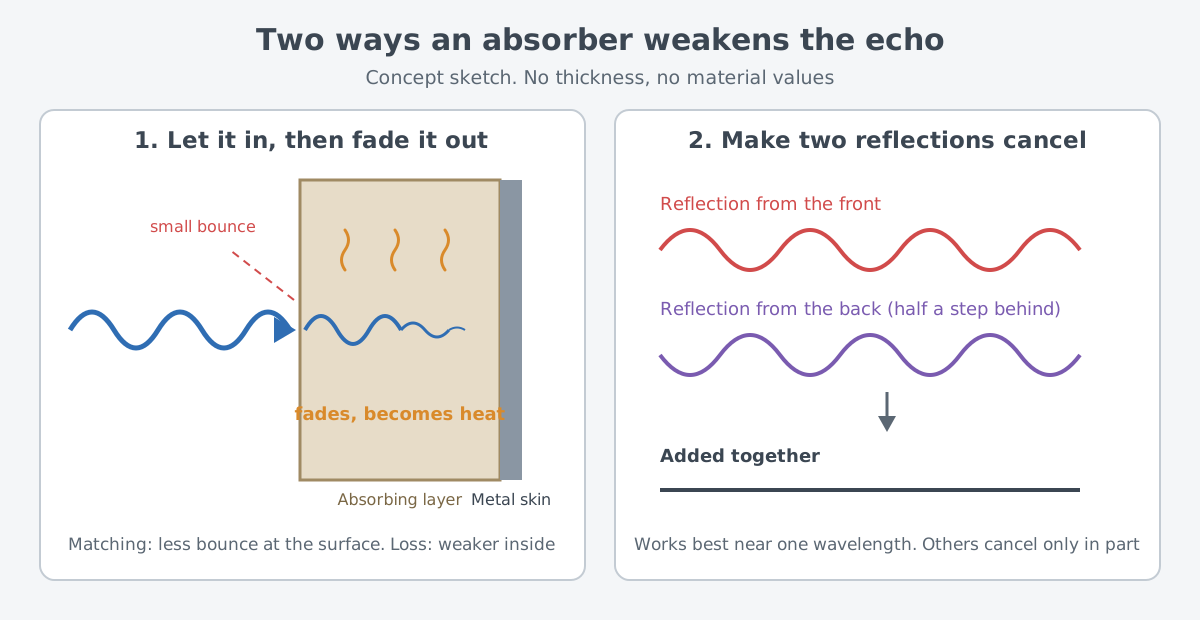
Picture a host who does not turn guests away at the door, but invites them in and walks them down a long hallway until they run out of energy. The real thing is different: a wave does not stop because it is tired. As it travels, its energy turns into heat a little at a time, so the field gets weaker. Whatever is not used up keeps going.
Cancelling reflections: interference
There is one more way to shrink the echo. The same review counts interference inside the absorber, which removes reflected waves, as another key factor in weakening electromagnetic waves.
Interference is easiest to see in the thin-film example from physics textbooks. When light reaches a thin film, only part of it reflects from the top surface; the rest enters the film, and part of that reflects from the bottom surface. Light coming back from the bottom has traveled farther, so it can end up in step or out of step with the reflection from the top. When it is half a step out, the two reflections cancel each other.
A camera with several lenses has a reflection at each lens surface, and those reflections blur the picture. Lenses are therefore given a thin film that makes the reflections cancel.
Such films are called anti-reflection coatings, or nonreflective coatings, and they are also used on car windows and sunglasses. The textbook adds that the name is only roughly right, because wavelengths other than the one the film was made for are only partly cancelled.
Interference is a property of all waves, and it works the same way for light and for radio waves. So any approach that leans on interference works best near the wavelength it was made for. The review states that an ideal absorber should be light, thin, effective over a wide band, and strongly absorbing. On an aircraft, every bit of weight and thickness in the coating is carried by the airframe.
Why paint alone is not enough
In the history of stealth, absorbers were one tool among several from the start. The Defense Advanced Research Projects Agency (DARPA) traces signature management back more than 100 years. It began with camouflage patterns on warships, later spread to aircraft and submarines, and in both World Wars engineers tried to cut visual and radar signatures together.
According to DARPA, the A-12/SR-71 reconnaissance aircraft designs used radar-absorbing coatings together with work on the edges of the airframe structure that cut its radar cross section (RCS). The job was not left to paint alone; the structure also helped cut reflections. Of the later Experimental Survivable Testbed (XST) program, DARPA writes that shaping and materials were both very important.
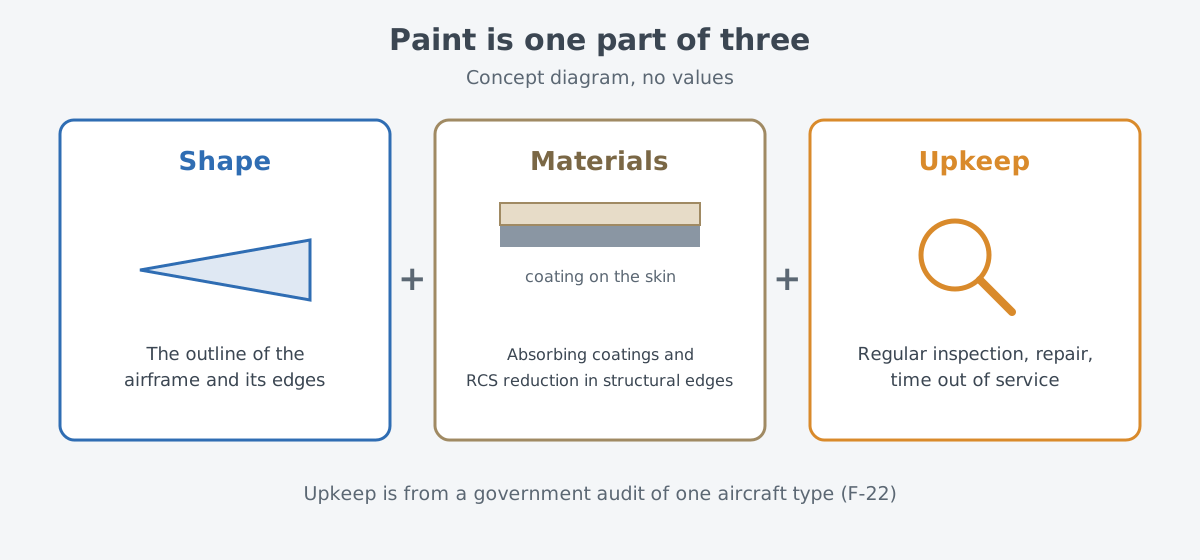
Absorbers are one item on the list of technologies the XST program helped develop, too. RCS reduction, radiation-absorbent material development and infrared shielding sit side by side. That is why stealth is hard to explain with a coating alone. How much shape changes an echo is covered separately in "Radar cross section: why a big aircraft can look small."
The hard part comes later: upkeep
The F-22 shows how demanding an absorbing coating can be once it is on. The U.S. Government Accountability Office (GAO) looked at this in a 2018 report on the F-22. It cited Air Force officials who said that keeping up the outer stealth coating takes a lot of time and greatly cuts how much time F-22s can spend on missions.
The officials explained that what is called the low observable (LO) coating on the F-22 is really several coatings stacked together. Applying and curing them takes care and a long time, and the aircraft cannot be used in the meantime. Each aircraft needs regular, thorough inspection so that damaged or worn areas are found and repaired. If damage goes past a set limit, the aircraft is treated as unable to fly its mission.
The coating also gets in the way of other maintenance, because it has to be removed and then restored. The report notes that the coating was starting to wear out as it neared the end of its useful life. It also points out that fourth-generation fighters, which are not fully covered in LO coating, avoid this maintenance problem.
This is one aircraft type, but the problem is not new. In a 2002 report, GAO wrote that maintaining low observable features had historically been harder and more time consuming than expected. At least for the F-22, the people and hours needed to keep the coating intact mattered as much as the material.
Where this meets lasers: lens coatings
Cancelling reflections through interference has long been used in optics. The anti-reflection coating in the camera example is one case of it. How overlapping light waves can add up or cancel is covered in Interference and diffraction: how light adds up and spreads.
The principle is shared, but the goals differ. A lens coating cuts reflection so more light gets through. A radar absorber cuts reflection and then turns that energy into heat inside the material. Coatings on optics that handle strong light continue in Mirrors, lenses and coatings: optics for strong light.
What to read next
- Radar cross section: why a big aircraft can look small: how shape and angle change the size of an echo.
- Stealth aircraft: truly invisible?: the bigger picture absorbers fit into, an aircraft that cuts several signatures together.
- Interference and diffraction: how light adds up and spreads: the cancelling principle again, this time with light.
- Mirrors, lenses and coatings: optics for strong light: what coatings do on the laser side.