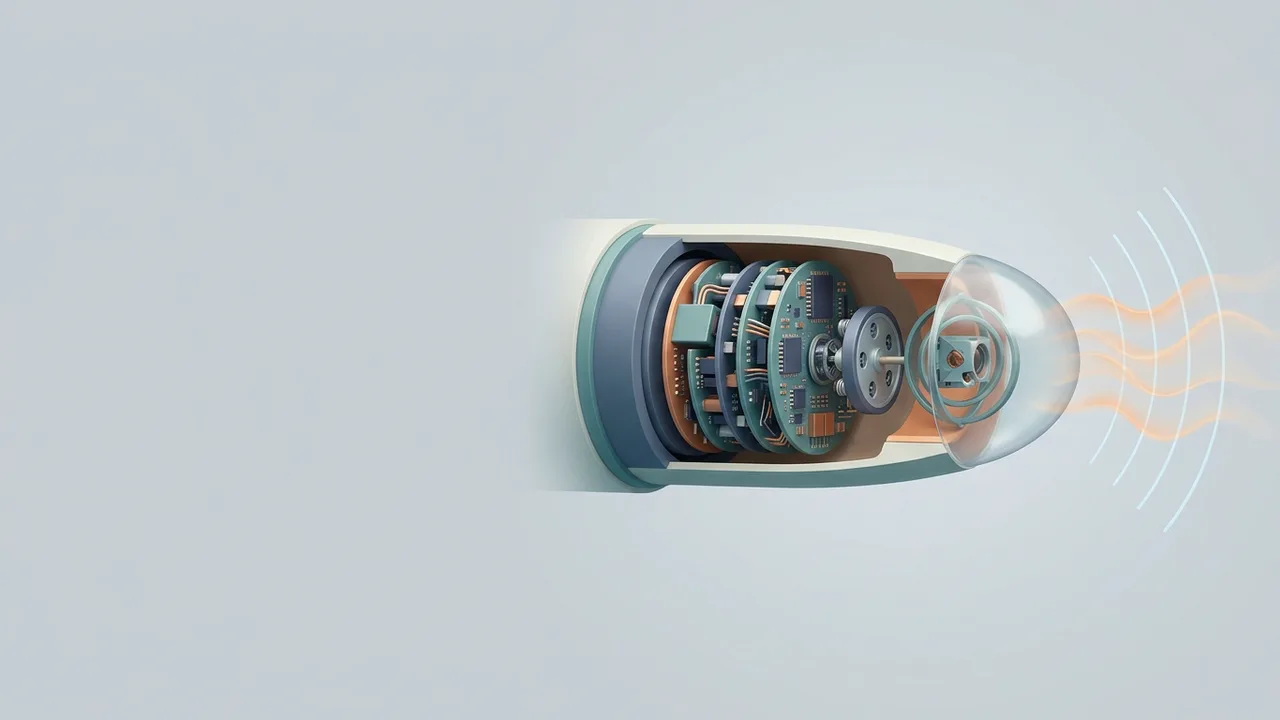
What sits inside the rounded cover at the very tip of a missile? Not wings, not the engine, but a device that finds the target and holds on to it. That device is called a seeker.
The earlier article, "Air-to-air missiles: what the missile sees," sorted seekers by the energy they receive. This one looks inside. Take off the cover, and what parts come out, and what do they do while the missile flies? And how do seekers that receive infrared light, radio waves or lasers differ?
What a seeker is made of
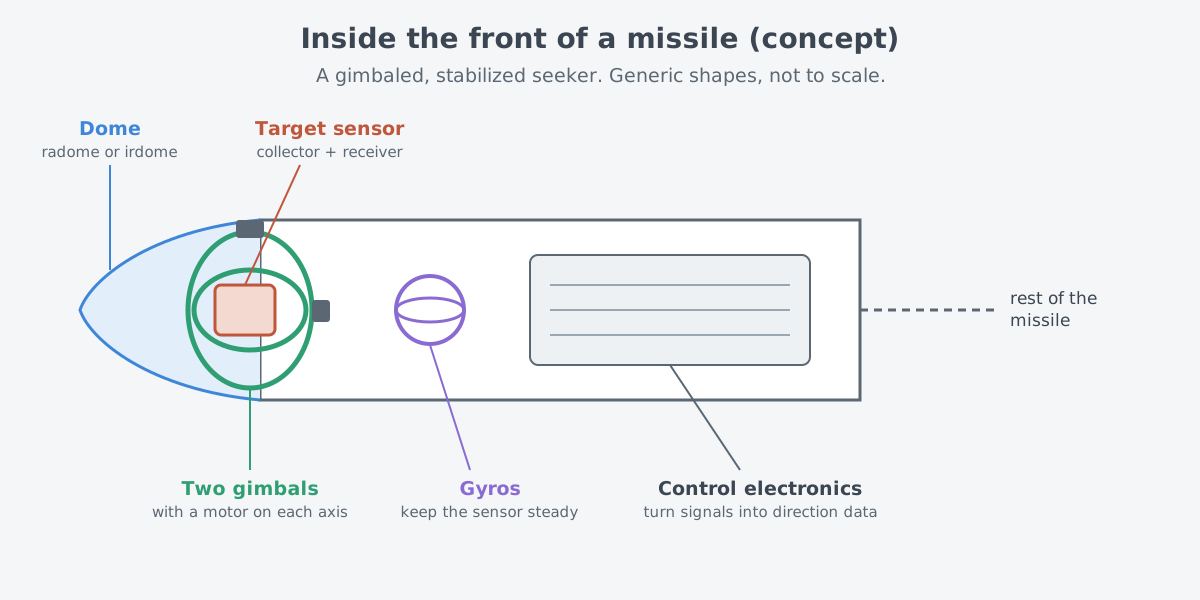
A technical journal from the Johns Hopkins University Applied Physics Laboratory (APL) uses one common design to define what a seeker contains. A seeker that keeps itself stable in space has four groups of parts. They are the target sensor, the gimbals with the motors that turn them, gyros, and the electronics that control it all.
The target sensor itself has two pieces. One gathers the energy, an antenna in the case of radio waves. The other is a receiver that takes in and handles the gathered signal.
This sensor is not fixed in place; it rides on a gimbal. A typical layout uses two gimbals set at right angles, each axis with its own motor, to swing the direction the sensor points.
If this picture looks familiar, you may be thinking of the beam director on a laser weapon. A beam director also turns on gimbals and fights vibration to keep its beam on one spot. The same problem, solved on the laser side, is the subject of Gimbals, pointing and tracking: holding the beam on one spot.
The four jobs of a seeker
The APL article lists four things a seeker must do. First, once it has caught the target, it keeps following it without letting go. Second, it measures the line from the missile to the target, the line of sight, either its angle or how fast that angle is changing.
The third job is holding steady. The missile body pitches and yaws as it flies, and that motion can be far larger than the change in the line of sight the seeker is trying to measure. Gyros help keep the sensor from being thrown off in all that motion.
Think of the image stabilization in a phone camera. Your hand shakes, yet the scene on the screen shakes much less. A real seeker goes further than smoothing out the shaking. Once the shaking is removed, it measures how the direction of the line of sight still changes and passes that to the guidance.
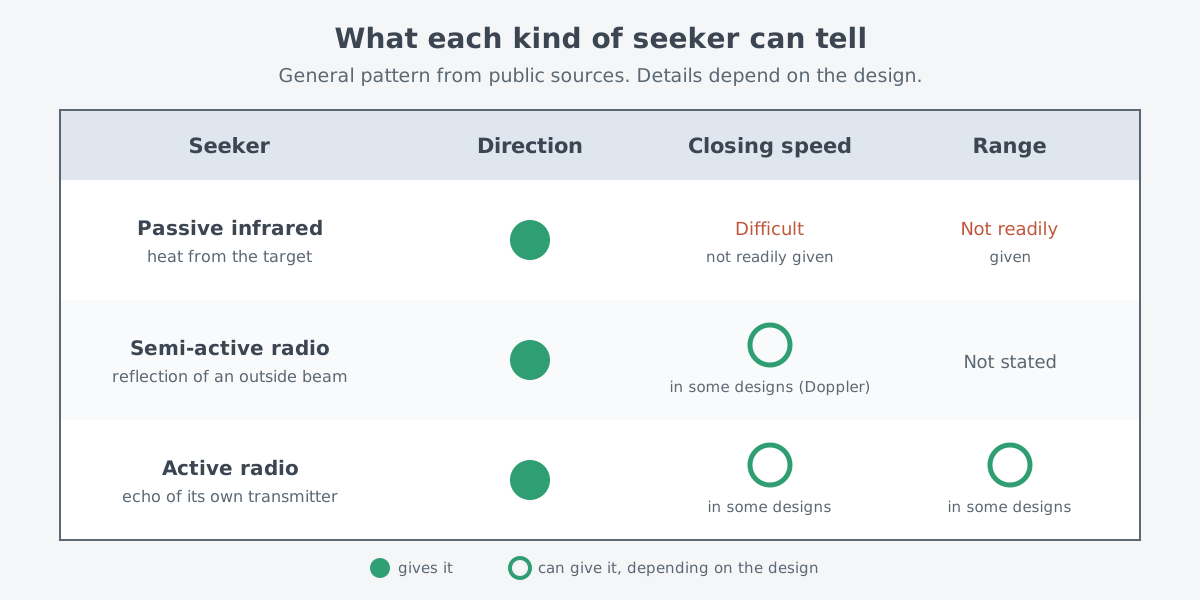
The fourth job, when possible, is measuring how fast the missile and target are closing. Radar designs can measure this from the returning signal, but it is hard for infrared designs, which take in the target's heat.
As the missile draws closer, the target information from the seeker keeps getting better. A target that looked blurry from far away grows sharper up close.
What it receives: passive, semi-active, active
Depending on where the energy they receive comes from, seekers fall into three kinds: passive, semi-active and active. What each kind receives is covered in detail in "Air-to-air missiles: what the missile sees," and what each can tell is gathered in the table diagram below.
The type of target sensor is also one of the key factors weighed when the guidance law is designed.
Infrared and imaging infrared seekers
A common example of a passive seeker is the infrared seeker. It finds and follows the heat a target naturally gives off. Infrared light is part of the electromagnetic spectrum, and its wavelength is longer than that of visible light. Our eyes miss it, but our bodies feel it as warmth.
Devices that "see" infrared are part of daily life too. Night-vision goggles and infrared cameras show the infrared light coming from warm things like people and animals. The story of the wavelength that separates visible from invisible light continues in Why wavelength matters: visible and invisible light.
Some infrared seekers carry the word "imaging" in their name. The U.S. Army describes Javelin as a "fire-and-forget" missile that locks on before it is fired and then steers itself. It also says the missile is fitted with an imaging infrared seeker. As the name says, it is a seeker that works with an infrared image.
Seekers that use radio waves or lasers, and seekers that use both
A seeker that uses radio waves, or radio frequency (RF) energy, reads the signal that returns from the target. In active and semi-active RF designs, the Doppler shift of that returning signal is a good way to estimate closing speed. How the Doppler effect reveals motion is covered in detail in Radar: measuring distance and motion with radio waves.
A laser can also be the light a seeker receives. When the target is lit from outside the missile, as in the semi-active kind, the beam can be light or laser energy, or it can be infrared or RF energy. The Congressional Research Service (CRS) likewise lists the guidance parts of precision-guided weapons. Next to inertial measurement units and GPS receivers, its list has laser seekers and seekers based on millimeter-wave radar.
There is no reason to stick to one kind. CRS says the SDB II, a small glide bomb, has a multimode seeker that combines an infrared sensor with millimeter-wave radar. It is a case of tying sensors for two different kinds of light into one seeker.
What the front of a missile demands
Sitting at the very front of the missile comes at a price. A missile flying inside the atmosphere needs a cover that shields the seeker from weather and the outside world. The cover for radio waves is called a radome and the cover for infrared is called an irdome, and vehicles flying above the atmosphere do not always need one.
Size is limited too. A passive infrared seeker is built with as wide an opening as it can get, so that more energy comes in. Radio antennas follow the same rule. Yet that size usually stops at whatever the diameter of the missile body allows.
Picture a funnel catching rainwater. The wider the mouth, the more it catches, but the mouth can hardly be wider than the bottle it sits in. In a real seeker, the opening is not the only thing to fit: the sensor, the gimbals and the gyros all have to go inside that same body.
What to read next
- Gimbals, pointing and tracking: holding the beam on one spot: solves the same gimbal and stabilization problem for a laser beam director.
- Why wavelength matters: visible and invisible light: covers the difference in wavelength between infrared and visible light.
- Radar: measuring distance and motion with radio waves: explains the Doppler effect that radio seekers use.
- Chaff and flares: the sparks behind an aircraft: meets the two kinds of light seekers watch, radio waves and infrared, again in history.