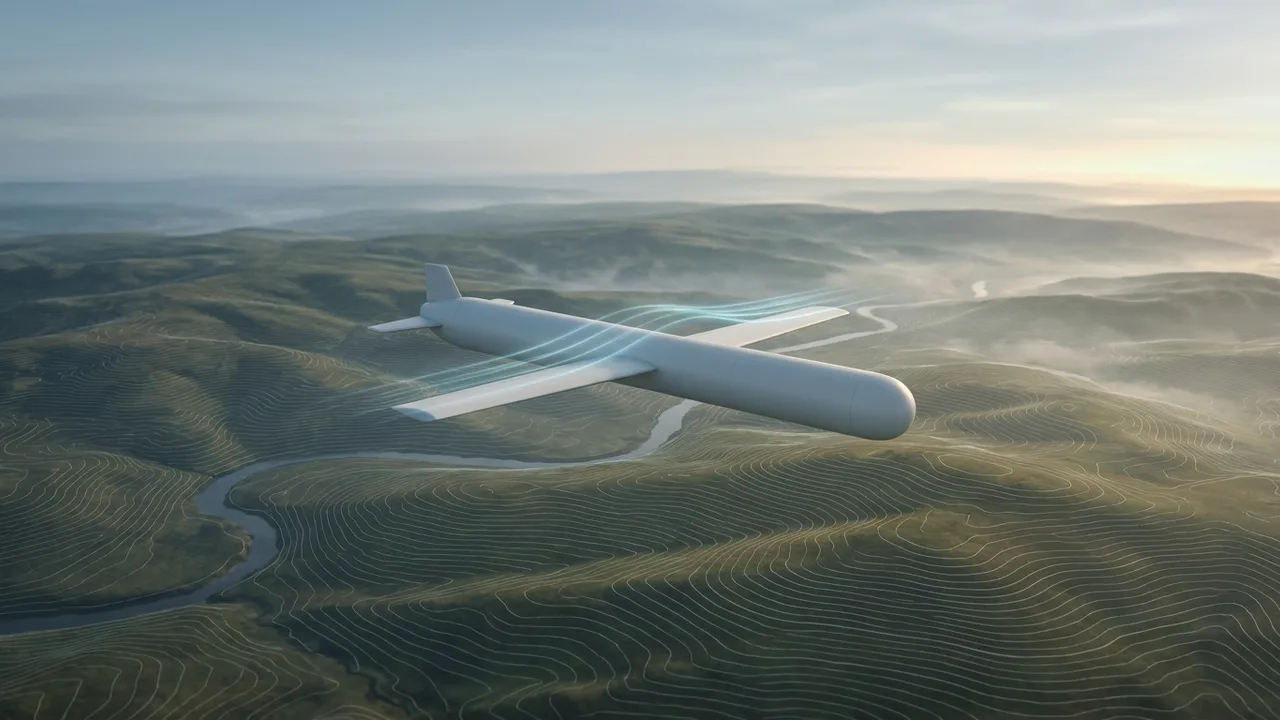
It has wings. An engine at the back pulls in air and pushes it out again as the thing crosses the sky. Most people would call it an airplane. But what is it if there is no cockpit, and it never comes back once it leaves?
That is a cruise missile. It rises on its wings, moves forward on an engine that breathes air, and finds its own way. This article walks through where it matches an airplane and where it parts ways, using NASA's aeronautics teaching pages and records released by the U.S. military and a national museum.
What counts as a cruise missile
A 1979 NASA contractor report reviewing cruise missile technology gave this definition. A cruise missile spends most of its flight in "cruise," flying at a nearly constant height and a nearly constant speed while aerodynamic lift holds up its weight. Under that definition, highly maneuverable short-range tactical missiles do not count.
A 2005 report by the Congressional Research Service (CRS) quotes a shorter definition from the Defense Threat Reduction Agency (DTRA). There, a cruise missile is a long-range, low-flying guided missile that can be launched from the air, the sea or the land. The two definitions stress different things. The 1979 report sorted cruise altitude into high and low and speed into subsonic, supersonic and hypersonic, so it also covered cruise missiles that fly high.
Underneath both definitions sits one idea. A cruise missile is a guided weapon that spends a long time flying through the air. So the quickest way into the subject is to look first at how an airplane flies.
The same four forces as an airplane
An airplane in flight feels four forces. Weight always pulls toward Earth's center. To overcome it, the airplane makes an opposing force called lift, and most of that lift comes from the wings.
The air pushes back against the moving airplane, and that force is drag. The airplane uses its propulsion system to make thrust, which overcomes drag. When the four forces balance, the airplane moves at a constant speed. That state is cruise.
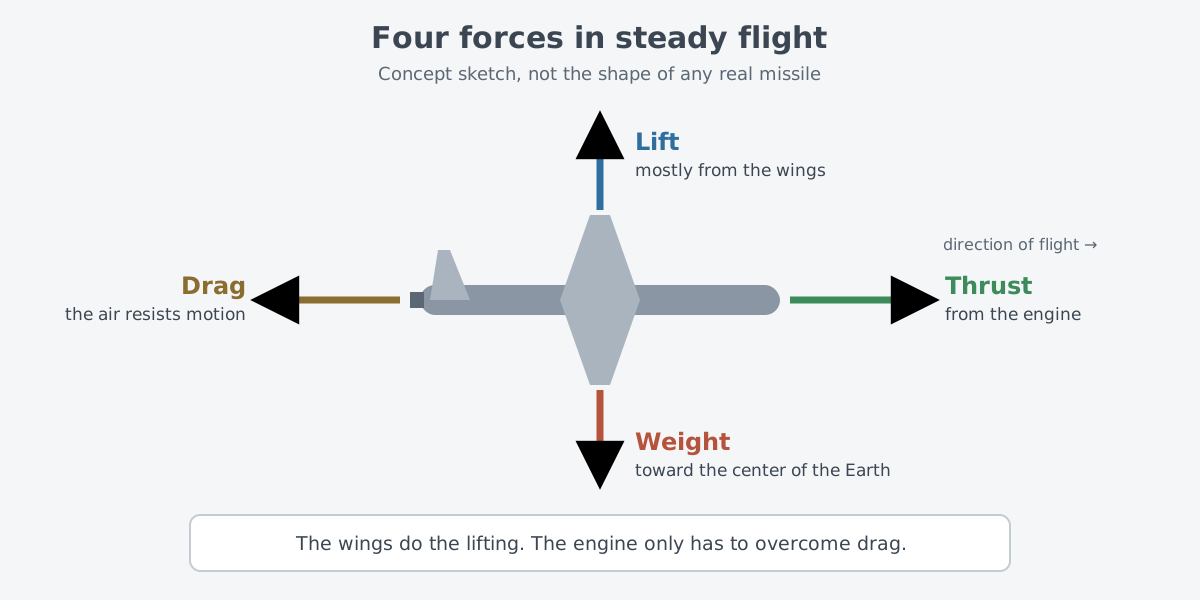
The engine's job is only to overcome drag. Lifting the airplane is not the engine's job, and the wings do the lifting. When the cruise missile definition says lift holds up the weight, it points to exactly this arrangement.
Hold your hand out of a moving car's window at a slight angle and you feel it pushed upward. The air flow hits your hand and gets turned, and that turning makes the force. A real wing differs from a flat hand because both its lower and its upper surface help turn the flow.
Lift comes with two conditions. The body has to be in contact with a fluid such as air, and there has to be motion between the body and the fluid. No air means no lift, and no motion means no lift. That is why a cruise missile held up by wings can fly only where there is air.
An engine that breathes air
Today, most airliners and military aircraft fly on gas turbine engines, the engines people usually call jet engines. Large amounts of the surrounding air flow into the engine inlet without a break. NASA notes that a typical jet engine burns only 2 pounds of fuel for every 100 pounds of air each second. Most of the hot exhaust leaving the back of the engine is air that came in at the front.
A rocket works differently. A rocket engine carries an oxidizer, a supply of oxygen, along with its fuel, and mixes and burns the two in a combustion chamber. Turbine engines and propellers get their thrust by working on air from the atmosphere, while a rocket works on its own exhaust gas. That is why a rocket can work in airless space while turbines and propellers cannot.
A cruise missile's engine sits on the airplane side of this line. According to the 1979 NASA contractor report, some earlier cruise-type missiles had airplane-like shapes with swept wings, flew at high subsonic speeds and used turbojet engines. From the outside to the engine, they looked like airplanes.
Some cruise missiles borrow their first burst of speed from a rocket. Missiles pushed up to cruise speed by solid rocket boosters that drop away go back a long way. The current Tomahawk (Block IV/V) also pairs a turbofan engine with a solid-fuel booster.
There are more kinds of engine. A footnote in the 2005 CRS report says ramjet engines give more speed and performance than the turbojets that cruise missiles use more often. It adds that ramjets are not considered especially fuel efficient. That engine is the subject of the article "Ramjets and scramjets: engines without fans."
Finding the way without a pilot
An airplane has a pilot to find the way, and a cruise missile does not. A machine takes over that job. The base device is the inertial navigation system (INS), which measures the accelerations and turns the body feels and works out on its own roughly where it is.
Inertial navigation has a weak spot: with inertial sensors alone, the error grows as time passes. A 2018 article from the Johns Hopkins University Applied Physics Laboratory (APL) explains how most modern missiles handle this. They track their own position with an INS that gets its starting values from an outside reference and is corrected by it throughout the flight. The reference used most often is GPS.
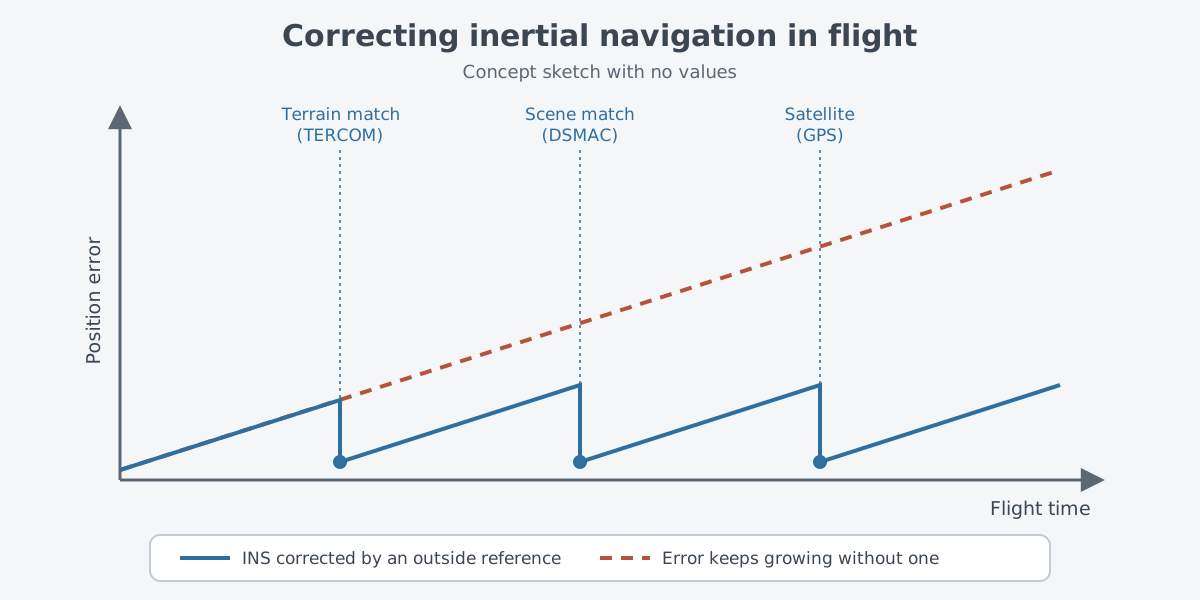
Picture walking with your eyes shut, counting steps, and opening your eyes now and then to check a signpost and correct your course. The real system differs because no one opens their eyes. A machine matches its measurements against data stored ahead of time, automatically. The method takes its name from the kind of reference it uses.
The first is Terrain Contour Matching (TERCOM), which APL recommended for the land-attack Tomahawk. An altimeter on the missile measures the rise and fall of the ground and matches it against stored elevation maps.
The second is the Digital Scene Matching Area Correlator (DSMAC). A television camera photographs the ground below the missile and matches the pictures against stored ones. Adding this camera to TERCOM greatly improved accuracy.
The third is GPS, which uses satellite signals. The guidance system of the current Tomahawk (Block IV/V) includes all of INS, TERCOM, DSMAC and GPS. Among the U.S. Air Force's air-launched cruise missiles, the AGM-86B corrects its inertial navigation with terrain contour matching, while the conventional AGM-86C/D uses GPS-aided inertial navigation. APL later developed PTAN, a refinement of TERCOM that corrects the INS without GPS.
What an INS measures, and why some of its gyros use laser light, is covered in Inertial and satellite navigation: knowing where you are.
How it differs from a ballistic missile
The ballistic missile is often set beside the cruise missile. In the DTRA definition quoted by CRS, a ballistic missile is guided only while its engine burns and is unguided during the free flight that follows. In free flight, its path is shaped only by the outside pull of gravity and air drag.
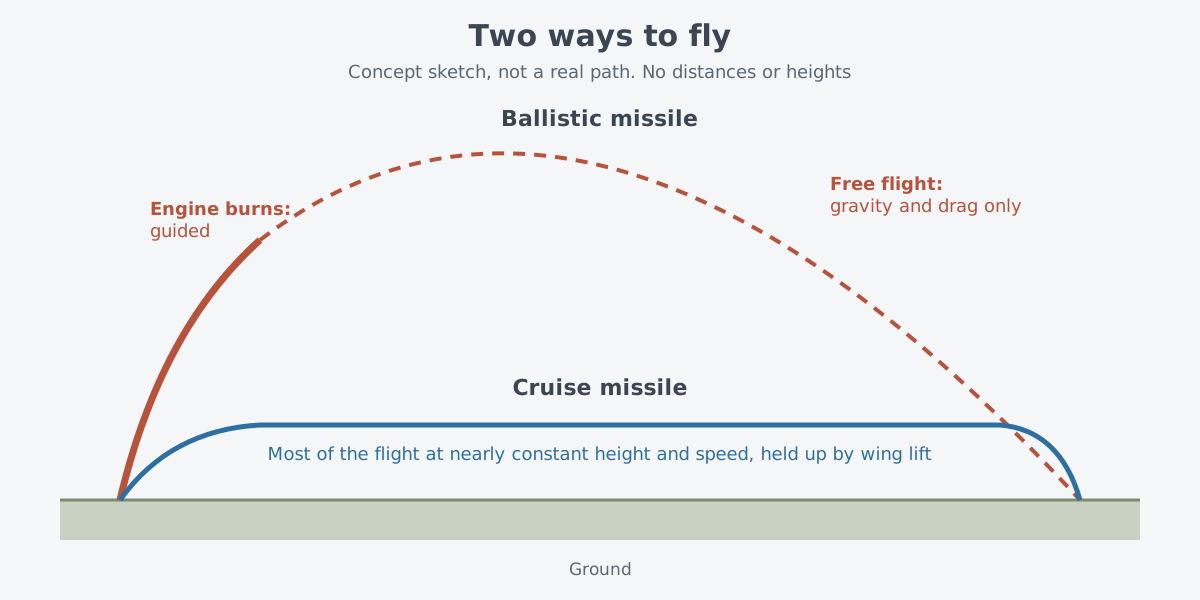
A cruise missile works the other way around and relies on its engine and wings for most of the flight. The engine beats drag, and the wings carry the weight with lift. So it needs air the whole way. An engine that carries its own oxidizer, like a rocket, can work without air, but wings and an air-breathing engine cannot.
The two missiles differ right from how they get their force. The path a ballistic missile traces is the subject of the article "Ballistic missiles: why they climb high and come down."
From the first cruise missile to today
The Smithsonian National Air and Space Museum presents the German V-1 as the world's first operational cruise missile. It was a monoplane with its wing set at mid-body, and it flew on a simple but noisy pulsejet engine. More than 20,000 were launched toward Britain and continental Europe from June 1944 to March 1945, yet they were very inaccurate.
Nobody steered the V-1 by radio. In its preset guidance system, a magnetic compass watched over an autopilot built around gyros. A pressure-sensing device set its height, and a small propeller on the nose served to measure distance. In theory a pulsejet makes thrust even when standing still, but the V-1 actually worked well only after being boosted into the air.
A person behind the V-1 had been working since 1939 on "pilotless aircraft." Today they would be called cruise missiles. Even the name started from the airplane.
The 1979 NASA contractor report wrote that the ALCM and Tomahawk, then in development, benefited from two advances of the previous decade. One combined microprocessors, sensors used near the target and TERCOM guidance and navigation. The other was better fuels and better small turbojets and turbofans. The U.S. Air Force's air-launched cruise missile (ALCM) became operational in December 1982.
The ALCM is a small, winged missile that holds subsonic speed on a turbofan jet engine. Its folded wings, tail surfaces and engine inlet unfold after launch. The conventional version, the CALCM, was retired in early spring 2019.
At sea, the success of the Harpoon anti-ship missile led to the Tomahawk, built as an anti-ship version and a land-attack version. The U.S. Navy describes the Tomahawk Land Attack Missile (TLAM) as an all-weather, long-range, subsonic cruise missile launched from surface ships and submarines. Its first operational use came in Operation Desert Storm in 1991.
From the V-1 to the Tomahawk, nearly half a century of change reshaped engines and navigation. The frame stayed the same: wings for lift and an air-breathing engine for push.
What to read next
- Inertial and satellite navigation: knowing where you are: A closer look at inertial navigation and GPS, the base of how a cruise missile finds its way.
- Missile seekers: the eye at the front: What the device a missile uses to look toward its target is made of.
- Ballistic missiles: why they climb high and come down: Compare it with a missile that flies on gravity after its engine stops.
- Ramjets and scramjets: engines without fans: An air-breathing engine faster than the turbojet.