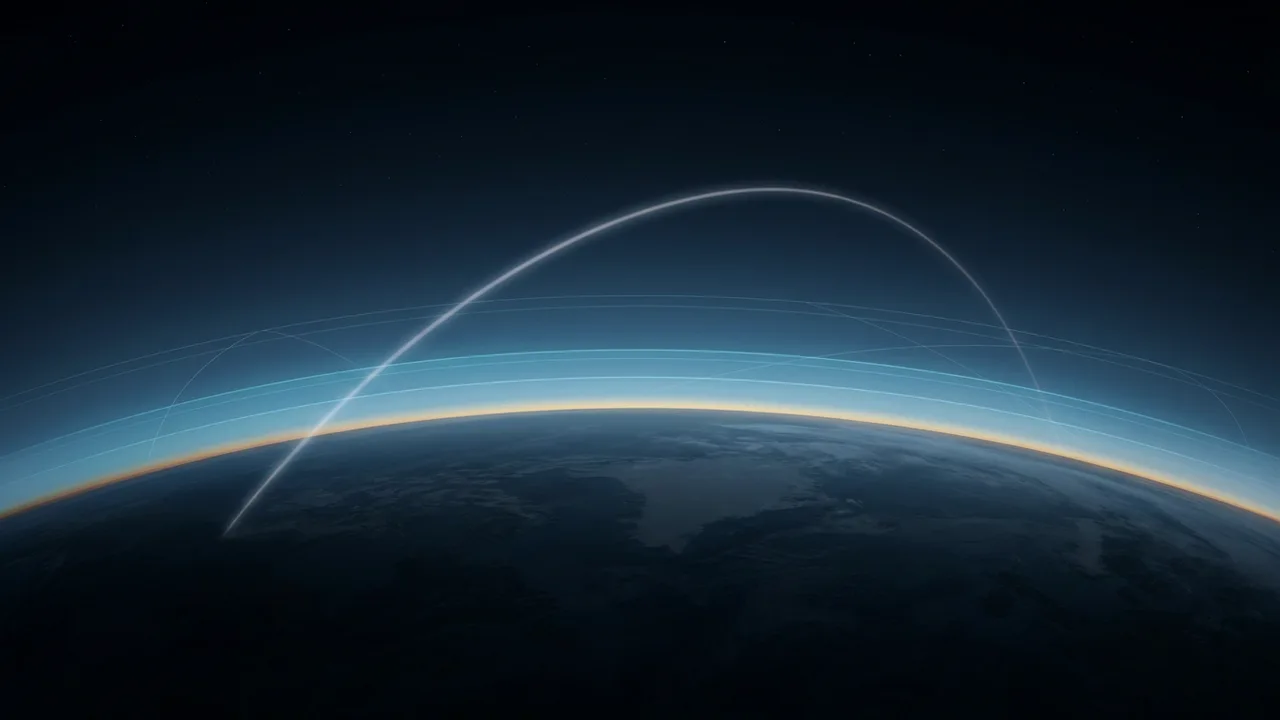
When people want to throw a ball far, they do not throw it parallel to the ground. They throw it up at an angle. The ball rises, curves over and lands a long way off.
A ballistic missile follows the same kind of path. The difference is scale: the ballistic missiles in the news climb above the atmosphere and then fall back. This article explains why with the projectile motion taught in physics class. It then walks through the three phases of flight and the common terms in the news, drawing on U.S. government and academic sources.
The same path as a thrown ball
A ballistic trajectory is a path flown under gravity alone. A ballistic missile first climbs hard on its rocket engines. Once the engines shut off, it no longer pushes itself forward. A 2025 assessment by the U.S. Defense Intelligence Agency (DIA), quoted by the Missile Defense Agency, describes traditional ballistic missiles as guided during powered flight and unguided during free flight.
After the engines stop, the path follows the same physics as a ball thrown by hand. Physics textbooks call such an object a projectile and its path a trajectory. The key fact is that sideways motion and up-and-down motion do not affect each other.
With no air resistance, the horizontal speed stays the same from start to finish, because gravity only pulls down.
The vertical speed behaves differently. It shrinks on the way up, reaches zero at the top, and then grows in the downward direction. Put the two motions together and the path is a parabola.
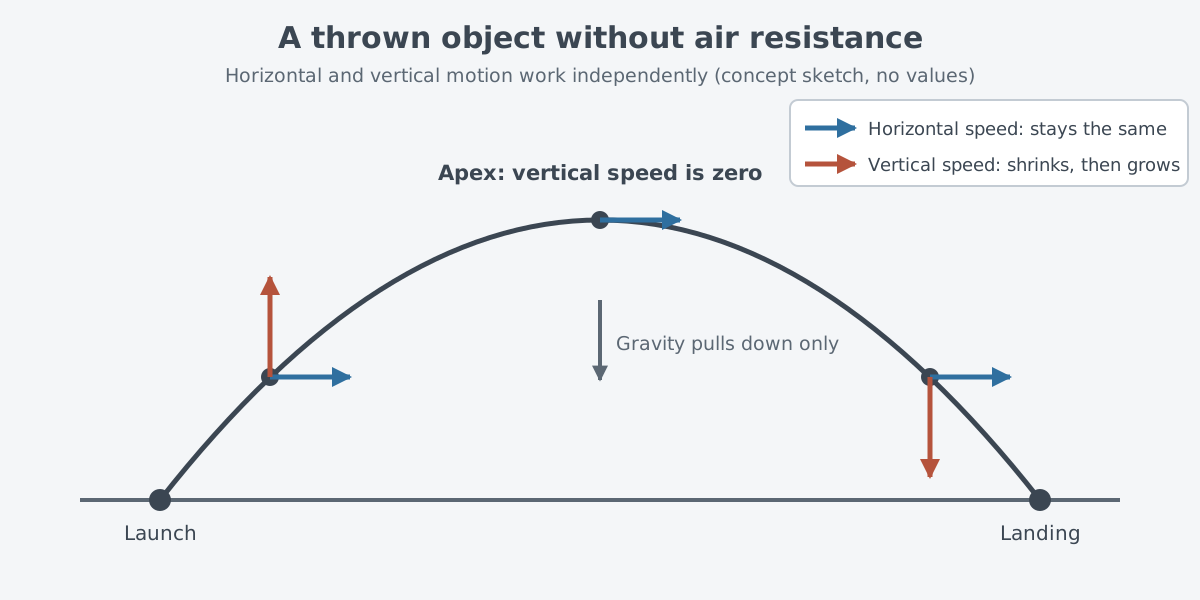
This neat parabola only holds when air resistance is ignored. A real ball bumps into the air and falls a little short. A ballistic missile also spends part of its flight in the air, so it does not fly exactly like the diagram.
To go far, it has to go high
There are two ways to send a projectile farther. At the same angle, a faster start gives a longer range. At the same speed, the angle matters: with no air resistance and launch and landing on the same flat surface, the range is longest at 45°.
Now add one more textbook result. The height of the top point depends only on the vertical part of the starting speed. Keep the angle and raise the speed, and the vertical part grows too.
So a projectile launched faster to go farther also climbs higher. Ballistic missiles that rise above the atmosphere are tied to the same idea.
Going high also changes something. Once it is outside the atmosphere, a missile with its engines off moves under Earth's gravity alone. That is close to the no-air-resistance case in the textbook.
At very long distances, the flat-ground assumption breaks down as well. The textbook explains that a projectile launched fast enough goes into orbit.
Suppose an object near the ground is given a sideways speed of 8000 m/s. As it falls, the round surface below keeps curving away, so it goes around the planet and never lands. That is why the path of a long-range ballistic missile looks less like a parabola over flat ground and more like a large arc over a round Earth.
Three phases of flight
A 2012 report on ballistic missile defense by the U.S. National Research Council (NRC) divides the flight into the boost phase, the midcourse phase and the terminal phase. The split comes from the defense side. A defense primer from the Congressional Research Service (CRS) notes that U.S. hit-to-kill interceptors are each designed to work in a particular phase of flight. The primer also lists a separate post-boost phase between boost and midcourse.
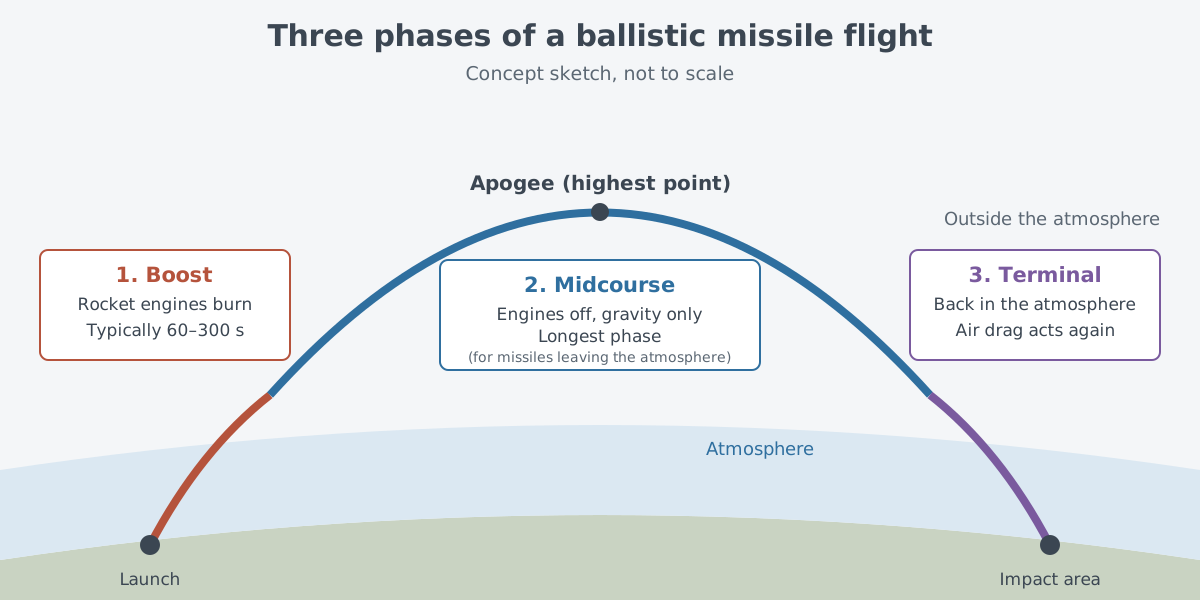
The boost phase is the time when the rockets of the missile's main stages are burning. When the engines shut off, the midcourse phase begins. Midcourse is flight outside the atmosphere after booster burnout, when every object coasts along a ballistic path pulled only by Earth's gravity. This is where the thrown-ball physics fits best.
The highest point of the flight, the apogee, lies within the midcourse phase. The stretch from the end of boost up to the apogee also counts as midcourse. After the apogee, the missile starts to come down.
The terminal phase begins once it is back inside the atmosphere. Air forces matter again. The altitude where midcourse turns into terminal is not sharply defined. The part that carries a warhead back into the atmosphere is called a reentry vehicle, and strong air forces act on it below about 40 km.
How defenses handle these phases layer by layer is covered in Layered missile defense: why defense comes in layers.
How long each phase lasts
The three phases are very different in length. According to the NRC report, powered flight in the boost phase is short, typically 60–300 seconds. How long it lasts depends on how far the missile is meant to go and what kind of propellant it burns. Solid rocket motors burn for a much shorter time than liquid-fuel ones, and longer ranges need longer burns.
The report also gives one example for an intercontinental ballistic missile. On one launch path, a liquid-fuel missile has about 250 seconds of boost, while the whole flight takes about 40 minutes. A solid-fuel missile fired from the same place has about 180 seconds of boost.
That makes 250 seconds a little over one tenth of 40 minutes. The engine burn is only the short opening part of the flight; most of the time is spent flying without power.
For missiles that leave the atmosphere, midcourse is the longest phase of the flight. It is a bit like throwing a ball: it leaves your hand in a blink, but it stays in the air much longer. Unlike a thrown ball, though, a missile's engines burn for minutes, gaining height and speed the whole time.
Reading the names in the news
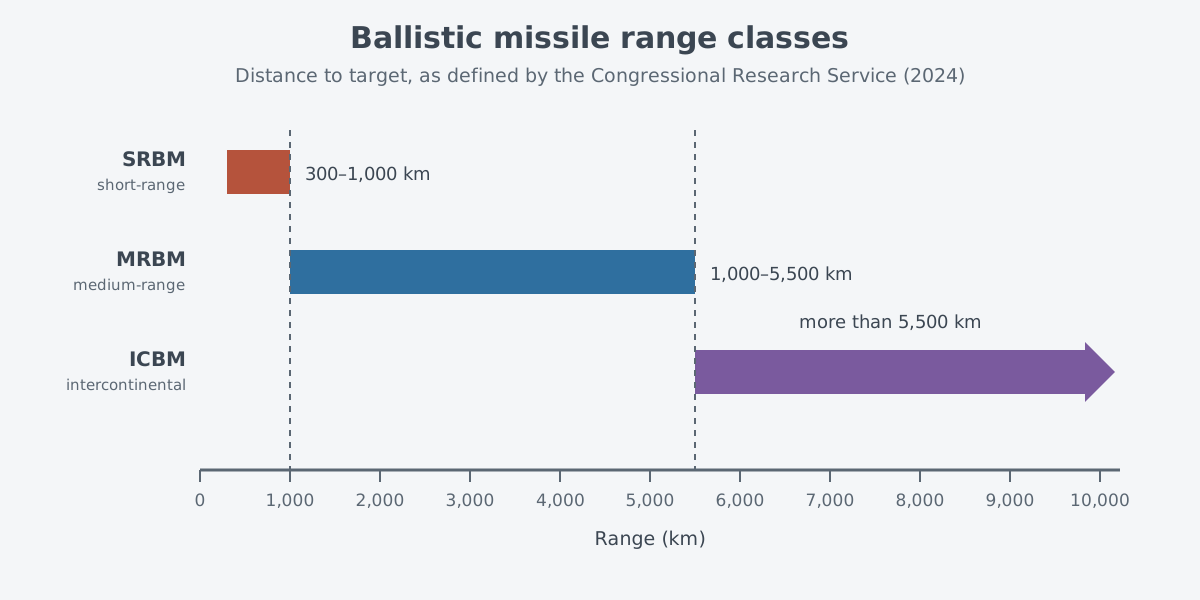
Ballistic missiles differ in where they are launched from, how far they go, and what they carry. The most common split in the news is by range. The CRS defense primer sorts them into three groups.
Short-range ballistic missiles (SRBMs) reach targets 300–1,000 km away. For medium-range ballistic missiles (MRBMs) the span is 1,000–5,500 km, and intercontinental ballistic missiles (ICBMs) go beyond 5,500 km.
Another common term is multiple independently targetable reentry vehicles (MIRV). It refers to missiles that carry multiple warheads, meaning there is more than one of the reentry vehicles described above.
Then there is the phrase "non-ballistic trajectory." CRS describes hypersonic weapons as moving at Mach 5 or faster, which is five or more times as fast as sound. Among them, a hypersonic glide vehicle is launched by a rocket and then glides to its target. A hypersonic weapon does not stick to a ballistic path the way a ballistic missile does, and it can change course on the way.
The U.S. Missile Defense Agency (MDA) also says that technical progress is making hypersonic glide vehicles and missiles on non-ballistic trajectories practical.
So when a news story says "ballistic missile," you can read it as a weapon that spends most of its flight, after the engines stop, under gravity. When "non-ballistic" appears, it signals a different kind of weapon that does not fit this picture.
Where this meets lasers: the airborne laser and the boost phase
The boost phase is short. There were efforts to act within that window of typically 60–300 seconds, and one of them was a laser carried on an aircraft: the U.S. Airborne Laser (ABL) program.
The NRC report notes that around 2010, when its study began, the U.S. Secretary of Defense made several decisions. One of them turned the ABL program into a research and development effort, because stopping a missile in the boost phase had proved hard both in operation and in technology. Separately, the same report names the short powered flight time as the main challenge of boost-phase intercept. What the ABL aircraft carried and how the program ended are covered in A history of laser weapons: from chemical to electric lasers.
What to read next
- Layered missile defense: why defense comes in layers: what changes when the three phases are seen from the defense side
- A history of laser weapons: from chemical to electric lasers: how the airborne laser aimed at the boost phase began and ended
- Hypersonic glide vehicles: a different flight path: how a non-ballistic trajectory comes about
- Cruise missiles: how they resemble aircraft: another kind of missile to compare with ballistic missiles