
Is it a drone or a missile? Some weapons spread their wings, circle over an area, and, once they find a target, dive straight into it and explode. No one is on board, and they do not come back. News reports call them loitering munitions, suicide drones or one-way attack drones.
This article looks at where the category of loitering munition sits between drones and missiles. The guides are U.S. government definitions and public documents, along with explanations from the debate on international humanitarian law.
What a loitering munition is
To loiter is to linger in one place without leaving. The name itself says that the key feature of this weapon is staying over an area.
On the U.S. Army's official website, one article treats loitering munitions as armed drones that hang around a target area and then crash into their objective. A piece by two researchers on the blog of the ICRC, the Red Cross's international committee, takes a slightly wider view. In that piece they are a kind of single-use aircraft with no crew that can draw on sensor data to stay above targets, find them and explode into them. It comes with a caveat: not every loitering munition has that technical ability.
The two descriptions share some elements. No one is on board, the aircraft can spend time over an area, and the aircraft is itself the munition, so it does not return.
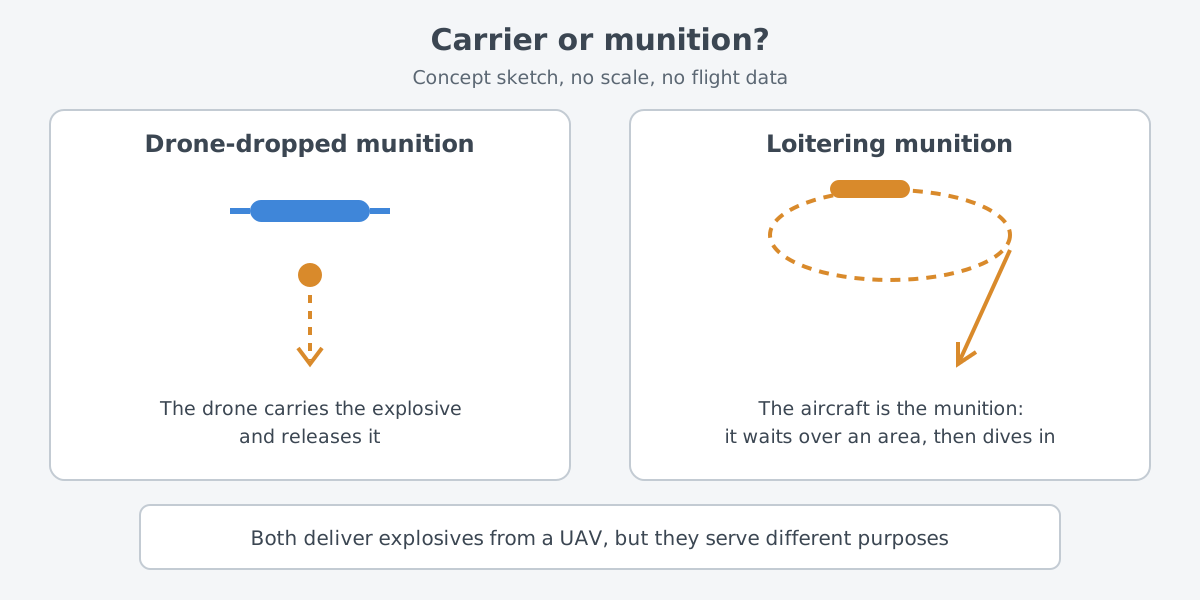
This is different from a drone that drops explosives. Both send explosives from an uncrewed aircraft, but they serve different purposes. In the first case the drone is the carrier; with a loitering munition the aircraft is the munition.
Through the definition of a UAV
Can a loitering munition be called a UAV? You can hold it up against the U.S. Department of Defense definition yourself. Here it is as summarized in a 2012 report from CRS, the Congressional Research Service.
- It is a powered aerial vehicle.
- It carries no human operator.
- It gets its lift from aerodynamic forces.
- It flies on its own or under remote control.
- It may be expendable or recoverable.
- It may carry a payload, lethal or not.
The word to notice is "expendable." Being used once and never coming back does not, by itself, take an aircraft out of the UAV definition.
Hold the two descriptions above against this list line by line, and three lines match at once: no one on board, possibly expendable, and a lethal payload. The other lines have to be checked aircraft by aircraft. Going by the wording alone, a loitering munition can fit on the UAV side, and that is as far as this check goes.
Where official documents place loitering munitions points the same way. CRS explains small one-way attack drones, or loitering munitions, in a document titled "U.S. Army Small Uncrewed Aircraft Systems Programs." The researchers' piece also places loitering munitions within single-use uncrewed aircraft.
Where it parts from missiles
The same definition also lists what is left out. Under the DoD definition, cruise missiles, artillery shells, and ballistic or semi-ballistic vehicles do not count as UAVs.
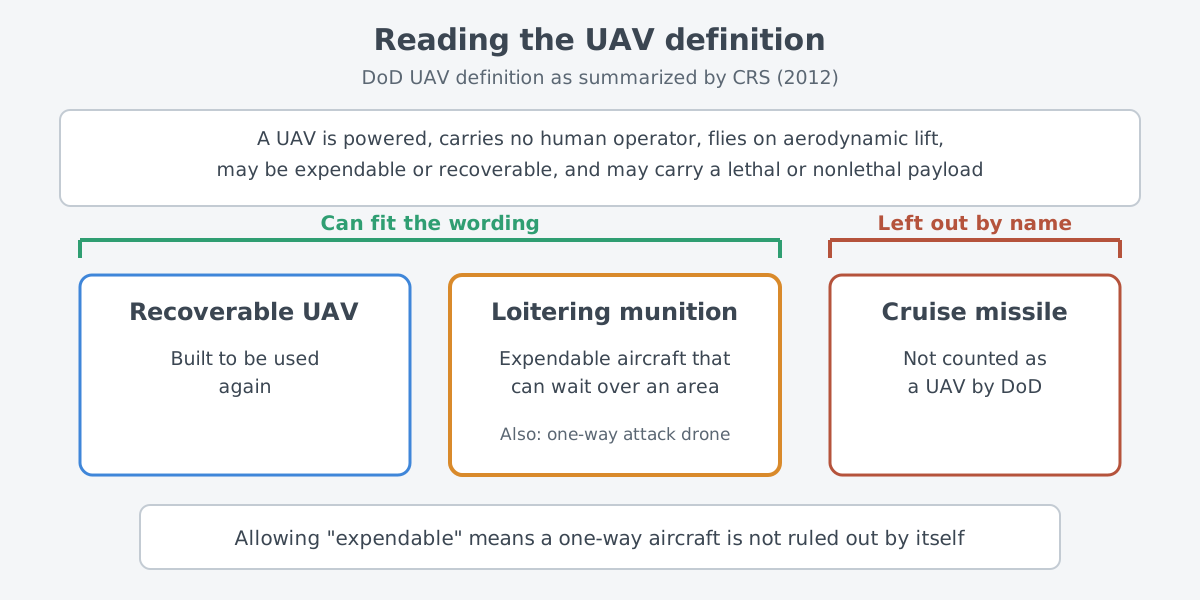
The definition does not say why cruise missiles are excluded. And since it allows "expendable," not coming back is not enough on its own to separate a drone from a missile. So the line is better read from what the weapon does in flight than from the words of the definition. Public sources keep returning to two things when they describe loitering munitions.
The first is waiting. The Army article says they "wait in target areas," and the researchers describe them staying above targets and finding them. Even after it arrives, the weapon can spend time over the area looking for a target.
Think of an airliner circling an airport while it waits its turn to land. The differences matter more, though. The airliner lands and takes off again, but the loitering munition ends when it goes down.
The second is the human in the loop. The question is whether, while the weapon waits, a person watches it and approves the decision to go down. Most makers claim that is the case, and what that claim means continues under "Where human judgment stays" below.
Hold the weapon in a news story up against these two questions and the line gets clearer. Can it wait over the area? Can a person watch and approve while it flies? The answers to those two questions say more than whether a story calls it a "drone" or a "missile."
Why it has several names
Loitering munition, one-way attack drone, suicide drone, kamikaze drone. These words mostly point to the same group, but each stresses something different. "Loitering" stresses the ability to stay; "one-way" stresses that it does not return; "suicide" and "kamikaze" stress that the aircraft is the munition.
Official documents mix the names too. In a CRS document, small one-way attack drones appear alongside a second name, "loitering munitions." In a U.S. Treasury release, one-way attack UAVs designed in Iran also go by "kamikaze drones," with the Shahed-136 as an example.
So whichever name a story uses, it helps to check what the agency behind it meant. Even a single agency may use two of these names for the same thing.
A public case: U.S. Army testing
How does this category show up in a real military program? According to CRS, the U.S. Army bought a few small one-way attack drones for special forces in the mid-2010s. Through a program called LASSO, it later proposed buying such drones for its Mobile Brigade Combat Teams.
Sources spell out LASSO a little differently. CRS writes "Low Altitude Strike and Stalk Ordnance," while the Army article writes "Low Altitude Stalking and Striking Ordnance." Both mean a munition that stalks and strikes at low altitude.
Testing for the program takes place at the Army's Yuma Proving Ground. The aim is to have loitering munitions in Soldiers' hands by summer 2028. The Army's Product Manager for Precision Strike and Reconnaissance Systems (PSRS) is running risk reduction tests on items from four companies.
The order of testing is public too. Before any explosives are used, safety flights check that the safety features work as planned, and the four test items also go through conditioning chambers, rough handling and climate testing.
Where human judgment stays
The debate around loitering munitions centers on human control. According to the two researchers met earlier, most makers of current loitering munitions claim their systems keep a "human in the loop." That usually means a human operator watches the system over a two-way data link and must approve any use of force.
The weapon has spread fast. Fewer than 10 countries made these weapons in 2017; by mid-2022 nearly 24 did, more than double. The earliest ones, the IAI Harpy among them, were built mainly to seek out and destroy radar systems.
The two researchers argue that development and spread are running far ahead of international rule-making. That debate takes place in a group of government experts (GGE) set up under the CCW (Convention on Certain Conventional Weapons). Another concern they raise: much of the public information on these weapons' technical abilities comes from a few sources, often tied to the makers. These are the researchers' arguments and should be read apart from any official position of the ICRC or of governments.
Where this meets lasers: reading category names
Just as the name "loitering munition" says what the weapon does, laser weapons carry category names too. Articles on laser weapons often use terms like high energy laser (HEL) or directed energy weapon (DEW).
The wider a name, the more different things it holds. What is a laser weapon? goes on to show what high energy laser and directed energy weapon each refer to.
What to read next
- What is a laser weapon?: what the category name "laser weapon" actually refers to.
- "The Shahed series: same name, different drones": how the names split within one series often reported as one-way attack UAVs.
- "Drone swarms: is every group of drones a swarm?": how many drones flying together differs from a swarm.