Soldiers talk over radios, find their position from satellite signals and search for the other side with radar. All of this daily work passes through the same invisible space: the electromagnetic spectrum. The other side uses that space too, so a contest arises over who uses it better and who blocks whom. Military action to control the spectrum in that contest is called electronic warfare (EW).
The phrase may first bring to mind jamming an opponent's radio signals. The official definition is wider: protecting your own use of the spectrum and finding and cataloguing the other side's signals are part of electronic warfare too. How do official U.S. sources divide this work, and when and where did electronic warfare begin?
Why the electromagnetic spectrum is contested
The electromagnetic spectrum is the range of wavelengths or frequencies of electromagnetic radiation. Radio waves, microwaves, visible light, X-rays and gamma rays all fall within it. Radio waves and visible light seem very different, yet they are the same family of waves with different wavelengths.
Militaries use the spectrum everywhere. Communications equipment lets forces talk and send data, get navigation and timing information, and command and control units around the world. The spectrum also tells forces where adversaries and friendly units are and what effects weapons achieve. Nearly every modern weapon system, such as those used by airplanes, satellites, tanks, ships and radios, depends on the spectrum to work.
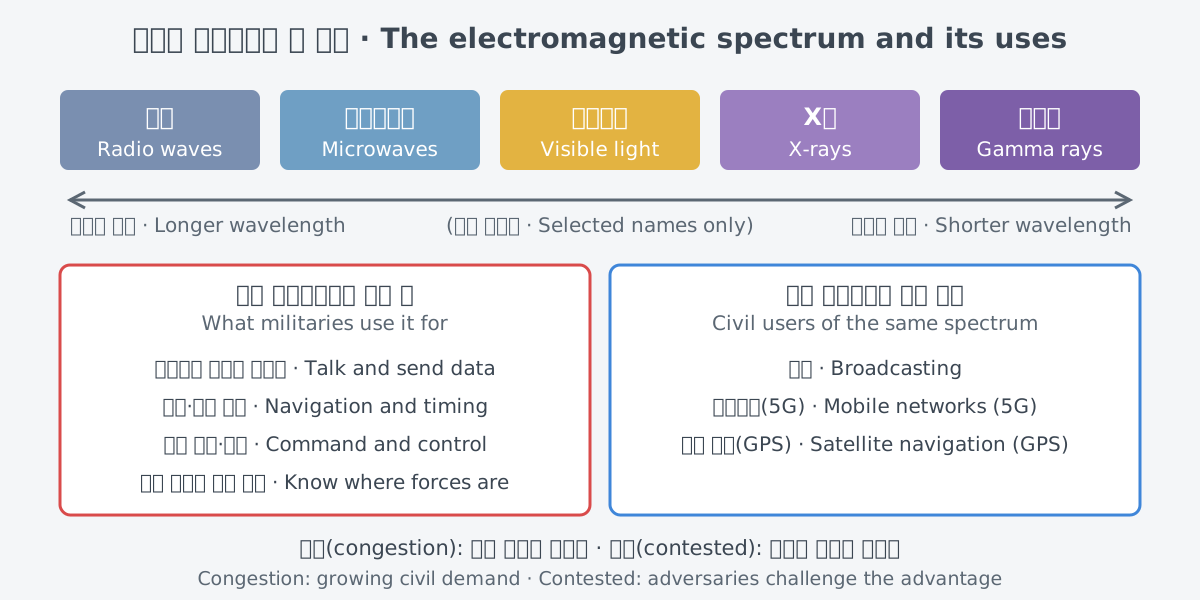
The catch is that no one has this space to themselves. The U.S. Department of Defense (DoD) calls the commercial sector's growing demand for spectrum "congestion." It calls potential adversaries building systems to challenge U.S. dominance of the spectrum "contested." DoD's Electromagnetic Spectrum Superiority Strategy, released in October 2020, combines the 2013 spectrum strategy and the 2017 electronic warfare strategy, which had each identified one of these problems.
Joint doctrine quoted in a Congressional Research Service (CRS) report calls the spectrum a "maneuver space" essential for control within the operational environment. Just as on land, at sea, in the air and in cyberspace, military forces maneuver and operate within the spectrum to gain an advantage.
Think of the spectrum as a wide road that many people share. When traffic grows, the road gets jammed, and when someone blocks it on purpose, a fight starts. The real spectrum differs in many ways. It is split into many bands by wavelength, and national and international rules decide in advance who may use which band.
The three divisions: attack, protection and support
Start with the overall definition. CRS report R44572 cites the February 2019 DoD Dictionary of Military and Associated Terms. That dictionary defines electronic warfare as "military action involving the use of electromagnetic and directed energy to control the electromagnetic spectrum or to attack the enemy."
The same report also gives a plainer description. EW generally means operations that detect, listen to, jam and deceive enemy radars, radio communication systems, data links and other electronic systems. Operations that defend against an enemy trying to do the same are EW too. So electronic warfare covers listening and protecting, not just jamming.
Where R44572 cites the 2019 DoD dictionary, it explains that DoD divides electronic warfare into three divisions. The meaning of each division, as CRS defense primer IF11118 describes it, is shown below.
| Division | What it does |
|---|---|
| Electronic attack | Uses electromagnetic energy to degrade or deny an enemy's use of the spectrum |
| Electronic protection | Protects access to the spectrum for friendly military assets |
| Electronic warfare support | Identifies and catalogues emissions from friendly or enemy forces |
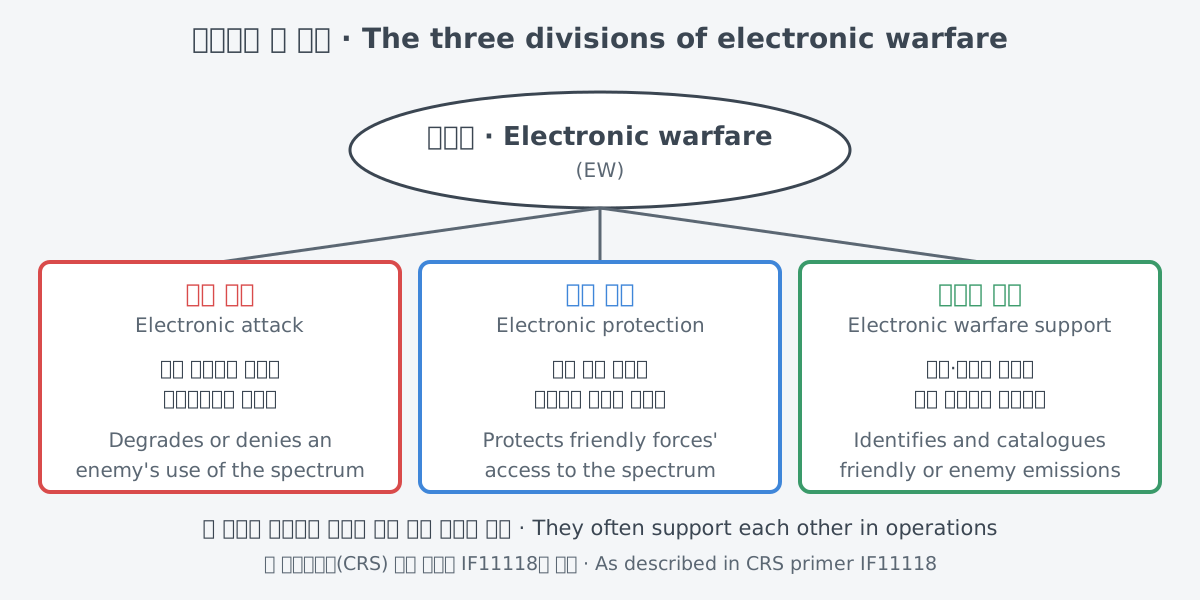
The three do not work in isolation. The primer adds that they often support each other in operations. The catalogue of emissions built by EW support is used both to protect U.S. forces and to plan how to deny an enemy access to the spectrum.
The name itself has shifted. According to CRS report R46564, DoD changed the doctrinal term from electronic warfare to electromagnetic warfare when it released Joint Publication (JP) 3-85 in 2020. Congress continues to use the term electronic warfare in legislation. The three division names in the table follow the CRS explanation, which cites the DoD dictionary from before this change.
U.S. documents now also use the term electromagnetic spectrum operations (EMSO). JP 3-85 combined electronic warfare and spectrum management into a single function. Before that, different organizations within each military command ran the two as separate disciplines. The introduction to a webinar hosted by the Defense Systems Information Analysis Center (DSIAC) also describes EMSO as the 21st-century DoD term for classic electronic warfare and spectrum management.
A short history from public accounts
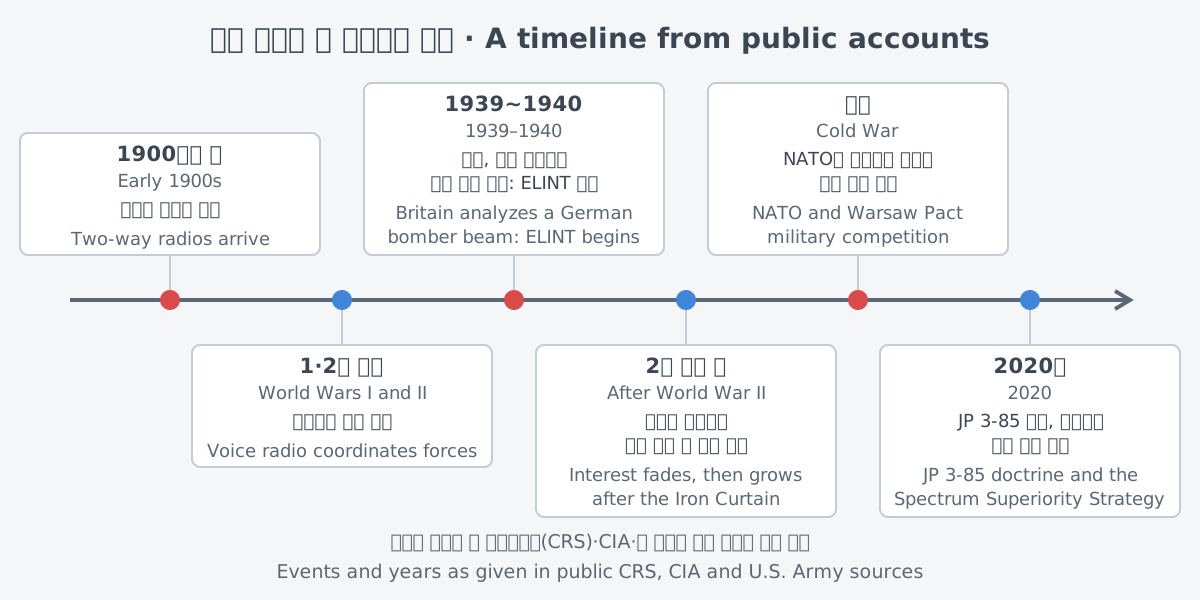
Militaries came to depend on the spectrum after two-way radios appeared in the early 1900s. The U.S. military has used ground-based radios to communicate for more than a century. In World War I and World War II, these early radios carried voice communications to coordinate forces. Over the following century, this reliance expanded to nearly every weapon system.
Electronic warfare is not a new concept. In World War II, the Allies and Nazi Germany competed to develop and improve radar, weapons and aircraft, and EW grew naturally out of that technological competition. How radar measures distance with radio waves is covered in the article "Radar: measuring distance and motion with radio waves."
A historical paper that the Central Intelligence Agency (CIA) approved for release in 1993 traces electronic intelligence (ELINT) to Britain just before World War II. Early in 1939, a British committee for the scientific study of air defense first pointed out that Britain knew little about new German weapons. British analysis then concluded that Germany had developed a radio beam that let its bombers operate over England regardless of weather, darkness or cloud cover. Work on possible countermeasures began right away.
The same CIA paper treats this interception and analysis of enemy electronic radiation as the birth of present-day ELINT and dates it to 1940. Finding and analyzing the other side's signals makes this work resemble the EW support described above.
During World War II, the United States made extensive use of electronic intercept devices in both the Pacific and European theaters. After the war, interest in ELINT tapered off, as it did for many wartime activities. The real push to learn about other countries' electronic advances did not begin until the Soviet Union clamped down its Iron Curtain.
During the Cold War, EW capabilities supported the competition in military capabilities between the U.S.-led NATO alliance and the Soviet-led Warsaw Pact. Ground EW traditionally focused on intercepting and jamming radios and artillery radars. More recently, it has also been used to jam improvised explosive devices (IEDs) in Iraq and Afghanistan.
Where electronic warfare touches daily life
Civilians use the same spectrum. The closest example is the Global Positioning System (GPS). GPS uses radio signals in frequencies reserved for radio navigation services. Keeping the GPS service running therefore requires protecting that spectrum from interference.
GPS interference can come from many sources. Examples include radio emissions in nearby bands, intentional or unintentional jamming and naturally occurring space weather. The U.S. government works to reduce human sources of interference through domestic and international spectrum regulations, interference detection and mitigation, and law enforcement.
Military spectrum operations also meet daily life directly. According to the U.S. government's official GPS website, the U.S. Space Force Joint Commercial Operations (JCO) monitors and characterizes threats within the electromagnetic operational environment. The JCO does this through EMSO, which includes situational awareness of positioning, navigation and timing.
Mobile networks face a similar question. CRS notes that reallocating spectrum from DoD may help speed the deployment of 5G networks, while DoD provides critical national defense functions. For that reason, CRS suggests Congress may want to encourage coordination between agencies to balance the needs of commercial 5G and DoD's mission-critical needs.
Policy and legal frameworks
The spectrum that electronic warfare contends over is not a free-for-all. National and international rules divide who may use which frequencies, and they also set out how military radio installations are treated.
Radio use does not stay inside one country. So the rules for sharing the spectrum start at the international level. The International Telecommunication Union (ITU) is the United Nations specialized agency for information and communication technologies, with 194 member states. It was established in 1865 to manage the first international telegraph networks, which makes it the oldest agency in the UN family.
The ITU Radiocommunication Sector (ITU-R) has a mission to ensure that all radiocommunication services use the radio-frequency spectrum rationally, equitably, efficiently and economically, including services that use satellite orbits. The backbone of those rules is the Radio Regulations. They form the international treaty governing the use of the radio-frequency spectrum and of geostationary and non-geostationary satellite orbits. World Radiocommunication Conferences (WRC) meet every 3–4 years to review and, if needed, revise them.
The ITU Constitution fully recognizes each state's sovereign right to regulate its own telecommunications. At the same time, Article 45 sets a limit. All stations, whatever their purpose, must be set up and operated so they cause no harmful interference to the radio services or communications of other member states and others.
Military installations get their own article. Under Article 48, member states keep their entire freedom with regard to military radio installations. Even so, these installations must, as far as possible, follow the rules on giving help in distress and on measures to prevent harmful interference.
Within a country, government agencies divide the work of managing the spectrum. In the United States, the National Telecommunications and Information Administration (NTIA) manages federal use. The Federal Communications Commission (FCC) manages nonfederal use, such as broadcasting, mobile, commercial, industrial and personal uses and state and local governments. The two agencies coordinate frequency allocation, assignment and technical requirements to avoid interference, and they represent the United States at international forums such as the WRC.
Many federal agencies use radio-frequency spectrum for vital operations, and NTIA manages that use so national and international needs are met while this limited resource is used efficiently. Among those agencies, CRS identifies DoD as the largest federal user of the electromagnetic spectrum.
There are also rules about jamming devices. The official GPS website states that consumers cannot legally use signal jammers within the United States. The FCC is clamping down on the marketing, sale and use of illegal cellphone and GPS jamming devices.
What to read next
- Radar: measuring distance and motion with radio waves: how radar, one of the systems electronic warfare contends with, uses radio waves to measure distance and motion.
- Light basics: waves, wavelength, frequency and photons: a high-school-level review of the wavelength and frequency mentioned in this article.