Picture trying to hit a fast airplane with a single artillery shell. While the shell is in flight, the airplane keeps moving. In the 1940s, in the middle of World War II, a direct hit like this was well beyond the technology of the time.
What if the shell did not have to hit at all, and burst near the target instead? The proximity fuze was the answer to that question. It was also called the VT fuze. The story runs from a start in the summer of 1940 to first combat use in 1943, and on into the years after the war.
Fuzes and proximity fuzes: near instead of on target
Artillery shells and bombs carry an explosive charge. A proximity fuze is a fuze that sets off that charge near the target.
A 1962 history article from the Johns Hopkins University Applied Physics Laboratory (APL) introduces it as "a mechanism for detonating an explosive shell within kill range of an aircraft." For a long time, such a device was considered impossible. VT stands for "variable time," and VT fuze is another name for the proximity fuze.
Why go to the trouble of bursting nearby? A NIST history of the task given to the National Bureau of Standards (NBS) gives two reasons. First, a direct hit is often hard to get, and bursting close to the target is good enough. Second, a burst at some distance from the target can often do more damage.
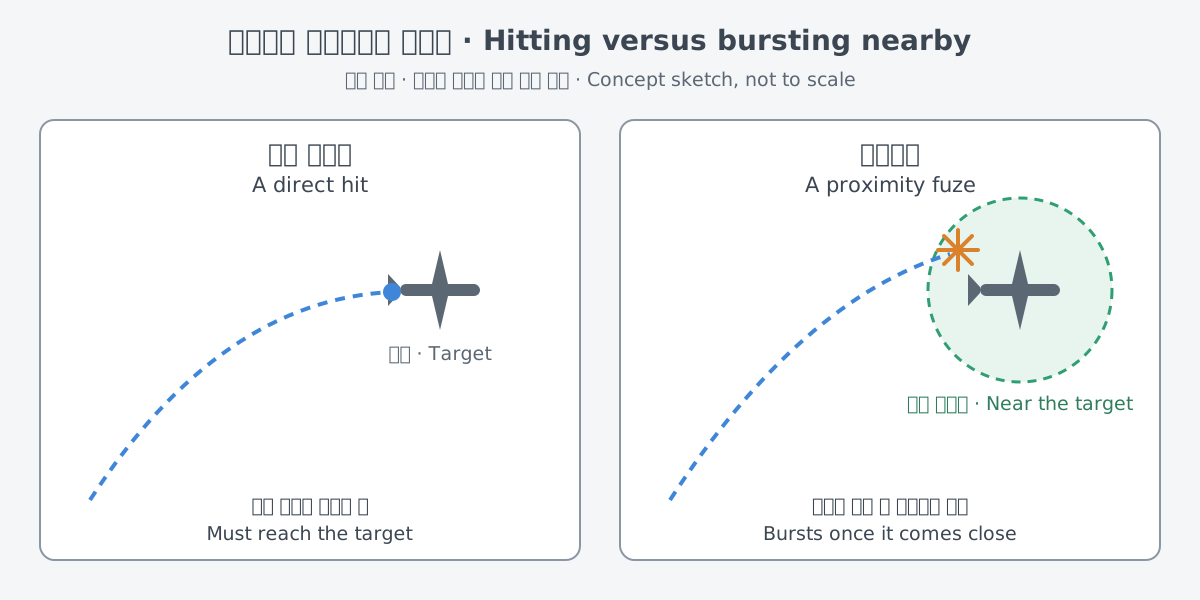
Think of a target game where one version scores only a hit on the center dot, and another also counts anything inside a ring around the dot. The real thing is different. In the game a judge looks at the ring, but a proximity fuze has to sense on its own, from inside the shell, that the target has come close.
The World War II development story
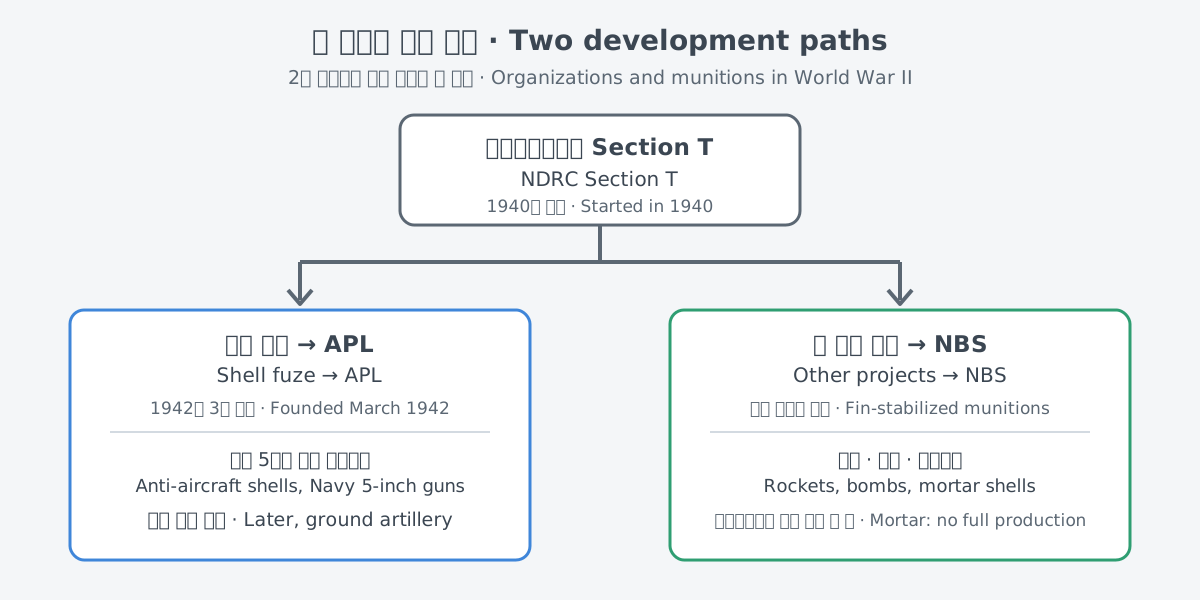
The story starts in the summer of 1940. On June 27, 1940, the United States set up the National Defense Research Committee (NDRC). A group under it, Section T, took on the search for a proximity fuze. A project was launched in mid-August 1940.
There was no single answer at the start. The researchers looked at three possible approaches together: a photoelectric one using light, an acoustic one using sound, and one using radio. A handful of scientists did the early work at the Carnegie Institution's Department of Terrestrial Magnetism.
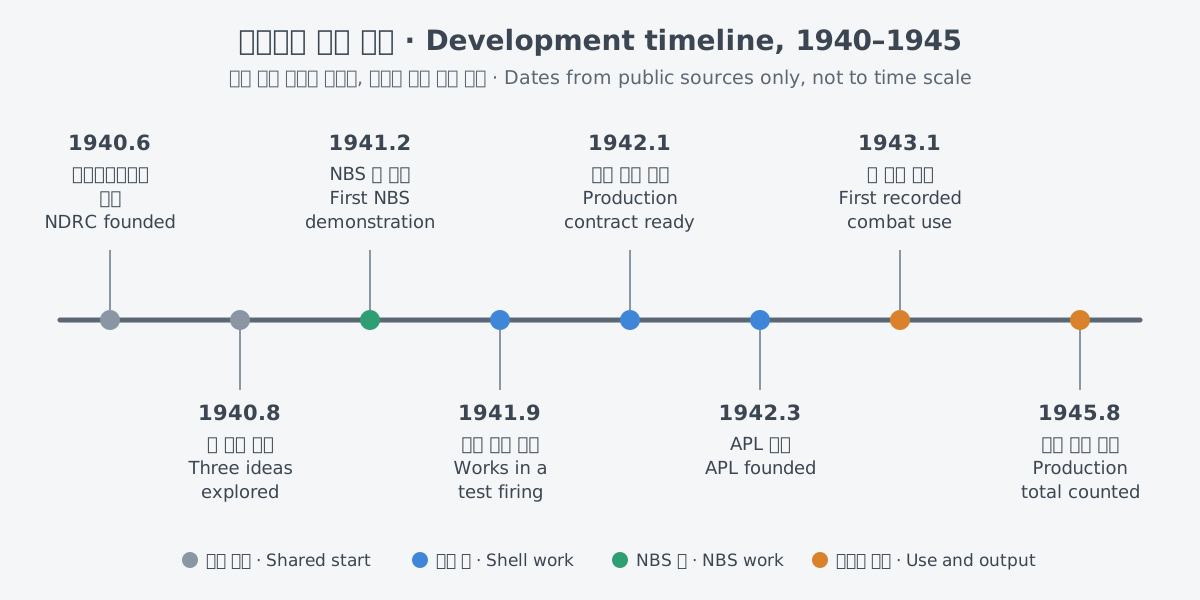
The work soon split into two paths. Every Section T project other than the shell fuze moved to the National Bureau of Standards (NBS). The NBS task was a fuze for munitions that do not spin and are steadied by fins: rockets, bombs and mortar shells. The NBS concept was first demonstrated in February 1941.
The shell side moved fast too. By September 1941, a complete fuze had worked properly in a test firing. By January 1942, a production contract for a basic model of the fuze, for Navy 5-inch guns, could be written.
On March 10, 1942, the Office of Scientific Research and Development (OSRD) and Johns Hopkins University signed a contract. APL was founded that same day, three months after the United States entered World War II. Its assigned task was to find a better way for ships to defend themselves against enemy air attacks.
The first fuzes went to ships in the South Pacific that had 5-inch guns. The APL Technical Digest records that on January 5, 1943, a Japanese plane was destroyed by a proximity fuze. Introduction in the Atlantic and Mediterranean was delayed on purpose by about six months, for several important reasons.
The scale was large. In a passage looking back on production, the APL Technical Digest says a total of 22,073,481 fuzes were produced up to August 14, 1945. The article does not say whether that count includes the NBS rocket and bomb fuzes. Even so, the development and manufacture of proximity fuzes was one of the best-kept secrets of the war.
The NBS fuzes reached the front as well. Fuzes for rockets and bombs went into mass production and were used widely toward the end of the war. Mortar shell fuzes never reached full production.
Why it mattered, according to public sources
What the fuze meant at the time can be gauged from the judgments left during and after the war. They come in three kinds, and each comes from a different speaker.
The first is the developer's own account. APL's history page says this radar proximity fuze greatly increased the effectiveness of anti-aircraft shells in the Pacific and, later, of ground artillery in the invasion of Europe. The same page says the result was later judged, along with the atomic bomb and radar, one of the three most valuable technology developments of the war. It does not say who made that judgment.
The second comes from the Navy's top command. The APL Technical Digest quotes the commander in chief of the U.S. Fleet at the time. He called the VT fuze's development "a major scientific achievement that has contributed greatly toward winning the war for the United Nations."
The third is the conclusion of the forces that used the fuzes. In the conclusion quoted by NIST, the attitude of the using arms toward the bomb and rocket fuzes at the end of the war was most favorable. At first, many doubted how useful the fuze would be. Combat experience in the various theaters changed that view, and by the close of the war the using arms were very enthusiastic about the fuzes.
All three judgments come from the organizations that built the fuze or the forces that used it. They read best as the views of the people involved, not as measured results.
After the war: the organization and the record
The proximity fuze work did not stop when the war ended. NIST's history pages name the proximity fuze as one of the best-known NBS wartime developments. In 1953, the whole NBS proximity fuze group, by then numbering 1,600 people, was transferred to the Department of the Army.
One part of the record stayed locked up for a long time. A single book that NBS staff wrote at the end of the war summarized all the proximity fuze work from about 1940 through 1945. It was classified Secret and was not declassified until 1960.
The core idea is simple. Instead of hitting the target, the shell senses that the target has come close and bursts right there. That idea, long considered impossible, began as research in the summer of 1940 and led to the first recorded combat use in January 1943.