
Laser weapon headlines often carry phrases such as "a 30-kilowatt laser," "2,000 won a shot" and "deployed within the year," and the numbers look clear. But a single headline cannot hold the conditions behind them.
The same 30 kW can mean different things depending on who measured what. Using reports from the U.S. Congressional Research Service (CRS) and Korean government releases, this article looks at what else to ask when you meet numbers like these.
One number, many missing conditions
A number in an article can be correct and still be only half the story. When the conditions are left out, the meaning blurs. Here are four kinds of words that come up often, side by side.
| Words in the article | What they tell you | Conditions often left out | Read more |
|---|---|---|---|
| "○○ kW-class" | A rough class of beam power | The optics that gather the beam, weather, time on the spot | Power, energy and intensity |
| "A range of ○○ km" | A distance reached under some conditions | Weather, line of sight, the target, who gave the number | Strengths and limits of laser weapons |
| "○○ per shot" | The electricity and fuel used each time it fires | Development, buying the system, maintenance | Strengths and limits of laser weapons |
| "Tested," "fielded" | How far development has come | What kind of test, how many units, prototype or production unit | The news explainer "The US Army E-HEL laser contract" |
"kW-class": what power tells you and what it does not
The kilowatt (kW) is a unit of power, and 1 kW equals 1,000 W. The CRS report on Navy shipboard lasers gives this number for laser weapons as "beam power." LaWS, a prototype laser the Navy tested from 2009 to 2012, had a reported beam power of 30 kW.
Even the term high-energy laser (HEL) has only a rough threshold. The same report says that in Navy discussions, a laser with a beam power of at least 10 kW is "generally" considered a high-energy laser. The word "generally" shows it is not a hard boundary.
A "class" label is a range, not an exact value, either. Take the "300 kW class [>250 kW]" in U.S. Army budget documents. When an article says "○○ kW-class," it is safer to read it as a range around that number. The background of both terms is in What is a laser weapon?.
Company releases work in a similar way. The U.S. company AV calls its system "a 30-kilowatt" system without saying which power the number refers to.
For a laser that fires light in pulses, the power number splits once more. The energy of one pulse times the number of pulses per second is the average power. The power during the brief moment a pulse leaves can be far higher than this average. If an article gives only kW and not which power it is, the number is hard to compare directly with another system's number.
The bigger issue is that power alone does not tell you the effect. In the CRS view, there is no consensus on the precise power level needed to neutralize different targets. By staying focused on one spot, a laser can cause disabling damage within seconds, depending on its power. How power and time tie together is the subject of Why a laser weapon does not finish "the instant it fires".
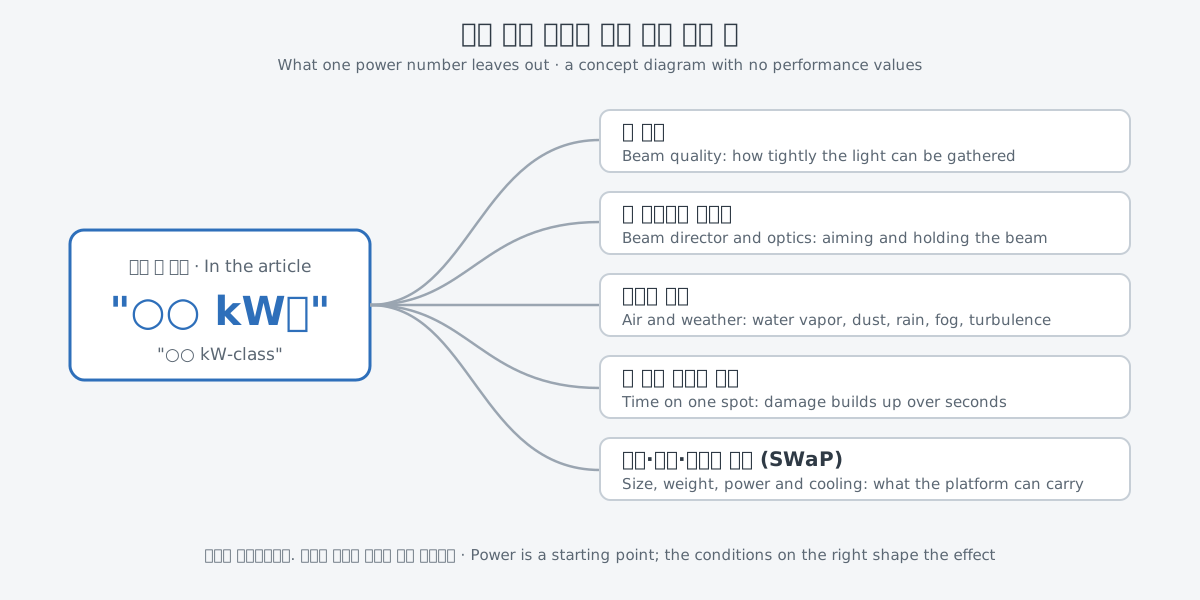
There is more to weigh than power. Judging how mature the technology is means raising beam quality and beam control to useful levels. It also means fitting size, weight and power (SWaP) and cooling needs into today's vehicles and ships.
The U.S. Department of Defense effort to scale up laser power also aims to improve beam quality and efficiency alongside power. The IFPC-HEL document above likewise counts not only the laser but also the vehicle, a power and thermal subsystem, a beam control subsystem and battle management software as one system.
Korean sources show the same pattern. Korea's Defense Acquisition Program Administration (DAPA) announced a Korean-made laser source (the core part that makes the light) with higher output and other improved key specifications. It was mounted on a system prototype for further testing, and DAPA said the time needed to shoot down a target became shorter.
That is the agency running the program reporting on itself, and the release does not say at what distance or in what weather the times were measured. More power changes the time it takes. It does not mean one power number decides the whole result.
"Range": a number that comes with conditions
Range is the number to read most carefully in laser weapon news. Sometimes a government release gives no distance at all. In July 2024, Korea's government news service said only that the laser air defense weapon can precisely strike small unmanned aircraft, multicopters and similar targets "at close range." A DAPA official's plan to develop a system with "further improved power and range" also came without a distance.
The reason for caution is the air. Water vapor, sand, dust, salt particles and smoke in the air absorb and scatter light. Atmospheric turbulence blurs the focus of the beam. These effects can reduce the effective range, and absorption generally grows with distance.
Bad weather makes the problem bigger. Lasers might not work well, or at all, in rain or fog, so they cannot be an all-weather solution. Laser light travels through the air on an almost straight path, so it can only reach targets along a clear, straight line of sight.
A car's fuel economy rating is a useful comparison. It is measured under set conditions, so real roads give a different figure. The difference is that a laser can be hard to use at all in some weather, such as rain or fog, which is not true of a fuel economy figure.
The target distance itself has shifted over time, and the CRS report sums up the view of laser supporters this way. Earlier goals were megawatt lasers for targets tens or hundreds of miles away. The more realistic goal now is kilowatt lasers for targets no more than a few miles away. So when you see "a range of ○○ km," first ask in what weather, against what target, and who measured it.
"Cost per shot": what is being counted
"Each shot costs only 2,000 won." That line comes from a July 2024 Korean government news item introducing the laser air defense weapon. The reason is that it needs no separate ammunition and can operate as long as electricity is supplied.
U.S. sources count the same way. Many current U.S. programs are solid-state lasers powered by electricity, so the cost per shot equals the cost of the electrical power needed for the shot. By a Navy estimate, that is about $1 to less than $10 per shot, much of it the cost of fuel to make the electricity.
So the "cost per shot" in an article is what one more shot costs with a system already bought, and buying the system is a separate cost. Unit prices and estimates by power level are covered in Strengths and limits of laser weapons.
Development cost is not in the cost per shot either. Korea's laser air defense weapon began development in August 2019 and cost 87.1 billion won. Directed energy weapons may need greater up-front investment than traditional weapons before a useful system is fielded. CRS also raises the option of Congress asking for an independent assessment of technical maturity and life-cycle cost estimates.
Comparing with missile prices also needs care. According to CRS, Navy air-defense missiles cost from several hundred thousand dollars to several million dollars each, depending on the type. That is the price of buying one missile, while a laser's cost per shot is the price of electricity and fuel.
The Navy paper also says there are no earlier programs of record to compare with, which limits cost analysis. It adds that it is too early to assign a meaningful value to lasers alone. Lasers, interceptor missiles and guns: how they share the work compares the three by yardsticks beyond cost.
The difference between "tested", "fielded" and "deployed"
Words for development stages get mixed from one article to the next. Laying out Korea's laser air defense weapon in the order of government releases makes the stages clear.
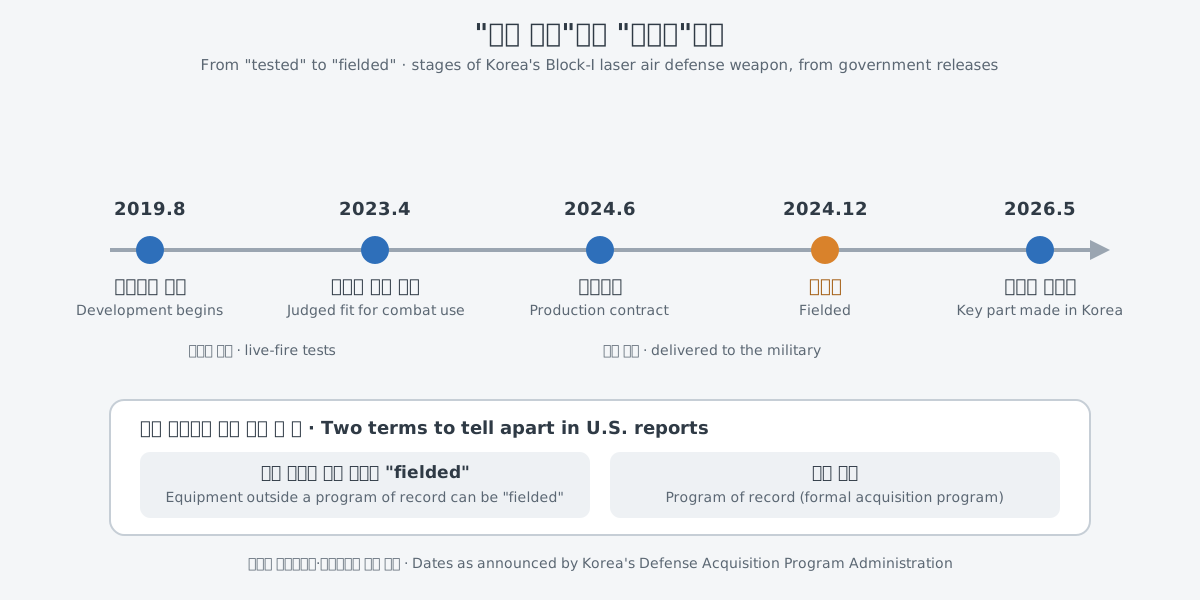
System development began in August 2019. After live-fire tests, the weapon was judged fit for combat use in April 2023, which completed system development successfully. A production contract was signed on June 25, 2024, and DAPA said the weapon was fielded that December.
These words have a place in Korean regulations. Under a Ministry of National Defense directive, operational testing of a newly developed weapon usually ends in one of three judgments: fit for combat use, conditionally fit, or unfit.
A DAPA regulation has the production plan finalized and the contract signed for a weapon judged fit, and it lists system development and production as separate stages. So the "fit for combat use" judgment is the gate from testing to production. The government news item also says that after the production contract, the equipment would be "delivered to the military" and put into full service as fielding. That shows fielding is the stage where production units are handed to the military and put into service.
Different words can also describe the same thing. The July 2024 government news item ran under the headline "deployed within the year," and a DAPA official in the text spoke of "deployment and operation." In this case, deployment and fielding meant the same stage.
Work continues after fielding. DAPA later said a domestic laser source, a key component, had been developed and will be used from later production lots. During system development, an imported laser source was used because the technology was not yet mature enough and the drone threat was growing fast.
U.S. sources also use different words for the same thing. Take the 30 kW laser put on the Navy ship USS Ponce in 2014. One part of a CRS report calls it the first "prototype" weapon, and the summary calls it the first "operational" U.S. directed energy weapon.
The Navy's dazzler ODIN was developed with research and development funds outside a program of record and put in the field, and Navy budget documents still call it "fielded." So "deployed" or "fielded" in an article does not by itself mean a formal acquisition program has begun.
A prototype in the field is not the same as a program of record. Under the plan as of 2024, the Army's IFPC-HEL was to move into a program of record only after four prototypes were delivered. The Army reportedly sent four vehicle-mounted laser prototypes to the Middle East in February 2024 for soldiers to test, and early feedback was described as "not overwhelmingly positive." Officials said results from the lab and test ranges are very different from the tactical environment.
Officially announced cases are gathered in Laser weapon programs that have been made public.
The long history is worth keeping in mind too. Skeptics note that predictions about when lasers would enter service have missed many times, and half-jokingly say that "lasers are X years in the future, and always will be." In January 2024, a Navy admiral overseeing laser development also spoke of "a tendency to over promise and under deliver." That history is traced in A history of laser weapons: from chemical to electric lasers.
Five things to check when reading an article
After reading an article, ask these five questions in order. They show what the article confirms and what it leaves open.
- Power: not just "how many kW," but which power? Check whether it says beam power, whether "class" marks a range, and whether beam quality or optics come up. The difference between power and energy is in Power, energy and intensity.
- Range: does it come with conditions? Check whether weather, time and target are given, and whether the number came from a government release or was added by the article. The limits that air and weather set are gathered in Strengths and limits of laser weapons.
- Cost per shot: what was counted? Check whether it is only electricity and fuel, or whether buying the system, development and maintenance are mentioned.
- Stage: prototype or production unit? Check whether it was a test, a production contract or delivery to the military, how many units, and whether it is a program of record.
- Source: who said it first? Check whether it is an original government or military release, a congressional report, a company release, or a news story repeating one of them. CRS reports put words such as "reportedly" in front of material taken from news stories. It helps to look for similar markers in an article.
Many articles will not answer all five. In that case, the surest step is to find the primary source the article relies on and read it yourself. For an example of unpacking one real story this way, see the news explainer on this site, "The US Army E-HEL laser contract and the directed-energy pilot at US bases."
Further reading
- What is a laser weapon? Film versus reality: the basics of high-energy lasers and power classes.
- Why a laser weapon does not finish "the instant it fires": how power and time tie together.
- Strengths and limits of laser weapons: the strengths and limits official reports list, plus detailed cost-per-shot figures.
- A laser weapon is more than a laser: the system at a glance: why the beam director, power and cooling come up together.
- Laser weapon programs that have been made public: official announcements to try the five questions on.
- Lasers, interceptor missiles and guns: how they share the work: putting cost per shot next to other means on the same yardsticks.
- Finding open sources: where to look for government reports, papers and standards: the way to primary sources.