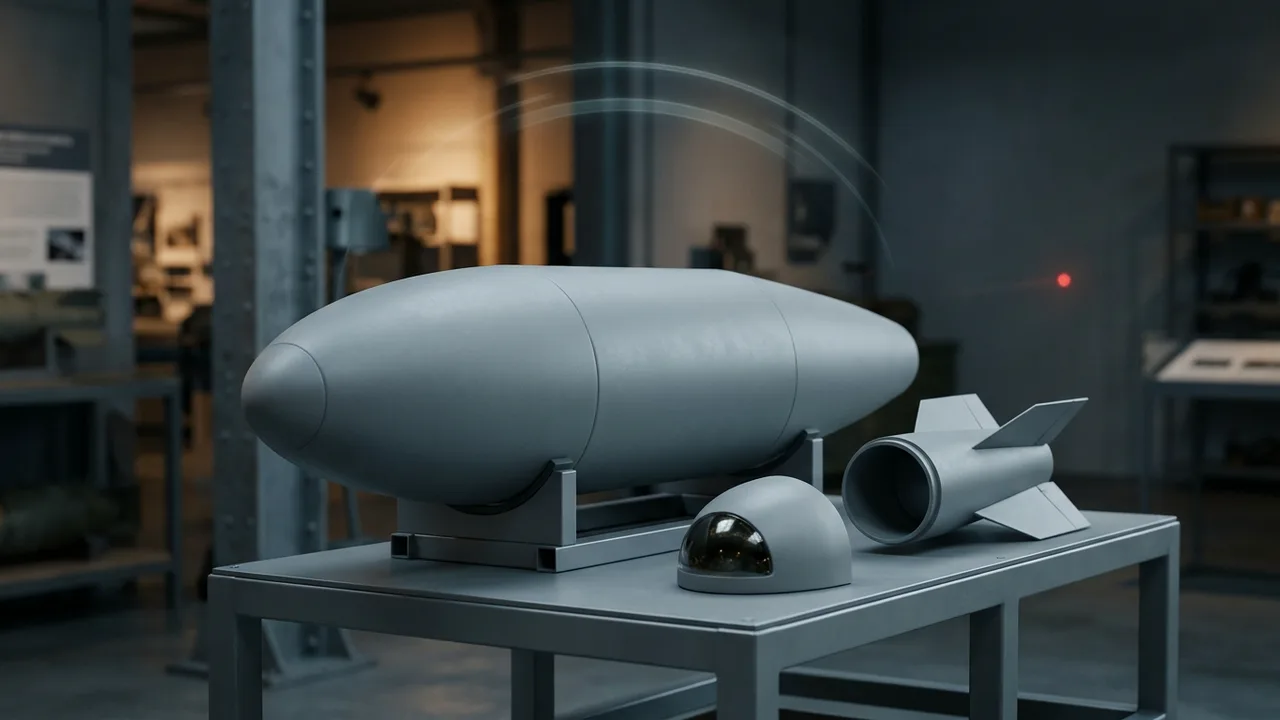
For a long time, a bomb dropped from the sky was at the mercy of wind and gravity the moment it left the aircraft. Once it was falling, nothing could correct its path. A precision-guided bomb adds exactly that: the ability to correct its path on the way down.
That ability does not always come from building a new bomb. The best-known laser kits and satellite-navigation kits leave the body of an ordinary bomb as it is and attach to its front or back. This article looks at what gets attached, what each kit follows, and how the idea changed from World War II to the 1990s.
What gets added: an eye at the front, fins at the back
The Congressional Research Service (CRS) quotes the Defense Department (DOD) definition. A precision-guided munition (PGM) is a "guided weapon intended to destroy a point target and minimize collateral damage." What sets it apart from an unguided round is that it can change its flight path. It corrects for aiming errors or weather during flight, which raises its chance of hitting the target.
These weapons are also called "smart bombs." Their guidance parts include laser seekers, radar seekers that work at millimeter wavelengths, GPS receivers and inertial measurement units. On a bomb, those parts come in the form of a kit.
The Paveway family of laser kits has two parts. A seeker at the bomb's nose looks for a laser that marks the target, and a tail kit at the back steers the bomb onto it. The satellite-navigation kit called JDAM (Joint Direct Attack Munition) is a tail-mounted kit. It adds GPS guidance to several kinds of unguided bombs that weigh 500, 1,000 or 2,000 pounds.
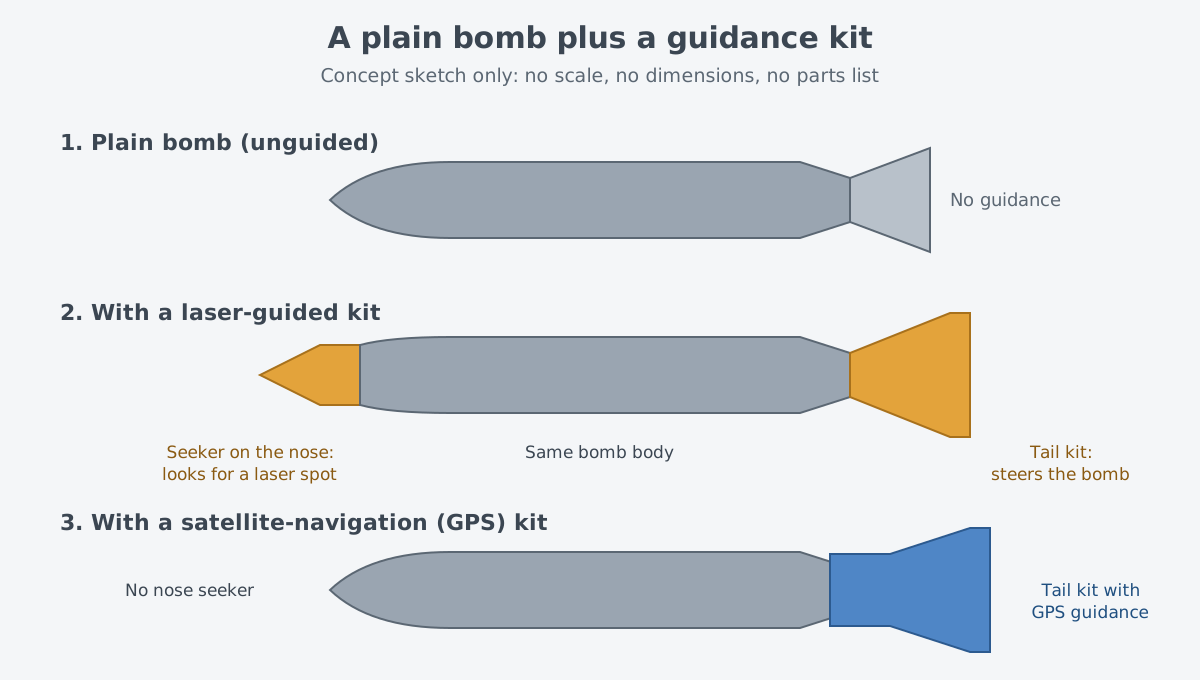
You can think of it as giving the bomb eyes and a steering wheel. The difference is that nobody inside holds the wheel. The tail kit corrects the course by itself, based on what the seeker or the satellite signals tell it.
First tries: guided bombs in World War II
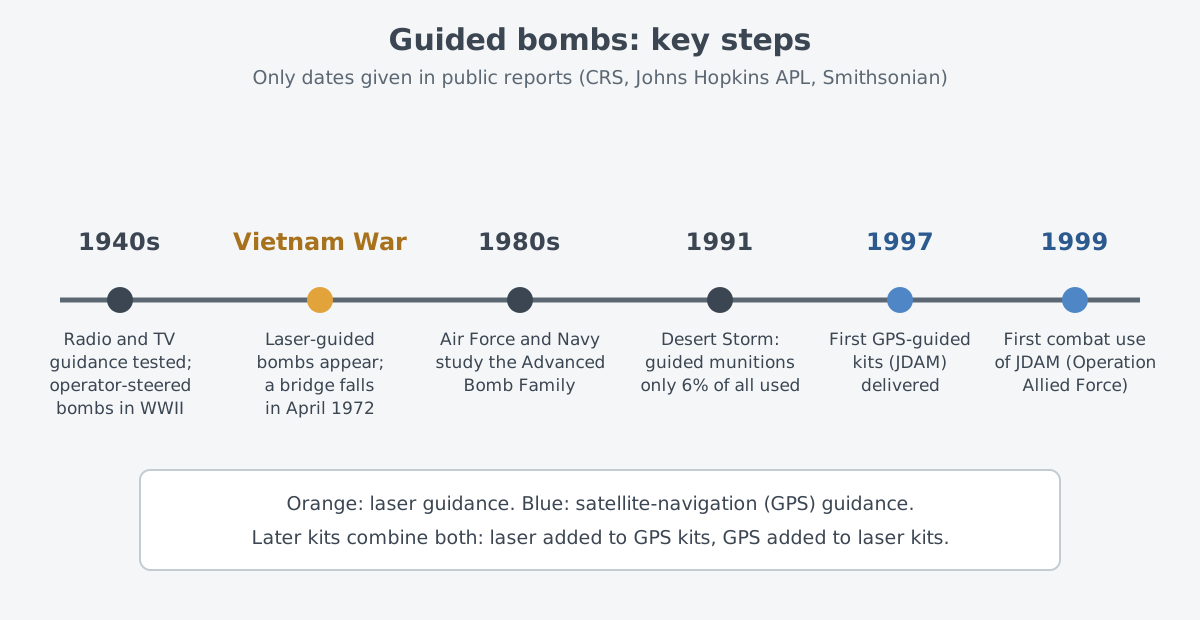
The roots of guided weapons go back to World War I. Tests of steering bombs onto targets followed in the 1940s. Radio guidance for glide bombs was tried out by the U.S. Army Air Corps. Guidance systems of that era used television signals and needed a separate chase aircraft to direct the weapon.
Germany's Fritz X (Ruhrstahl X-1) was an armor-piercing guided bomb that Germany used in the Mediterranean against Allied warships during World War II. The Smithsonian National Air and Space Museum's collection record explains how it was steered. After release, an operator guided it with a joystick and a transmitter, and spoilers on its cross-shaped tail changed its path. The aircraft carrying it had to fly slowly and level while the bomb was being steered.
Guidance at that time depended on a person watching and steering by hand. Such systems never reached full deployment in that war.
Following a laser spot: the Vietnam War
Technology from the 1960s changed the picture. CRS credits laser guidance, semiconductors and other advances in missile technology with improving how accurately weapons could strike. Precision-guided munitions rose to prominence in the Vietnam War with the arrival of the laser-guided bomb. Paveway itself was first developed then, so that tactical aircraft such as the F-4 and A-6 could drop weapons precisely.
The idea is simple. A laser makes a bright spot on the target, and the seeker on the front of the bomb finds that spot and homes in on it by itself. A Johns Hopkins Applied Physics Laboratory (APL) article describes these as air-launched weapons that automatically home on "the bright spot illuminated by a laser." Lighting the target from outside the weapon is called semi-active guidance, which is covered in Missile seekers: the eye at the front.
APL points to an often-cited example: the Thanh Hóa Bridge in Vietnam. Over six years, the United States dropped hundreds of bombs on it and lost aircraft and pilots. The bridge came down in April 1972 to just a few laser-guided bombs.
The cloud problem and the satellite-navigation kit
Laser guidance rests on one condition: the laser light has to reach the target, and the seeker has to see the spot. The U.S. General Accounting Office (GAO), in its 1997 evaluation of the 1991 Desert Storm air campaign, recorded what happened when that condition broke down. Flying at medium and high altitude put aircraft into cloud, haze, smoke and very humid air more often. That hampered infrared and electro-optical sensors, and the laser designators used for laser-guided bombs.
Desert Storm was also the operation that brought laser-guided bombs wide attention. Even so, CRS notes that precision-guided munitions made up only 6% of all munitions used in that campaign.
A path that relied on satellite signals instead of light was also opening up. In the 1980s, the U.S. Air Force and the Navy started to study GPS-guided weapons in a program called the Advanced Bomb Family. JDAM deliveries began in 1997, and operational testing followed in 1998–1999. The Air Force first used JDAM in Operation Allied Force in 1999.
What a satellite-navigation kit follows is not light on the target but the bomb's own position. Today's guided munitions typically combine GPS signals, laser guidance and an inertial navigation system (INS). The INS keeps track of position by itself and the satellite signals correct it.
Writing about missile navigation, APL points out that GPS can be jammed during parts of a flight. Why the two kinds of navigation work as a pair is explained in Inertial and satellite navigation: knowing where you are.
Both methods on one bomb
The two methods follow different things and are held back by different conditions. So the kits gradually moved toward carrying both.
CRS lists the addition of laser guidance to GPS guidance as one of the major upgrades to JDAM. With laser guidance added, it can strike moving targets as well as fixed ones. On the laser side, Paveway III from the 1990s improved guidance at low altitude, while Paveway IV, from the late 1990s, added satellite guidance.
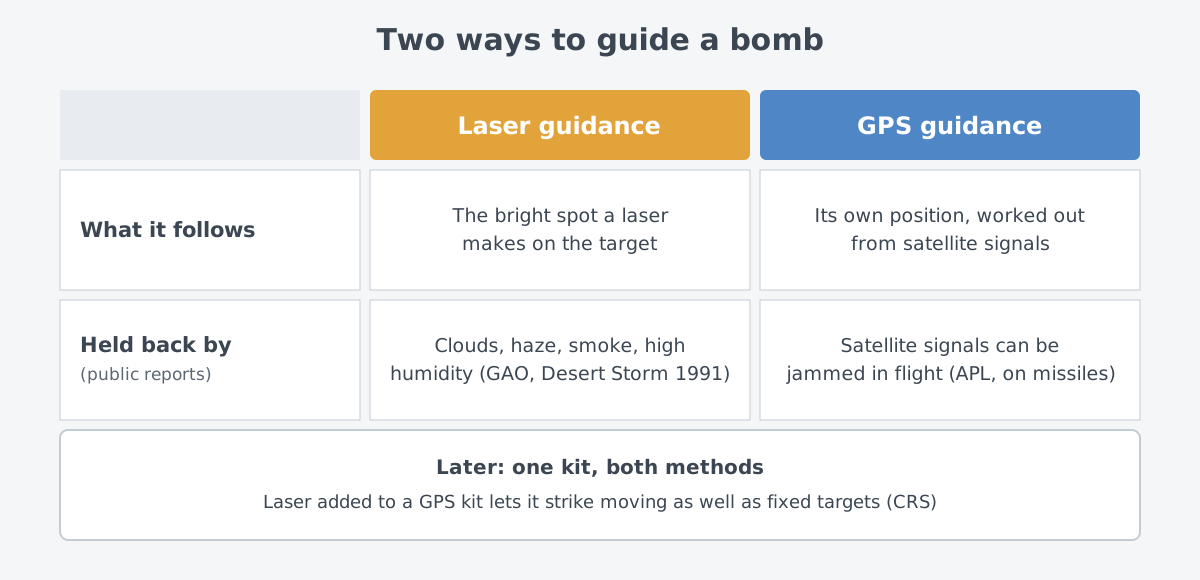
The manufacturer, RTX, says newer Paveway bombs have GPS and inertial navigation. In RTX's words, this pairs the accuracy and flexibility of older laser-guided designs with GPS guidance that works in all weather. That is the benefit the maker claims.
What "precision" really means
The word "precision" usually brings to mind a number, such as landing within a few meters. CRS puts it differently. Over time, it says, "precision" came to mean less a particular guidance system, type of munition or accuracy figure. It came to mean guided munitions as a whole, and how well the people using them gather intelligence, plan and decide.
A kit can bring a bomb to the place it was set for. Whether that place is the right one is decided outside the kit. Cost remains a limit too. CRS names cost as the main drawback of precision-guided munitions, especially long-range missiles.
Where this meets lasers: the light has to cross the air
A laser-guided bomb uses laser light as a marker. A laser weapon uses laser light as energy that heats the target. The jobs differ, but both need the light to cross the air and reach the target.
The clouds, haze, smoke and humidity in the GAO report are the same weather conditions that come up again and again with laser weapons. How molecules and particles in the air scatter and absorb light is covered in Light through air: absorption, scattering, turbulence, thermal blooming.
What to read next
- Missile seekers: the eye at the front: what a seeker that looks for a laser spot is made of.
- Inertial and satellite navigation: knowing where you are: the two kinds of navigation a satellite-guided kit relies on.
- Light through air: absorption, scattering, turbulence, thermal blooming: how weather weakens and blurs laser light.