A black aircraft crosses the night sky and simply vanishes from the radar screen. Films and games have shown stealth aircraft this way for years. Is a stealth aircraft really something nobody can see?
Public U.S. government material points to "no." Stealth is not a way to erase an aircraft. It is a way to make the aircraft harder to find.
Vanishing from a radar screen for a while is not the same as never being seen by any sensor. The key to stealth lies in the gap between those two.
The "invisible" misunderstanding
"Invisible" is a very strong word. It means that no sensor picks the aircraft up, near or far.
The U.S. Air Force fact sheet for the B-2 bomber is far more careful. It says the reduced signatures make the B-2 "difficult" for advanced defenses to detect, track and engage. Difficult is not the same as impossible.
In the 1970s, the Defense Advanced Research Projects Agency (DARPA) put a question to aircraft companies, and it came with a condition. How low would an aircraft's radar signature need to be so that, at a range useful in operations, it was close to impossible to detect? From the start, the goal was written together with a distance.
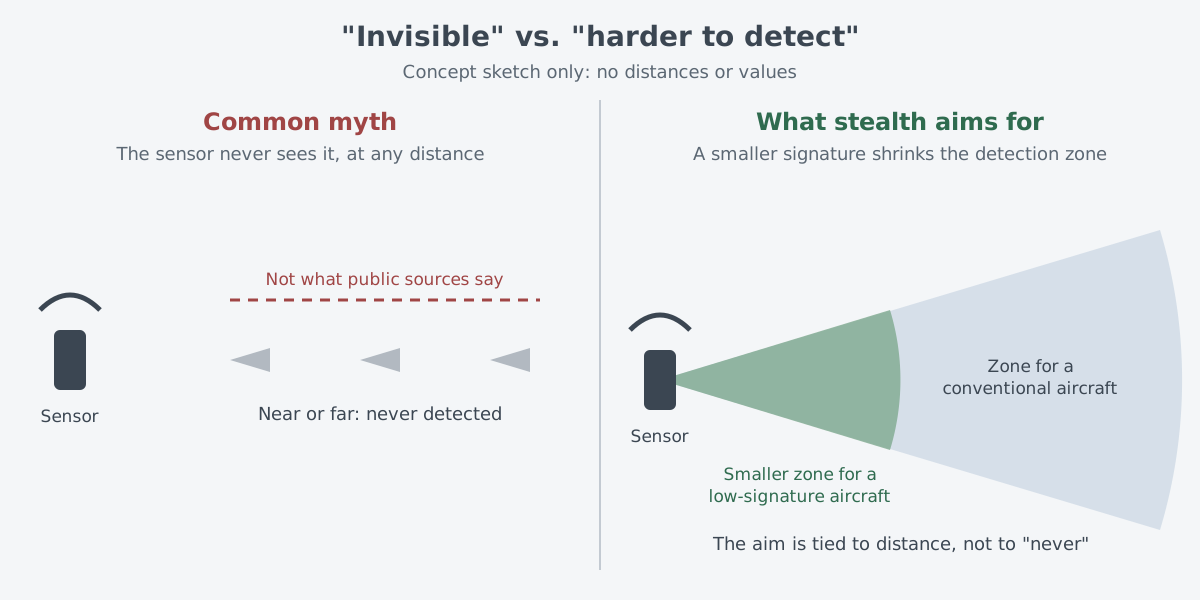
Think of a person walking down a dark street in dark clothes. From far away, they are hard to spot, but they have not disappeared. The real case differs in one key way: it is not one pair of eyes but many kinds of sensors, each reading a different signal.
What stealth means: harder to detect
DARPA describes military stealth as cutting the "signature" of ships, planes and similar assets, meaning how present they appear. A moth that disappears against tree bark is a much older, biological kind of stealth. So is an octopus whose skin takes on the pattern of its surroundings.
In U.S. Air Force material, the term low observable (LO) is used in the same sense as stealth. The B-2 fact sheet puts the two side by side: "low-observable, or 'stealth,' characteristics." Low observable literally means observed at a low level. Nothing in the term says "zero."
How is the signature reduced? Only a short answer is public: composite materials, special coatings and the flying-wing design all add to the B-2's stealthiness. Much of how low observability is achieved is still classified. On the radar side, the size of the signature is described by a value called the radar cross section (RCS), which the next article explains.
There is more than one way to detect
If you think of stealth only as "not showing up on radar," you miss half the story. The U.S. Air Force says the B-2 gets its low observability by cutting its radar, infrared, visual, acoustic and electromagnetic signatures together. The eye covers only one of them.
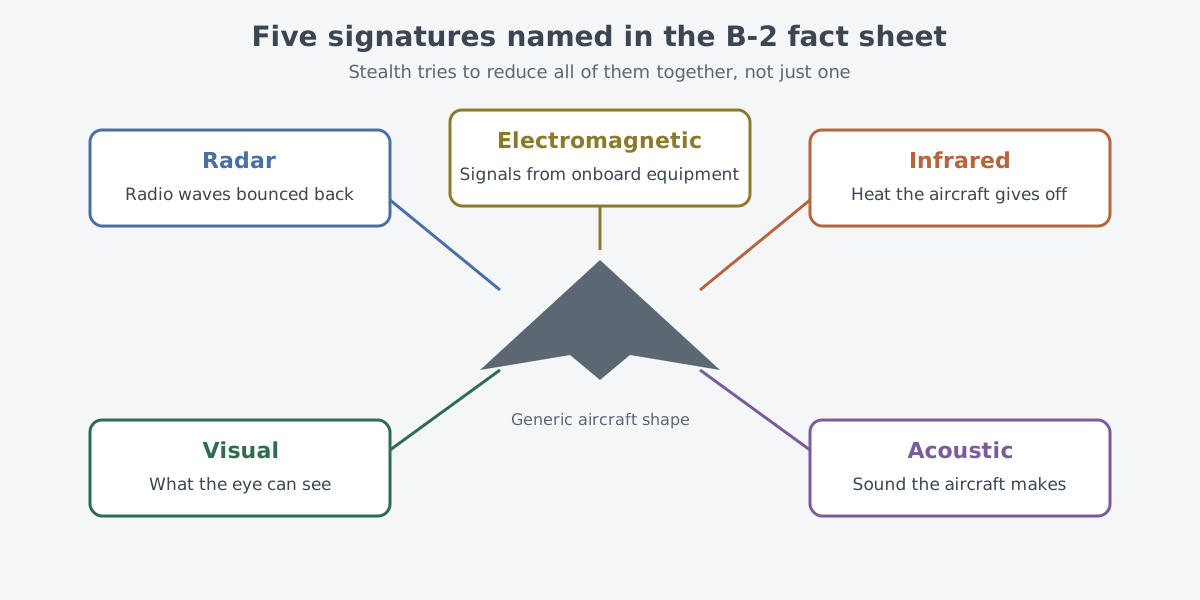
Grouping the names of technologies DARPA developed in its 1970s test program by the signature each name points to gives the table below. The grouping is this article's, not DARPA's.
| Signature | What reads it | Related DARPA technology names |
|---|---|---|
| Radar | A radar that sends radio waves and receives the echo | RCS reduction, radiation-absorbent material, inlet shielding |
| Infrared | An infrared sensor that picks up heat | Infrared shielding, exhaust cooling and shaping |
| Visual | The human eye | Reduced visual signatures |
| Acoustic | Anything that listens for sound | No matching name |
| Electromagnetic | Equipment that receives radio signals from the aircraft | Low-probability-of-intercept radar |
The last row deserves a second look. Having "low-probability-of-intercept radar" on the list means the signals from the aircraft's own equipment are also a signature to reduce. How radar measures distance is covered in Radar, and a sensor that finds aircraft by heat without sending out radio waves is covered in Infrared search and track (IRST).
A short history from public sources
Efforts to reduce signatures are older than aircraft stealth. According to DARPA, managing signatures has a history of more than a century. It began with camouflage painted on warships and later spread to aircraft and submarines. In both world wars, engineers were already working to shrink what eyes and radars could pick up.
Stealth aircraft as they are known today trace back to 1974. That year, the U.S. Department of Defense hosted a study by its Defense Science Board (DSB). The study warned that advanced air defenses linked into networks were spreading and put U.S. aircraft in serious danger. Building on it, DARPA set out to develop technologies for aircraft with much lower RCS than before.
The program was called the Experimental Survivable Testbed (XST). After the tests, Lockheed was chosen to build two demonstrator aircraft, and when the Air Force took over the lead, the effort took the name Have Blue. Have Blue had flown for the first time before 1977 was over, and it led directly to the purchase of the F-117.
Also in 1977, Northrop won a contract from DARPA and the Air Force for another experimental aircraft. Later known as Tacit Blue, it was the first aircraft to succeed in cutting its signature with curved surfaces, and it laid the foundation for the B-2 bomber.
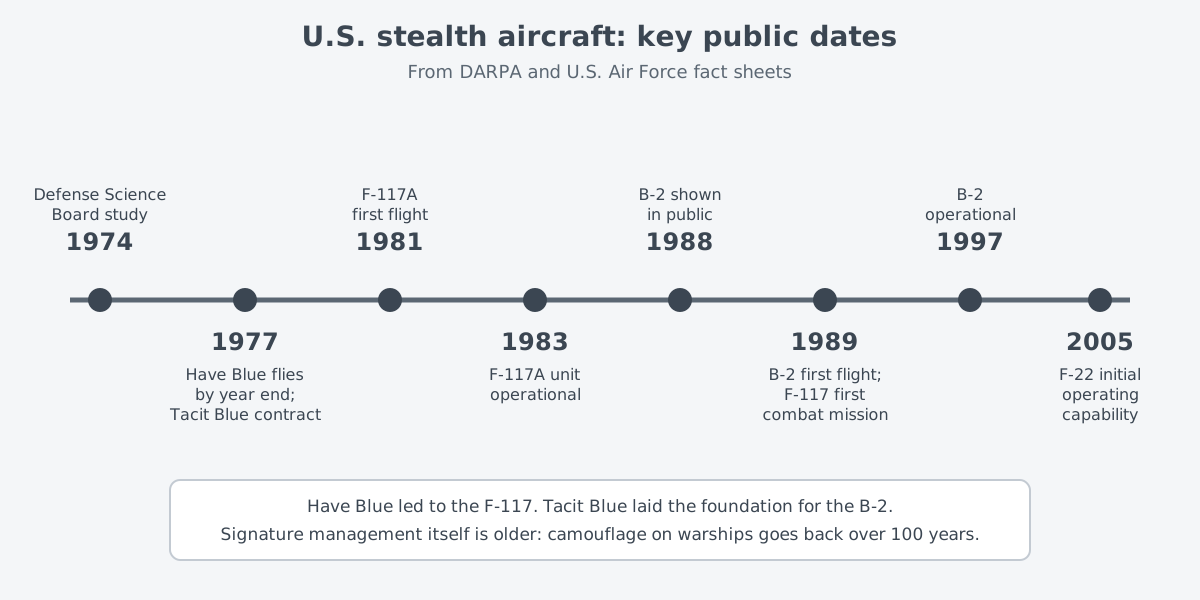
A 1996 U.S. Air Force fact sheet describes the F-117A as the first operational aircraft in the world designed to make use of low-observable stealth technology. The production decision came in 1978, the first flight in 1981 and the first delivery in 1982, and the unit reached operational capability in October 1983. Its first combat mission came in 1989.
The B-2 was first shown in public on Nov. 22, 1988, as it came out of its hangar at the Air Force's Plant 42 in Palmdale, California. It first flew on July 17, 1989, and the first aircraft was delivered on Dec. 17, 1993. DARPA notes that the B-2 entered operational service in 1997 and went into combat for the first time in 1999.
Later fighters made stealth a basic feature. The U.S. Air Force describes the F-22 as bringing together stealth, integrated avionics, supercruise and maneuverability, and lists its initial operating capability as December 2005. The F-35 is presented as a fifth-generation fighter that combines advanced stealth with fused sensor information. In the United States today, stealth features are also built into ships, missiles, ground vehicles and helicopters.
The limits of stealth
Stealth makes detection harder but does not remove it. With five kinds of signatures, reducing just one is not enough. DARPA's goal in the 1970s also came with the condition of a range useful in operations.
Maintenance is another heavy burden. A 2018 report by the U.S. Government Accountability Office (GAO) found that the F-22's stealth depends on its low observable coating, yet maintaining that coating lowers aircraft availability. Air Force officials said that upkeep of the coating on the skin takes a lot of time and sharply reduces how long each F-22 can be ready for missions. Fourth-generation fighters lack a full LO coating, so they do not face this problem.
This difficulty is not new. In a 2002 report, GAO had already noted that keeping low observable features in shape had, over the years, proven harder and slower than planned. Stealth is not a property you build once and forget. It has to be kept up through maintenance.
Much of it also cannot be seen from the outside. That is because much of how low observability is achieved is still classified. So when a news story gives a number for radar cross section or detection range, the first question is which official source that number came from. The approach in How to read laser weapon news works the same way for any weapon story with numbers in it.
What to read next
- Radar cross section: why a big aircraft can look small: what the value that sizes a radar signature actually means.
- Radar: measuring distance and motion with radio waves: how the main sensor that stealth works against operates.
- Infrared search and track: seeing aircraft without emitting: how heat, not radio waves, can be used to find aircraft.