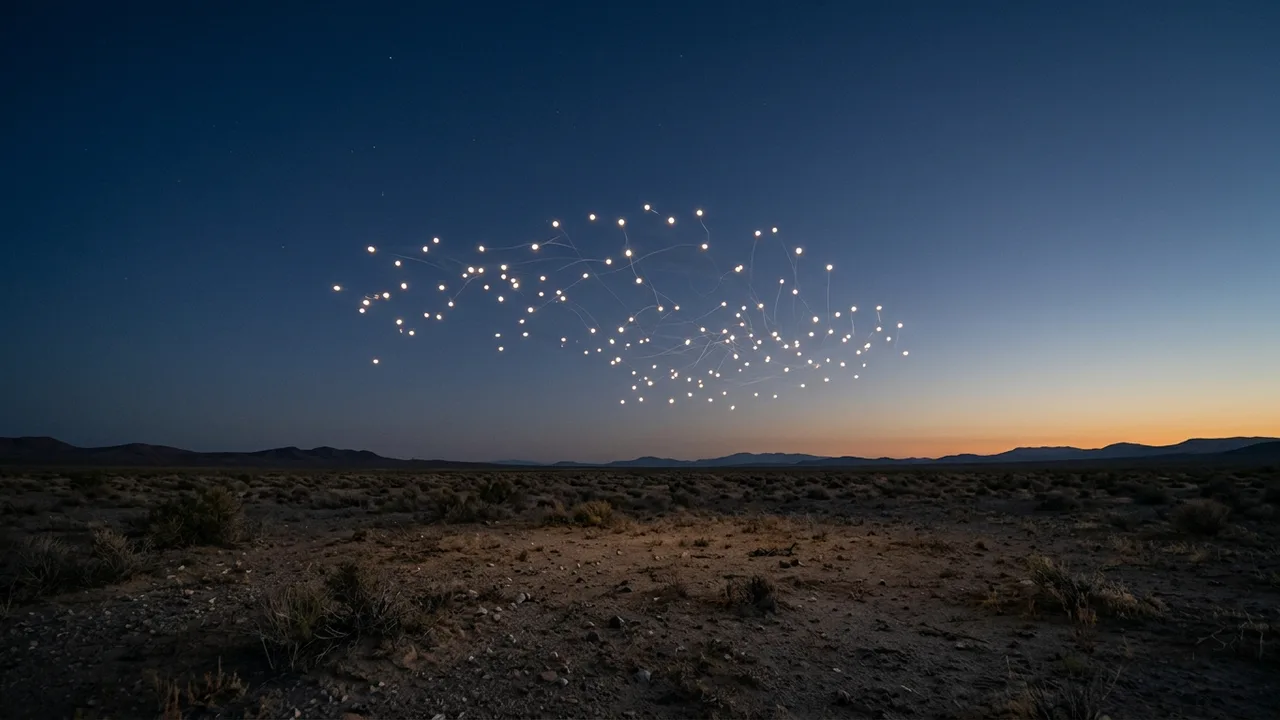
On a festival night, hundreds of drones rise and draw letters and pictures in the sky. Is that a swarm? Watching them fly in neat lines, you might want to call it one. But when researchers and militaries say "swarm," they mean something that matters more than the head count.
This article looks at how many drones flying together differs from a swarm. Its guides are one academic definition and two public examples from the U.S. government: a test and a research program.
How many differs from a swarm
Picture two scenes. In the first, every drone has a path planned in advance, and each one follows only its own path. If the drone beside it stops, the others carry on as before.
In the second, each drone has a few simple rules and sets its own motion by watching how its near neighbors move. If one drops out, its neighbors change their motion to fill the gap. The swarm that swarm robotics talks about is the second kind.
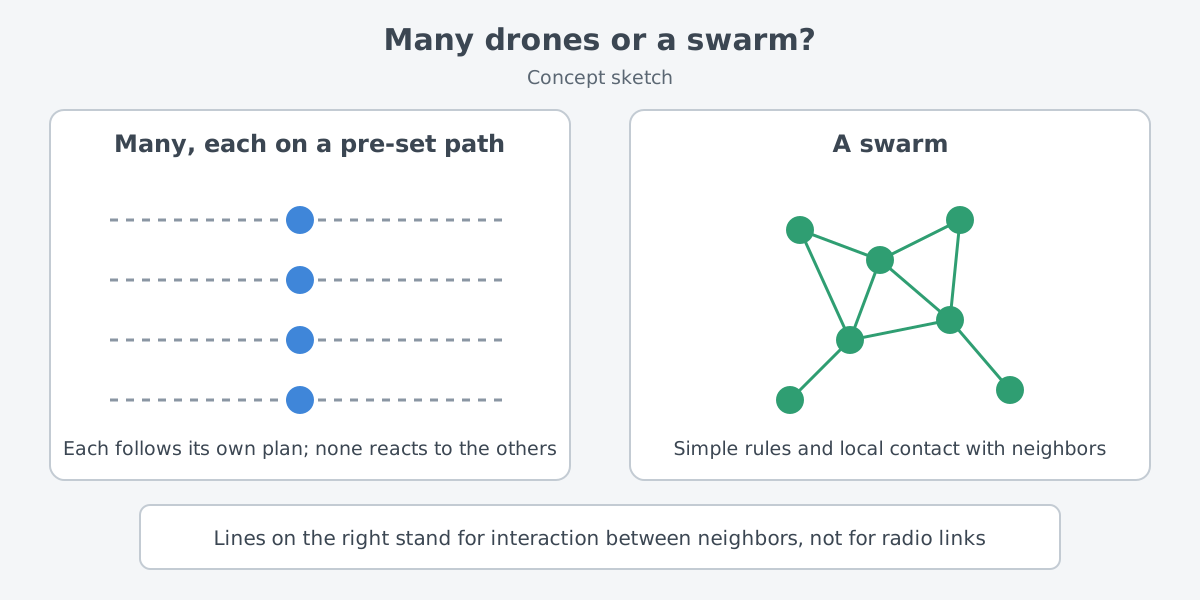
A definition of swarm robotics makes the difference sharper. A 2013 review by Brambilla and colleagues defines swarm robotics as a branch of collective robotics inspired by the self-organizing behavior of social animals. The goal is to design group behavior for large numbers of robots working together, behavior that is robust, scalable and flexible, using only simple rules and local interactions.
Each of those three words means something. Robust means the group keeps working when a few members drop out. Scalable means the same approach still works as numbers grow. Flexible means the whole group adapts when conditions change.
A large head count alone guarantees none of these.
Back to the drone show, then. A large number of drones in tidy lines does not tell you which scene you are watching. The dividing line is whether each drone follows a path planned in advance or sets its motion by its neighbors.
An idea borrowed from flocks
Think of a flock of migrating birds at dusk. Many birds seem to turn as one body. This is the kind of group people have in mind when they say swarm robotics takes its inspiration from "social animals."
The real thing is different. Birds are living animals, while a drone's rules are written in by people. The same review also introduces a new field called swarm engineering. It seeks orderly procedures for swarm robot systems, from modeling and design through to verification, operation and upkeep.
A public case: a test with 103 drones
There is a public military test of this idea. On January 9, 2017, the U.S. Department of Defense announced a demonstration of one of the largest micro-drone swarms in the world. It was run by the department's Strategic Capabilities Office (SCO) together with Naval Air Systems Command (NAVAIR). The site was China Lake, California.
The test took place in October 2016. Three F/A-18 Super Hornets released 103 tiny drones called Perdix. According to the release, the drones showed swarm behaviors such as group decision-making, formation flying that adjusted as it went, and self-healing.
Perdix began at a university. Engineering students at the Massachusetts Institute of Technology (MIT) first designed it, and from 2013 MIT Lincoln Laboratory adapted it for military use. The department said the test confirmed that the current design, built only from commercial parts, worked reliably under conditions close to real deployment.
What "no leader" means
The most striking line in the release comes from the SCO director. He said that Perdix drones are not "pre-programmed synchronized individuals." Instead, he described them as one collective organism that shares a single distributed brain for decisions and adapts the way swarms in nature do.
This lines up with the two scenes above. What he said Perdix is not is the first scene: a group in which each member follows its own planned path in step. What he said it is, is the second.
The same yardstick works for the drone show. If each show drone flies its own planned path, then however neat the formation, it matches the first scene, the one he set apart from Perdix. Which kind a given show is depends on how its makers say it works.
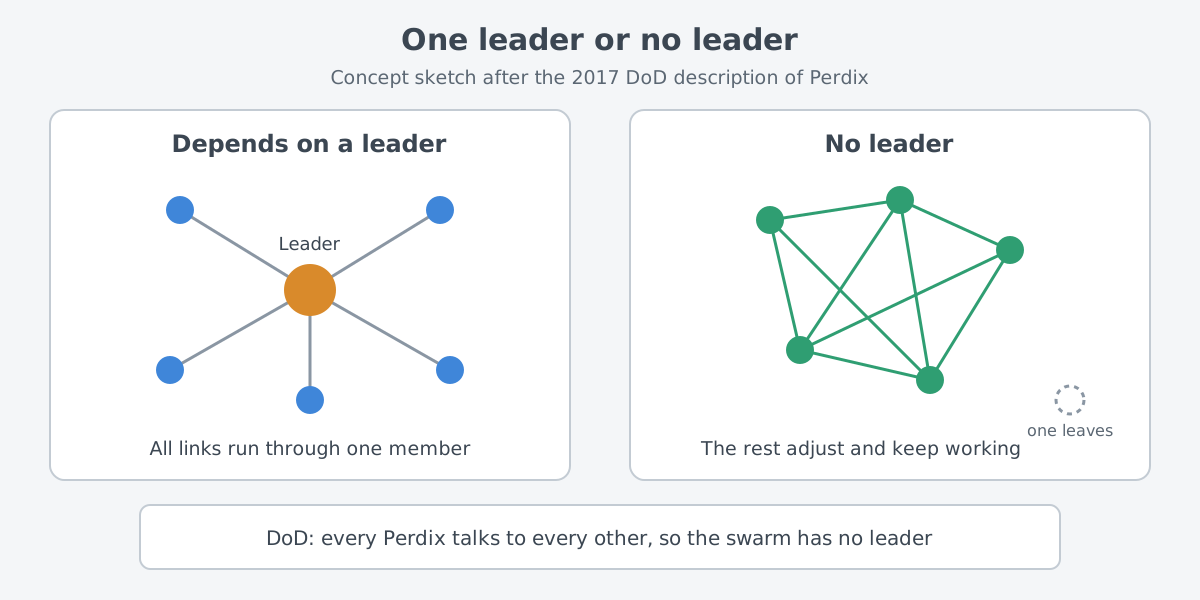
The release also gives the reason Perdix has no leader. Every Perdix talks and works with every other Perdix. As a result, the swarm adjusts smoothly as drones join or leave the team.
No leader does not mean no people. It means there is no single drone acting as the leader. That difference leads to the next question.
Where people fit in
In the same release, the SCO director stressed that in the department's view of a future battle network, humans will always be in the loop. Having no leader drone and keeping a person in the loop are matters at different levels.
The OFFSET program of the Defense Advanced Research Projects Agency (DARPA) also puts people at the center. It pictured small infantry units using swarms of more than 250 small uncrewed aircraft and ground vehicles. That would require a person to watch and direct hundreds of platforms at once, in real time, so one of its goals was a human-swarm interface. The program has now ended.
Before the test range: virtual worlds and experiments
Putting hundreds of drones over a test range at once is hard. So OFFSET had two parts. One was a virtual world, linked over a network and running in real time, that follows the laws of physics. The other was frequent live experiments with a range of uncrewed air and ground platforms.
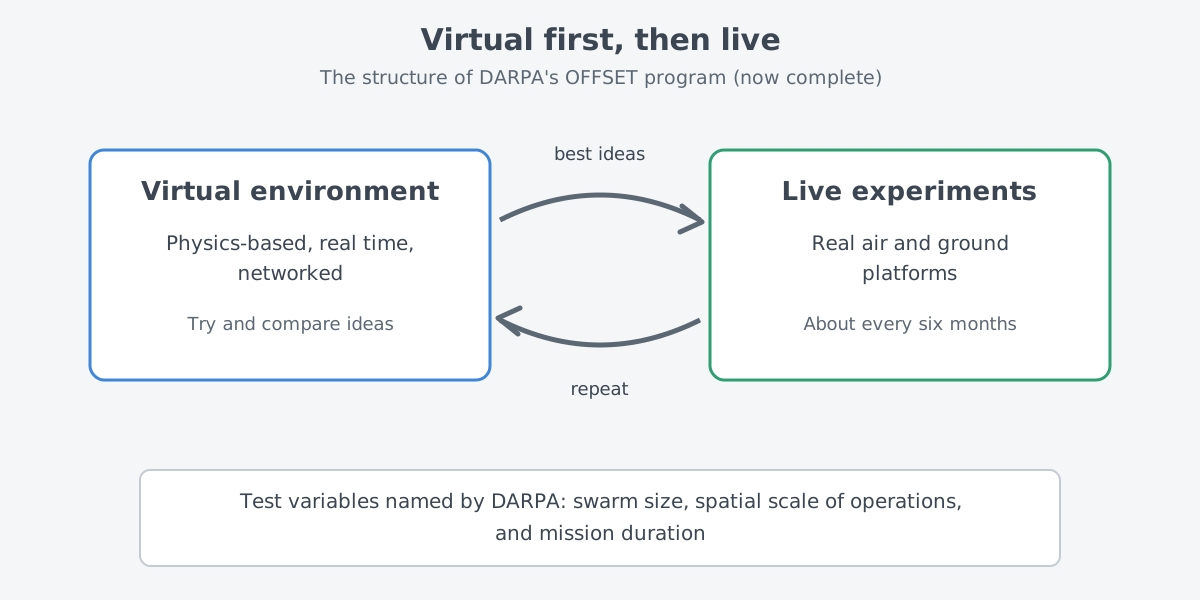
According to DARPA, live experiments came about every six months, with situations that grew more complex each time. The test variables included how many drones were in the swarm, how large an area they covered and how long the mission lasted. An idea that looked good in the virtual world still had to be checked with real machines.
What calculations and tests each show is the subject of the article "Simulation versus testing." Why lasers, too, are worked out by calculation before experiments is covered in Why lasers are studied by calculation first.
An idea shared with lasers: many acting as one
The idea of making many units act as one, instead of side by side, also appears in lasers. It is called beam combining: gathering the light of many lasers into a single beam.
One family of beam combining methods lines up the phase, the timing of the light wave, of each laser. Much as swarm drones match their neighbors, many beams that are matched to one another act like a single beam.
The comparison ends there. Light makes no decisions; equipment does the matching. Why beam combining is needed, and its three approaches explains how.
What to read next
- Why beam combining is needed, and its three approaches: three ways to gather the light of many lasers into one beam.
- Coherent beam combining: the principle, from published reviews: combining light by matching its phase, read through a public review paper.
- "Loitering munitions: between missile and drone": how names and categories split when a single drone becomes the munition.