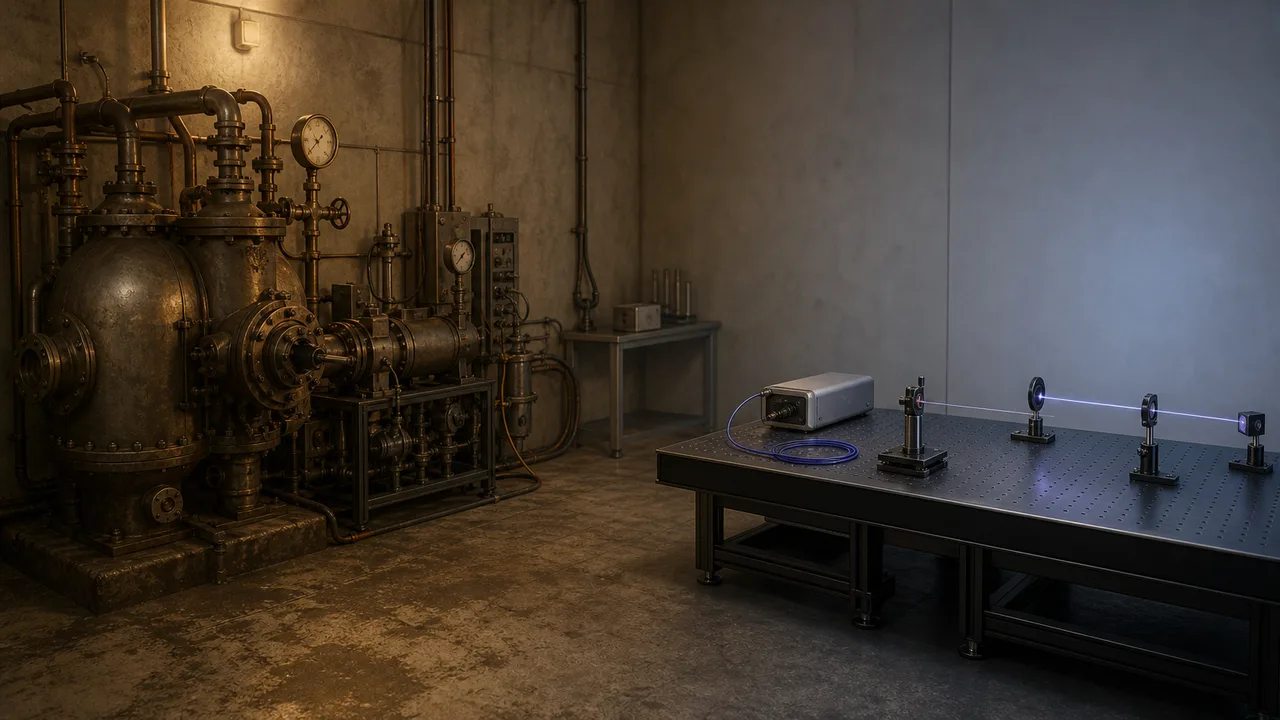
The first laser to shine, in 1960, was a solid-state laser. More than half a century later, many U.S. laser weapon programs also use solid-state lasers that run on electricity, and South Korea's laser air-defense weapon Cheongwang uses a fiber laser. Looking only at the start and the present, the field seems to have come full circle.
In between lies a long detour. For decades the most mature laser weapon concepts were based on chemical lasers, which make light from chemical reactions. One of them put its laser on a converted large freighter aircraft. How did those programs end, and why did the field turn to electric lasers?
This article follows that path through public records. They come from the U.S. Congressional Research Service (CRS), Government Accountability Office (GAO), Missile Defense Agency (MDA) and Army, and from South Korea's Defense Acquisition Program Administration (DAPA).
A question that began as soon as the laser appeared
Soon after the laser appeared, people asked whether this light could be used as a weapon. The United States has researched directed energy since the 1960s. A directed-energy weapon (DEW) uses concentrated electromagnetic energy, rather than kinetic energy, against enemy forces. It is a different branch from weapons such as missiles and shells, which destroy a target by hitting it.
A weapon needs high power. In discussions of Navy shipboard lasers, a high-energy laser (HEL) is generally a laser with a beam power of at least 10 kW. What laser weapons actually do, and how they differ from the movies, is set out first in What is a laser weapon? Film versus reality.
GAO traces the Defense Department's decades of effort to the considerable advantages these technologies could offer. They act on targets at the speed of light and may cost less per use than weapons such as missiles.
The same decades also left another record. Some experts observe that the department spent billions of dollars on directed-energy programs that never matured and were cancelled. Following that record leads first to chemical lasers.
The chemical laser era: high power, heavy burden
A chemical laser makes light from the energy released when chemicals react. Reactions that give off heat raise atoms or ions to excited states, and those particles emit laser light. The reactions must run at very low pressure, so the device becomes large, with vacuum pumps and complex systems to manage the chemicals. The main kinds of lasers are covered in Laser types at a glance: gas, solid-state, fiber, semiconductor.
Chemical lasers stayed at the center for a reason. A 2018 CRS report reproduces a 2012 analysis by the think tank CSBA. It named chemical lasers as the only directed-energy systems of the time that could reach the power to stop targets such as ballistic missiles over hundreds of kilometers. It added that, until then, the Defense Department's most mature high-energy laser concepts had been based on them.
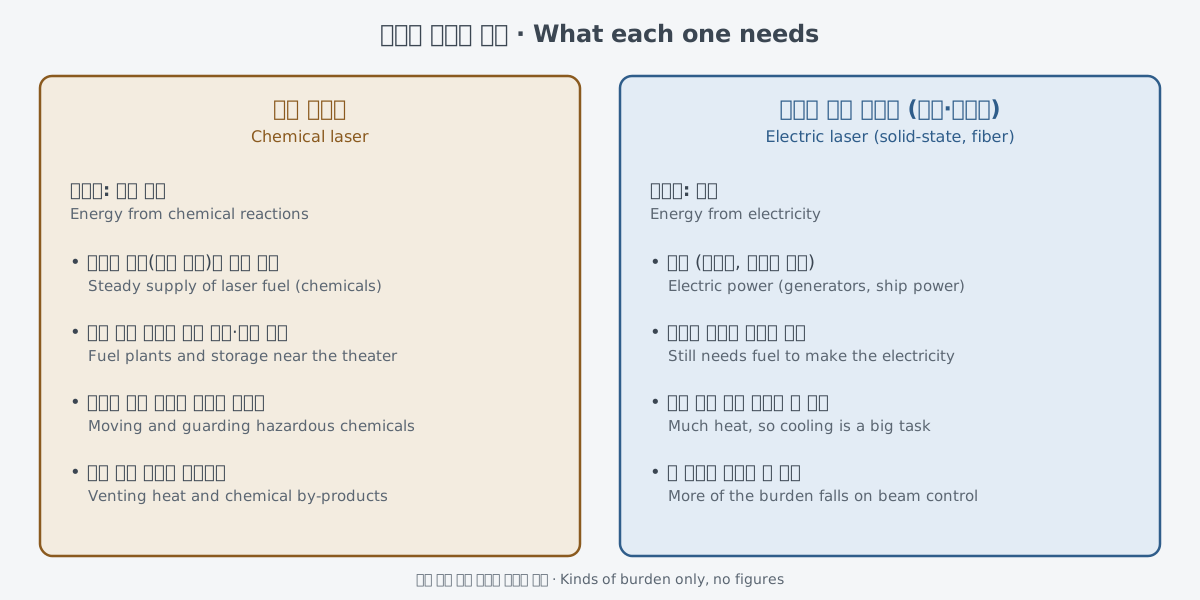
High power came with a heavy burden. A chemical laser is a bit like a heater with a fuel tank attached. When the fuel runs out it has to be refilled, and making, moving and guarding the fuel never stops.
In reality, the difference is that nothing is burned for heat as in a stove; the reaction between chemicals itself excites the atoms that give off the light. Electric lasers are not entirely free of fuel either. A shipboard solid-state laser can keep firing only while the ship has fuel to make electricity.
Official sources describe this burden in some detail. In 2004, GAO found that fielding the Airborne Laser (ABL) would need laser fuel production facilities close to the theater of operations. Chemical facilities would have to be guarded, and a ground support squadron and chemicals moved forward.
Chemical lasers carry a large logistics footprint and use hazardous chemicals. Long, repeated firing also depends on venting the by-products of making the beam, such as heat and chemicals.
On the ground, one program that showed this burden was the Tactical High Energy Laser (THEL). The United States and Israel began it together in 1996 to build a laser that could shoot down Katyusha rockets, artillery shells and mortar rounds. Its laser was a deuterium fluoride (DF) chemical laser. According to CRS, THEL shot down 28 Katyusha rockets and 5 artillery shells in operational testing in 2000 and 2001.
Despite good test results, THEL was never deployed. Looking back in a 2014 article, the U.S. Army wrote that THEL relied on toxic chemicals, which affected its reliability, logistics, cost and safety. In January 2006, after repeated setbacks, cost overruns and concerns that THEL was too large to carry on vehicles, the Pentagon cancelled the program.
Lasers taken into the air, and how those programs ended
One program took chemical lasers into the air. In 1996 the U.S. Air Force began acquiring the Airborne Laser (ABL), meant to defeat ballistic missiles in the boost phase, while their rocket motors still burn. In October 2001 the program passed to what is now the Missile Defense Agency. MDA's fact sheet says the test bed was a Boeing 747-400 freighter rebuilt to carry a megawatt-class chemical oxygen iodine laser (COIL) and two solid-state lasers.
It took more money and time than planned. In 2004, GAO reported that the value of the ABL prime contract rose from about $1 billion to $2 billion between 1996 and 2003. Its 2010 report gives the program's own estimate: nearly $5.1 billion through the first lethality demonstration, almost five times the estimate for the original 1996 contract.
The turning point came in 2009. Long-standing technical problems, cost growth and schedule delays led the Secretary of Defense to make three recommendations. He proposed cutting the fiscal 2010 ABL budget by more than $200 million, cancelling the planned second aircraft, and focusing on technology development. The same GAO report states that the current program will not result in an operational system.
The tests delivered results after that. On February 3, 2010, the ABL test bed destroyed a boosting solid-fueled rocket, and on February 11 it destroyed a liquid-fueled ballistic missile. MDA called this a proof-of-concept demonstration and the first directed-energy lethal intercept of a liquid-fuel boosting ballistic missile from an airborne platform.
The test bed flew its last mission on October 11, 2011. On February 14, 2012, it flew to Davis-Monthan Air Force Base, went into storage and retired from active service. It has since been demilitarized, and most of its parts have been reused in other government research.
Efforts to put lasers on aircraft continued. The U.S. Air Force developed SHiELD, a prototype meant to mount as an external pod on aircraft such as fighters and target incoming missiles. In May 2024 its program manager said the program had concluded with no plans for further testing, and SHiELD was never installed on a fighter test bed.
Why the direction changed: lasers that run on electricity
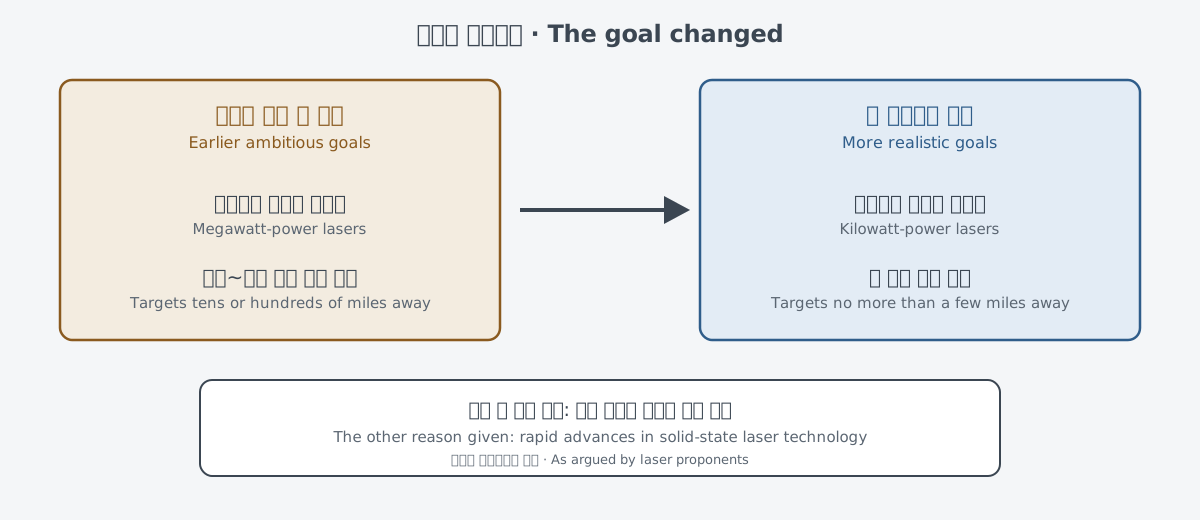
Official sources give two reasons. The first is the burden. Solid-state lasers are more compact than chemical lasers and need only electricity to run. To the Army, solid-state lasers powered only by electricity seemed the better solution.
The second is that the technology caught up. The Army article says solid-state lasers were at first not mature enough for a weapon. The Joint High Power Solid State Laser (JHPSSL) program was the answer to that gap. In 2009 it met its main goal when a solid-state laser produced more than 100 kW for several minutes.
The Navy, over the past 15–20 years, has drawn on major advances in industrial solid-state lasers and on decades of military laser research by other parts of the Defense Department. How fiber lasers spread in factories first is told in Why fiber lasers became so widely used: from the lab to the factory.
The same trend shows up in the programs. As the mobile follow-on to THEL (MTHEL) went on, the Army reportedly began to shift its focus from bulky, logistics-intensive chemical lasers to solid-state lasers powered by diesel generators.
Laser proponents make a related argument. Against the skeptics' line that lasers are always some years away, they admit the record of missed predictions but argue that the situation has now changed.
Solid-state laser technology has advanced quickly, and there has been a shift to more realistic goals. It went from megawatt-power lasers aimed at targets tens or hundreds of miles away to kilowatt-power lasers aimed at targets no more than a few miles away. The skeptics' line, and what it means, is covered in How to read laser weapon news: "kW-class", "range" and "cost per shot".
Switching to electricity also changes how the cost of a shot is counted. Many current U.S. programs use solid-state lasers powered by electricity, so the cost per shot would equal the cost of the power for that shot. The advantage of firing again and again while power lasts, and its conditions, are explained in Strengths and limits of laser weapons.
There is a price: the Army notes that the new electric lasers work at much shorter wavelengths and lower powers than the chemical lasers before them. A shorter wavelength can give a smaller, more intense beam, but its effects in the air and on the target can be very different. More of the performance burden also shifts to beam control. Weapons-grade solid-state lasers also make a lot of heat, and CRS sees practical cooling technology as a way to raise their military value.
Work on beam quality and efficiency also continues. The Defense Department has launched a High Energy Laser Scaling Initiative to strengthen the industrial base for directed-energy weapons and improve laser beam quality and efficiency. The principle of joining several laser beams into one to raise power is covered in Why beam combining is needed, and its three approaches.
Getting onto ships and vehicles
Electric lasers reached the sea first. In 2009–2012 the U.S. Navy tested a prototype solid-state laser, the Laser Weapon System (LaWS), against drones, first on land and then on a ship at sea. Its reported beam power was 30 kW. In 2010–2011 another prototype, MLD, hit a small boat from a ship.
In August 2014 the Navy installed LaWS on USS Ponce to evaluate shipboard lasers in an operational setting, and in December it declared that LaWS an "operational" system. The CRS Defense Department report calls the same equipment the first operational U.S. directed-energy weapon in its summary and the first prototype weapon in its Navy section. Ponce was decommissioned in October 2017, and LaWS was removed at that time.
On land, the U.S. Army's DE M-SHORAD seeks to put a 50 kW laser on a Stryker combat vehicle to give brigades short-range air defense. In February 2024, the Army reportedly sent four of these prototypes to the Middle East for soldiers to test. Early soldier feedback was described as "not overwhelmingly positive," and officials said results on test ranges were very different from the tactical environment.
South Korea's laser air-defense weapon started in August 2019, with the Agency for Defense Development leading system development. In July 2024, Korea's government news portal reported a combat suitability pass in April 2023 ("April of last year"), and DAPA says Cheongwang was fielded in December 2024. Cheongwang shines a fiber-based laser beam directly on the target. System development used an imported laser source, and at the end of May 2026 this key component was made in Korea.
There is still a gap between a prototype in the field and a fielded weapon. GAO notes that the Defense Department and the services have shot down drones in live-fire demonstrations with several laser weapon demonstrators and prototypes. It also repeats a long-standing concern: a gap between the development and acquisition communities, the so-called "valley of death," holds back technology transition.
How power, cooling and the beam director connect outside the laser is shown in A laser weapon is more than a laser: the system at a glance. How news stories mix the words "prototype," "operational" and "fielded" is covered in the news-reading article above.
The timeline at a glance
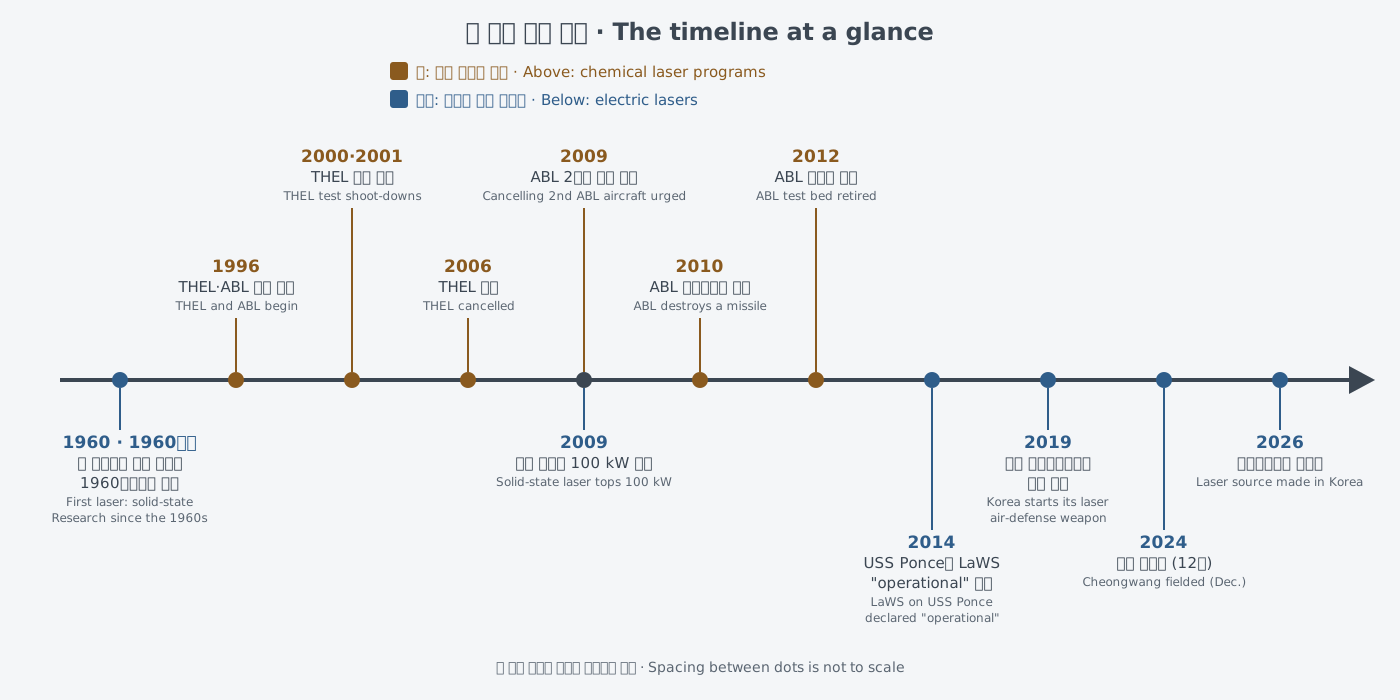
- 1960: The first laser shines. It is a solid-state laser. U.S. directed-energy research dates from the 1960s.
- 1996: The U.S.-Israeli THEL and the U.S. Air Force ABL acquisition program begin. Both use chemical lasers.
- 2000 and 2001: THEL shoots down 28 Katyusha rockets and 5 artillery shells in operational testing.
- January 2006: The Pentagon cancels THEL.
- 2009: The Secretary of Defense recommends cancelling the second ABL aircraft. The same year, a JHPSSL solid-state laser tops 100 kW.
- 2009–2012: The Navy tests the prototype solid-state laser LaWS.
- February 2010: The ABL test bed destroys a boosting solid-fueled rocket and a liquid-fueled ballistic missile.
- February 2012: The ABL test bed goes into storage and retires from active service.
- 2014: In August LaWS goes aboard USS Ponce, and in December it is declared "operational."
- August 2019: South Korea starts its laser air-defense weapon.
- 2024: In February, reportedly, U.S. Army Stryker laser prototypes are tested in the Middle East, and in December South Korea's Cheongwang is fielded.
- End of May 2026: Cheongwang's laser source is made in Korea.
What to read next
- Laser weapon programs that have been made public: picks up where this timeline ends and gathers today's cases that governments have officially announced.
- Lasers and high-power microwaves: two kinds of directed energy: sets the other kind of directed energy, researched over the same years, beside lasers.
- A laser weapon is more than a laser: the system at a glance: a block diagram of what else, outside the laser, an electric laser needs to become a weapon.
- Eye safety and international rules: the protocol on blinding laser weapons: what the international rules that apply to laser weapons have set out.
- "Power and efficiency: the share of electricity that becomes light sets the size of the system": an upcoming article on why efficiency sets the size of an electric laser system.