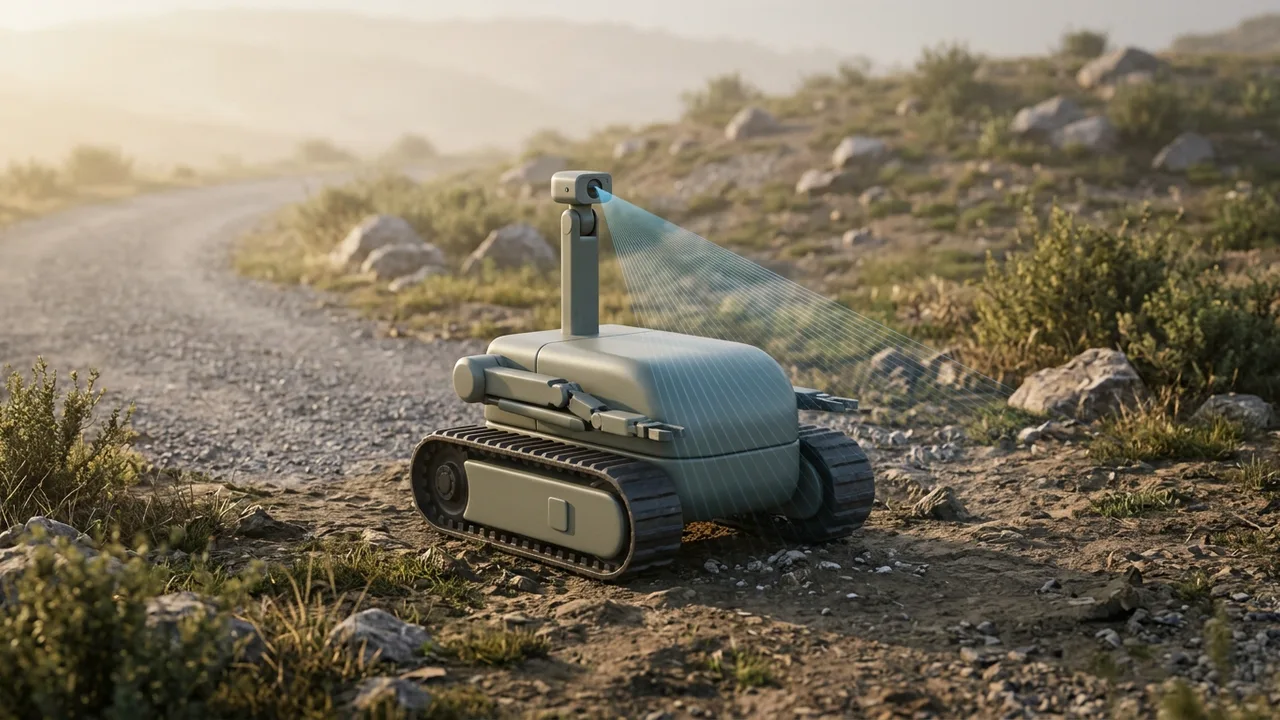
A bag sits by the side of a road with no owner in sight. If nobody knows what is inside, a small robot can roll up to it before any person does and send back camera pictures. People watch the screen from far away.
A robot that goes first in place of a person is called an unmanned ground vehicle (UGV). Its jobs range from bomb disposal to hauling gear. Getting one to find its own way without a human at the controls is still being researched.
What counts as an unmanned ground vehicle
The U.S. National Institute of Standards and Technology (NIST) published a glossary of unmanned-system terms in 2008. In it, an unmanned system (UMS) is a system with its own power that carries no human operator on its main parts. It does physical work in the real world to get its assigned jobs done, and it may move around or stay put.
The examples cover UGVs on land, unmanned aerial vehicles (UAVs) in the air, and unmanned craft on and under the sea. Missiles, rockets, their submunitions, and artillery, on the other hand, do not count as the main parts of an unmanned system. Having no one on board is not enough on its own.
UGVs are the group that travels on the ground. The range of sizes is wide. The same label covers robots a Soldier carries on their back and vehicles meant to move alongside crewed combat vehicles.
From remote control to autonomy
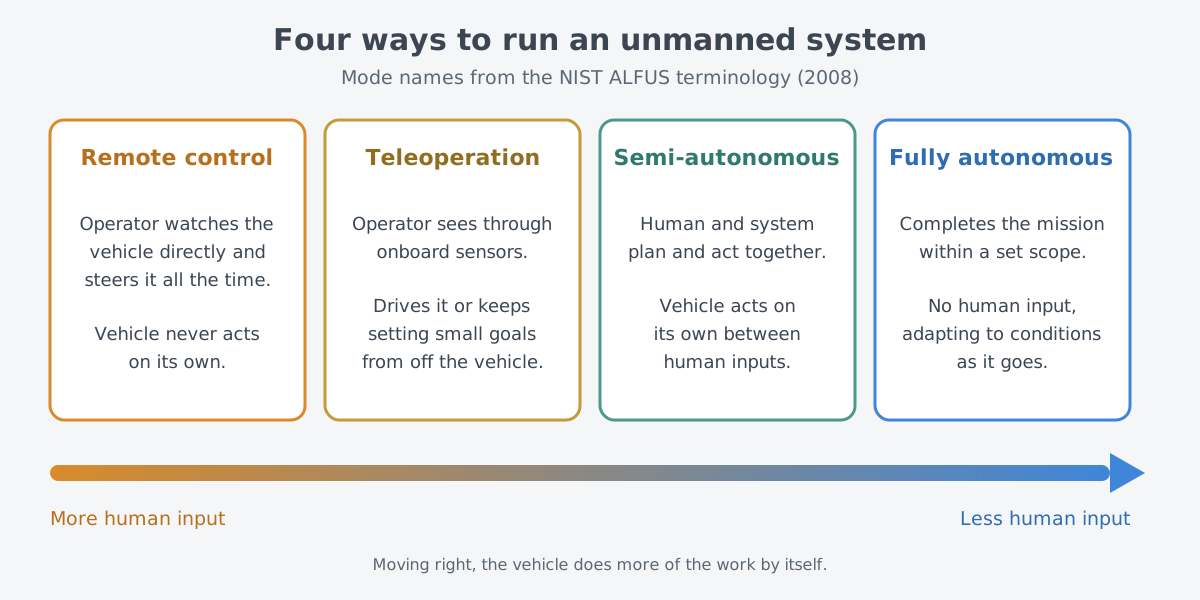
People run unmanned systems in one of four modes: remote control, teleoperation, semi-autonomous, and fully autonomous. Further down the list, people step in less and less.
Remote control is like a toy radio-controlled car. The operator stays off the vehicle, watches it with their own eyes, and steers it all the time, and the vehicle never acts on its own. In teleoperation, the operator relies on what the vehicle's sensors send back, and either works its drive parts directly or keeps giving it small goals.
In the semi-autonomous mode, people and the system plan and carry out the mission together. Between human inputs, the vehicle moves on its own. Fully autonomous means the system completes its mission within a set scope without human help, adjusting to conditions and surroundings as it goes.
The toy car only fits remote control. A toy car stays where its driver can see it, but a robot sent into danger may have to go where no one can watch it directly. Whether the vehicle's sensors stand in for the operator's eyes is what separates teleoperation from remote control.
The U.S. Department of Defense (DoD) uses similar words. DoD Directive 3000.09 has been in effect since January 25, 2023. It defines a remotely operated platform as one that an operator actively steers without being on board. The platform may work in the air, on land, on or under the water, or in space.
Bomb disposal: robots that buy distance
One job UGVs take on is explosive ordnance disposal (EOD). What the robot buys here is distance. A safe standoff distance stays between the Soldier and an object that might be dangerous, and the robot does the close-up work.
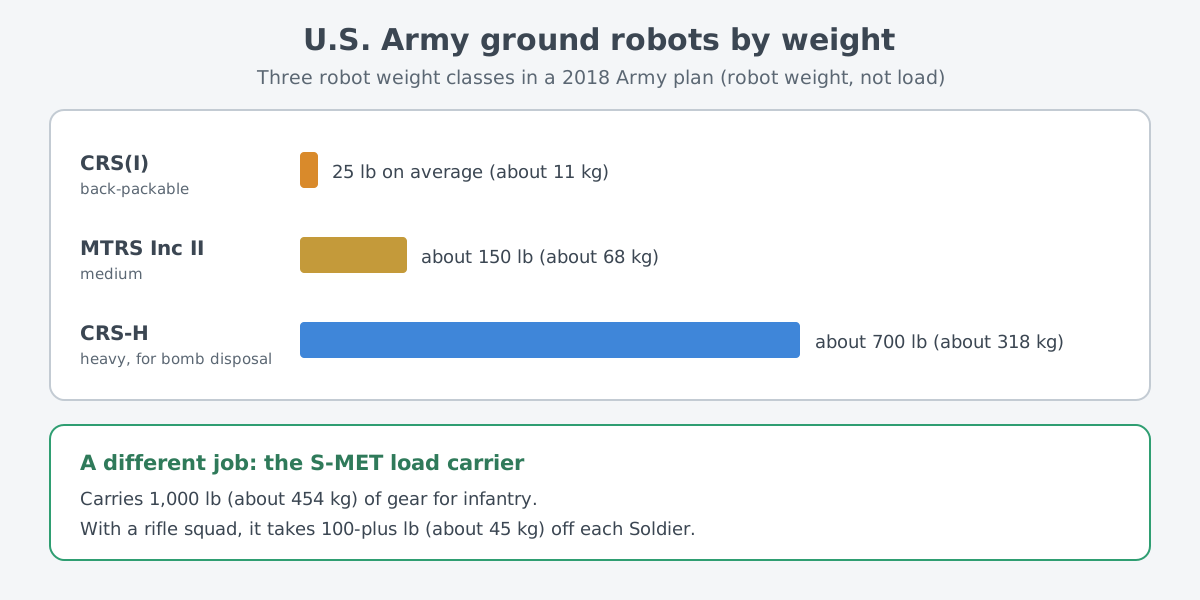
In 2018 the U.S. Army was sorting its ground robots into three programs by weight. The smallest, CRS(I), weighs 25 lb (about 11 kg) on average, and a Soldier carries it on their back and runs it remotely. The medium MTRS Inc II is about 150 lb (about 68 kg), and the largest, CRS-H, is about 700 lb (about 318 kg).
CRS(I) lets Soldiers carry out many kinds of tasks while keeping a safe standoff from threats that could be dangerous. In 2019 the 82nd Airborne Division ran a three-week operational test of it. The missions spanned infantry and engineer work, CBRNE tasks (chemical, biological, radiological, nuclear, and explosive hazards), and EOD. The larger CRS-H aims to protect EOD Soldiers better by adding standoff when they examine hazardous devices, and it comes with cameras, a strong manipulator arm, and a control unit.
Splitting the robots into three programs also helped tidy things up. The Army wanted to retire roughly 7,000 different systems bought in a hurry for recent conflicts and use a common chassis within each weight class.
A standard called the Interoperability Profile (IOP) sets how robots, controllers, and payloads work together. Just as you can add a new app without buying a new phone, a payload can change with technology without replacing the whole vehicle.
Robots that carry the load
Infantry on foot haul water, spare ammunition, and more gear on their own backs. All of that weight becomes a physical burden. The Army's Small Multipurpose Equipment Transport (S-MET) program aims to hand that load to a robot, and these robots got the nickname "mules."
The 2019 S-MET can run with no one aboard or with a driver. It carries 1,000 lb (about 454 kg), and when it supports a rifle squad it takes 100-plus lb (about 45 kg) off each Soldier. The first contract was for 624 of them.
The first S-MET is a radio-controlled platform on eight wheels. It was built to carry payload, make electricity for the unit's electronic equipment, and move without being tied to a road. The goal is to cut the fatigue and injury that heavy loads cause by shifting that burden to the robot.
The second version of S-MET aims to double how much it can carry. If its development testing succeeds, a production contract for up to 2,195 systems is expected in the second half of fiscal year 2027.
Why the ground is hard
Self-driving cars on public roads are a familiar idea by now. For self-driving software, though, on-road and off-road driving are two different problems.
On-road self-driving software works in places that are well structured, highly predictable, and have few obstacles. Off the road, things change. Military off-road autonomy has lagged behind because the terrain is complex and vehicles still have to cross it at useful speeds.
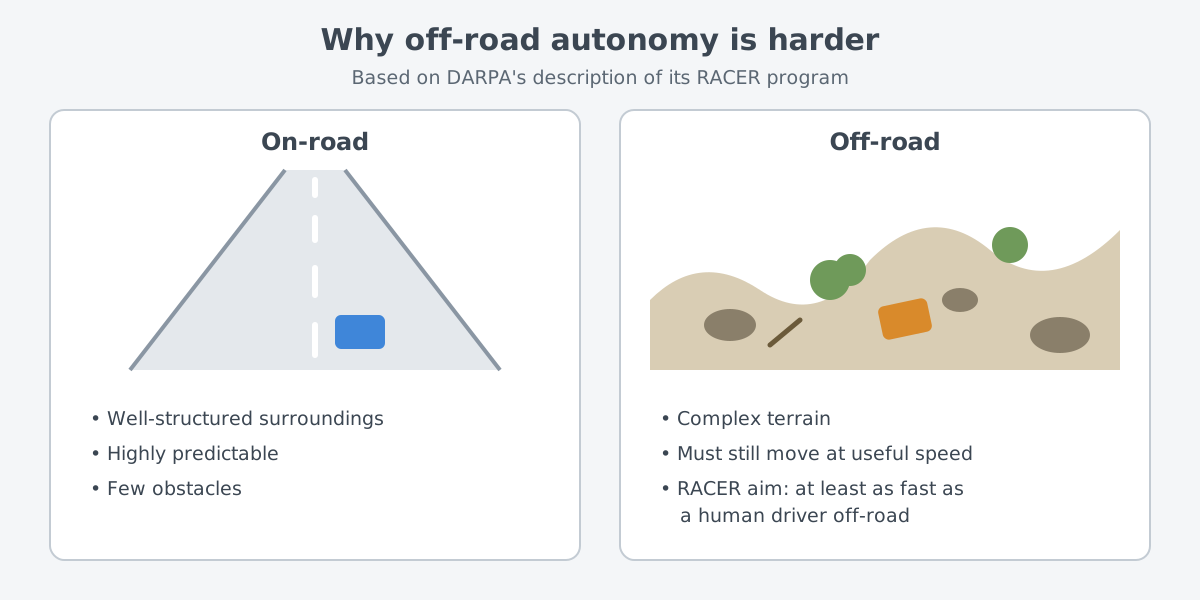
The RACER program of the Defense Advanced Research Projects Agency (DARPA) is research aimed at that gap. It puts its effort into self-driving software, not new vehicles or sensors, and sets a goal of software that drives off-road at least as fast as a human driver. Carnegie Mellon University, NASA's Jet Propulsion Laboratory, and the University of Washington took on the first phase.
Teaching that software takes a great deal of data. Around January 2022, the sensors and electronics on a RACER test vehicle gathered four terabytes of sensor data every hour. DARPA also gathered over 100 terabytes of sensor readings covering more than 500 km of terrain and shared them with the teams.
The Army's Robotic Combat Vehicle (RCV) faces the same wall. As of a January 2025 paper from the Congressional Research Service (CRS), each RCV is meant to be driven from inside a crewed Next Generation Combat Vehicle (NGCV). The Army hopes that better ground navigation and artificial intelligence will one day let one operator handle several RCVs, or let RCVs act more on their own.
The Army first planned light, medium, and heavy versions, but it has since moved to a single vehicle with a common chassis. The production decision is set for fiscal year 2027, with the first unit to be fielded in fiscal year 2028.
The Army assessed off-road autonomy software in June 2024. According to press reports, one Army official said afterward that "industry is nowhere near where people think in terms of off-road autonomy" and that much development work remains. Ground navigation and AI remain open problems for RCV, and they are on the list of questions for Congress to examine.
Human judgment and policy
Once robots move on their own, a question follows. If a system carries weapons, where does human judgment fit? The standard set by DoD Directive 3000.09 is "appropriate levels of human judgment over the use of force." Autonomous and semi-autonomous weapon systems must be designed so commanders and operators can exercise that judgment, and they must pass strict hardware and software checks and realistic testing.
An autonomous weapon system is one that, once switched on, can select and engage targets with no further action by an operator. The directive also has clear limits. It does not cover platforms that carry no weapons, whether someone steers them from afar or rides aboard, and whether they run fully or partly on their own. It also leaves out self-running systems that are not weapons at all.
So when this directive comes up in a talk about UGVs, the first question is whether the robot is armed. For weapon systems, failure gets its own attention. Possible causes include human mistakes, poor interaction between people and machines, malfunctions, weakened communications, and bugs in software code. The aim of cutting failures is to bring the chance and effects of unintended engagements down to acceptable levels.
Where this meets lasers: seeing the ground with lidar
To drive off-road, a vehicle first has to see the ground. RACER test vehicles carry several lidars. A lidar measures distance from the time a laser pulse takes to travel out and back.
The lidar does not work alone. Beside it ride pairs of stereo cameras, color cameras, infrared cameras, radar, event sensors, and motion-tracking inertial sensors. How lasers measure distance, and how lidar gathers distances into a map, continues in Measuring with lasers: range finding and lidar basics.
What to read next
- Measuring with lasers: range finding and lidar basics: the principle behind lidar, one of the sensors unmanned vehicles use to see the ground.
- Manned-unmanned teaming: when a pilot's wingman is a drone: putting crewed and uncrewed machines on one team, and the question of human judgment.
- ISR drones: why endurance matters: what unmanned systems in the air are used for.