A laser and a light bulb both give off light. Yet a bulb lights up the ceiling, the walls and the floor at once, while a laser pointer puts one small dot on the wall.
The difference lies in the light itself. A laser is a device that amplifies light of a specific wavelength and sends it out as a narrow beam in one direction. This article looks at three features of that light, then at what the name "LASER" stands for, the first working laser, and three common misunderstandings.
A light bulb and a laser, side by side
An ordinary light source such as the sun or a light bulb emits waves that are a mixture of visible and invisible light. These waves have varying wavelengths and move in all directions. That is why one bulb can light a whole room.
Laser light has a specific wavelength. The US Food and Drug Administration (FDA) explains in its guidance on laser products that amplifying this wavelength gives a narrow beam that can be emitted in one direction. So a laser pointer lights a dot, not a room.
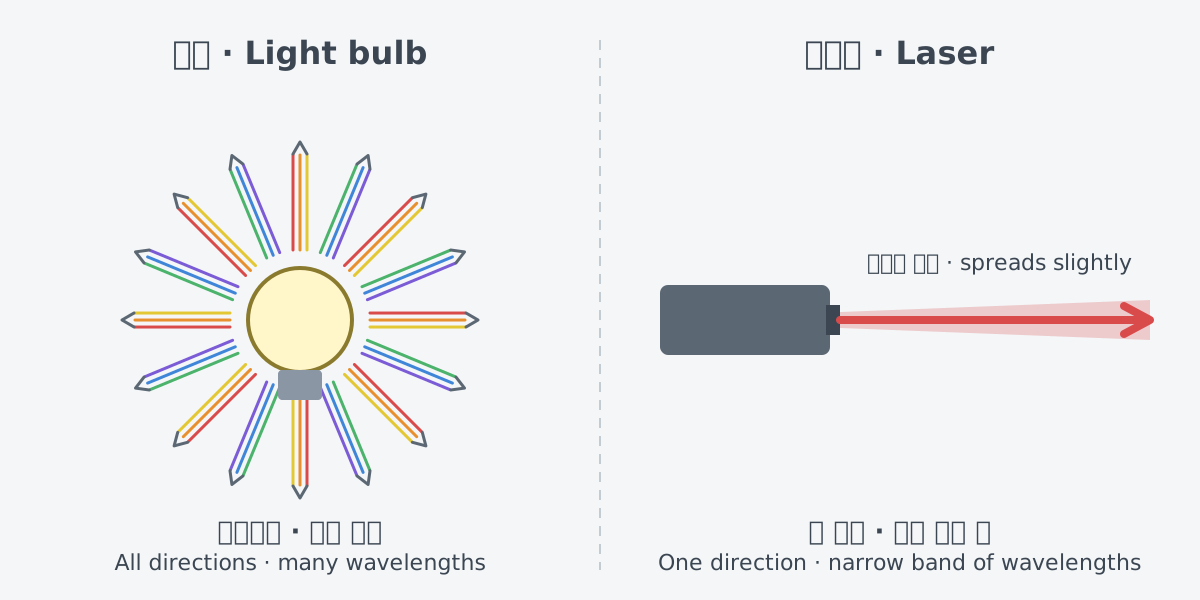
| Item | Light bulb | Laser |
|---|---|---|
| Direction | All directions | One direction, a narrow beam |
| Wavelength (color) | Many wavelengths mixed | A specific wavelength (the spread of wavelengths is very narrow) |
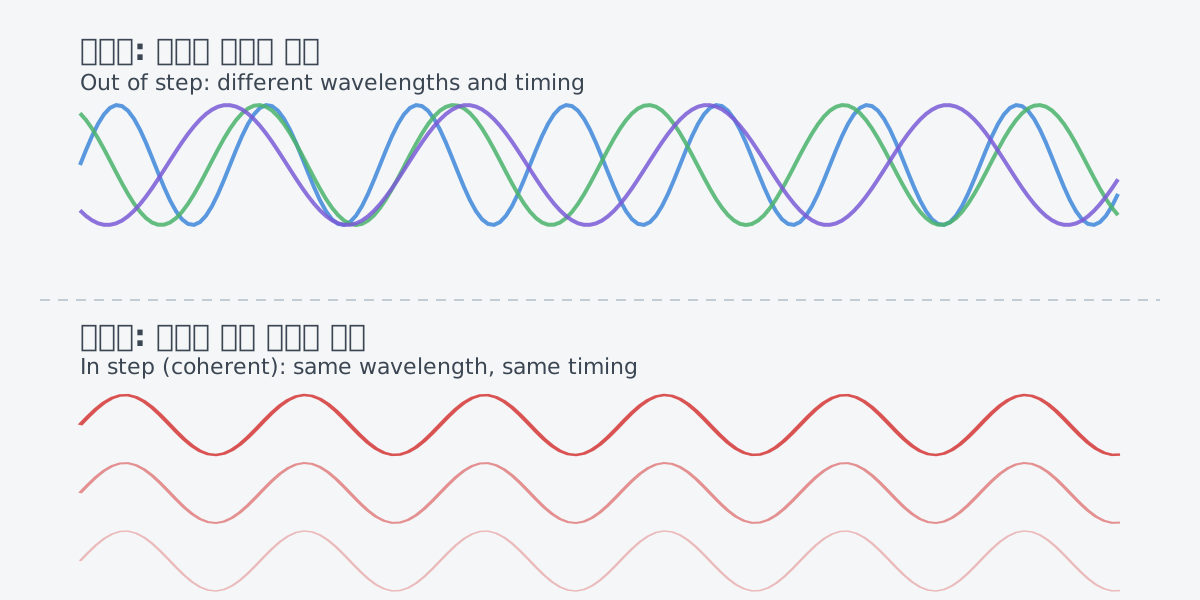
| Timing of the waves | Random | In step |
Three features of laser light: one direction, one color, in step
One direction (directionality). A flashlight beam grows wide after only a few steps. Laser light does not spread like that and travels as a narrow beam. It is not perfectly parallel, though, and it spreads a little as it travels. The first misunderstanding below puts a number on that.
One color (monochromaticity). Light is called monochromatic if its photons have a single frequency, that is, a single color. Bulb light contains many wavelengths, while laser light has a specific wavelength.
A Blu-ray player is a good example. According to the OpenStax University Physics textbook, a Blu-ray player uses blue laser light at 405 nm, and CDs and DVDs use red laser light. Each device uses light of a set color.
In step (coherence). Light is coherent when the photons that make it up are in phase, meaning their waves rise and fall together. In laser light, all the waves share the same frequency and the same phase. Picture a crowd of people walking in step to one beat.
The picture breaks down in one place. Footsteps do not cancel each other when they overlap, but light waves can add up or cancel out. Staying in step is not permanent either. The phase of light can drift without bound, and the result is the linewidth described under the second misunderstanding below.
What the name "LASER" stands for
LASER is an acronym for "Light Amplification by the Stimulated Emission of Radiation."
The words to watch are stimulated emission. A photon of the right energy meets an atom that holds extra energy. An electron in the atom drops to a lower energy level and releases one more photon, and the two photons travel on together. Repeating this makes the light grow.
The first working laser dates from May 16, 1960. Theodore Maiman operated it in Malibu using a synthetic ruby crystal. Maiman worked at Hughes Research Laboratories. In a paper published in the journal Nature that August, he reported stimulated optical emission from ruby at a wavelength of 6943 Å, which is 694.3 nm. The date and place come from the records of HRL Laboratories and DPMA, the German patent and trademark office.
Two years earlier, in 1958, Schawlow and Townes published a proposal in the journal Physical Review to extend maser techniques to infrared and visible light. A maser (microwave amplification by stimulated emission of radiation) works in a similar way to a laser but mainly amplifies microwaves.
One half of the 1964 Nobel Prize in Physics went to Townes and the other half jointly to Basov and Prokhorov. The reason the Nobel Foundation gave was "for fundamental work in the field of quantum electronics, which has led to the construction of oscillators and amplifiers based on the maser-laser principle."
Where lasers are used
The FDA names these products that use lasers:
- CD, DVD and Blu-ray players and recorders
- many barcode readers
- printers, copiers and fax machines
- laser pointers
- fiber-optic systems for telephone, video and computer networks
- material processing equipment for cutting, welding, engraving and marking
- lasers designed for medical procedures
- laser light shows
Lasers are not limited to lab equipment. They are already inside things people use every day. Lasers in defense are covered separately in this site's "Laser weapons" section.
Common misunderstandings
Misunderstanding 1: Laser light does not spread. It does. Any beam of light with a finite diameter spreads because of diffraction, and a laser beam made of rays as parallel as possible is no exception. The smaller the beam and the longer the wavelength, the more it spreads.
The reverse also holds: a wider beam spreads less. That is why the laser light used to measure the distance to the Moon is widened through a telescope before it is sent.
Even so, it spreads a lot on the way. According to NASA, a beam a few meters wide on the ground can spread to more than 2 km by the time it reaches the Moon's surface. NASA talks about the atmosphere just before giving this figure. The laser photons pass twice through Earth's thick atmosphere, which tends to scatter them.
So the 2 km should not be read as the size of diffraction alone. How much a beam spreads is described by its beam divergence.
Misunderstanding 2: A laser has exactly one wavelength. Very nearly, but not exactly. A single frequency is the idealized definition of monochromatic light. The wavelength of a real laser is concentrated very close to one value but can have a width. That width is the linewidth, and light with a very narrow linewidth is said to be highly monochromatic.
Why is the linewidth not zero? A finite linewidth arises when the phase of the light drifts without bound. The RP Photonics Encyclopedia, an optics reference, names two causes: quantum noise from spontaneous emission, and technical noise such as mechanical vibration, temperature changes and pump power fluctuations.
Misunderstanding 3: Lasers are only big, powerful machines. The list above already says otherwise. Laser pointers, barcode readers and disc players are all laser products, and the FDA itself notes that products using lasers come in many sizes, shapes and forms.
What to read next
This site is easiest to follow in the order of the reading path.
- "Light basics: waves, wavelength, frequency and photons": a fresh look at the wavelength and photons mentioned here.
- "The three parts of a laser: gain medium, pump and resonator": the structure that uses stimulated emission to grow light.
- "Why a beam spreads: divergence, focus and aperture": the reason behind misunderstanding 1, in detail.
- "Laser safety: classes and how to read eyewear labels": how to read laser classes and eyewear labels.
If you are curious about laser weapons, start with "What is a laser weapon? Film versus reality".