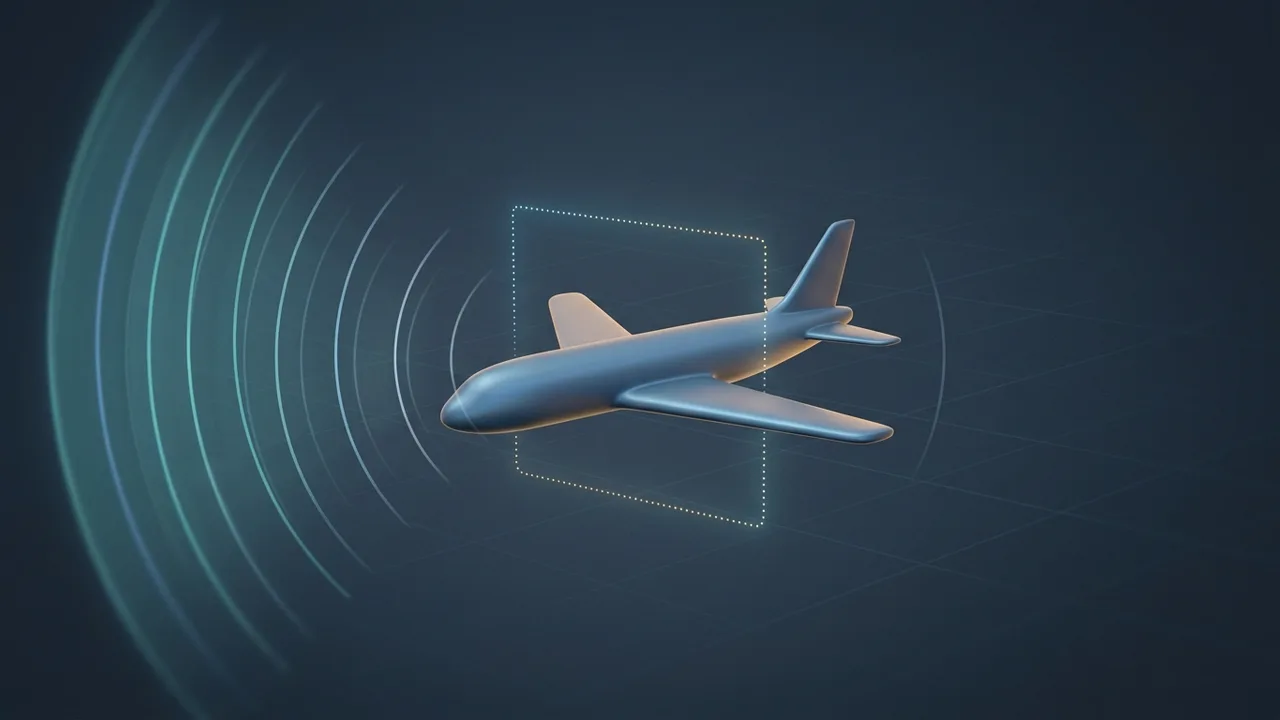
A large blip on a radar screen does not always mean a large object. A small wooden or fiberglass boat may barely show up. In textbook figures, a bicycle has twice the RCS of a person. The "size" a radar sees is not the size you would measure with a ruler but the size of the echo that comes back.
That echo, written as an area, is the radar cross section (RCS). When people say a big aircraft "looks small," they mean this number is small, not that the aircraft has shrunk. This article explains what RCS is and how distance, shape, angle and wavelength (λ) change it, at the level of a textbook.
RCS: the size of an echo, written as an area
A radar sends out radio waves and listens for what comes back. Waves that hit an object scatter in many directions, and only part of them heads back toward the radar. RCS measures the energy a target catches and sends back toward the radar.
The definition takes a small detour. Imagine an area that catches radio waves and sends all that power out again, evenly in every direction. If that imaginary area would give the radar exactly the same echo as the real object, its size is the RCS. This is how a public radar course from MIT Lincoln Laboratory defines it, and the unit is square meters (m²).
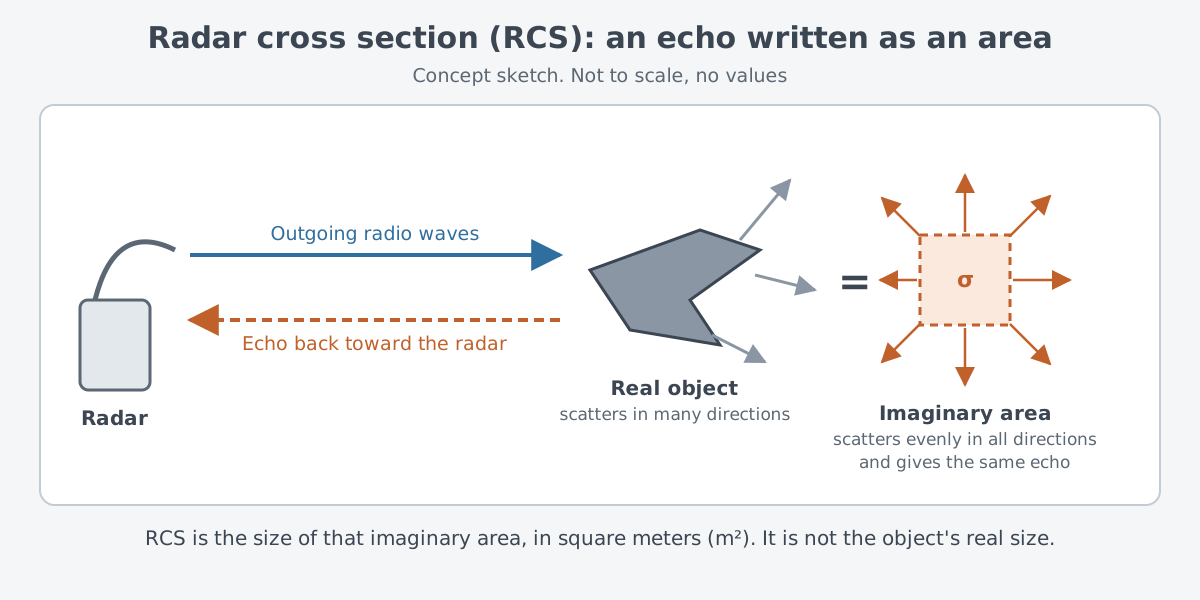
So RCS can differ from an object's surface area or the area of its shadow. A Congressional Research Service (CRS) report describes RCS as "the amount of measurable radar signal reflected back to its source." And one object does not have just one RCS number.
Echoes fade fast with distance
The radar range equation ties four things together. They are the target's properties, including RCS; the radar's own features, such as transmitter power and antenna; the distance between radar and target; and the medium, such as the air. RCS is only one of the four.
Distance matters a great deal. The radio waves spread out on the way to the object, and the echo spreads out again on the way back. The course notes show the echo weakening with the square of the distance on its return trip. Add the outbound trip and the echo fades with the fourth power of distance, so doubling the distance leaves one-sixteenth of the echo.
This is why the same object does not always look the same on radar. The UK Maritime and Coastguard Agency (MCA) makes the same point in its guidance for small boats. Detection depends mainly on the radar's quality and mounting height, and on the target's distance, size, shape and aspect. Waves and the atmosphere also play a part.
Shape and angle: a mirror versus a sheet of paper
The law of reflection works the same way for light and radio waves. A wave leaves a surface at the same angle at which it arrived, with both angles measured from a line perpendicular to the surface. This one law explains most of why shape and angle matter.
Paper is visible from every side. Its surface is rough, so light hits each spot at a different angle and scatters everywhere. A mirror is smooth and sends light off in one set direction, and only someone standing in that direction sees the reflection.
A radar is like an observer whose flashlight and eyes sit in the same spot. A mirror-like surface returns a strong echo only when it faces the radar squarely; from other directions the reflection does not come back to the radar.
Real radio waves differ from light in some ways. Whether a surface counts as smooth or rough depends on the wavelength. A surface that is rough for light can act smooth for radio waves, whose wavelength is much longer. Radio waves also scatter from the edges of an object, not only from its faces.
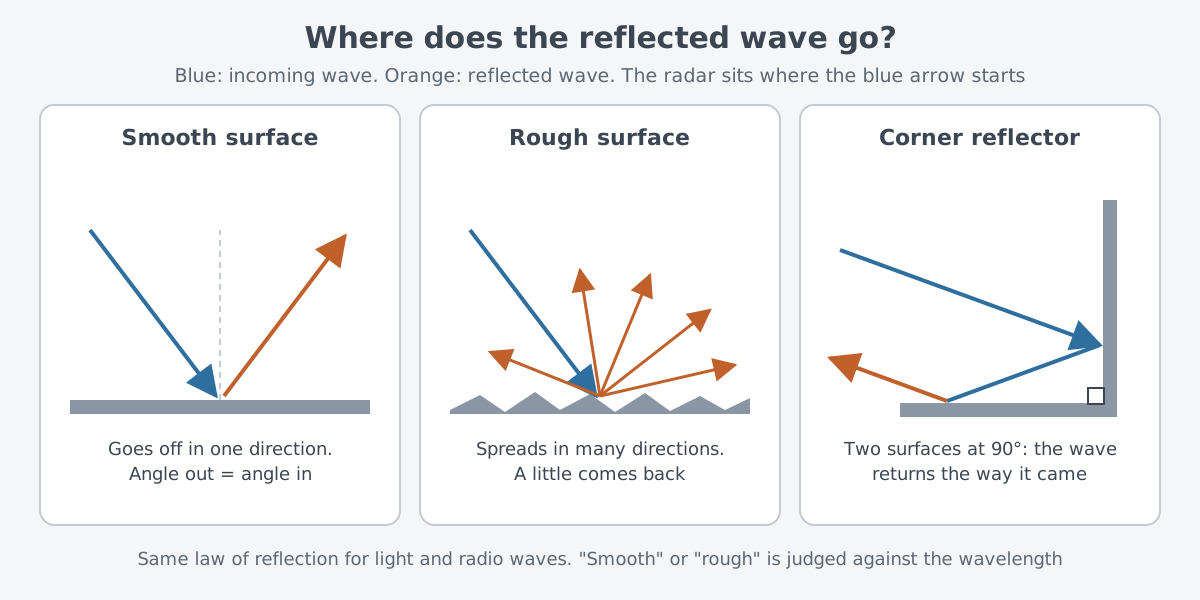
A corner where two surfaces meet at a right angle is special. Light that strikes it goes back exactly parallel to the way it came, whatever the angle of arrival. A corner reflector with three surfaces at right angles does the same in three dimensions. That is why corner reflectors are a common type of radar reflector.
RCS depends on the target's shape and material, and on the radar's frequency and polarization. So the same object has different RCS values at different angles and frequencies.
Wavelength and size
A sphere is a good way to get a feel for RCS. Its RCS falls into three ranges depending on how the wavelength compares with the sphere's size. When the wavelength is much longer than the sphere, it is the Rayleigh range, and RCS becomes very small, falling with the fourth power of the wavelength.
When the wavelength is close to the sphere's size, it is the resonance range. The wave bouncing straight back interferes with a wave that creeps around the sphere, and the value rises and falls.
When the wavelength is much shorter than the sphere, it is the optical range. Here the sphere's RCS is πa², the same as the cross-sectional area of a sphere of radius a. That makes it a handy case for picturing RCS as an area, but the match holds only for a sphere. Objects with corners or flat faces can show values far from their cross-sectional area, depending on direction.
Typical values for everyday objects show how wide the spread is. In the MIT course table, a bird is 0.001–0.01 m², a person 1 m², a car or small truck 100–200 m², and a 5,000-ton ship (L band) 10,000 m². They only fit in one picture on a logarithmic scale, where each step is ten times the last.
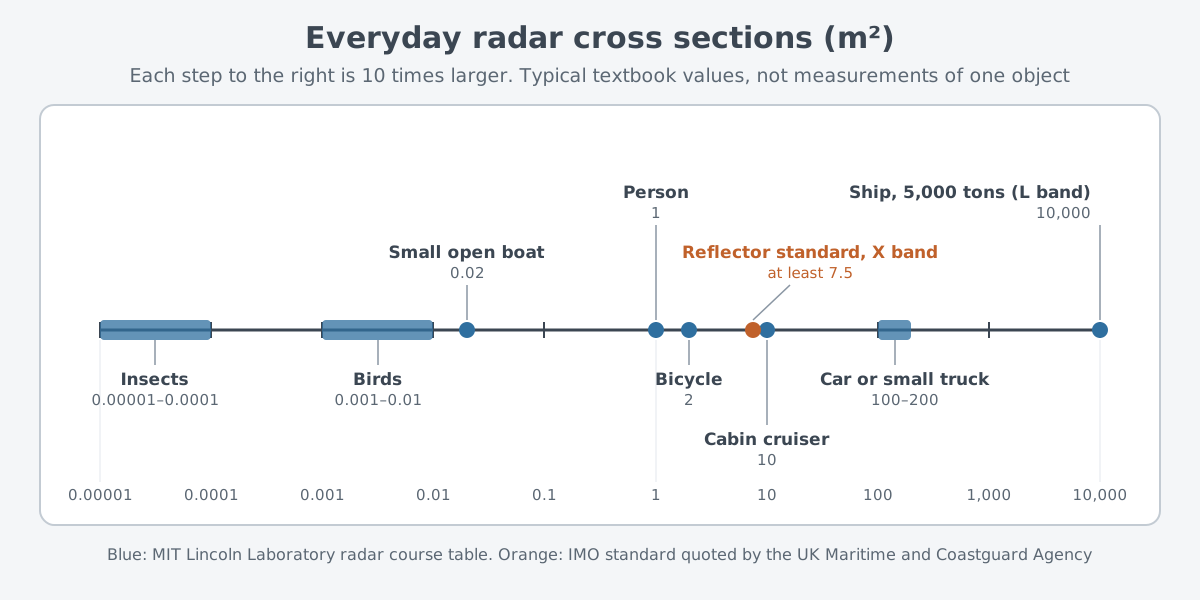
A small value does not mean a radar cannot see something. According to the National Weather Service (NWS), weather radar gets echoes from more than rain and snow. Birds, insects, shifts in wind and even mountainsides send waves back too. The table values are typical figures, and the same object gives different values at other angles and frequencies.
Making things look bigger on purpose: radar reflectors on small boats
Some people want a larger RCS. In most conditions, small wooden or fiberglass boats do not reflect radar waves strongly. To avoid collisions they need to show up on the radar of larger ships, so they carry radar reflectors, usually mounted high. The corner reflector described above is the kind used here.
International rules cover this. The International Convention for the Safety of Life at Sea (SOLAS) addresses it in Chapter V, Regulation 19. Ships under 150 gross tonnage should, where they can, carry a reflector or some other way to be seen by radars at both 9 GHz and 3 GHz. The UK MCA points to the loss of the yacht "Ouzo" and her crew as a deadly example of what poor radar visibility can lead to.
The International Maritime Organization (IMO) standard quoted by the MCA asks for RCS in numbers. Mounted at least 4 m above sea level, a reflector should reach at least 7.5 m² in the X band and 0.5 m² in the S band. It should keep that level over at least 280° of azimuth. The fact that one reflector has a different target for each band is another sign that RCS depends on frequency.
Meeting this standard makes a reflector large, and it may not suit boats under 15 m long. There are also radar target enhancers (RTE), active devices with their own power supply. An RTE receives a radar pulse, amplifies it and sends it back out, and it gives a larger equivalent RCS from a smaller body. Here too, RCS is about the returning echo, not physical size.
How RCS is found
There are three main ways to find RCS. You can measure the real object at full scale, measure a scaled-down model, or predict it by calculation. In the course notes, the graph comparing measurement and prediction has the target's aspect angle along the bottom. The result is not one number but a value for each direction.
For full-scale measurement, the object sits on a support. A foam column works well because its electrical properties are close to those of empty space, so the support does not add to the echo. For a scale model, the size is reduced by some factor and the measuring frequency is raised by the same factor. This keeps the ratio of wavelength to size the same as for the real object.
The fact that light and radio waves follow the same law of reflection matters on the laser side too. On the Moon, Apollo astronauts left a corner reflector behind. Laser signals sent from Earth bounce off it to measure the Moon's distance, which grows by a few centimeters each year. How light is used to measure distance continues in Measuring with lasers: range finding and lidar basics.
What to read next
- Radar: measuring distance and motion with radio waves: how the return time of an echo gives distance.
- Stealth aircraft: truly invisible?: what a small RCS actually means, continued.
- Radar-absorbing materials and structures: how materials affect RCS.
- Light basics: waves, wavelength, frequency and photons: a refresher on wavelength and frequency.