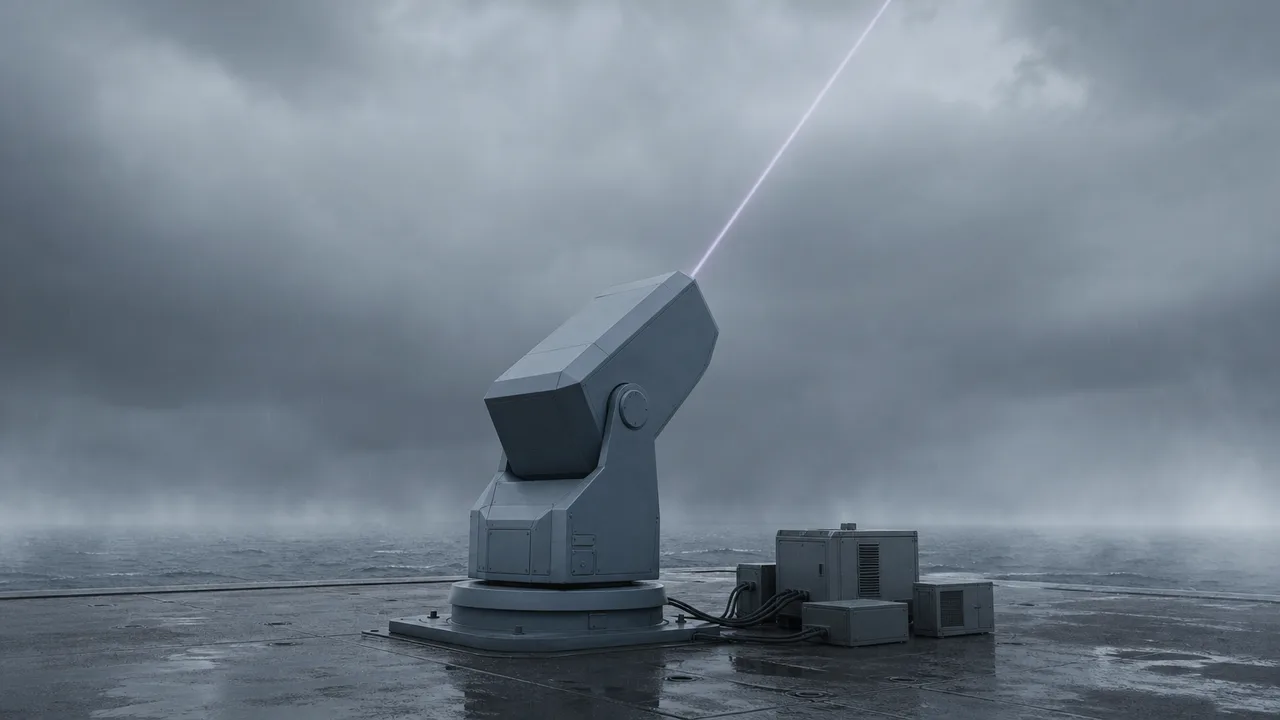
News stories about laser weapons repeat the same phrases: a few dollars a shot, no running out of ammunition, a hit at the speed of light. None of these is false. Yet the official sources behind them usually add conditions: as long as there is power, as long as there is no rain or fog, one target at a time.
This article takes the strengths and limits from two public reports by the Congressional Research Service (CRS) and gives them equal weight in one table. The first, R46925 (updated July 11, 2024), covers directed energy weapons across the U.S. Department of Defense. The second, R44175 (updated in 2026), covers U.S. Navy shipboard lasers. Below, the first is the Defense Department report and the second is the shipboard laser report.
A directed energy weapon (DEW) uses concentrated electromagnetic energy, rather than kinetic energy, against an opponent. A kinetic weapon, such as a missile or a shell, destroys a target by hitting it. The Defense Department report places both high-energy laser (HEL) weapons and high-power microwave (HPM) weapons in this group. This article is about HELs.
One point is worth keeping in mind from the start. Strengths and limits are specific to each system, so they may not apply equally to every system.
Strengths listed in official reports
Three strengths come first. Compared with traditional munitions, these weapons may need less logistical support, cost less per shot and have deeper magazines. Only the magazine point carries a condition: "assuming access to a sufficient power supply."
A deep magazine means the number of shots is not tied to the number of rounds on board. Take a shipboard solid-state laser. It draws power from the ship's overall electrical supply and can fire again and again as long as the laser keeps working and the ship has fuel to make electricity.
Missiles and guns are different. A surface ship can shoot down only a certain number of targets before its air-defense missiles and close-in gun ammunition run out. The shipboard laser report counts this as a current weakness.
The appendix of the Defense Department report has four more strengths.
- Fast engagement. Light reaches the target almost instantly. There is no need to calculate an intercept course, as an interceptor missile must. Still, the beam has to stay on one spot to disable the target, and that takes "within seconds, depending on the laser power." Turning to the next target also takes several seconds.
- Countering sharply maneuvering missiles. The beam can follow and stay on missiles that turn hard enough to strain an interceptor.
- Precision. The area the beam lights up is several millimeters to several inches across. It affects what it hits and generally does not directly affect other objects nearby.
- Graduated responses. Besides destroying targets, the laser can detect and watch them or jam electro-optic (EO) sensors, which see with light much as a camera does, in a reversible way. The response can move in steps, from a warning to disabling damage.
If light arrives almost instantly, why does it take seconds? Why a laser weapon does not finish "the instant it fires" explains the reason.
Limits listed in official reports
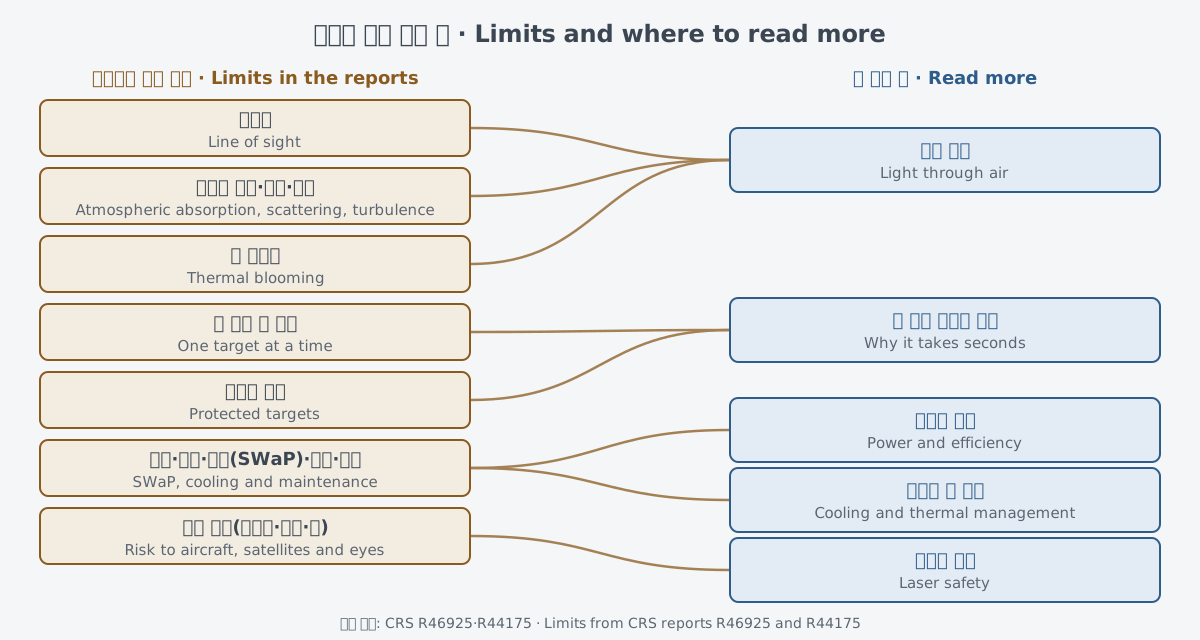
The warning appears as early as the summary of the Defense Department report: these weapons may face limits that kinetic weapons do not. The limits in the two reports fall into seven groups.
- Line of sight. Laser light travels through the air on an almost straight path. So the weapon can only engage targets in its line of sight, the range it can see in a straight, clear line. It cannot reach targets over the horizon or behind something in the way.
- Light through the air. Water vapor, along with sand, dust, salt particles and smoke, causes absorption and scattering of the light. Atmospheric turbulence blurs the focus of the beam. Air over the sea holds a lot of water vapor, so absorption by water vapor is a particular concern for shipboard lasers.
- Thermal blooming. If a laser keeps firing in the same direction for some time, it heats the air along its path. The heated air then blurs the beam. In general, this becomes more of a concern as beam power goes up.
- One target at a time. The laser needs several seconds per target and several more to turn to the next one. So there is a ceiling on how many targets it can disable in a given time. Fitting more than one laser, as space and energy allow, can ease this limit.
- Protected targets. Lasers whose power is measured in kilowatts (kW) rather than megawatts (MW) can be less effective against targets with protective treatment.
- Size, weight and power (SWaP), cooling and maintenance. SWaP is shorthand for how much room a system takes, how heavy it is and how much power it uses. Two questions of technical maturity go together in the Defense Department report: raising beam quality and meeting SWaP and cooling needs so the weapon fits on current platforms. Some systems are small enough for a military vehicle, but many need larger or fixed platforms. Maintenance may also be harder than for traditional weapons. In a passage that cites the Government Accountability Office (GAO), the internal parts are sensitive and repairs typically need a special clean room.
- Risk to others. Light from an upward-pointing laser that misses its target keeps going up in a straight line, so it could harm aircraft or satellites. The light from the Navy's solid-state lasers can permanently damage human eyes, including blinding. Blinding can happen at ranges much greater than the ranges at which the laser damages its target. Laser safety: classes and how to read eyewear labels covers the standards that protect eyes. The international rule that bans laser weapons designed to blind is covered in Eye safety and international rules: the protocol on blinding laser weapons.
There are ways to ease some of these limits. At certain wavelengths, absorption by water vapor is much lower, and a laser can be designed to emit at or near them. Absorption generally grows with distance, so it is less of a problem at short range. Adaptive optics (AO) makes rapid, fine corrections to the beam in response to the turbulence it measures, and this can offset the turbulence.
Some limits remain. In both reports, lasers might not work well, or at all, in rain or fog, so they are not an all-weather solution. For the link between wavelength and the air, Why wavelength matters: visible and invisible light gives the background.
Strengths and limits in one table
Here the two lists sit side by side. There are seven strengths and seven limits, and the last column gives the report number and page. R46925 is the Defense Department report, and R44175 is the shipboard laser report.
| Type | Item | What the report says (shortened) | Where |
|---|---|---|---|
| Strength | Deep magazine | Fires again and again while power and fuel last | R46925 summary, R44175 p. 3 |
| Strength | Low cost per shot | Cost per shot equals the cost of the power for that shot | R46925 p. 1, R44175 p. 3 |
| Strength | Lower logistics needs | May need less logistical support than traditional munitions | R46925 summary |
| Strength | Fast engagement | Light arrives almost instantly; disabling takes seconds, depending on power | R46925 p. 20 |
| Strength | Maneuvering missiles | Keeps the beam on missiles that turn hard | R46925 p. 20 |
| Strength | Precision | Affects what it hits; generally no direct effect on objects nearby | R46925 p. 20 |
| Strength | Graduated responses | From watching and jamming sensors to disabling damage | R46925 p. 20 |
| Limit | Line of sight | Cannot reach targets over the horizon or behind obstacles | R46925 p. 20 |
| Limit | Atmosphere | Absorption, scattering, turbulence; rain and fog | R46925 summary, pp. 20–21 |
| Limit | Thermal blooming | Heated air blurs the beam, more so at higher power | R46925 p. 21 |
| Limit | One target at a time | A ceiling on targets disabled per unit of time | R46925 p. 21 |
| Limit | Protected targets | kW-class lasers can be less effective | R46925 p. 21 |
| Limit | SWaP, cooling, maintenance | Fitting on platforms; clean-room repairs | R46925 p. 17 |
| Limit | Risk to others | Aircraft, satellites, human eyes | R44175 p. 27 |
Compare the top half with the bottom half and some rows read like pairs. Fast, precise engagement and the limits of line of sight and weather can both be seen as coming from firing light. A deep magazine and the burden of power and cooling look like two sides of a weapon that uses electricity instead of rounds. Reading the strengths alone makes these pairs easy to miss.
What "low cost per shot" means
The explanation is short. In the Defense Department report, many current U.S. laser programs use solid-state lasers that run on electrical power. So the cost per shot equals the cost of the electrical power needed to fire it.
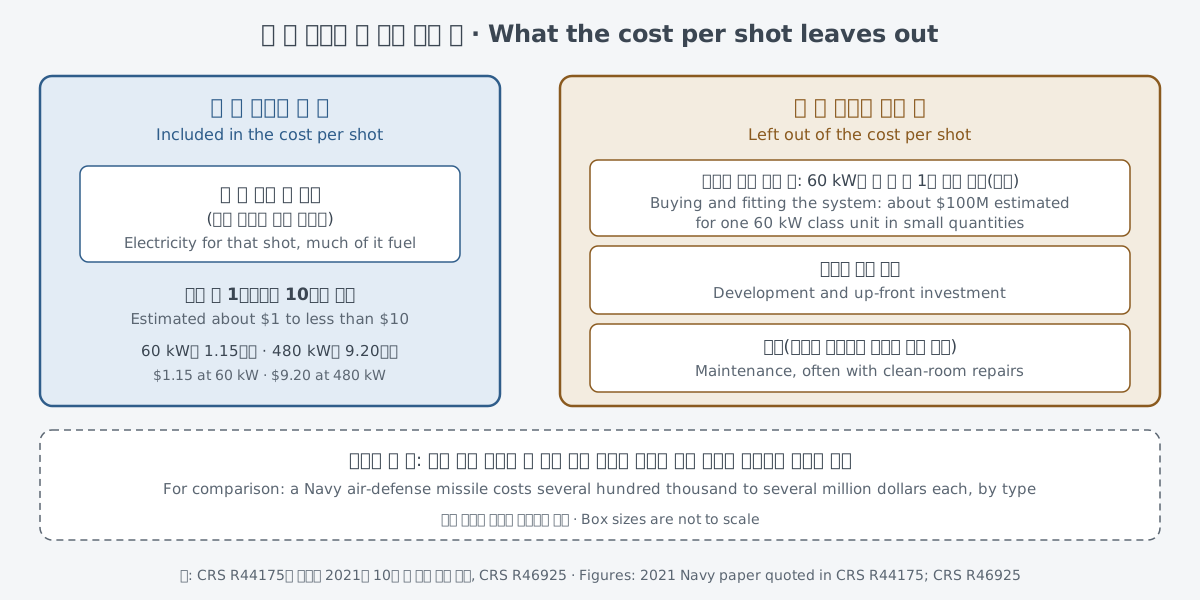
In numbers, a shipboard solid-state laser is estimated to cost about $1 to less than $10 per shot, depending on beam power. Much of that is the cost of the fuel used to make the electricity. The estimate comes from a Navy information paper from October 2021.
A longer passage from the same Navy paper, quoted in the shipboard laser report, gives estimates by power level: $1.15 for the 60 kW class and $9.20 for 480 kW. Page 3 of the same report also gives the procurement cost of a Navy air-defense missile. Depending on the type, it ranges from several hundred thousand dollars to several million dollars per missile.
The gap looks huge, but the two numbers are different in kind: the missile figure is a price to buy, and the laser figure is a cost to fire. The laser figure is a "marginal cost." That is the extra cost of one more shot from a laser that has already been bought and installed. The Navy paper also frames it as the cost of engagements "after procurement."
The price of the system itself is separate. The Navy estimates that one 60 kW class laser will cost about $100 million per unit in limited quantities. With no earlier programs of record to compare against, the cost analysis has limited accuracy. For procurement alone, kinetic and non-kinetic weapon systems cost about the same as laser systems, from $70 million to $150 million.
The money needed at the start differs too. In the Defense Department report, fielding a successful system may take greater up-front investment than traditional kinetic weapons do. That leaves a question for Congress: how do total lifecycle costs compare?
So "a few dollars a shot" is not wrong. It is half the story. Each shot costs very little, but the money it takes to be able to fire that shot is not in the number. How to read laser weapon news: "kW-class", "range" and "cost per shot" lists what to ask when such a number shows up in the news.
Relation to existing weapons: a complement, not a replacement
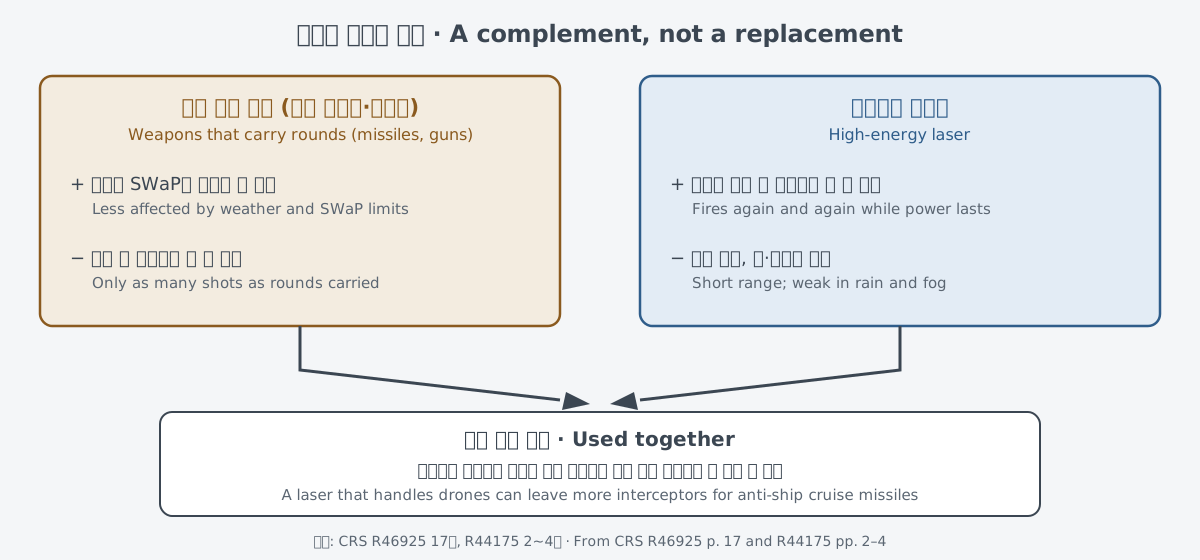
The Navy view fits in one sentence of the Navy paper quoted in the shipboard laser report. The Navy expects laser weapon systems to augment other weapons, sensors and the overall combat system. The laser adds to the defense in ways tangled up with all of these. So, in the same paper's judgment, it is too early to put a meaningful value on the laser's own share of the defense.
There is an example of this. A laser strong enough for small boats and drones, but not for anti-ship cruise missiles, can still help. If the laser handles drones, the ship uses fewer of its air-defense missiles on drones and keeps more for anti-ship cruise missiles. The laser does not have to replace a missile to improve the defense as a whole.
The other side matters too. Atmospheric conditions and SWaP and cooling needs can limit the range and beam quality of directed energy weapons, while traditional weapons are less affected by these factors. Shipboard high-energy solid-state lasers are generally short-range defensive weapons, for targets at about one mile to perhaps eventually a few miles. So existing weapons still have a role in rain and at longer range.
One kind of weapon is tied to the number of rounds on board. The other fires while power lasts but is tied to weather and distance. Their limits sit in different places, so keeping both closes more gaps.
The question the Defense Department report leaves for Congress is what the right balance is between directed energy weapons and traditional munitions within the military's mix of capabilities. Lasers, interceptor missiles and guns: how they share the work sets the three side by side by cost, magazine, weather and platform.
What to read next
- A history of laser weapons: from chemical to electric lasers: follows the path that led to today's electrically powered laser weapons.
- Laser weapon programs that have been made public: looks at officially announced cases in light of these strengths and limits.
- A laser weapon is more than a laser: the system at a glance: shows where in the system the SWaP and cooling burdens from this article come from.
- How to read laser weapon news: "kW-class", "range" and "cost per shot": what to ask when a news story mentions a cost per shot.
- "Light through air: absorption, scattering, turbulence, thermal blooming": looks at each way that weather and air weaken a beam.