In the news, South Korean weapons tend to appear one name at a time. One day it is the K9 self-propelled howitzer, the next day Cheongung, then the Cheongwang laser weapon. Followed name by name, they look like unrelated machines.
In fact there are lines between them. The same organizations handle them, they pass through the same steps, and in some cases technology from one system moved into another. This article draws those lines using only material published by the Defense Acquisition Program Administration and the Agency for Defense Development. It looks at who does what, the steps a weapon goes through, which systems sit in which field, and where they connect.
The organizations behind one weapon
One agency handles buying and developing weapons: the Defense Acquisition Program Administration (DAPA). It opened on January 1, 2006. It merged acquisition offices and functions from eight organizations, including the Ministry of National Defense, the Joint Chiefs of Staff, the armed services and the procurement headquarters.
DAPA has three main jobs. It runs defense capability improvement programs, which develop or buy the weapon systems the military needs. It also procures military supplies and supports the defense industry. The Defense Acquisition Program Act was passed when DAPA opened, so acquisition began to run under a law, and major program decisions go through a committee that includes civilian experts.
At the center of research and development is the Agency for Defense Development (ADD). Under Article 1 of the act that set it up, its mission is technical investigation, research, development and testing of the weapons and defense technology the country needs. The armed services and the Joint Chiefs of Staff, who use the weapons, and the companies that build prototypes and production units complete the picture.
From requirement to fielding
A weapon starts with a statement that a certain capability is needed. This is called a requirement. An armed service raises it, and the Joint Chiefs of Staff decide it.
Once a requirement is set, DAPA forms an integrated project team (IPT). The team first runs a pre-study, then sets a program strategy, and from there the path splits into development or purchase.
On the development side, a system goes through exploratory development and system development. Exploratory development proves key technologies through simulation or prototype tests. System development then uses design, prototypes and test and evaluation to produce a weapon system that can be mass-produced. After that come production and fielding, operation and support, and finally disposal.
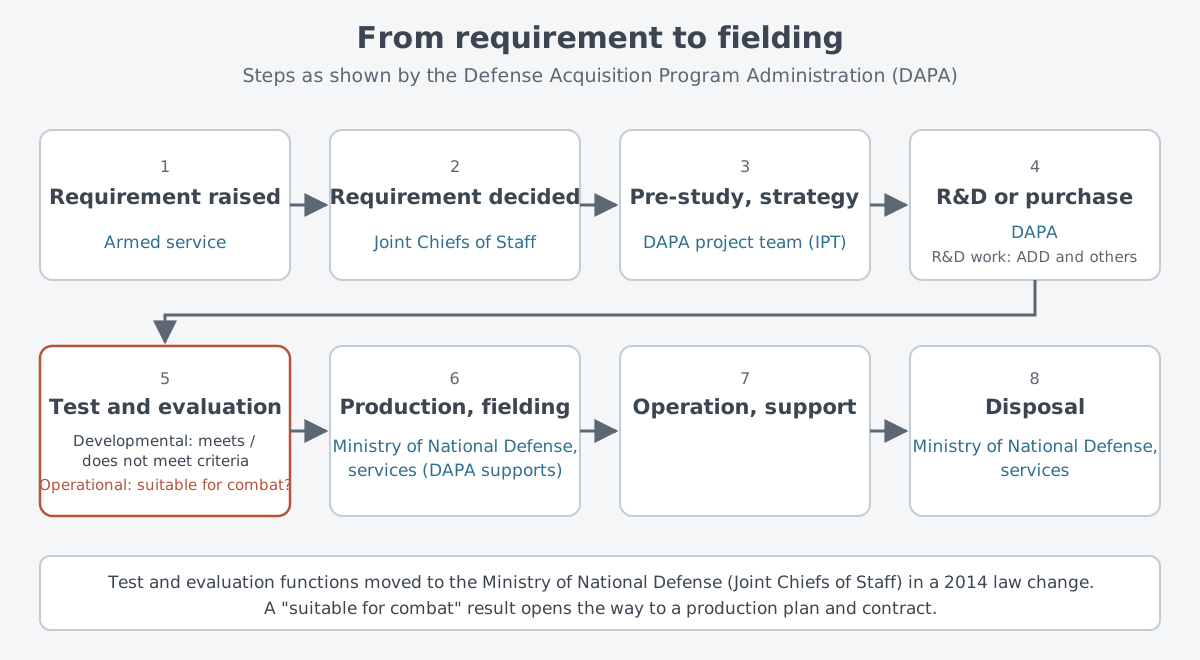
Test and evaluation has two kinds of result. Developmental testing ends with "meets criteria" or "does not meet criteria." Operational testing ends with "suitable for combat," "conditionally suitable for combat" or "unsuitable for combat." DAPA's program management rules say a production plan is confirmed and a contract signed for systems judged suitable for combat or similar.
So when a news story says a weapon was found "suitable for combat," it has cleared the step before production. How the phrase is used in laser weapon news is covered in How to read laser weapon news.
Fielding is not the end either. The Ministry of National Defense's force development directive has each service run a fielding evaluation on weapon systems within one year of deployment. It checks how far the operating concept and required performance were met, and whether support elements such as doctrine, organization, training and maintenance are in place. So when a story says a weapon was "fielded," read it as more than delivery: the weapon has settled in as a capability units can use.
One thing changed along the way. A 2014 amendment to the Defense Acquisition Program Act moved test and evaluation functions from DAPA to the Ministry of National Defense and its Joint Chiefs of Staff. The same program is handled by different organizations at different steps.
A map by field
Now place the weapons by field. The ADD website groups its research and development into ten fields. They are missiles, missile defense, ground systems, underwater and naval systems, aircraft and UAVs, surveillance, command and control and information warfare, defense space technology, core technology and future technology.
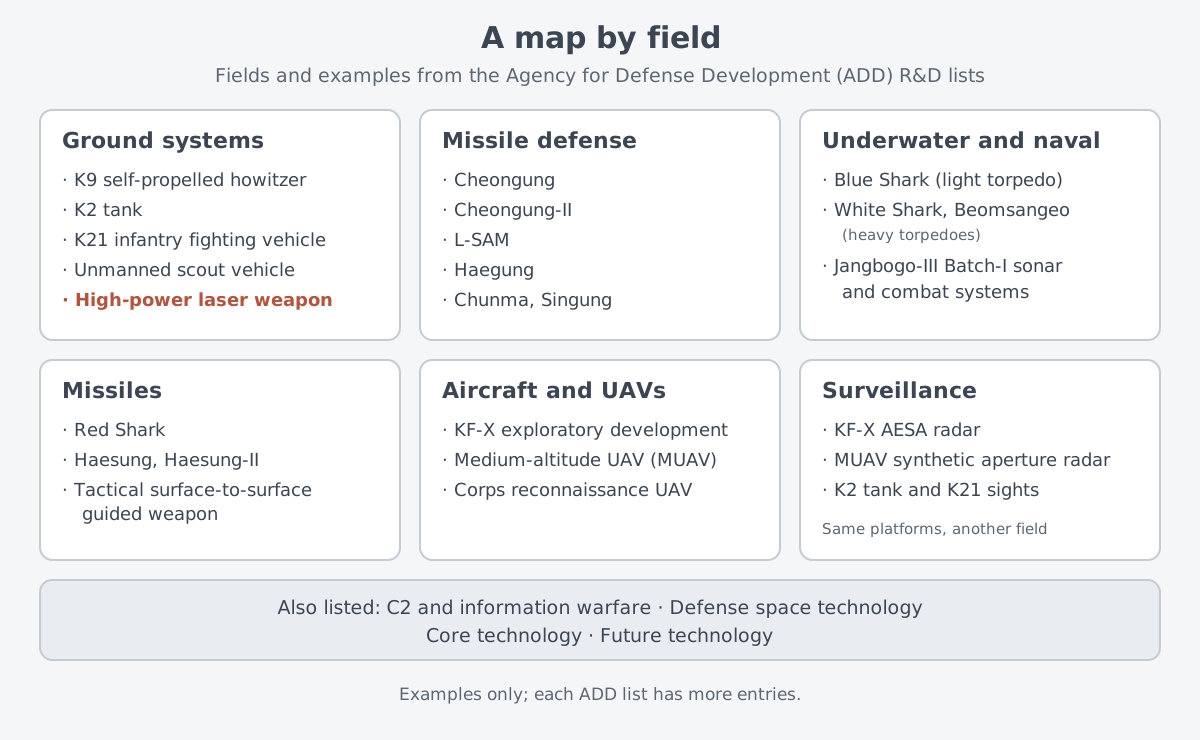
The ground systems list includes the K9 self-propelled howitzer, the K2 tank and the K21 infantry fighting vehicle. The first entry under missile defense is Cheongung. Cheongung was the first medium-range surface-to-air guided weapon developed in Korea, built to replace the Hawk that the air force had used since the 1960s. ADD finished developing it in 2011, and it has been deployed since 2015.
On the naval side are the Blue Shark lightweight torpedo and the White Shark and Beomsangeo heavyweight torpedoes. The sonar and combat systems of the Jangbogo-III Batch-I submarine are on the same list. These boats carry both systems developed in Korea. The submarine as a whole has a localization rate of 76%, about twice or more that of the Jangbogo-I and II classes.
Jang Yeongsil, the first boat of Batch-II, carries lithium batteries and is due to be delivered to the navy at the end of 2027. What drives a submarine is covered in submarine propulsion.
In the air there is the medium-altitude reconnaissance UAV (MUAV). DAPA describes it as Korea's first strategic-level UAV, developed and produced by domestic companies under DAPA and ADD. The MUAV's localization rate is 90%, and it is to be handed to the air force in stages from 2027.
One system can also appear on more than one list. The MUAV is on both the aircraft and UAV list and the surveillance list, and the sights for the K2 tank and the K21 have their own entries under surveillance. It looks like a transfer station on a subway map, where several lines meet. The difference is that a station already exists and the lines share it, while a weapon system only comes into being by combining results from several technical fields.
Technology that links one system to the next
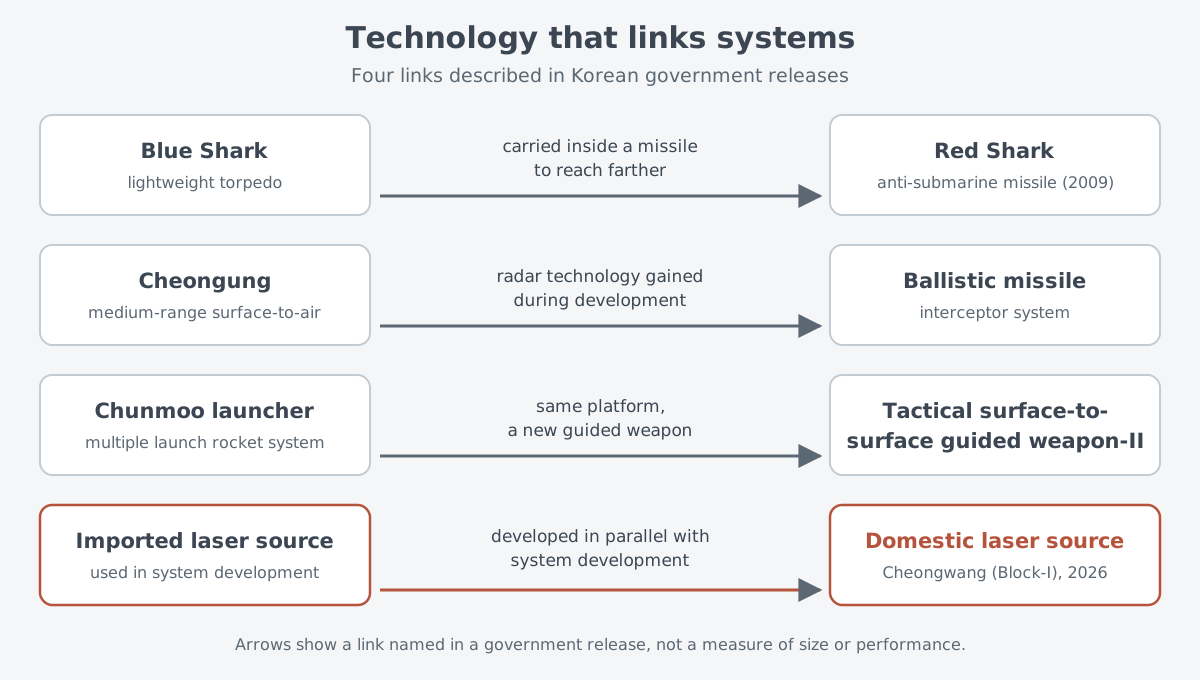
The lines on the map are clearest where technology from one system moved into another. Government releases describe four such cases.
The first is the Red Shark. In June 2009, ADD announced it had finished developing the Red Shark anti-submarine guided weapon. It carries the Blue Shark lightweight torpedo inside a missile to the waters where an enemy submarine is. An existing torpedo became the cargo of a new weapon.
The second is Cheongung. Its delivery to the military was completed in 2020. At that point the then head of DAPA said that radar technology gained while developing Cheongung had led to a successful ballistic missile interceptor program. Why missile defense comes in several layers is explained in layered missile defense.
The third is Chunmoo. Chunmoo is a multiple launch system whose launcher and ammunition carrier form one set. According to a government policy briefing article, the Tactical Surface-to-Surface Guided Weapon-II was developed to be fired from the Chunmoo platform. The same launcher gained a new weapon to fire.
The fourth is the laser source in Cheongwang. When development began, the technology was not mature enough and drone threats were growing fast, so system development used an imported laser source. Instead of the usual order, finishing the system first and localizing parts afterward, a higher-performance domestic source was developed in parallel with the system. This link, a domestic part taking the place of an imported one, continues in the laser section below.
The industry in numbers: what the government reports
How big is the industry? On its website, DAPA lists 2024 figures next to 2030 targets under the vision "a great transformation of the defense industry to rise into the global top four." In 2024, defense orders reached $9.6 billion, employment was 52,000 people and the global market share was 2.2%. Small and medium firms held 18% of sales.
The 2030 column of the same table shows orders of $20 billion, employment of 80,000, a 6% market share and 25% for small and medium firms. These are targets, not results. Defense orders count the value of contracts won, which is not the same as the value of weapons actually delivered that year.
ADD keeps a table of export cases. It lists the KT-1 basic trainer (Peru, Turkey and others), K2 tank technology (Turkey), the K9 self-propelled howitzer (Turkey, India, Poland and others), and Singung, exported to Indonesia. More detailed statistics appear as defense industry surveys on the "defense industry statistics" board of the DAPA website. Ways to find government material are collected in Finding open sources.
Where this meets lasers: Cheongwang on the map
At the end of the ground systems list is "high-power laser weapon." ADD also names directed energy as one of the advanced fields where it will focus its research. A weapon that sends this energy to a target is a directed energy weapon (DEW), and laser weapons are one branch of it. On this map, laser weapons are both a system already on a list and a field for future effort.
The system that fills that spot is the Block-I laser air defense weapon, Cheongwang. According to DAPA, Cheongwang was fielded in December 2024 and fires a fiber-based high-power laser at drones and unmanned aircraft. The laser source localization described above was led by ADD and finished at the end of May 2026.
The same release says the laser air defense weapon's localization rate rose from 76% to 90% by value. "By value" means the share is counted in money, not in number of parts. This figure is for the Cheongwang system as a whole, so it belongs to a different weapon from the Jangbogo-III and MUAV figures above.
Cheongwang's story follows the map in this article: a DAPA program, ADD development, test and evaluation, and then localization of a key component. DAPA says it plans to keep raising output power and precision and to make the system smaller and lighter through programs such as Block-II system development. How Cheongwang was shown at an army exercise is in the Cheongwang and vehicle-mounted laser demonstration article.
What to read next
- Hanwha Systems shows the Cheongwang laser and a 30 kW-class vehicle-mounted laser at a South Korean Army exercise: how the system in the laser spot on this map was presented at a public event.
- What is a laser weapon? Film versus reality: what the term directed energy weapon refers to.
- Layered missile defense: why defense comes in layers: why the systems in the missile defense field are stacked in layers.