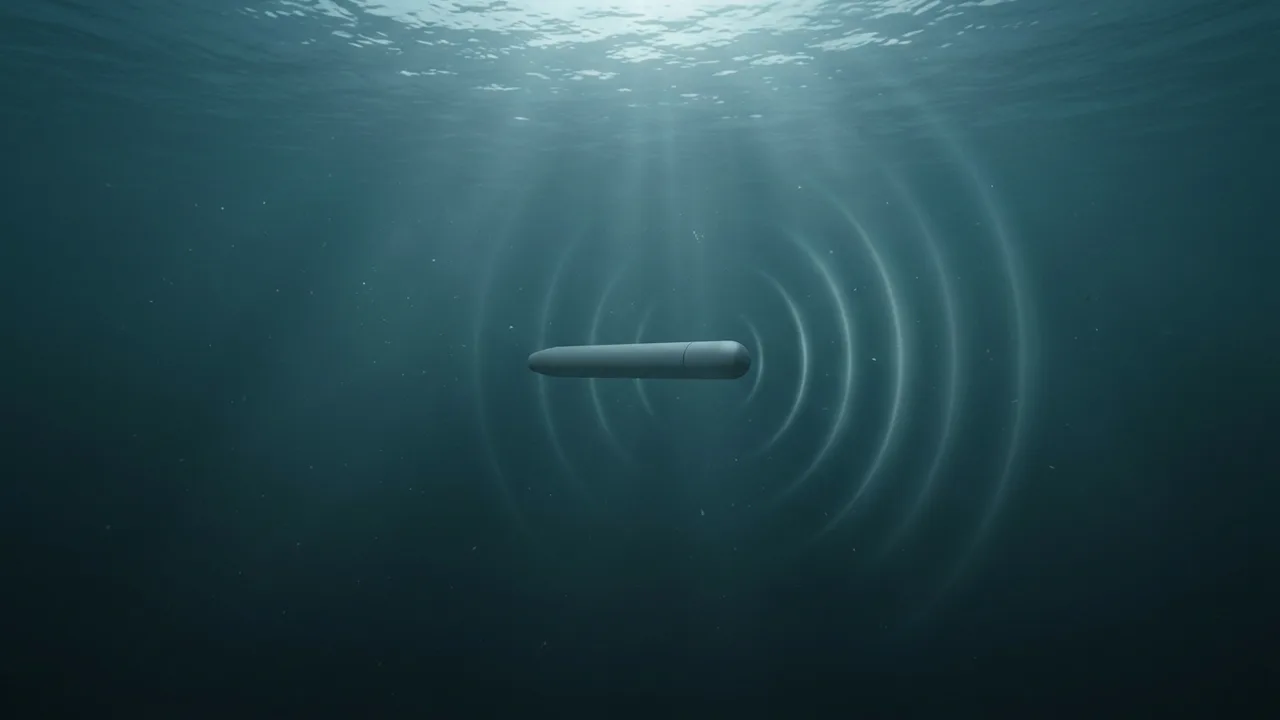
A submarine moves while hidden under the sea. Suppose a ship on the surface or an aircraft overhead has found one. What does it use next? One answer is a lightweight torpedo.
Blue Shark (Cheong Sangeo) is the Korean-made lightweight torpedo operated by the Republic of Korea Navy. This article looks at how lightweight torpedoes differ from heavyweight ones and when Blue Shark finished development. It also covers the weapons Blue Shark connects to and why a successor, Lightweight Torpedo-II, is being built. It relies on public releases from Korea's Defense Acquisition Program Administration (DAPA) and the Agency for Defense Development (ADD).
Lightweight and heavyweight torpedoes
Underwater, hearing comes before seeing. Ships and submarines find each other by sound, working out things like position and speed. Blue Shark, the subject here, also follows sound. The equipment that listens underwater is the subject of the upcoming article on sonar.
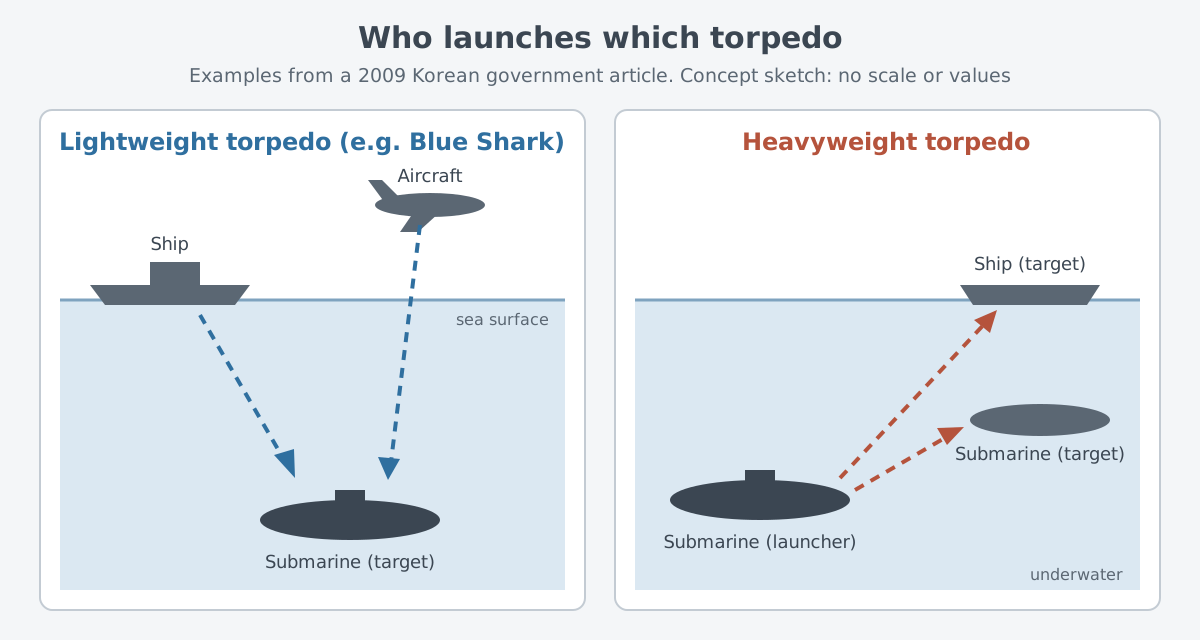
The Korean names contain the words for light (gyeong) and heavy (jung). So where is each one used? A 2009 Kookbang Ilbo article, carried on the government's policy briefing site, explains that a ship that finds a submarine first attacks it with a lightweight torpedo. When a submarine attacks a submarine or a ship, it uses a heavyweight torpedo.
Blue Shark belongs to the first group. It is launched from a ship or an aircraft and then, underwater, follows the sound made by an enemy submarine. Picture it as the torpedo that ships and aircraft carry out to sea.
Who developed Blue Shark
Official sources give a two-part answer. The Agency for Defense Development (ADD) counts Blue Shark among its own R&D achievements, and LIG Nex1 lists it as a weapon system it has finished developing and now mass-produces. Blue Shark appears both on the institute's list of achievements and on the company's production list.
Development was completed in 2004. ADD's website lists Blue Shark (lightweight torpedo) as a 2004 entry among its "50 major R&D achievements." A 2022 DAPA press release calls the torpedo in navy service "a weapon system whose development was completed in 2004." The English version of the ADD website lists Blue Shark among its maritime and underwater weapon systems, next to White Shark and Heavyweight Torpedo-II.
The official sources found for this article do not say how the two organizations divided the work on Blue Shark, or when development began. Why it matters who leads development becomes clearer with its successor, Lightweight Torpedo-II.
Three weapons with shark names
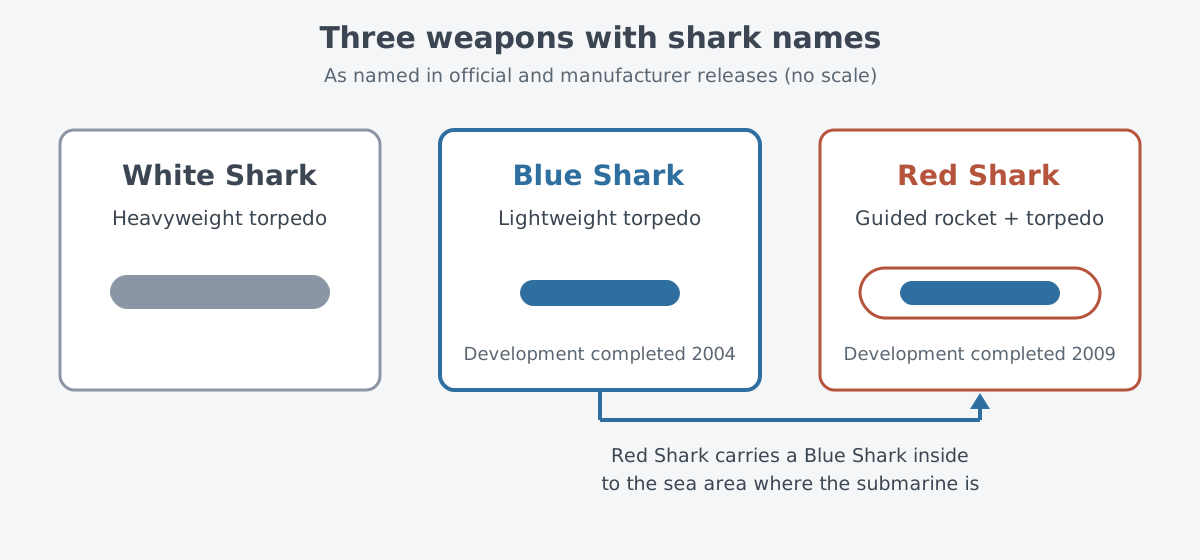
Several Korean underwater weapons carry shark names. The LIG Nex1 list puts three side by side: the White Shark heavyweight torpedo, the Blue Shark lightweight torpedo, and Red Shark, which joins a torpedo to a guided rocket. White Shark is the heavy one; Blue Shark is the light one.
Red Shark works differently. ADD announced on June 22, 2009 that it had completed Red Shark, nine years after starting the project.
Red Shark is an anti-submarine guided weapon that carries a Blue Shark inside a missile, flies to the sea area where an enemy submarine is, and attacks it there. The aim was to greatly extend the reach of the lightweight torpedo fired from a ship.
Red Shark is launched from a vertical launch system mounted below a ship's deck, and it sets the Blue Shark it carries down into the water of that sea area. A parachute softens the impact as the torpedo enters the water.
Think of a parcel. The rocket is the box, and Blue Shark is what sits inside. The real thing differs in one way: the rocket never goes underwater. Chasing the submarine below the surface is the torpedo's job from start to finish.
The next generation: Lightweight Torpedo-II
Blue Shark will need a replacement at some point. On August 11, 2022, DAPA signed a contract worth 154.9 billion won with LIG Nex1 to develop Lightweight Torpedo-II. The whole program, at about 165 billion won, is to produce a new lightweight torpedo that surface ships of frigate size and larger can use against enemy submarines.
Why build a new one? The press release gives three reasons. Parts for Blue Shark are going out of production, a problem that is slowly growing. Enemy torpedo technology has moved forward, and Blue Shark's own technology has become dated.
The project was first called "lightweight torpedo performance upgrade." But the new torpedo will have every component newly developed except the warhead section. That is closer to a new design than an upgrade, so in March 2022 DAPA renamed the project "Lightweight Torpedo-II."
Here is where the new torpedo is headed. The new torpedo is to travel farther and faster than Blue Shark. A new acoustic sensor is to be developed so it can better detect and attack submarines that move quietly.
Most parts are to be made in Korea, with a target of 95% or more.
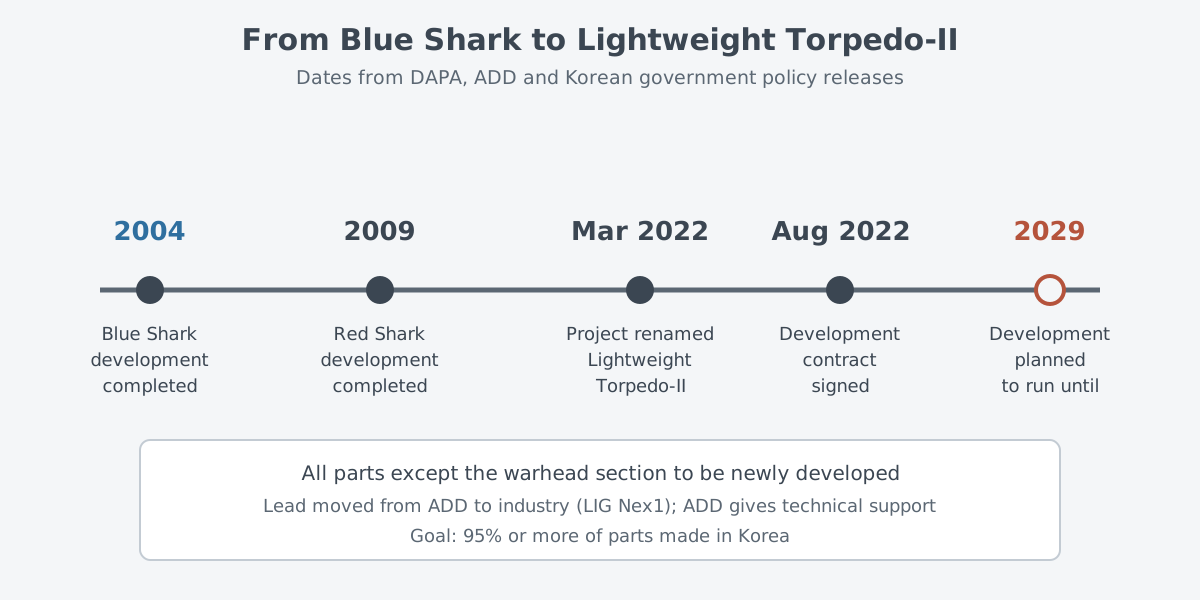
The way the work is shared has changed too. DAPA moved this program from ADD-led to industry-led development as part of a "defense R&D system reform."
To lead a program means to carry responsibility for running the development. Under industry leadership, LIG Nex1 leads development until 2029, while ADD provides technical support: it hands over the technology needed and advises on technical decisions. The head of ADD's maritime technology institute, quoted in the press release, expected that moving staff this way would let ADD focus its research on classified and core advanced technologies. DAPA's head of guided weapons programs expected the program to help Korean industry gain its own ability to develop underwater guided weapons.
What public sources do and do not say
Put together, the official sources are clear on several points. They describe where lightweight and heavyweight torpedoes are mainly used, the year Blue Shark completed development, and its link to Red Shark. They also give the contract and schedule for Lightweight Torpedo-II, along with the reasons and general goals for the new design.
Values such as speed or range are another matter. The 2022 DAPA release only says Lightweight Torpedo-II will go farther and faster than Blue Shark; it does not say by how much. Figures for Blue Shark do circulate in online encyclopedias and news reports, so it is worth checking who published them first. Ways to trace a source are covered in Finding open sources.
Company news needs the same care. LIG Nex1 said it would take part in Colombiamar 2025, an international naval defense conference to be held in Cartagena, Colombia, in March 2025. There it planned to present naval guided weapons, including the Haeseong (C-Star) anti-ship missile and the Blue Shark lightweight torpedo. News that a weapon will be shown at a conference is promotional news, not news of an export contract.
The same habit helps when reading about laser weapons. Check first whether the source is a government or a company, and whether a number is actually stated. That approach continues in How to read laser weapon news.
What to read next
- Sonar (upcoming article): how torpedoes and ships find each other by sound underwater.
- Vertical launch systems: what sits below a warship deck: how the launch system that fires Red Shark is built.
- How to read laser weapon news: how to sort out who is speaking and which numbers are real, using laser weapons as the example.