A telescope head turns slowly on top of a mount. The beam it sends out starts in a semiconductor chip smaller than a fingernail. That weak light passes through several hands before it becomes a beam in the tens of kilowatts. What happens in between?
The laser company nLIGHT has posted a figure on its defense laser page that draws this chain as five boxes. This article uses those five boxes as a map and follows one stream of light from start to end. For each box it explains the physics inside in plain words, notes what is hard, and points to the article that goes deeper.
The five stages on one page
From the left, the figure lines up the semiconductor laser device, the semiconductor laser module, the fiber laser amplifier, the high energy laser source and the high energy laser effector. The job of each box is light generation, fiber coupling, amplification, beam combination and beam delivery. Under each box, three short lines name what that stage has to deliver.
| Box | Job | The three lines under it |
|---|---|---|
| Semiconductor laser device | Light generation | Wavelength stabilized, volume manufactured, high efficiency |
| Semiconductor laser module | Fiber coupling | Durable Locking, Instant-On, wide temperature operation |
| Fiber laser amplifier | Amplification | Suited to both kinds of beam combining, low SWaP (size, weight and power), reliability |
| High energy laser source | Beam combination | Both kinds of beam combining, the company's claim that one of them can scale to 1 MW, brightness |
| High energy laser effector | Beam delivery | Low SWaP designs, AI-based atmospheric correction, irradiance (intensity) on the target |
The company gives no explanation for the first two terms in the module row, so they stay in their original words.
Two terms at the end of the table make the rest easier. Intensity is the power that light carries through each unit of area, and irradiance on the target is that value where the beam lands. Brightness is often glossed as power per unit area as well, and for a fixed focusing angle the intensity at the focus grows with brightness, not just with power. Of two beams with equal power, the brighter one packs more tightly into a spot.
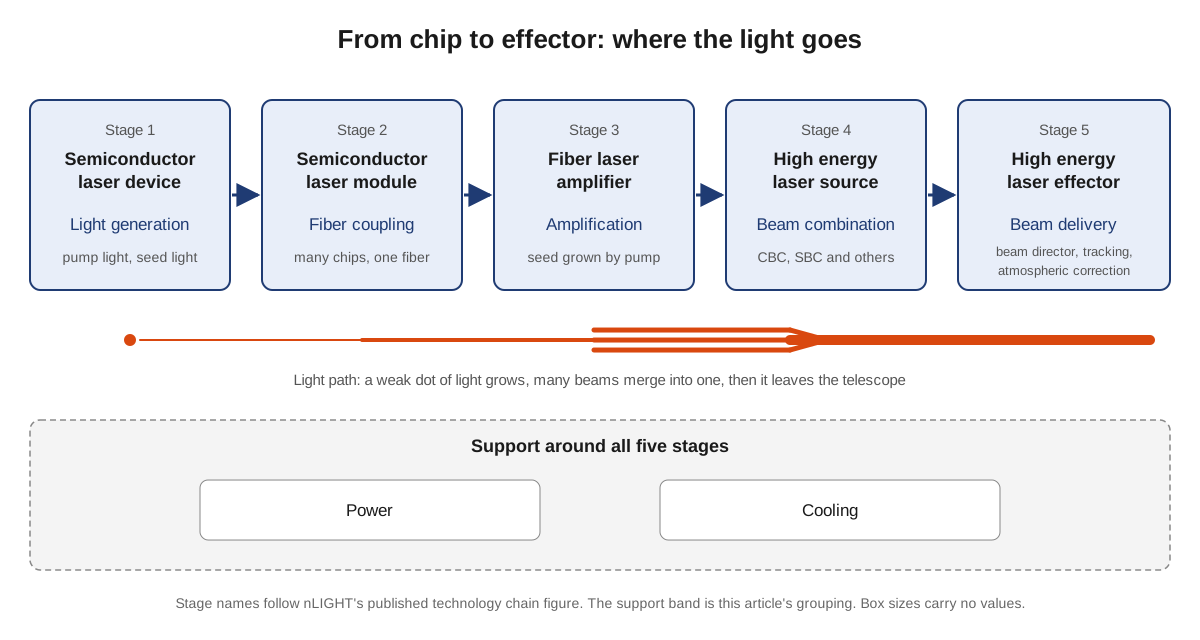
Power and cooling run under all five boxes. They do not belong to one box. They hold up the whole chain. Tracking the target and correcting for moving air are jobs inside the last box.
Box by box, the hardware gets bigger and the light gets stronger. The chip is the size of a fingernail, and the effector is a large mount that carries a telescope head. A bigger box does not mean a simpler job, though. Different physics sets the limit in each one.
Making light: the semiconductor laser device
The first box is a semiconductor chip that turns electricity into light. Inside the chip is a junction where two semiconductor layers meet, and current flows through it in one direction, as in a diode. That is why the chip is called a laser diode (LD).
The current pushes charges into the junction, and when those charges meet again they give off light. With enough current, more of the material sits in the higher energy state than in the lower one. This is population inversion, and from that point passing light can call out more light just like itself, which is stimulated emission. The faces of the semiconductor crystal differ so much from air in refractive index that they can act as the mirrors of the laser without extra parts.
The light from the chip is used in two ways. One kind works as fuel. Nearly every fiber laser gets its energy from the light of laser diodes or of other fiber lasers. The chip that does this job is the pump diode.
The medium that takes in pump light does not swallow every color equally. A gain medium absorbs well in a narrow band of wavelengths, its absorption line, and a diode's narrow spectrum can be placed right on that line. An ultrafast laser textbook, in its chapter on solid-state lasers, explains that this makes absorption efficient and cuts the heat.
Wavelength stabilization, the first line in the table, means holding that chosen wavelength in place. It is a bit like keeping a radio tuned to one station. The difference is that a radio receiver picks the channel, while here the chip that sends the light has to match the absorption line of the fiber that receives it. According to nLIGHT, the spectrum of its stabilized chips keeps its wavelength fixed across wide swings in temperature and drive current, so the pump light is absorbed steadily and well.
The other kind of light becomes the signal. A seed laser, or seed source, makes the original light that the amplifiers will grow. The seed sets properties of the beam such as wavelength and linewidth, and its power is low.
Linewidth is the spread of wavelengths, or colors, mixed into one light. Combining methods that line up the timing of beams start from a seed with a narrow linewidth. For defense use there are also narrow linewidth seed products that can be tuned for either kind of beam combining.
- The pump chip itself: "Pump diodes: the part that turns electricity into light"
- The signal light: "Seed Lasers and Phase Modulators: Why Broaden a Narrow Line"
Putting light into fiber: the semiconductor laser module
The light from one chip is not enough. So many chips go into one box, and their light is gathered into a single fiber that leaves the box. This box is the semiconductor laser module, and its job is fiber coupling.
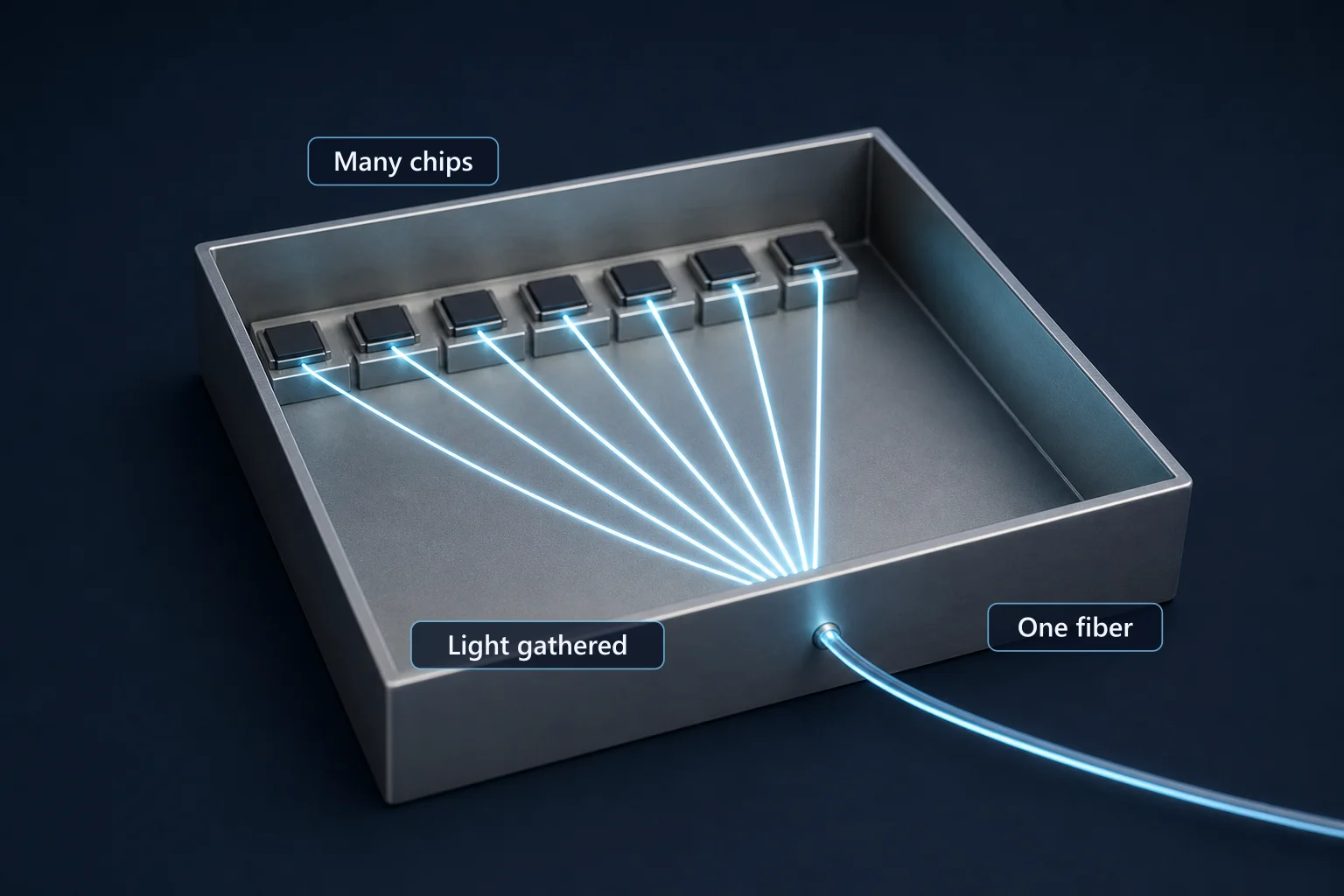
Gathering the light of many chips does not turn it into one even beam. The chips are not linked to each other, so the combined light has much lower coherence. It is still far brighter than an ordinary flashlamp.
Picture several taps pouring into one funnel that feeds a single hose. Light is not like water, though: it cannot enter from any direction. The fiber's numerical aperture (NA) sets the range of angles it accepts, and only light arriving inside that cone stays in the fiber.
Light gathered this way is far from a thin, straight beam. So the pump light does not go into the thin core of the gain fiber. It goes into the wide cladding around the core. This layout, used widely to bring low-quality diode light into a fiber, is the double-clad fiber.
- From chip to fiber end: "Pump Modules: Putting Chip Light into One Fiber"
- How pump light gets in: "Double-clad fibers and how pump light gets in"
Growing the light: the fiber laser amplifier
In the third box, pump light and seed light meet. The word LASER is an acronym for "light amplification by stimulated emission of radiation", and an amplifier does exactly what that name says.
The core of the gain fiber holds a rare-earth element such as ytterbium. The pump light bounces many times inside the cladding, and each time it crosses the core, the ions there absorb it and store the energy. When seed light passes by, stimulated emission releases that stored energy, and more light just like the seed appears.
A battery makes a handy picture. The pump light charges it, and the seed draws the energy out as it passes. What sets it apart from a battery is that the energy leaves as light with the same wavelength and direction as the seed, not as electric current.
Making a small light first and growing it later is called a master oscillator power amplifier (MOPA). The power amplifier raises the seed's power a lot while keeping the qualities the seed already has.
As the amplifier row of the table shows, the amplifier is built to suit the combining method of the next box. The product text for one amplifier also mentions built-in systems that protect it in cases such as loss of seed.
One strand cannot be grown forever. Nonlinear effects, where strong light makes new light inside the glass, and beam instability caused by heat stand in the way. That is why the next box combines the light of many strands.
- The MOPA layout: "Oscillators and amplifiers: making light, then growing it"
- Fiber parts inside the amplifier: "Pump and Signal Combiners and Endcaps", "Isolators and fiber components: keeping light from going backwards"
- Limits of one strand: "Limits of a single fiber (1): nonlinear effects (SBS, SRS)", "Limits of a single fiber (2): heat and mode instability"
Combining: the high energy laser source
Exail writes that one fiber laser today reaches the kilowatt range, and as much as 10 kW. It adds that setting the phase of many sources to match can reach several hundred kilowatts. That is the job of the fourth box, beam combining.
A 2014 article from MIT Lincoln Laboratory sorts combining into two basic ways. One lines up the timing of every beam, and the other gives every beam its own color. Either way, each beam has to be aimed so that all of them land on the same spot.
Coherent beam combining (CBC) splits one seed among many amplifiers, grows each copy, and overlaps them again. Because the beams share one source, they can interfere, and when their phase is set so that crest meets crest, they add up. Just as rowers must pull in time for the boat to go straight, the beams must keep the beat for their power to add. With light, no person keeps it: a sensor measures the phase difference between beams, and phase actuators keep cancelling it.
Keeping that beat is hard. Light has such a short wavelength that passive schemes, which try to make the phases match on their own, had only limited success. Only active control, which measures and corrects the phase, made it possible to grow to large arrays of beams.
Spectral beam combining (SBC) gives each beam a slightly different wavelength, that is, a slightly different color. A part such as a diffraction grating then lays the beams of different colors on top of each other as one beam. It is like a spectrometer splitting light into colors, run backwards. The Lincoln Laboratory article judges that holding wavelength is less demanding than holding phase.
The beam combining articles on this site add a third branch, incoherent combining, which places beams side by side without matching either timing or color. According to nLIGHT, HADES, which it calls 70 kW-class, uses CBC, its 30 kW-class laser uses SBC, and its 10 kW-class laser uses dichroic beam combination (DBC). Only the name of DBC is public, so neither how it works nor which branch it belongs to is known.
The company also says it built a 300 kW-class laser in 2023 under a U.S. Department of Defense program, the "High Energy Laser Scaling Initiative" (HELSI). It is now working on the next phase, toward 1 MW. These are goals the company states, and they do not mean that such power is in use as a weapon.
Combining more beams also adds difficulty. The same textbook notes that coherent combining opens the way to higher energy and average power, but makes the overall system even more complex. The more beams there are, the more phases there are to measure and match.
- The big picture of the three ways: "Why beam combining is needed, and its three approaches"
- Each way in detail: "Incoherent Beam Combining: Side by Side", "Spectral Beam Combining in Detail", "Diffraction Gratings: The Part That Merges Colors", "Coherent beam combining: the principle", "Walking Through a Coherent Beam Combining System"
Sending: the high energy laser effector
The last box sends the combined beam far away. The HADES description names high energy beam directors, tracking systems and atmospheric correction as the technology in this box. All three have to work together for the power gathered in the first four boxes to stay on one distant spot.
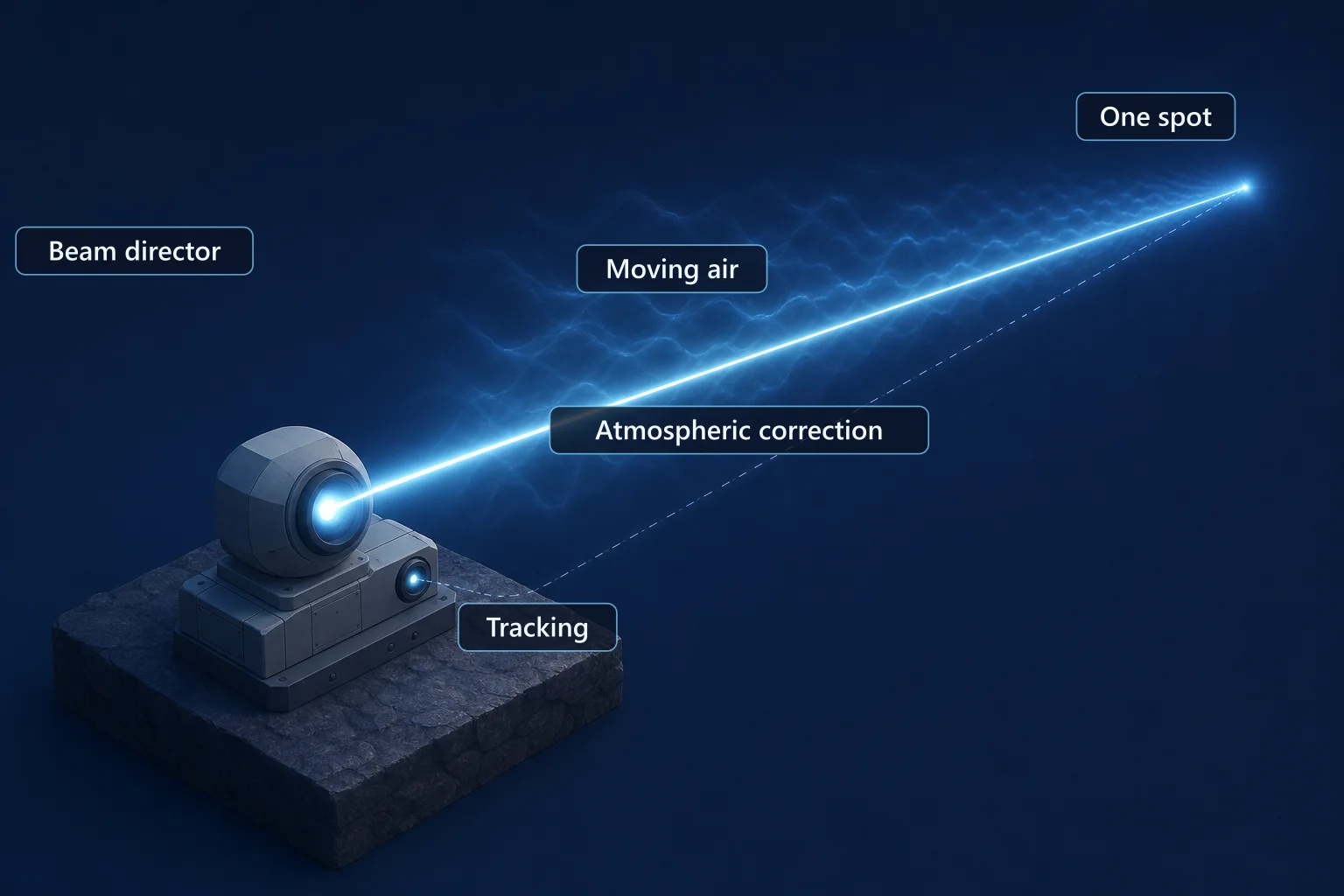
At the heart of a beam director is a telescope. It acts as a beam expander, making the beam wider before it leaves. The wider a beam is at its narrowest point, its waist, the longer it travels before it spreads. While sending the beam out, the director also has to keep shaking, or jitter, low and keep the focus sharp.
Holding the beam is split into two jobs. A gimbal swings the telescope to point it roughly, and a fast steering mirror (FSM) tilts a small mirror quickly to filter out fast shaking and point it precisely. Laser communication terminals in space split the work the same way.
Think of a camera whose tripod head sets the framing while the image stabilizer inside wipes out small shakes. The difference is that an FSM tilts one mirror in the beam path, not a lens.
The air shakes the beam too. The same kind of shimmering air that makes the view above hot asphalt ripple, atmospheric turbulence, can blur the focus of the beam. Adaptive optics keeps making quick, small corrections to the beam based on the turbulence it measures. Even so, the U.S. Congressional Research Service (CRS) notes that lasers may work poorly or fail entirely in rain or fog.
- Telescope and optics: "Beam director optics", "Mirrors, lenses and coatings: optics for strong light"
- Holding the beam: "Gimbals, pointing and tracking", "Fast steering mirrors: small, quick mirrors that cancel shake"
- The air: "Light through air: absorption, scattering, turbulence, thermal blooming", "Adaptive optics: restoring a blurred beam"
Support outside the map: power and cooling
In the chips and the amplifiers, not all the electricity becomes light. The rest becomes heat. In fiber lasers, the quantum defect is named as the most important heat source. Each particle of pump light, a photon, usually carries more energy than a photon of signal light, and the difference stays behind as heat.
What happens when you pay with a bill worth a little more than the price? There is change left over. Here the change never comes back to you, and it warms the fiber instead.
Heat limits performance. The abstract of a 2010 review of high power fiber lasers singles out thermal management, damage and optical nonlinearity as key limiting factors. A CRS report also says that size, weight, power and cooling needs can cut the range of directed energy weapons and degrade their beam quality. So when a laser goes on a vehicle or a ship, the size and weight of the power and cooling equipment have to be weighed as well.
Control, which decides when and where the beam goes, is not drawn separately on this map. How the whole system fits together is covered in "A laser weapon is more than a laser: the system at a glance".
- Electricity and efficiency: "Power and efficiency: the share of electricity that becomes light sets the size of the system", "Power supplies and chillers: the equipment behind a laser"
- Heat: "Cooling and thermal management: where the heat that did not become light goes"
One company building the whole chain
nLIGHT says it builds every link of the chain, from chips to beam directors, and that designing and making everything in house gives it control over system performance. It makes its own wafers, chips and packages, and it makes gain fiber in Finland. Its active fibers are doped with one of three elements: thulium (Tm), erbium (Er) or ytterbium (Yb).
The company also says that in 2025 it is delivering a 50 kW-class laser for Stryker vehicles in the U.S. Army's short-range air defense program, DE M-SHORAD.
This is what the company says about itself. It does not mean that makers who split the boxes among suppliers do worse. These sources also do not show whose parts went into which weapon.
What to read next
- "Pump diodes: the part that turns electricity into light": the chip that fuels the first box.
- "Seed Lasers and Phase Modulators: Why Broaden a Narrow Line": the other light of the first box, the one that becomes the signal.
- "Pump Modules: Putting Chip Light into One Fiber": how light is put into fiber in the second box.