Suppose a news story says "according to a U.S. congressional report." Where is that report, and can anyone open it? Opening the original sometimes shows conditions or dates that the story left out.
This note sorts the open sources this site cites into three kinds and points to the official window for each. It also notes what is free to open, what is paid or restricted, and what to check before citing what you find.
The sources this site uses
This site uses only material that is already public. That means official documents from governments, militaries, standards bodies and international organizations, papers published in journals, textbooks, and official technical material from manufacturers. Articles on trends in laser technology also use the public abstracts and proceedings of conference talks. Encyclopedia-style explainer sites are used only to aid understanding and are not cited as sources.
Unpublished or leaked material is not used. The paths in this note likewise stop at windows open to everyone. For material with restricted access, only the fact that it is restricted is mentioned.
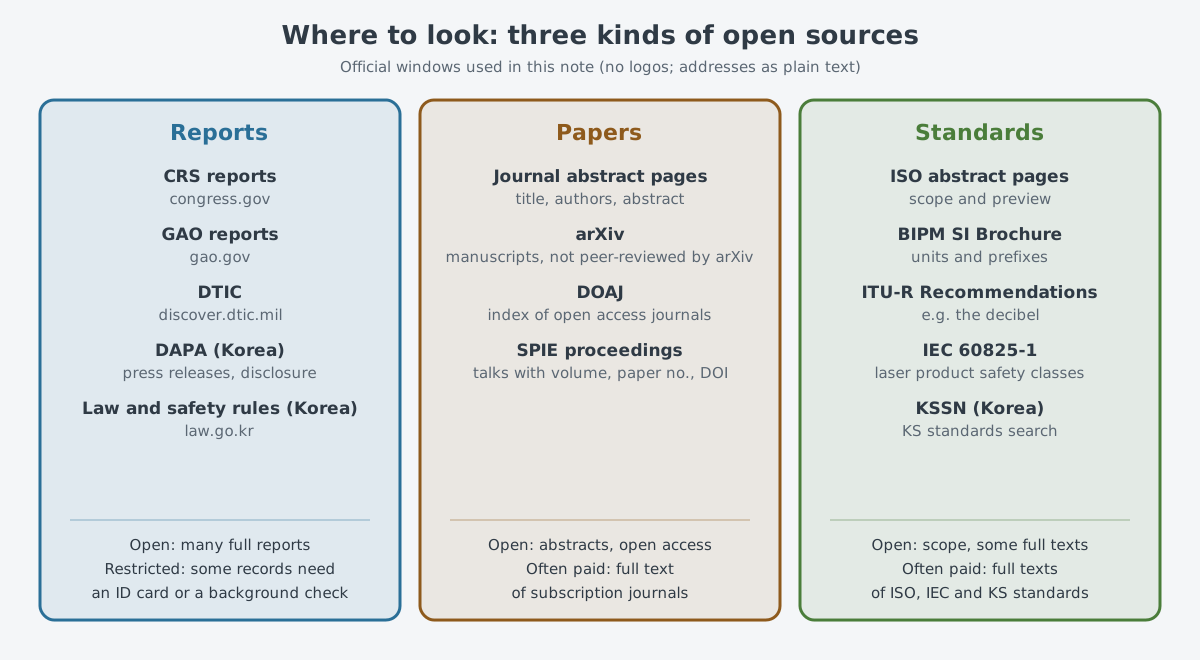
Government and parliamentary reports
One source this site's laser weapon articles often use is the reports of the U.S. Congressional Research Service (CRS). According to the disclaimer at the end of each report, CRS works as nonpartisan staff shared by congressional committees and members, and acts only at the direction of Congress. CRS reports open as PDFs on the congressional website, congress.gov.
CRS reports go through many versions. Take R46925, the directed energy weapons report this site has used in several articles. Its cover says "Updated July 11, 2024," and the page footer says "VERSION 10." The same report number can carry different content in different versions, so cite the version and date together.
The same disclaimer covers copyright. Because they are works of the federal government, CRS reports carry no U.S. copyright. A report can still contain pictures or text owned by others, which may need separate permission, so it is safer not to copy images from a report as they are.
The U.S. Government Accountability Office (GAO) also investigates defense programs and publishes reports. One example GAO report page is divided into "What GAO Found," "Why GAO Did This Study" and "Recommendations," with the published and publicly released dates near the top. That 2023 report on directed energy weapons says it was done under a provision in a Senate report, and it made four recommendations to the Department of Defense.
The Defense Technical Information Center (DTIC) holds defense technical reports. Not all of them are open, though. The DTIC front page places its collection of controlled unclassified technical reports behind a gateway that requires an ID card issued by the defense authorities.
In Korea, the website of the Defense Acquisition Program Administration (DAPA) has menus for press releases, its information disclosure system and proactive disclosure. Its page on viewing defense acquisition records ("방위사업자료열람 안내") is a different matter. Those records include Grade III classified material, so only people cleared in a background check can view them, and taking notes, copies or photos is forbidden. Because this is not a window open to everyone, this site does not use such material.
The full text of product safety standards can also be read at the national law information center run by the Ministry of Government Legislation (law.go.kr). The Korean Agency for Technology and Standards (KATS) revised its safety standard for handheld laser products. It said the full text could be found on the KATS website and at the national law information center.
Papers
Journal papers start from the abstract page on the journal's website, where the title, authors, affiliations and abstract are usually open to anyone. Access to the full text depends on the journal. The 2010 JOSA B review of high-power fiber lasers, for instance, has an open abstract. Its full text is marked "Not Accessible," and the page suggests a library or personal subscription might open it.
Some journals publish their full texts free of charge. The Directory of Open Access Journals (DOAJ) indexes free-to-read journals across many countries. Its stated mission is to make quality, peer-reviewed open access journals more visible.
arXiv is an open repository where researchers post their own manuscripts, and it calls itself a curated space open to anyone. Volunteer moderators check whether a posting fits its subject area and has scholarly value. But arXiv says it does not peer-review what is posted, and that the person who posts it is responsible for the content.
When the "Journal reference" and "Related DOI" fields on an arXiv abstract page carry a journal citation, the same work also appeared in that journal. For example, the arXiv page of the 2020 review of transverse mode instability (TMI) in fiber lasers lists Advances in Optics and Photonics, volume 12, pages 429–484 (2020). The arXiv manuscript may still differ from the published version, so check numbers in the published version where possible. A manuscript with empty fields is best not used as the only support for a number or a definition.
Conference talks are open sources too. Manuscripts presented at SPIE, an optics society, appear in the Proceedings of SPIE and are posted to the SPIE Digital Library. SPIE's manuscript guidelines say papers not presented at the meeting are not published, and that conference chairs and editors check technical merit and clarity and may ask for changes. The same guidelines describe the proceedings as fast reporting of current research, which may be a progress report on unfinished work.
So when citing conference material, give the conference name along with the volume number, paper number, date and DOI. SPIE's preferred citation follows the same order: authors, title, the Proc. SPIE volume and its title, the paper number, the date of publication and the DOI. The numbers let readers find the same talk again and check in the manuscript whether it reports finished or ongoing work.
Standards
A standard is a document that sets down an agreement on measurement or safety. For standards from the International Organization for Standardization (ISO), the summary page shows the scope (abstract), edition, month of publication and page count to anyone. The full text has a price, and the summary page has a preview button for the opening pages. The summary page of the beam measurement standard ISO 11146-1 is one example.
A laser example is IEC 60825-1, which sets the safety classes of laser products. The summary page of the International Electrotechnical Commission (IEC) says it covers the safety of laser products that emit light between 180 nm and 1 mm. It also sets up a way of sorting them into classes by how hazardous their light is.
It is edition 3.0, published on 15 May 2014, with 220 pages, and the full text is paid as well. This site's "Laser safety: classes and how to read eyewear labels" also cites this summary page.
Some international documents can be opened in full as PDFs. Examples are the SI Brochure of the BIPM, the body that keeps the International System of Units, and the decibel recommendation from the International Telecommunication Union (ITU). This site's "Units and dB notes: reading W, dBm and ratios" is based on these two documents.
Being able to read a document does not mean you may republish it, though. The ITU recommendation PDF forbids copying any part of it without ITU's written permission. Reading and quoting is one thing; republishing the whole document is another.
Korean Industrial Standards (KS) are found on the Korean Standards Service Network (KSSN). It offers a KS search and a guide to buying standards, so it is the first place to look when you need a standard in Korean.
Five checks for what you find
Once you have found a source, check five things before citing it. A news story or a summary points to the source; it is not the source itself.
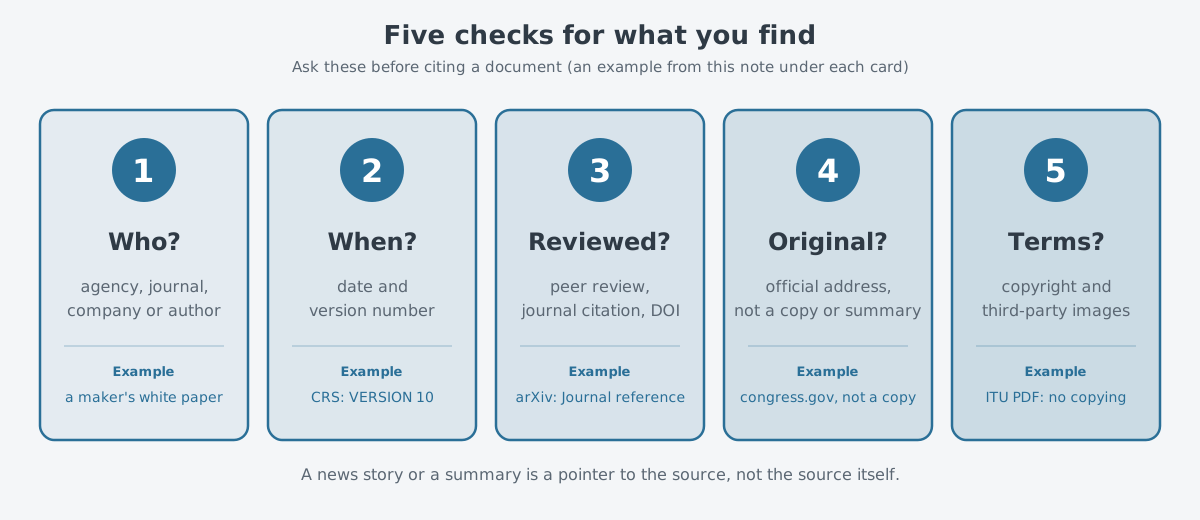
First, check who published it. What a document can speak to depends on whether it comes from a government agency, a journal, a company or an individual. Keep in mind that company material describes the company's own products.
Second, check when it was published and which version it is. For documents that change versions, like CRS reports, cite the version number and date together. Words such as "currently" or "recently" in a report belong to the time that version came out.
Third, check whether it was reviewed or published. For a paper, see whether there is a journal citation and DOI. For a manuscript in an open repository, see whether there is a publication note.
Fourth, check whether it is the original. The same report sometimes appears as a copy on other websites. Even if you first read a copy, find and cite the agency's official address.
Fifth, check the terms of use. A government document without copyright can still contain third-party images, and an international document that is free to open can still forbid copying. That is also why this site draws its own diagrams instead of taking figures from papers or reports.
What to read next
- How to read laser weapon news: "kW-class", "range" and "cost per shot": how to set the original next to the news story and see what was left out.
- "Reading a review paper on high-power fiber lasers": how to read the reviews among the papers you find.