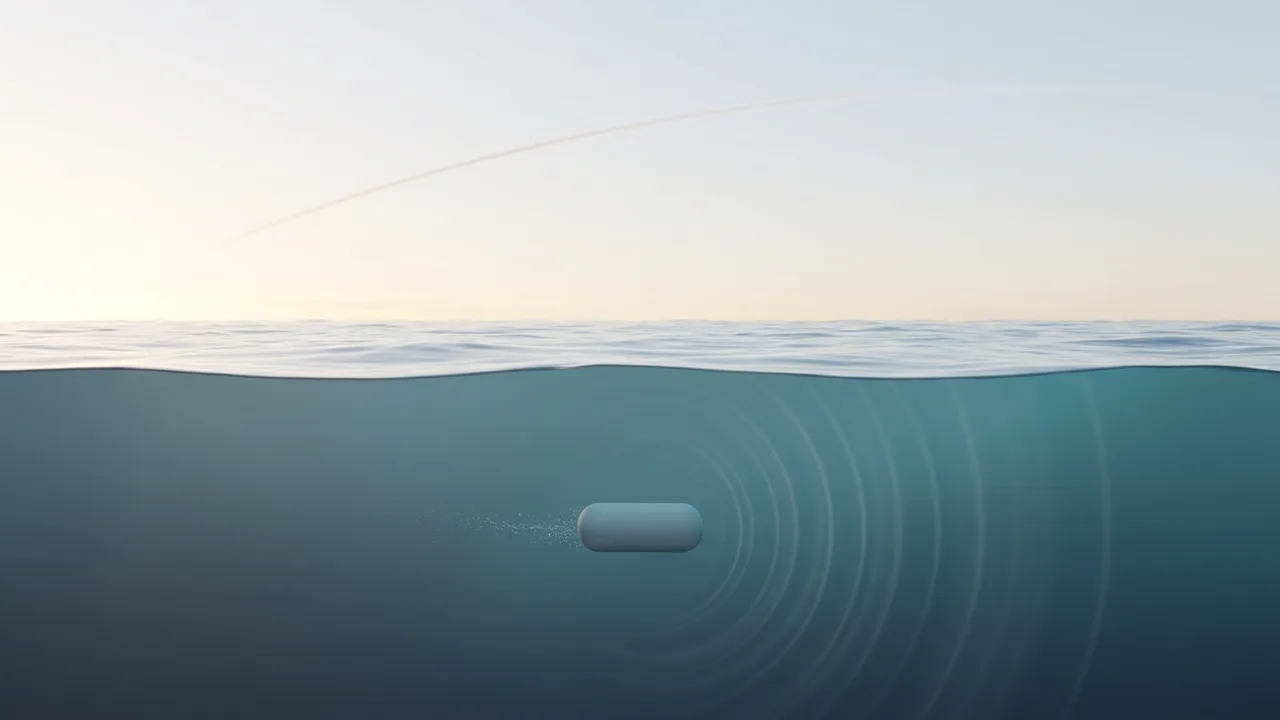
Finding a submarine is only the start. A torpedo still has to travel through the water, and the submarine does not sit still while it comes.
The Red Shark (Hongsangeo) answers this problem in a different way. It puts a torpedo on a guided missile, sends it through the air first, and drops it into the sea close to the submarine. The sections below follow why the torpedo flies, what stages the Red Shark goes through, and how development led to production. The guide throughout is official announcements from Korea's Agency for Defense Development (ADD) and Defense Acquisition Program Administration (DAPA).
Why a torpedo is late under water
Under the sea, ears come before eyes. Ships and submarines find each other by sound, which tells them position and speed.
Suppose a ship finds a submarine first and fires a lightweight torpedo. A torpedo a ship uses against a submarine is called a lightweight torpedo, and one a submarine fires at another submarine or a ship is called a heavyweight torpedo. The torpedo the Red Shark carries, the Blue Shark (also called Cheongsangeo), is also a lightweight torpedo.
Water pushes back hard on a moving torpedo, so the torpedo can sometimes lose its target. The sound of the torpedo reaches the submarine before the torpedo does, and the submarine can hear it and run at full speed. That is the explanation given in a 2009 Korean government briefing.
ADD called this "the limit of a torpedo that cannot help being slower than sound." The Red Shark was developed to get past that limit and to reach submarines beyond a torpedo's own range. By flying to the sea right above the hidden submarine, it cuts the time the submarine has to hear the torpedo and get away.
Think of rolling a ball to someone far away versus throwing it so it lands at their feet. The real case is different. After landing, the torpedo has to do the rest on its own under water, and it does not stay put like a ball but moves off to find the submarine.
Carried through the air, searching under water
The Red Shark is a full system, not a single round. It is made up of a vertically launched missile, a vertical launch system and a launch control console, and it works linked to the ship's combat system. The Blue Shark lightweight torpedo rides inside the missile.
The sequence falls into four parts. First, the missile rises from below the ship's deck and then settles its heading and attitude. Next, it flies to the sea area near the submarine; the 2009 Kookbang Ilbo report on the completed development describes this flight as more than 10 km and supersonic.
Third, the lightweight torpedo separates from the missile and comes down toward the water. A parachute softens the shock of hitting the surface. Last, once the torpedo is in the water, its seawater battery switches on and it starts moving by itself. It drops the parachute and uses its own sonar section to find and attack the submarine.
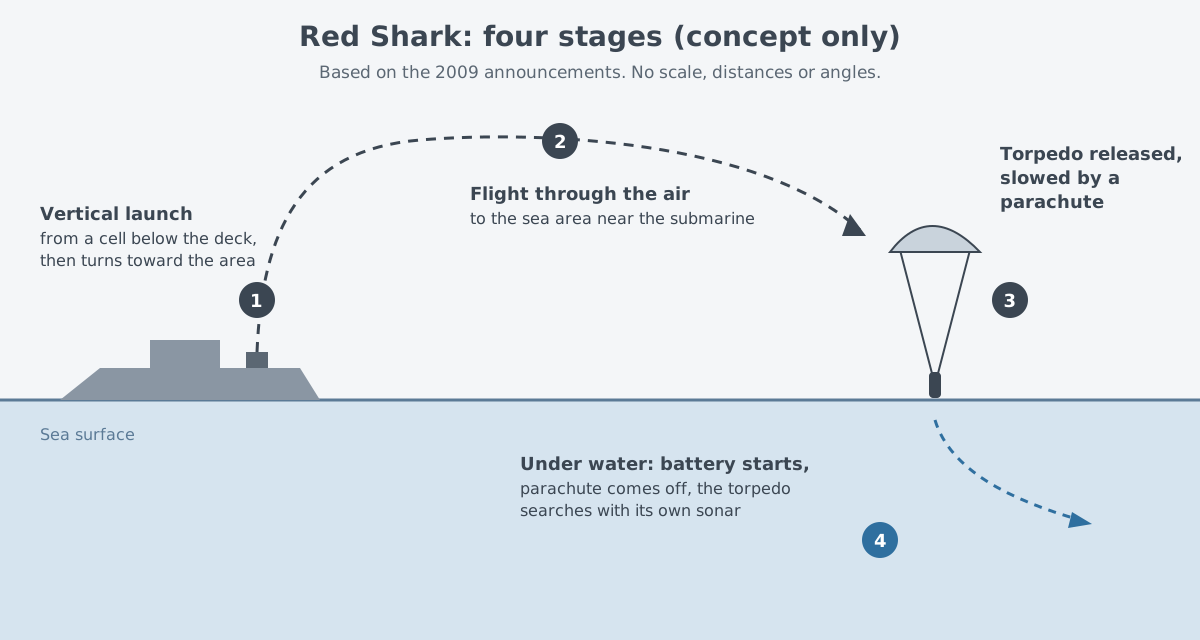
The announcement also has one line on how the missile keeps its course in flight. In the middle stretch it uses guidance based on an inertial navigation unit, called midcourse guidance. Inertial navigation, which works out position from acceleration and rotation without outside signals, is covered in Inertial and satellite navigation.
The vertical launcher under the deck
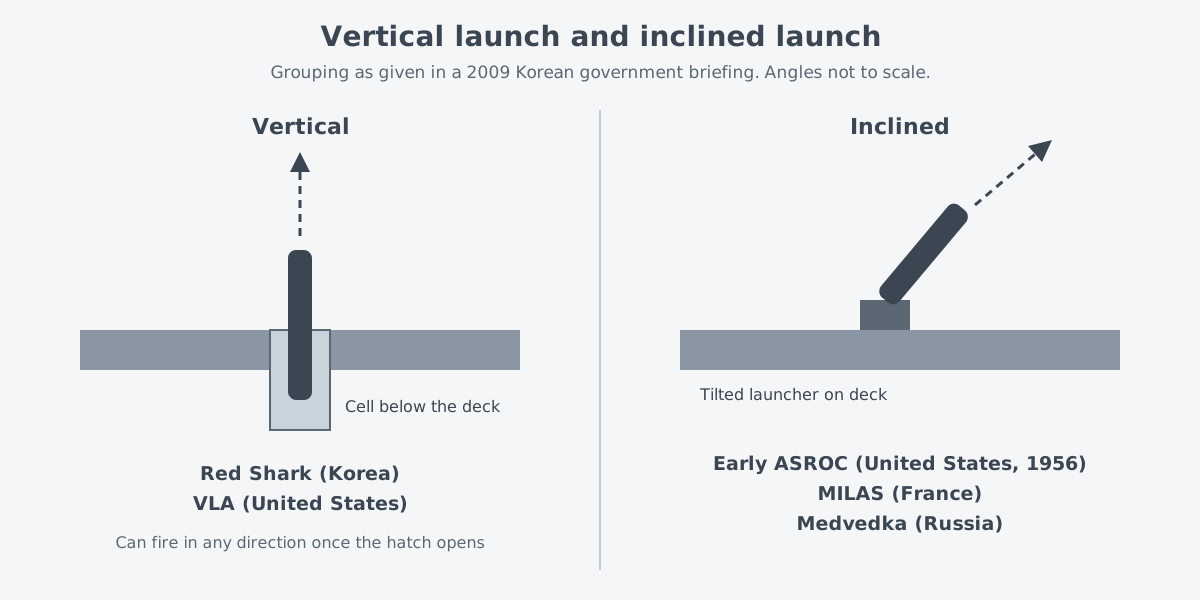
The Red Shark is not fired at a slant from the deck. It stands upright below the deck and goes straight up. The ship's vertical launch system for the Red Shark was also developed with Korean technology. Once the hatch on deck opens, it can fire in any direction, according to the government briefing.
At the 2009 announcement, the ships able to carry the Red Shark were the 4,400-ton Korean destroyers (DDH-II) and the 7,600-ton Aegis destroyer Sejong the Great (DDG). These ships had Korean vertical launchers fitted so they could operate the Red Shark.
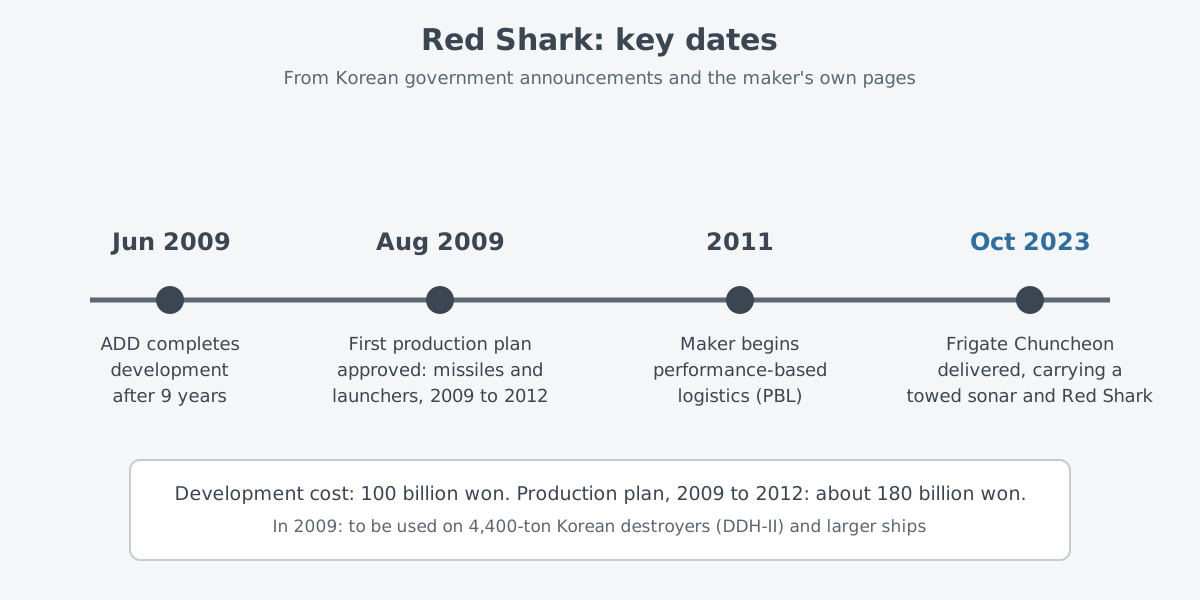
The Red Shark went onto frigates as well as destroyers. One example is the Chuncheon, the eighth ship of the new Ulsan-class Batch-II frigates, delivered to the navy in October 2023. The ship carries a towed array sonar (TASS) and the Red Shark long-range anti-submarine torpedo, which strengthen its anti-submarine capability.
If you want to know how missiles stand in cells below a deck, see Vertical launch systems.
Similar weapons in other countries
Sending a torpedo on a rocket was not a new idea with the Red Shark. The 2009 government briefing named missile systems that carry torpedoes in the United States (VLA), France (MILAS) and Russia (Medvedka).
According to the briefing, the United States developed ASROC (Anti-Submarine Rocket) in 1956. It had a parachute built in behind the torpedo and a rocket motor attached, and it was fired at a fixed tilt, an inclined launch. The United States later reworked it into the VLA, fired straight up from below the deck, and vertical launch let it attack in every direction.
In the briefing's grouping, the US VLA is a vertical launch weapon like the Red Shark, while the French and Russian ones use inclined launch. The 2009 Kookbang Ilbo report wrote that the Red Shark was the second ship-launched vertical anti-submarine guided weapon in the world, after the United States.
Steps in development and production
ADD finished developing the Red Shark in June 2009. It had taken 9 years since the start, and development cost 100 billion won. In announcing this, ADD said that about ten shipboard tests had proven the weapon's power and the merit of its new technology.
The next step came less than two months later. On August 13, 2009, the 38th Defense Acquisition Program Promotion Committee approved the first production plan for the Red Shark system. The plan was to spend about 180 billion won from that year through 2012 to build Red Shark missiles and vertical launchers.
The maker is LIG Nex1, whose website now carries the name LIG Defense & Aerospace. The company describes the Red Shark as a weapon that "combines a torpedo with a guided rocket" and lists it among weapons it has finished developing and now produces. Since 2011, the same company has also handled performance-based logistics (PBL) for the Red Shark.
ADD's own history groups 2000–2019 as its "precision weapons development" period. Among the results of that period, it lists the Blue Shark (lightweight torpedo) and the Red Shark (anti-submarine guided weapon) side by side.
Reading the official announcements
The 2009 announcements contain several sentences of judgment. The government briefing forecast that the Red Shark would give the navy "world-class anti-submarine combat capability." The Kookbang Ilbo article also wrote that the Red Shark was rated as having world-class performance.
Sentences like these are the judgment and outlook of the developer and the government, made just as development ended. It helps to read them apart from the sentences that state facts. The development period, the cost and the date of the production decision are facts; "world-class" is an assessment to read together with who said it.
Numbers have a date too. The figures of more than 10 km and supersonic flight come from the 2009 report on the completed development. When an article gives a different number, the first thing to check is who released it and when.
Where this meets lasers: time to arrive
At the center of the Red Shark story is time. While a torpedo travels through water, its sound spreads ahead and gives the target a chance to escape. The Red Shark tries to shrink that chance by crossing that stretch through the air.
How long a weapon takes to reach its target after firing also comes up often when people talk about laser weapons. What is a laser weapon? looks at that time from a very different angle, the speed of light. Reading the two side by side shows how different weapons reach very different answers to the same question.
What to read next
- The Blue Shark lightweight torpedo. A closer look at the lightweight torpedo that the Red Shark carries.
- Vertical launch systems: what sits below a warship deck. How the cells below the deck that hold the Red Shark are arranged.
- Sonar: seeing with sound underwater. The basic reason ships and submarines find each other by sound.