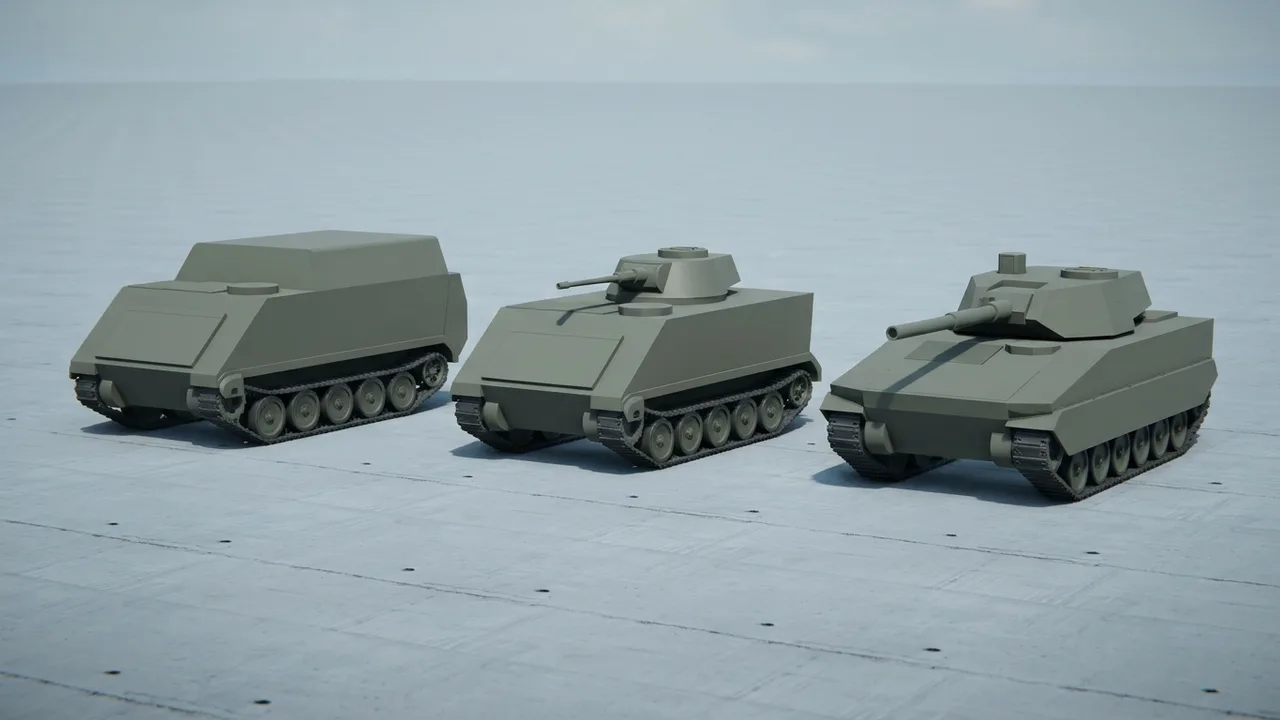
A tracked vehicle rolls down a dirt road on the evening news, and most people call it a "tank." But what if its rear door opens and soldiers climb out? Then it is most likely not a tank at all.
Armored personnel carriers and infantry fighting vehicles can look like tanks, yet they do a different job. Both carry infantry. One is mostly about getting the squad there; the other carries the squad and also fights alongside it. Below, a treaty definition and public U.S. and Korean sources show the difference, and the last part looks at why replacing an old vehicle is so hard.
How a treaty sorts armored vehicles
If you want to count weapons and cut their numbers, you first have to decide which box each one goes in. The Treaty on Conventional Armed Forces in Europe (CFE), signed in 1990, is one such case. It sorts conventional weapons into five groups: tanks, armored combat vehicles, artillery, combat helicopters and combat aircraft. It then puts numerical limits on the ones it covers.
In the treaty, an armored combat vehicle is a self-propelled vehicle with armor protection that can drive across open country. Three kinds sit inside this group: the armored personnel carrier (APC), the armored infantry fighting vehicle (usually called an IFV), and the heavy armament combat vehicle.
The third kind, the heavy armament combat vehicle, is a box for vehicles with a direct-fire gun of 75 mm or more. It holds those that are not an APC, an IFV or a tank. This article focuses on the first two, the vehicles that carry infantry. Tanks are not in this group at all; the treaty counts them separately.
The APC: a protected ride for the squad
Under the treaty, an APC is an armored combat vehicle designed and equipped to carry a combat infantry squad. As a rule, its built-in weapon is under 20 mm caliber. "As a rule" matters here: not every APC has to fit that pattern.
An armored bus is a fair place to start. It takes soldiers where they need to go while armor protects them. The real thing does not have to be a one-job vehicle like a bus, though. The AMPV described below adapts the same hull to move the wounded, to serve as a command post, or to carry a mortar.
The U.S. Army's M113 family is an example. In a 2024 release, the Army describes the AMPV as its program to replace the old fleet of M113 armored personnel carriers dating from the Vietnam War. According to a recent Congressional Research Service (CRS) report, the Armored Multi-Purpose Vehicle (AMPV) replaces the M113 family inside the Armored Brigade Combat Team (ABCT). The M113 family makes up about 30% of the ABCT's tracked vehicles, and the program aims to swap out 2,897 M-113s at brigade level and below.
Five AMPV variants are planned: general purpose, medical evacuation, medical treatment, mission command and mortar carrier. The general purpose variant lets soldiers move under protection next to the ABCT's combat vehicles and supports the infantry squad.
The IFV: carry the squad and fight with it
An IFV is also built mainly to carry a combat infantry squad. The difference lies in its weapons and in how it fights. In the treaty definition, an IFV normally lets the troops fire from inside the vehicle while armor protects them. It carries a cannon of at least 20 mm, and sometimes an anti-tank missile launcher as well.
For what an anti-tank missile is, see Anti-tank guided missiles: rockets versus guided missiles. The definition also goes one step further. IFVs are the principal weapon system of armored, mechanized and motorized infantry units in ground forces. If an APC is close to "the vehicle you ride in," the IFV sits at the center of how those units fight.
The U.S. Army's M-2 Bradley is a well-known IFV. It has been in service since 1981. It carries infantry on the battlefield and gives fire support to troops who have left the vehicle.
Korea has the same kind of vehicle. The Agency for Defense Development (ADD) presents the K21 as an armored vehicle in which infantry can fight while still on board. It has a 40 mm cannon, drives across open country and can also move on water.
On the K21, anti-tank guided missiles are an option, and the vehicle links into a vehicle-to-vehicle data system and the ground tactical C4I system. The K21 serves as a core part of Korea's armored and mechanized forces.
How they differ from a tank
An IFV has a cannon too, so is it just a small tank? In the treaty definitions, the first difference that stands out is a simple one: who was the vehicle built to carry?
The treaty describes a battle tank as a self-propelled armored fighting vehicle with heavy firepower, high cross-country mobility and strong self-protection. It is also a vehicle not designed and equipped mainly to carry combat troops. APCs and IFVs start from the opposite point: carrying an infantry squad is the basis of their design. The tank itself has its own article, Main battle tanks: is it all about the gun?.
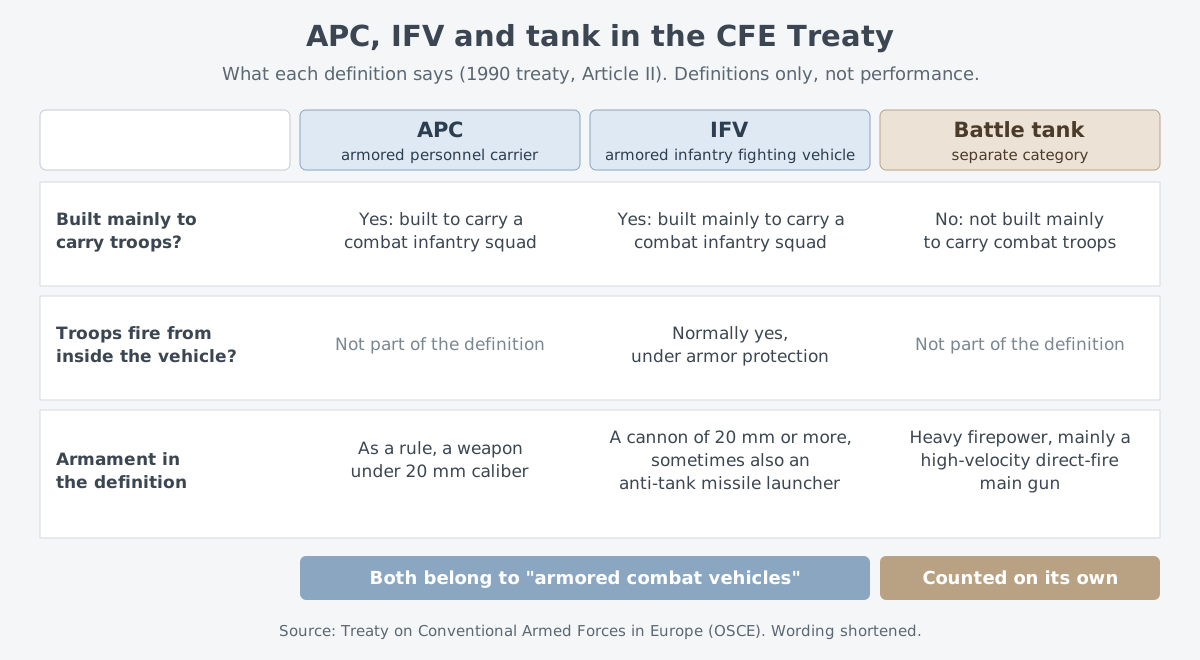
Laid out in a table, the difference is clear. The APC is about carrying, the IFV is about carrying and fighting together, and the tank fights with heavy firepower without carrying troops. Keep in mind that these definitions exist so that weapons can be counted. They are not a scorecard of which vehicle is stronger.
Vehicles that move together in one brigade
These three kinds do not work apart. A single U.S. Army armored brigade combat team includes tanks, infantry fighting vehicles and carrier and support vehicles together.
CRS lists the M-1 Abrams tank as the ABCT's primary major weapon system. The same brigade has the M-2 Bradley IFV, and about 30% of its tracked vehicles are from the M113 family. Defense Department material describes the Bradley's successor as a vehicle that moves soldiers to a favorable position for close combat as part of "combined arms maneuver."
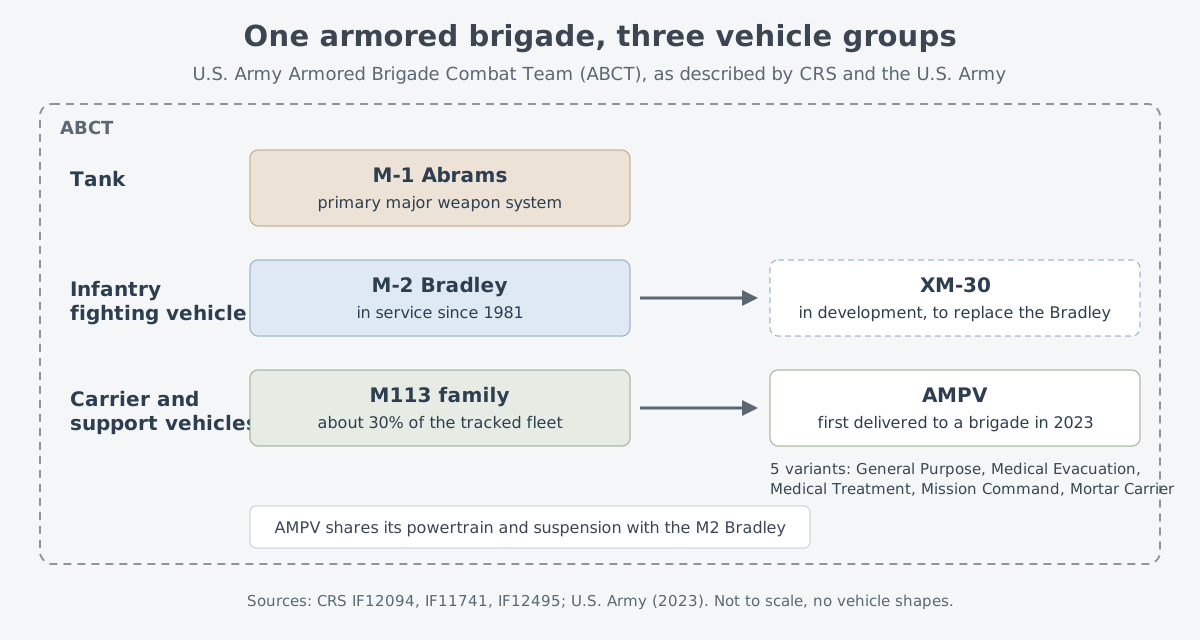
When one brigade mixes vehicle types, it also mixes maintenance and supply. In a 2023 release, the U.S. Army said the AMPV uses the same powertrain and suspension as the M2 Bradley, which lowers the logistics and maintenance load across ABCTs.
Hard to replace: the Bradley successor
The M-2 Bradley has been upgraded many times since 1981. The CRS report notes that it is widely seen as having reached the technical limit of how much new electronics, armor and defensive equipment it can take on. The vehicle is still in service, but adding more to it has become hard.
Building a new one has not gone smoothly. Two earlier efforts to replace the Bradley, the Future Combat System (FCS) and the Ground Combat Vehicle (GCV), were cancelled for program-management and cost reasons. The third attempt began as the Optionally Manned Fighting Vehicle (OMFV). On June 26, 2023, after the first digital design phase ended, it was renamed the XM-30 Mechanized Infantry Combat Vehicle.
"Optionally manned" means the vehicle should also be able to run by remote control with no crew inside. The Army wants a hybrid-electric drive that saves fuel and allows quiet running and watch. The same drive would power new electronic warfare gear, counter-drone defenses, active protection and command systems.
The design follows a modular open systems architecture (MOSA) built on an open standard that the Army defines and owns. As technology and software change, MOSA could help upgrade the vehicle faster and at lower cost.
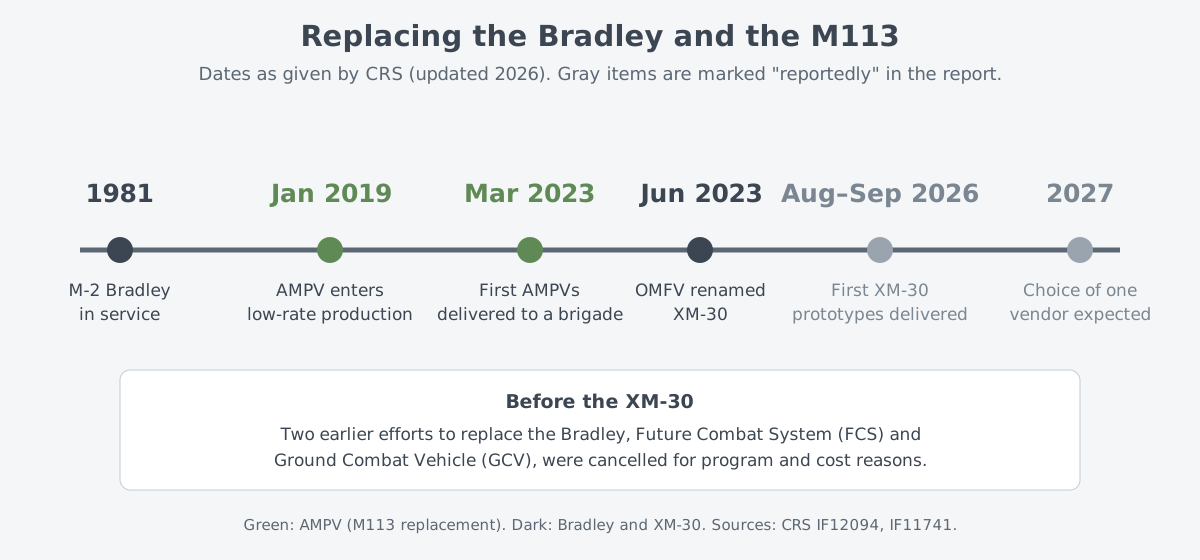
The CRS report also passes on the program's 2026 events, citing press reports. According to those reports, Army leaders did not sign the Milestone B decision papers in February 2026. The program then returned to the rapid prototyping path of the middle tier of acquisition (MTA) that it started on.
According to press reports, the two competitors delivered their first prototypes at the end of August and on September 1, 2026. At the time of the CRS report, the choice of a single company was expected in late spring or in June 2027. Because these points come from press reports, they should be read apart from official decisions.
The same report lists questions for Congress. The Army has said the XM-30 will carry an active protection system (APS) that detects, tracks and defeats anti-tank threats. It is not clear whether the vehicle will also have its own counter-drone capability.
Views are split. Some say one-way attack drones, loitering munitions and uncrewed aircraft may leave armored fighting vehicles obsolete. Others say new technology is needed to help them survive. Why defending against drones takes more than one device is the subject of Counter-drone systems: why one device is not enough.
What to read next
- Main battle tanks: is it all about the gun?: the tank used for comparison here, seen as a balance of firepower, protection and mobility.
- Active protection systems: defending beyond the armor: what the active protection planned for the XM-30 is.
- What is a laser weapon? Film versus reality: the basics of the laser weapons that often come up in talk about drone defense.