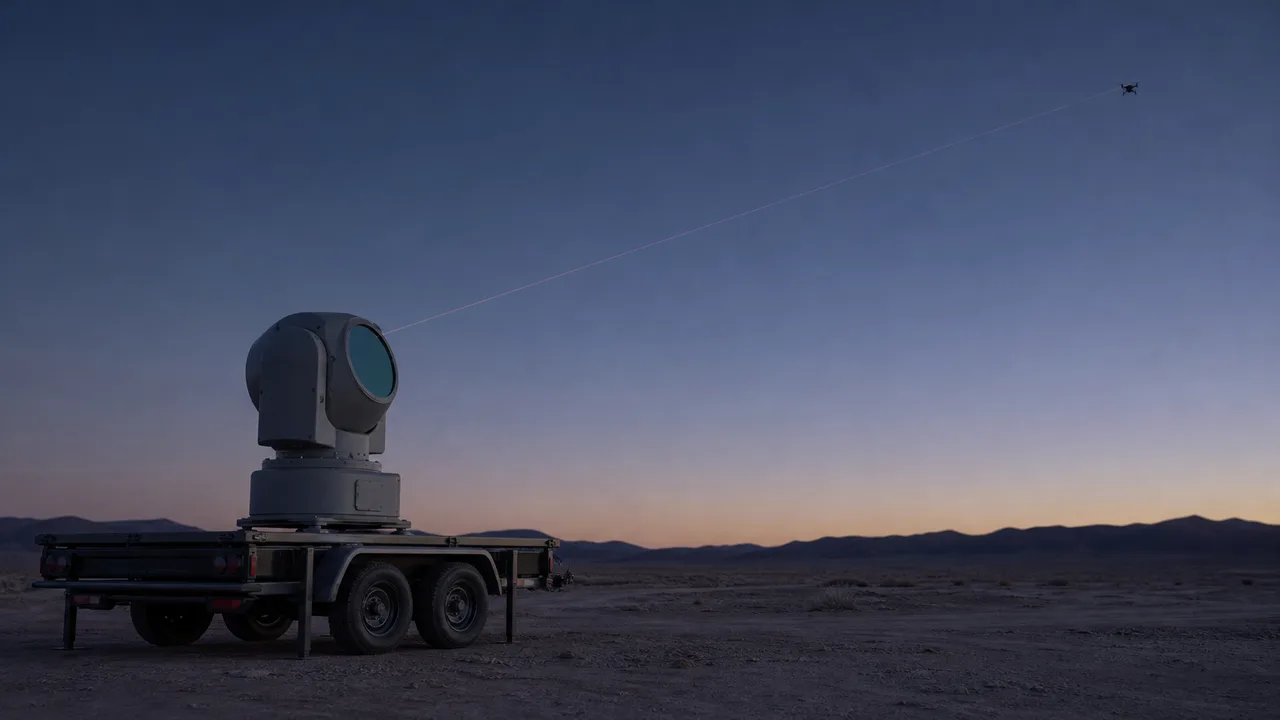
In films, a laser gun fires a red or blue bolt. It makes a "pew" sound, the bolt moves slowly enough to follow with your eyes, and whatever it hits explodes on the spot. A real laser weapon differs from that scene in almost every way.
A real laser weapon keeps light, which may be invisible, on one spot of a target and heats that spot. It sends the light without sound or an explosive flash, and damage builds up while the light stays in place.
So what do terms in the news such as high-energy laser (HEL) and directed-energy weapon (DEW) refer to? And what are these weapons actually meant for?
Lasers in films and lasers in reality
The first difference is whether you can see the light. South Korea's Defense Acquisition Program Administration (DAPA) describes the laser in its laser anti-aircraft weapon as invisible to the eye and silent. A system tested by the British Army sends an intense beam of infrared light to its target. Infrared light is light that human eyes cannot see.
There is also no glowing bolt in flight. Laser light travels at the speed of light and reaches the target almost instantly. Nobody has time to follow it between the moment it fires and the moment it arrives.
The instant explosion is wrong too. The light arrives at once, but damage builds up only while the light stays on the same spot. How long it has to stay depends on the power of the laser.
| Scene | In films | In reality |
|---|---|---|
| The beam | A colored bolt is visible | It may be invisible. Some systems use infrared light |
| Sound | It goes "pew" | It is described as silent |
| Speed | You see a bolt flying | It arrives almost instantly, at the speed of light |
| After the hit | The target explodes at once | The light must stay on one spot, and damage can come within seconds, depending on power |
| Weather and cover | No effect | It works only within line of sight and does poorly in rain or fog |
What a laser weapon does: it heats one spot
Focus sunlight through a magnifying glass onto one spot of a sheet of paper, and after a moment the spot scorches. The light energy has piled up in a small area. A laser weapon does the same thing in broad terms.
In reality, much is different. As What is a laser? explains, laser light leaves in one direction as a narrow beam, while the target is far away and moving. So the system needs separate equipment that keeps the beam on the same spot of the target.
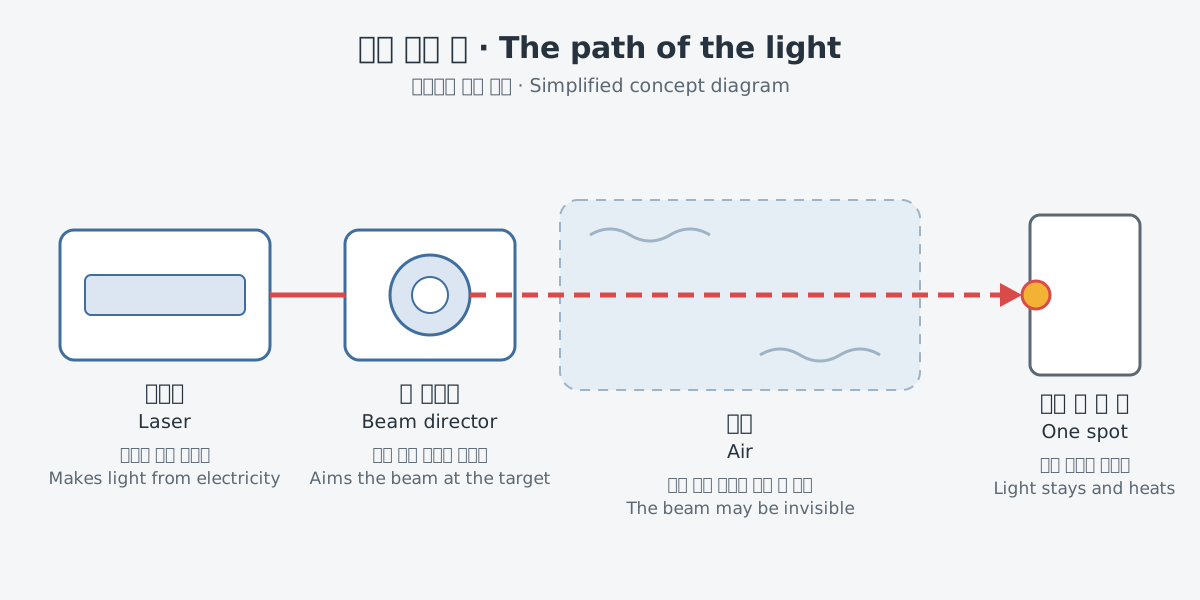
Factories already use lasers for welding, cutting, drilling and heat treatment. The principle behind this is simple. Light that a material absorbs turns into heat, and over time that heat moves into the surrounding material. A laser weapon tries to use this principle at a much longer distance, against a moving target.
The UK Defence Science and Technology Laboratory (Dstl) says laser weapons engage targets at the speed of light and "cut through the target" with an intense beam of light. A Congressional Research Service (CRS) report says that a laser kept focused on one spot of a target can cause disabling damage within seconds, depending on the laser power.
The light also heats the air it passes through. If a laser keeps firing in the same direction for a while, the air along the beam warms up and can spread the beam out. This effect is called thermal blooming. In other words, the light can heat the air before it even reaches the target.
Why heating takes time is the subject of Why a laser weapon does not finish "the instant it fires". For now, the key point is that the effect of a laser weapon is not an explosion but the heat that absorbed light leaves in the target.
The terms high-energy laser (HEL) and directed-energy weapon (DEW)
News reports often mix the two terms. The broader one is directed-energy weapon. A CRS report quotes the U.S. Department of Defense definition. A directed-energy weapon uses concentrated electromagnetic energy, not kinetic energy, to incapacitate, damage, disable or destroy enemy equipment, facilities or personnel.
A kinetic weapon, such as a bullet or a missile, sends an object flying fast so that it hits the target. A directed-energy weapon sends the energy itself, with no object in flight.
Directed-energy weapons include high-energy laser weapons and high-power microwave (HPM) weapons. HPM weapons can affect electronics over a wider area, while high-energy lasers emit a narrower beam. Every laser weapon is a directed-energy weapon, but not every directed-energy weapon is a laser. The two branches are set side by side in Lasers and high-power microwaves: two kinds of directed energy.
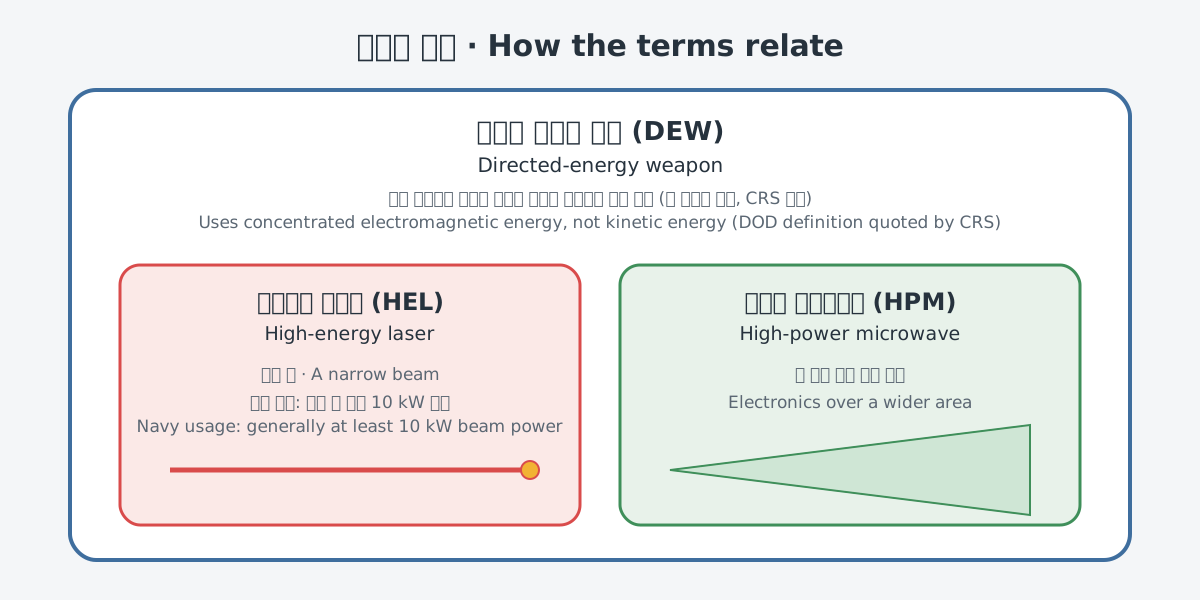
So how strong must a laser be to count as "high-energy"? A CRS report on Navy shipboard lasers says that in Navy discussions, a high-energy laser is generally considered a laser with a beam power of at least 10 kW. As the word "generally" suggests, this is not an official definition, only the usual threshold in Navy shipboard laser discussions.
Power is given in kilowatts (kW) or megawatts (MW), and 1 kW equals 1,000 W. Reports and news often use names like "300 kW class". A budget document for one U.S. Army system writes "300 kW class [>250 kW]", which shows that "class" means a rough grade rather than an exact value.
What one such number can and cannot tell you is covered in Power, energy and intensity: W, J and W/cm².
What it is meant for, according to official sources
Official reports usually describe uses with words like "could" and "might". Read the table below as uses that official sources are studying or have announced, not as a fixed list of missions.
| Use | English term | Source |
|---|---|---|
| Short-range air defense | short-range air defense (SHORAD) | Congressional Research Service report, ground forces |
| Countering unmanned aircraft | counter-unmanned aircraft systems (C-UAS) | Congressional Research Service report, ground forces |
| Countering rockets, artillery and mortars | counter-rocket, artillery, and mortar (C-RAM) | Congressional Research Service report, ground forces |
| Briefly blinding or damaging satellites and sensors | dazzle | Congressional Research Service report |
| Jamming surveillance sensors, countering small boats and drones, and possibly anti-ship missiles in the future | ISR sensors, small boats, UAVs, anti-ship missiles | Congressional Research Service report on shipboard lasers |
| Precision strikes on small drones and multicopters at short range | small drones, multicopters | DAPA (South Korea) |
Lasers for Navy ships are generally described as short-range defensive weapons. The CRS report on shipboard lasers expects them to counter targets at ranges of about one mile, perhaps eventually a few miles. As line-of-sight weapons, they engage only targets with a straight, unobstructed path to the laser.
Destroying things is not the only use. An appendix of the same report explains that lasers can also detect and monitor targets and produce nonlethal effects, such as reversible jamming of electro-optic (EO) sensors. Briefly "dazzling" a sensor is one example.
South Korea's laser anti-aircraft weapon Cheongwang was fielded in December 2024, according to DAPA. It shines light from a fiber laser directly on the target to strike small drones and multicopters at short range.
A laser alone is not enough
The name "laser weapon" makes it easy to picture a single laser. In reality it is a system of many parts working together. The budget document for the U.S. Army system mentioned above lists its parts. They are a vehicle, a 300 kW class laser subsystem, a power and thermal subsystem, and a beam control subsystem integrated with battle management, command, control and communication software.
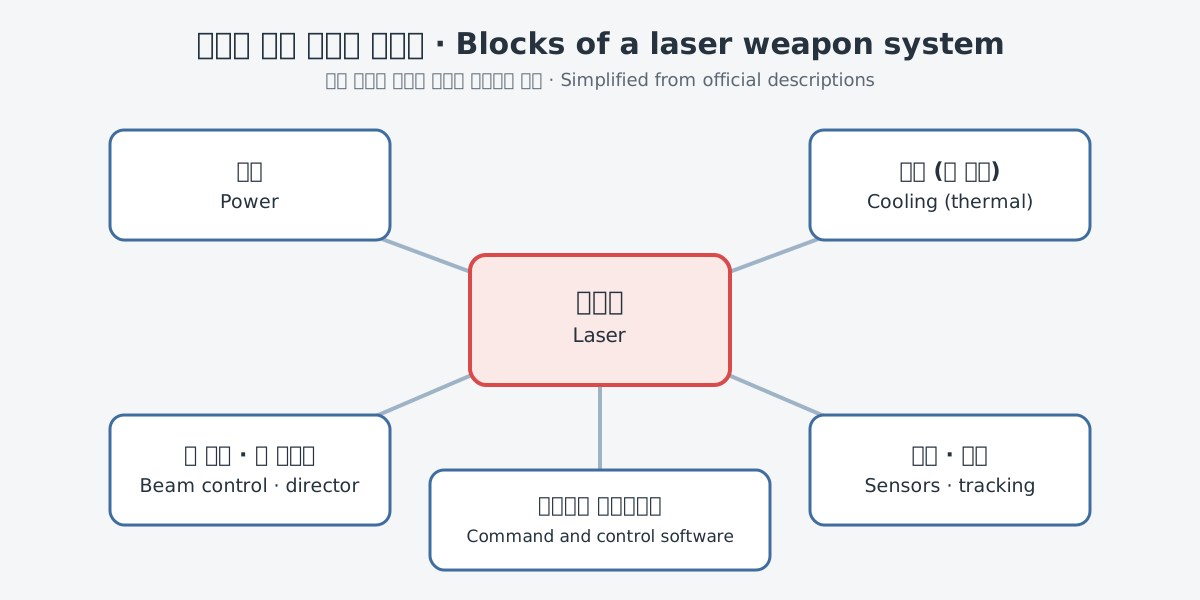
The laser that makes the light is still the center. DAPA calls the laser oscillator the most important core component, the one that decides the performance of a laser weapon. That light comes from electricity.
Cheongwang needs no separate ammunition and runs as long as electricity is supplied, and many current U.S. programs also use solid-state lasers powered by electricity. In place of ammunition, the system needs enough electrical power.
The beam director sends the light to the target. A beam director gathers the powerful laser energy and points it at the target. The British Army's test system uses advanced sensors and tracking systems to keep lock-on and accuracy in real time.
Size and cooling are major challenges as well. Open questions of technological maturity include raising beam quality and control to militarily useful levels. They also include meeting size, weight, and power (SWaP) and cooling requirements for current platforms. Some systems are small enough for military vehicles, but many need larger or fixed platforms.
Weather and terrain come into play too. Laser light crosses the air on an essentially straight path, so a laser can engage only targets within line of sight. It may work poorly or not at all in rain or fog, and official reports do not treat lasers as an all-weather solution.
The United States has researched directed energy since the 1960s. Some experts observe that the Department of Defense spent billions of dollars on programs that never matured and were cancelled. In 2014, it deployed the first operational U.S. directed-energy weapon aboard the Navy ship USS Ponce. After a trial, a team leader at the UK's Defence Equipment & Support (DE&S) still called it "an emerging technology".
That long path is traced in A history of laser weapons: from chemical to electric lasers.
What to read next
Six articles follow. Why a laser weapon does not finish "the instant it fires" explains why turning light into heat takes time.
Strengths and limits of laser weapons gathers the strengths and limits that official reports list into one table. A laser weapon is more than a laser: the system at a glance shows how the laser, optics, power, cooling and drive parts connect.
How to read laser weapon news: "kW-class", "range" and "cost per shot" covers what the words in a news report mean.
A history of laser weapons: from chemical to electric lasers follows the path to today's electrically powered lasers. Laser weapon programs that have been made public gathers cases that governments have officially announced.