
When a missile intercept appears on the TV news, the screen often shows one interceptor climbing into the sky. Missile defense is not built from one kind of interceptor, though. Different interceptors wait high in the sky, in space and close to the target, and sensors and communication links bind them together.
Why not stop at a single layer? The answer lies in how a ballistic missile flies. This article starts with how official U.S. sources divide the flight into phases, then looks at what layers give and what limits remain. At the end, it widens the view to drones and asks where lasers fit.
A ballistic missile flies in three phases
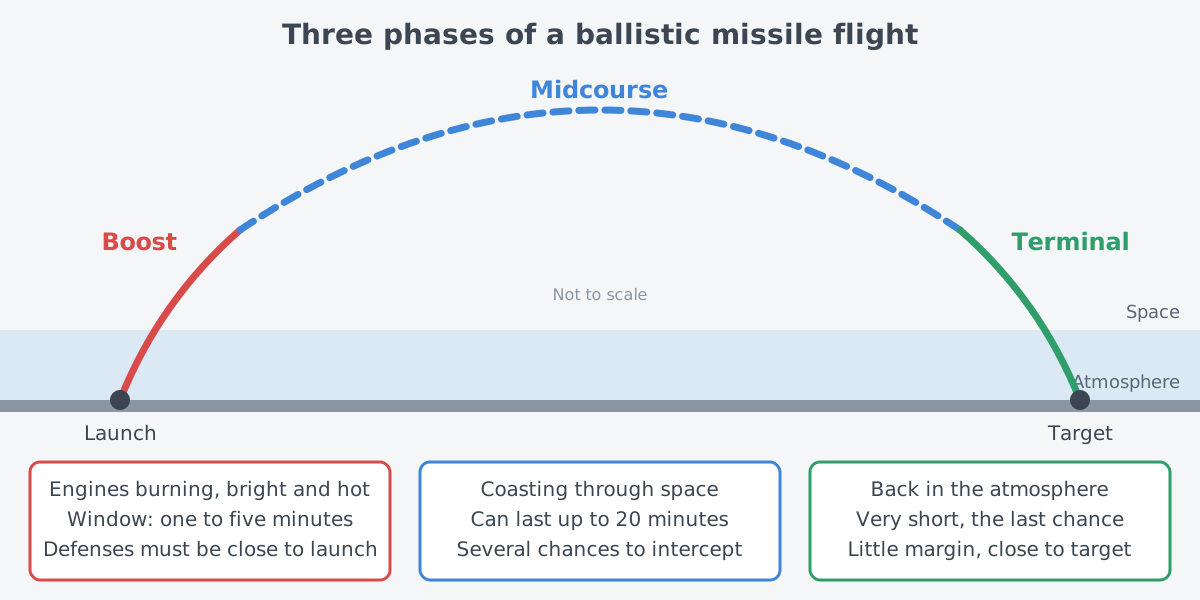
A ballistic missile first climbs on the thrust of its rocket engines. Once the engines stop, it follows a fixed path, much like a thrown ball. The U.S. Missile Defense Agency (MDA) usually splits this path into three phases. The boost phase lasts while the engines burn, the midcourse phase crosses space, and in the terminal phase the missile falls back through the atmosphere toward its target.
Missiles are not all alike either. A defense primer from the Congressional Research Service (CRS) groups them by reach. Short-range ballistic missiles reach 300–1,000 km, medium-range ones 1,000–5,500 km, and intercontinental ones beyond 5,500 km. MDA says U.S. missile defense technology is designed to counter missiles of every range, from short to long.
Each phase brings its own difficulty
The boost phase is when a missile is easiest to find, because its exhaust is bright and hot. Yet it is the hardest phase in which to intercept. The window to intercept lasts only 1 to 5 minutes, and both the interceptors and the sensors have to be close to the launch site.
In the midcourse phase, the booster has burned out and the missile coasts through space. This stretch can last up to 20 minutes. With that much time, there are several chances to try an intercept outside the atmosphere.
The terminal phase begins when the missile re-enters the atmosphere, and it is very short. It is the last chance before the warhead arrives. There is little room for error, and the intercept happens near the place being defended. That makes it the hardest and least desirable of the three phases.
Put the three phases side by side, and the easy and hard parts trade places from phase to phase. When the missile is easy to see, defenses struggle to be close enough. When there is plenty of time, the missile is out in space. When it is closest, almost no time is left.
What layers give: more than one chance
Missiles differ in range, speed, size and performance. For that reason, the U.S. missile defense system is built as an integrated, "layered" structure. The aim is to create several chances to destroy a missile and its warhead before they reach their target. What one layer misses, the next layer can take on.
Each layer covers a different phase. The hit-to-kill systems at the center of today's U.S. ballistic missile defense are each designed to intercept a missile at one particular stage of flight. Grouped by phase, the examples in the CRS primer look like this.
| Phase covered | Example in official sources | What it is designed to face |
|---|---|---|
| Midcourse | Ground-based Midcourse Defense (GMD) | Intercontinental ballistic missiles; the only U.S. hit-to-kill defense against them |
| Midcourse | Aegis Ballistic Missile Defense (Aegis BMD) | Short- to intermediate-range ballistic missiles |
| Terminal | THAAD | Short- and medium-range ballistic missiles |
| Terminal | Patriot (PAC-3) | Works with THAAD for an integrated, overlapping defense in the terminal phase |
A soccer defense gives a rough picture: when an attacker brings the ball forward, a midfielder tries first, then a defender, and finally the goalkeeper. Real missile defense differs in many ways. Each layer is not a player on the same field but a separate piece of equipment. Each one is designed for a particular stage of flight.
What ties the layers together: sensors and command
Stacking layers is not enough to make a system. The interceptors further back need to know what the sensors further forward have seen. The United States links sensors on land, at sea and in space into a network that detects and tracks targets. A command, control and battle management network connects those sensors to the interceptors.
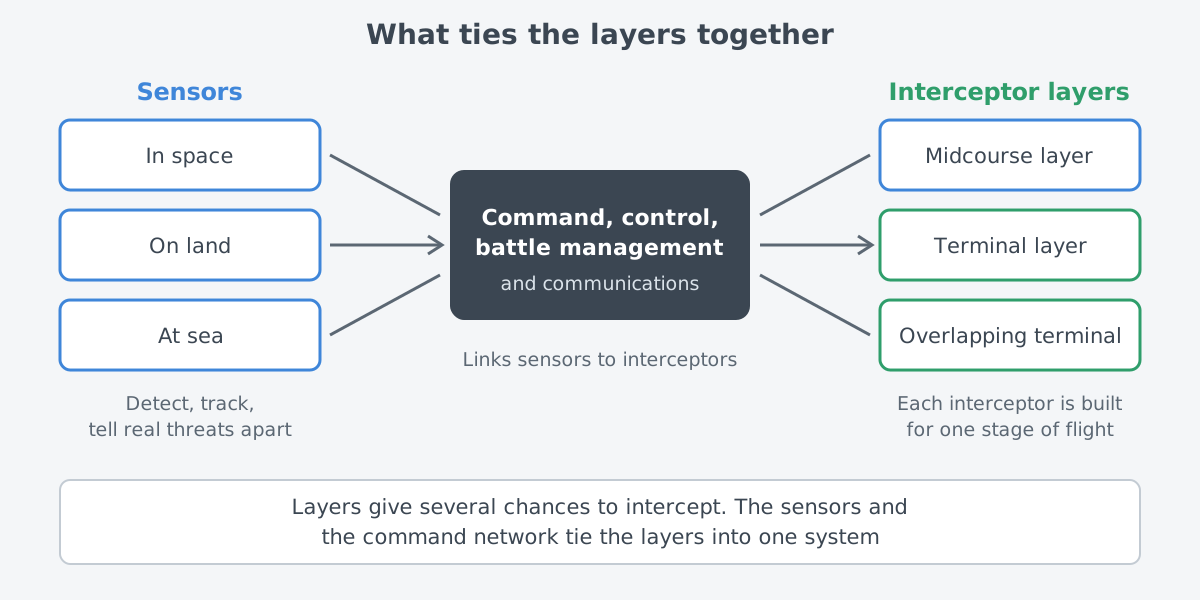
The part that does this linking is Command and Control, Battle Management and Communications (C2BMC). It is the element that integrates the whole missile defense system. An effective layered defense includes many kinds of sensors that detect and track a threat through every phase of flight. Besides finding and following objects, sensors also help pick out the real threat.
How information from many sensors is merged into one picture continues in "Integrated air defense and sensor fusion." The basic way radar measures distance and motion is in "Radar: measuring distance and motion with radio waves."
Limits that remain
Many layers do not mean everything can be stopped. The CRS primer states plainly that U.S. ballistic missile defense was never meant to handle every kind of ballistic missile threat. Every defense has an intended opponent and scope set from the start.
Numbers matter too. The same primer notes that recent conflicts have shown how large, mixed salvos of missiles and drones can overwhelm missile defenses and drain stocks of interceptors. Among the questions it suggests Congress might ask is whether interceptor and launcher capabilities, stockpiles and rates of purchase are enough.
Cost and connection are open issues as well. The U.S. Missile Defense Reviews of 2019 and 2022 differ in places. Both, however, stress an integrated system, resilient networks of sensors, and costs the country can bear.
Widening the view: aircraft and drones too
Ballistic missiles are not the only threat. NATO's Integrated Air and Missile Defence (IAMD) uses a 360-degree approach that deals with air and missile threats from every direction. It covers both round-the-clock air defense and ballistic missile defense. NATO says its air defense uses many layers facing every direction, which lets it react faster and more flexibly when the security situation shifts.
As drones have spread, the layers have reached lower. The CRS counter-drone primer places counter-drone work inside an air and missile defense concept with six layers, drawn up by the U.S. Army's Combat Capabilities Development Command. Two of those six are high-energy laser (HEL) programs, and none of these systems has finished development. The full picture of drone defense is in "Counter-drone systems: why one device is not enough."
When a laser takes over one layer, the other layers can carry less, a point made in a CRS report on Navy shipboard lasers. Even a laser that can stop small boats and drones, but not anti-ship cruise missiles, could indirectly help a ship against those missiles. It would let the ship spend fewer surface-to-air missiles on drones and keep more for cruise missiles. How lasers, interceptor missiles and air defense guns share the work continues in "Lasers, interceptor missiles and guns: how they share the work."
What to read next
- Lasers, interceptor missiles and guns: how they share the work: sets the share a laser can take among the layers next to the other means.
- Integrated air defense and sensor fusion: looks more closely at the sensors and command links that tie the layers together.
- Counter-drone systems: why one device is not enough: splits the lowest layer, drone defense, into detection, identification and response.