Say "torpedo" and most people picture a submarine firing one underwater. Yet some torpedoes are dropped into the sea from helicopters and patrol aircraft. Are these the same weapon fired from different places, or different weapons from the start?
Navy sources sort torpedoes into two groups: lightweight torpedoes and heavyweight torpedoes. This article uses public material from the U.S. Navy and Korea's Agency for Defense Development (ADD) to compare the two. It looks at who launches them, their diameter and weight, what they are aimed at, and the version numbers that keep changing under the same name.
Names sorted by who launches them
The first difference is who does the launching. The U.S. Navy's MK 54 lightweight torpedo is an anti-submarine weapon launched from surface ships and aircraft. The MK 46, first introduced in 1965, belongs to the same group. It is now the NATO standard, and more than 25 countries have bought it.
Korea's lightweight torpedo, the Blue Shark, comes from similar places. Surface combat ships, maritime helicopters and submarine-hunting patrol planes all use it.
Heavyweight torpedoes belong to submarines. Every class of U.S. Navy submarine carries the MK 48 heavyweight torpedo. A 2009 article on the Korean government's Policy Briefing portal, supplied by the defense daily Kookbang Ilbo, made the same split. While describing a ship attacking with a lightweight torpedo, it added in brackets that a torpedo fired from a submarine at a submarine or a ship is a heavyweight torpedo.
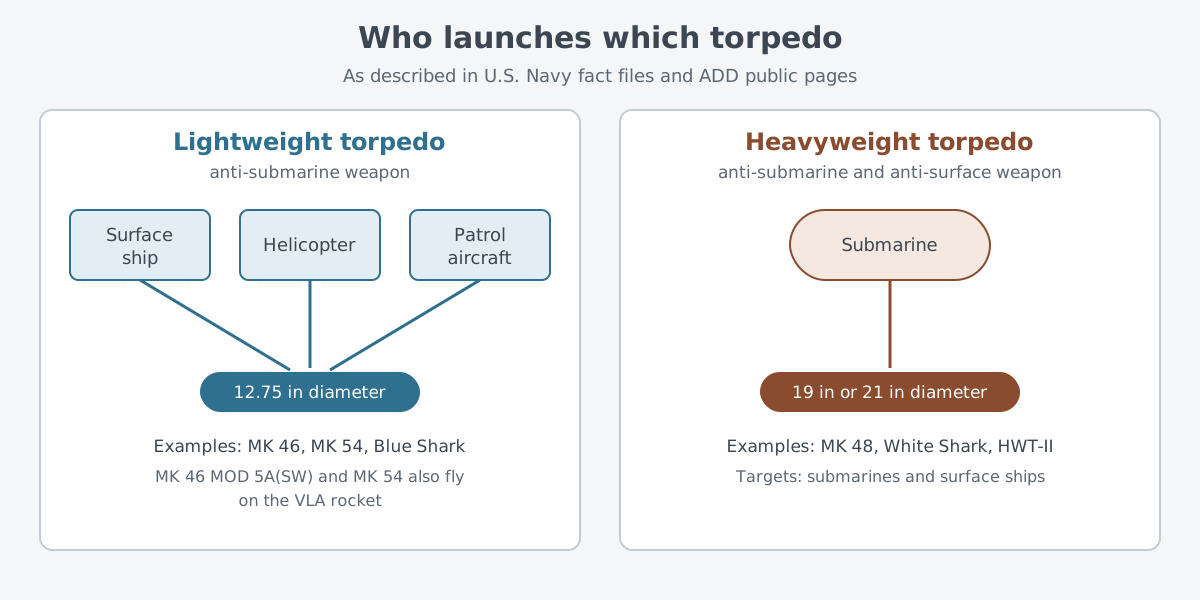
A lightweight torpedo can also travel on a rocket. The MK 46 MOD 5A(SW), an upgraded MK 46, serves as a payload for the Vertical Launch Anti-Submarine Rocket (VLA). The MK 54 VLA system reached initial operational capability in 2010. Even when a rocket carries it, the cargo is still a lightweight torpedo.
Comparing diameter and weight
"Light" and "heavy" show up in actual size too. Put the published general characteristics side by side and the gap is plain.
The MK 54 is 12.75 inches (about 32 cm) across and weighs 607 pounds (about 275 kg). The MK 46 is also 12.75 inches across and weighs 518 pounds (about 235 kg). The Blue Shark, which ADD calls a "standard type" lightweight torpedo, is 12.75 inches across as well.
Heavyweight torpedoes are much thicker and heavier. The MK 48 is 21 inches (about 53 cm) across and weighs 3,744 pounds (about 1,700 kg), more than six times the weight of the MK 54. Among Korea's heavyweight torpedoes, the White Shark is 19 inches (about 48 cm) across and the HWT-II is 21 inches.
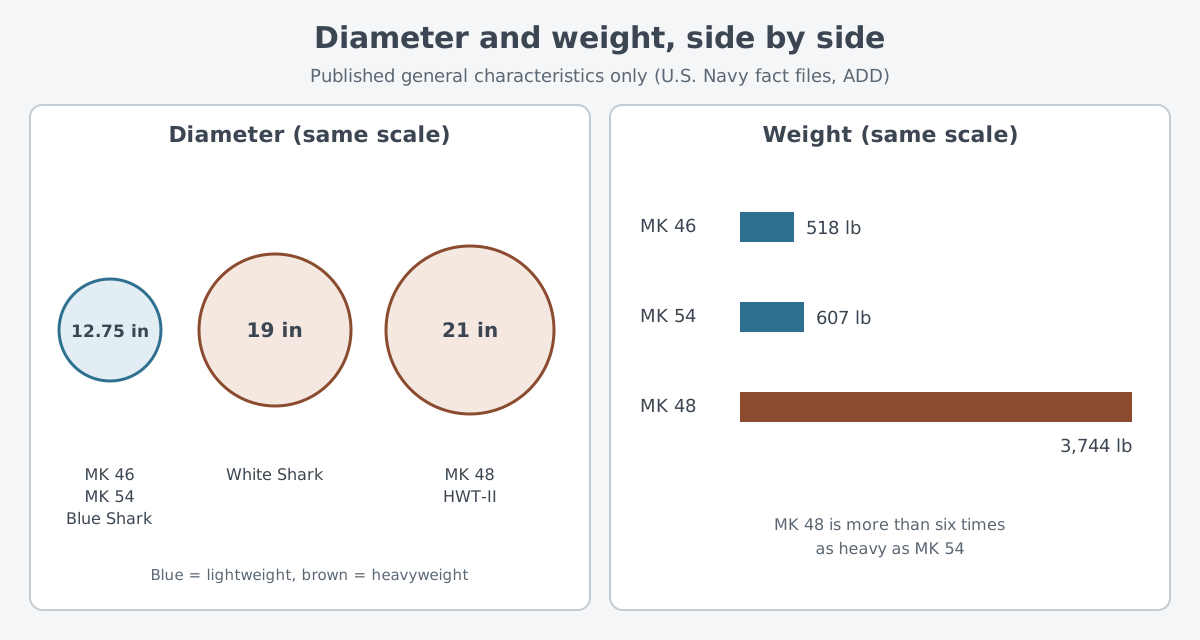
The same figure, 12.75 inches, appears for lightweight torpedoes from both the U.S. and Korea. Like batteries of the same size, several lightweight torpedoes share one diameter. The comparison has a limit, though. Public sources confirm only that the diameter matches; that number alone does not tell you whether one can stand in for another.
One weapon for submarines and surface ships
The two groups also differ in their targets. The official descriptions of the MK 46, MK 54 and Blue Shark all call them "anti-submarine" weapons. They are meant for submarines under the water.
A heavyweight torpedo covers both jobs. The MK 48 serves submarines in both anti-submarine warfare (ASW) and anti-surface warfare (ASuW) roles. The White Shark is likewise described as a weapon against both surface ships and submarines, and the HWT-II as a wire-guided torpedo for surface and sub-surface targets. For a submarine, the heavyweight torpedo is the weapon that deals with ships on the surface as well as submarines below it.
Underwater, the search is by sound
What does a torpedo use to find a target underwater? Sound. According to the U.S. National Oceanic and Atmospheric Administration (NOAA), sound waves travel farther in water than radar or light waves. That is why sonar is used to explore the ocean.
The MK 48 is an "acoustic-homing" heavyweight torpedo. It carries sophisticated sonar and all-digital guidance and control. The Blue Shark lightweight torpedo has also been described as following the sound of an enemy submarine underwater.
Sonar comes in two kinds. Active sonar sends a burst of sound out through the water and picks up the echo that bounces back from an object. The time between sending the pulse and receiving it gives the object's range and direction. Passive sonar sends out no signal of its own and only picks up sound waves coming toward it.
Picture shouting in the mountains and waiting for the echo, and you have active sonar. The echo picture fits only the active kind, though. The passive kind makes no sound and just listens.
The White Shark has both kinds. ADD says the White Shark's passive and active acoustic homing is meant for shallow water, which it calls crucial in the seas around the Korean peninsula.
Torpedo names in the Korean Navy
Korean torpedoes are named after sharks. The lightweight torpedo is the Blue Shark (Cheongsangeo), and the heavyweight torpedoes are the White Shark (Baeksangeo) and Beomsangeo. ADD's list of major research and development results lists them as "Cheongsangeo (lightweight torpedo)" and "Beomsangeo (Heavyweight Torpedo-II)."
ADD's history page lists the White Shark, labeled a heavyweight torpedo, under its "growth and leap" period of 1980–1999. ADD's English pages describe the White Shark as a 19-inch heavyweight torpedo and the HWT-II as a 21-inch wire-guided torpedo. So two heavyweight torpedoes of different diameters are on public record.
The English names line up with the Korean ones. Cheongsangeo is the Blue Shark and Baeksangeo is the White Shark. Beomsangeo appears on the English pages not under a shark name but under a category name, Heavyweight Torpedo-II.
Same name, changing insides
The MK 48 name has stayed the same for a long time, but the torpedo inside it has changed several times. The U.S. Navy gives each version a MOD number. The last production MK 48 MOD 6 was delivered in 1996, and MOD 6 reached initial operational capability (IOC) in 1997. Since then, the Navy has improved MOD 6 with upgrade kits for its guidance and control and its propulsion.
The newest version, MOD 7, came out of a joint development program with the Royal Australian Navy and reached IOC in 2006. The MK 48's digital guidance system is built to be improved again and again through software. The MOD 7 hardware upgrade widened the room for those software improvements.
Lightweight torpedoes follow the same pattern. The MK 54 MOD 0 combined hardware and software from the MK 46 and MK 50 programs with commercial digital signal processing, and it reached IOC in 2004. In 2023, MOD 1, with a new sonar array and related electronics, reached IOC. The MK 46 has also received several rounds of upgrades to its acoustics, guidance and control, and ability to detect countermeasures.
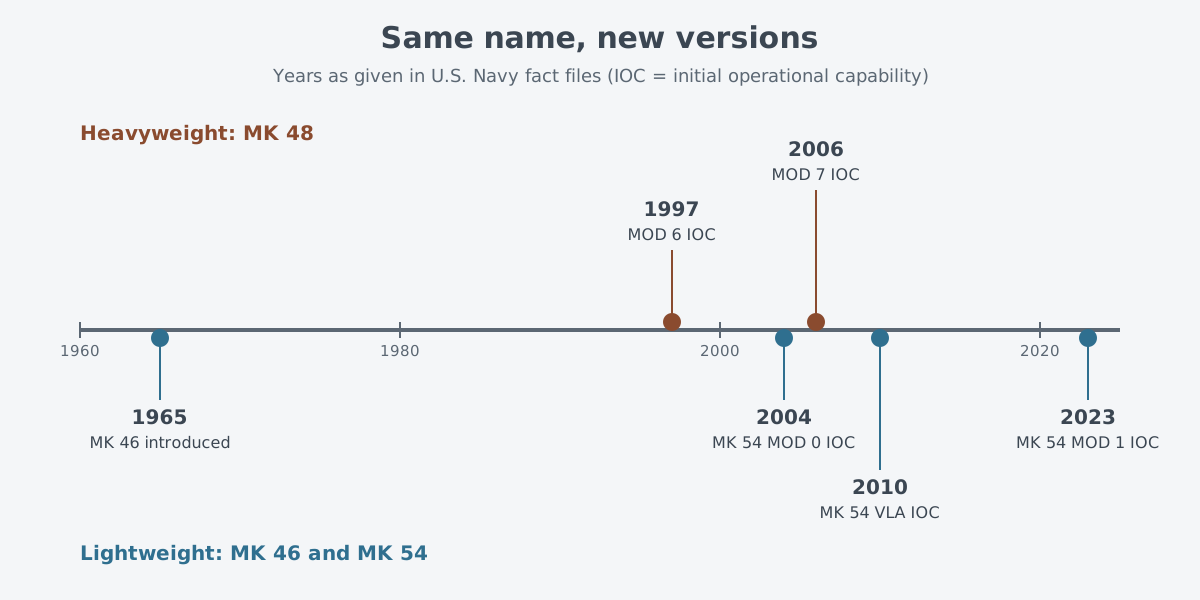
So when a news story names only "MK 48" or "MK 54," you cannot tell which version it means. Under the same name, the hardware and software have kept changing.
Where this meets lasers: sound instead of light
A laser weapon sends light through the air. On the way, the air absorbs, scatters and shakes the light. The article Light through air goes through these limits one by one.
Water is a different story. Underwater, sound waves travel farther than light. A laser in the air is judged first by how far its light gets; a torpedo in the water, by how far sound gets.
What to read next
- "The Blue Shark lightweight torpedo": a closer look at one Korean lightweight torpedo.
- "The Red Shark anti-submarine weapon: a torpedo that flies": a weapon that carries a torpedo through the air.
- "Sonar: why sound is used to see underwater": more on how active and passive sonar work.
- Light through air: absorption, scattering, turbulence, thermal blooming: the limits laser light meets as it crosses the air.