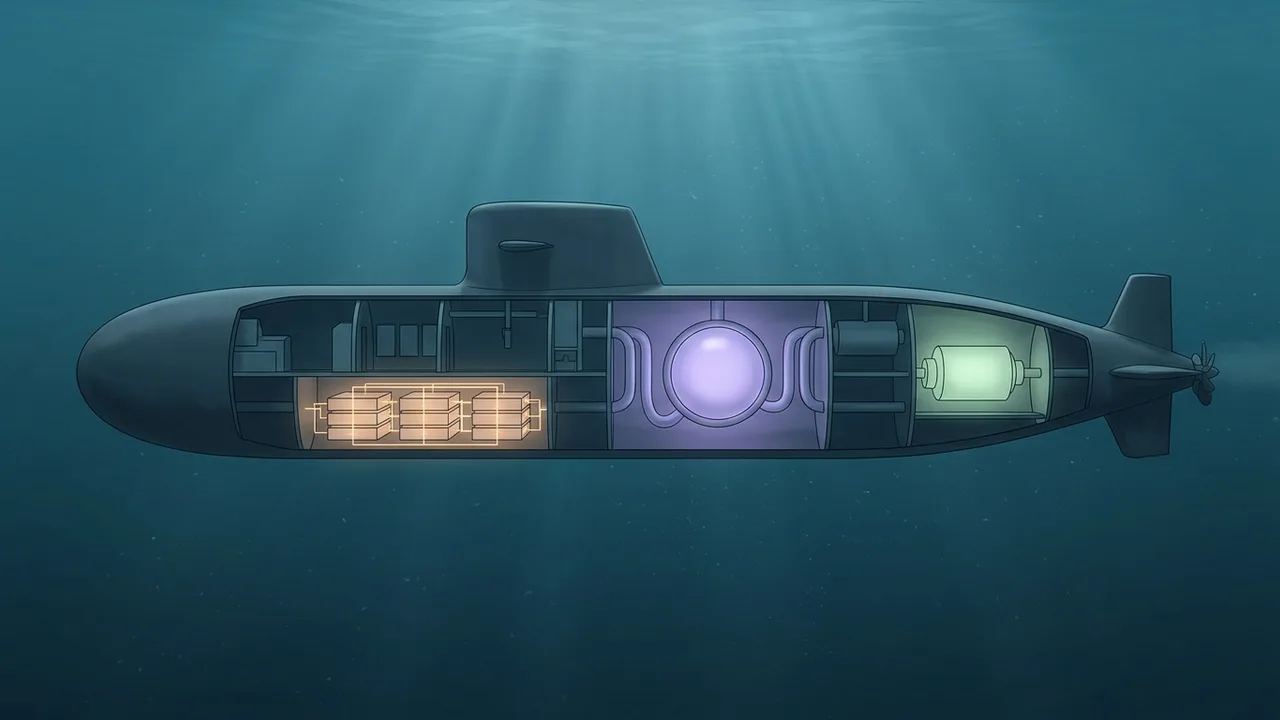
Picture a diesel engine running inside a submarine. The engine has to burn fuel, and burning needs air. Deep under the sea, though, there is no air to breathe in.
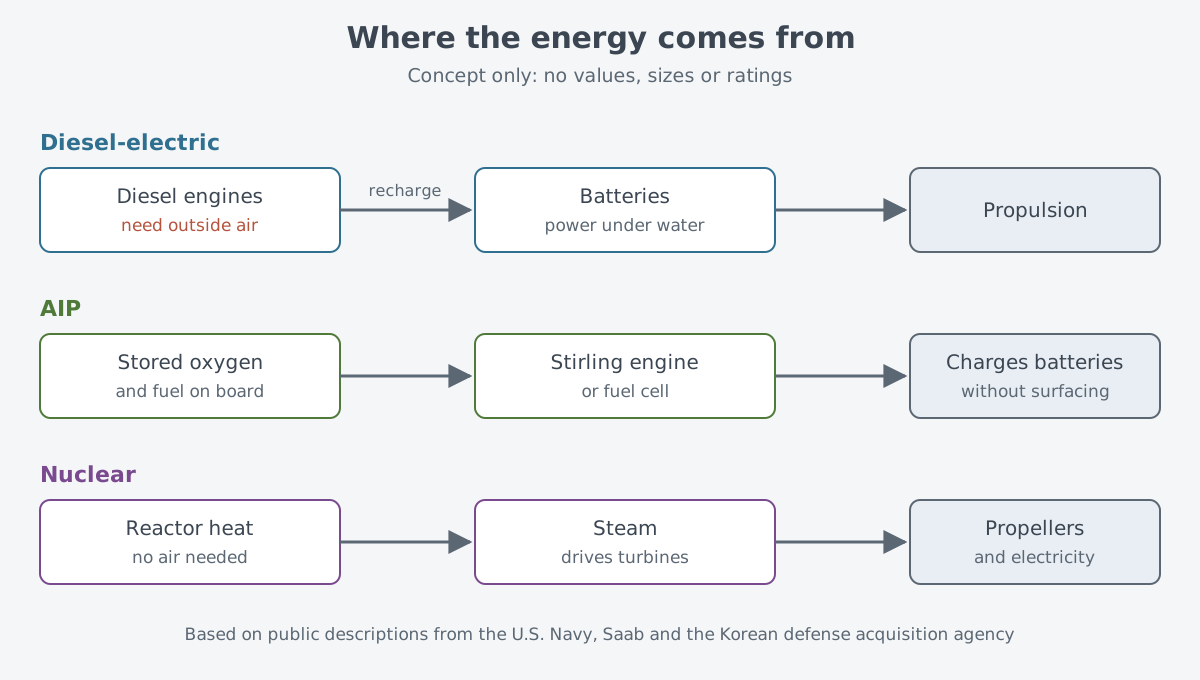
What moves a submarine is really a story about how to get around that problem. This article looks at three answers: diesel-electric, air-independent propulsion (AIP) and nuclear power. For each one, it shows where the energy comes from and why the time under water differs.
Underwater, there is no air
Submarine power sources fall into two groups. A boat runs either on a nuclear reactor or on a nonnuclear source like diesel engines or fuel cells. That is how the Congressional Research Service (CRS) sorts them, and every U.S. Navy submarine is nuclear-powered.
An engine that burns fuel has to take in air to run. For a ship on the surface that is no trouble. For a submarine that needs to stay hidden under water, it is a serious limit, and the three designs work around it in different ways.
Diesel-electric: charge near the surface, run on batteries below
A diesel-electric submarine splits the job in two. Under water it runs on electricity stored in batteries, and when the batteries run low, its diesel engines charge them again. Diesel engines need air, so to recharge, the boat has to come up to the surface or break the surface with a snorkel.
It is a bit like a mobile phone. You use the battery while you are out and plug in when you find a socket. The real case is different. The submarine's "socket" is its own diesel engine, and because that engine must breathe, the boat has to stay near the surface while it charges.
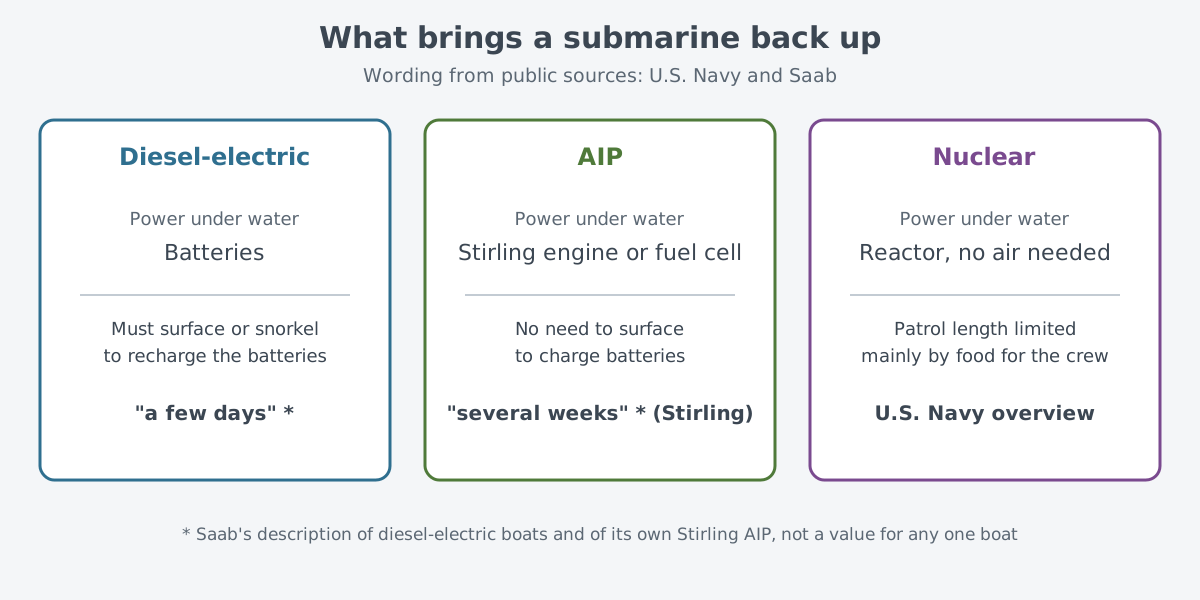
So how long can it stay down? Saab, which builds Sweden's submarines, says a boat with only diesel-electric propulsion can stay under water for a few days before it must come up. Before nuclear power, submarines were tied to battery power, could travel 150 miles or fewer under water, and moved much more slowly.
Nuclear propulsion was developed to remove exactly this limit. An article by the National Nuclear Security Administration (NNSA) Administrator names two big shortcomings of earlier boats. They could go only as far as their fuel allowed, and they had to come up often to refill their batteries.
Better batteries also mean more time under water. South Korea's Jang Yeongsil, launched on October 22, 2025, carries lithium batteries that lengthen both its submerged time and the time it can sail at top speed. A diesel submarine, it is due to reach the navy at the end of 2027.
AIP: more time without outside air
Air-independent propulsion, or AIP, is just what the name says: a way to make electricity without outside air. If a submarine carries its own oxygen and fuel, it can recharge its batteries without coming up.
The Stirling engine used in Swedish submarines is one example. Heating and cooling the gas inside it moves a piston in a cylinder. The heat comes from burning low-sulfur diesel with liquid oxygen kept in tanks on board, and cold seawater does the cooling. Each engine sits in a module that also holds the oxygen and fuel systems and a generator.
Saab says that with its Stirling AIP the boat need not come up to recharge, so time under water grows from days to weeks. That is a maker describing its own product, so it is best not read as a value for any one boat. The first Stirling engine in a submarine went into the Swedish Navy's HMS Näcken in 1988. The boat was cut in two in a dry dock, drained of water, and a new AIP section was fitted in between.
AIP can also use fuel cells. South Korea's Anmu, a Jangbogo-III Batch-I boat, carries an air-independent system built on Korean fuel cell technology. The country's defense acquisition agency says this lets it keep up long underwater operations.
Nuclear power: reactor heat boils water
A nuclear submarine solves the air problem in a completely different way. Heat from a reactor boils water, and the steam turns turbines.
U.S. naval nuclear plants are pressurized-water reactors with two separate closed water loops. In the first, the primary loop, heat from the reactor core passes into water held under pressure so it cannot boil. That water flows to a steam generator and then back to the reactor.
In the second, the secondary loop, water picks up that heat across a watertight wall inside the steam generator and boils. The steam spins the main propulsion turbines that turn the propellers, and the turbine generators that supply the boat with electricity. After the turbines, the steam turns back into water and returns to the steam generator. Because the loops stay apart, radioactivity does not get into the water of the second loop.
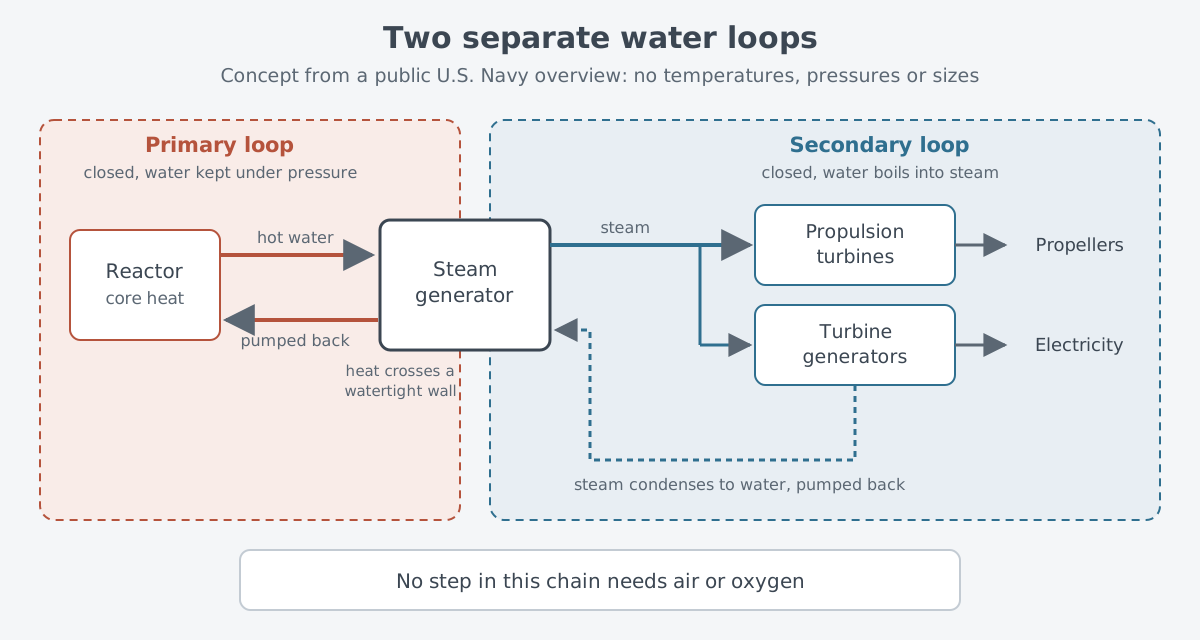
No step in this chain uses air or oxygen. The boat can also make oxygen and clean water from seawater, so it can stay cut off from the atmosphere for long periods. As a result, the length of a submerged patrol is set mainly by how much food the boat can carry for the crew.
How far one reactor core can take a ship before refueling has also grown a great deal. As an example of technical progress, the NNSA says the first submarine core went about 62,000 miles, while today's submarine and aircraft carrier cores go more than 1 million miles.
The first nuclear submarine was the U.S. Navy's USS Nautilus. On January 17, 1955, as it headed out on the Thames River in Connecticut, it signaled "UNDERWAY ON NUCLEAR POWER." In 1958 it traveled more than 2,000 miles beneath the polar ice.
The three side by side
One question separates the three designs: what brings the submarine back up?
A diesel-electric boat has to come up when its batteries run low. AIP uses stored oxygen and fuel to recharge the batteries and pushes that moment back. A nuclear boat uses a heat source that needs no air, so its time under water depends more on food than on fuel or air.
According to the NNSA article, nuclear submarines could stay submerged for long stretches: first for days and, later, for months. South Korea fitted fuel cell AIP to the Anmu and lithium batteries to the Jang Yeongsil. These are other answers to the same task: staying under water longer without a reactor.
Nuclear-powered is not nuclear-armed
The phrase "nuclear submarine" can mean two things. It can mean a submarine that runs on a reactor, or one that carries nuclear weapons. The CRS report states plainly that whether a submarine uses nuclear or nonnuclear power says nothing about whether it carries nuclear weapons.
A submarine with a reactor may have no nuclear weapons aboard, and one without a reactor may carry them. U.S. Navy hull codes keep the two apart. SS stands for submarine, N for nuclear-powered, B for ballistic missile and G for guided missile. So an SSN is a nuclear-powered submarine, and it takes an added B to make a ballistic missile submarine.
What to read next
- SLBMs: how a missile starts from under the sea: how the ballistic missiles that submarines carry start their flight from under water.
- Sonar: why submarines "see" with sound: how a submarine senses its surroundings in water, where there is no air.
- Power and efficiency: the share of electricity that becomes light sets the size of the system: why efficiency matters when a ship's own electricity powers a weapon, seen from the laser side.