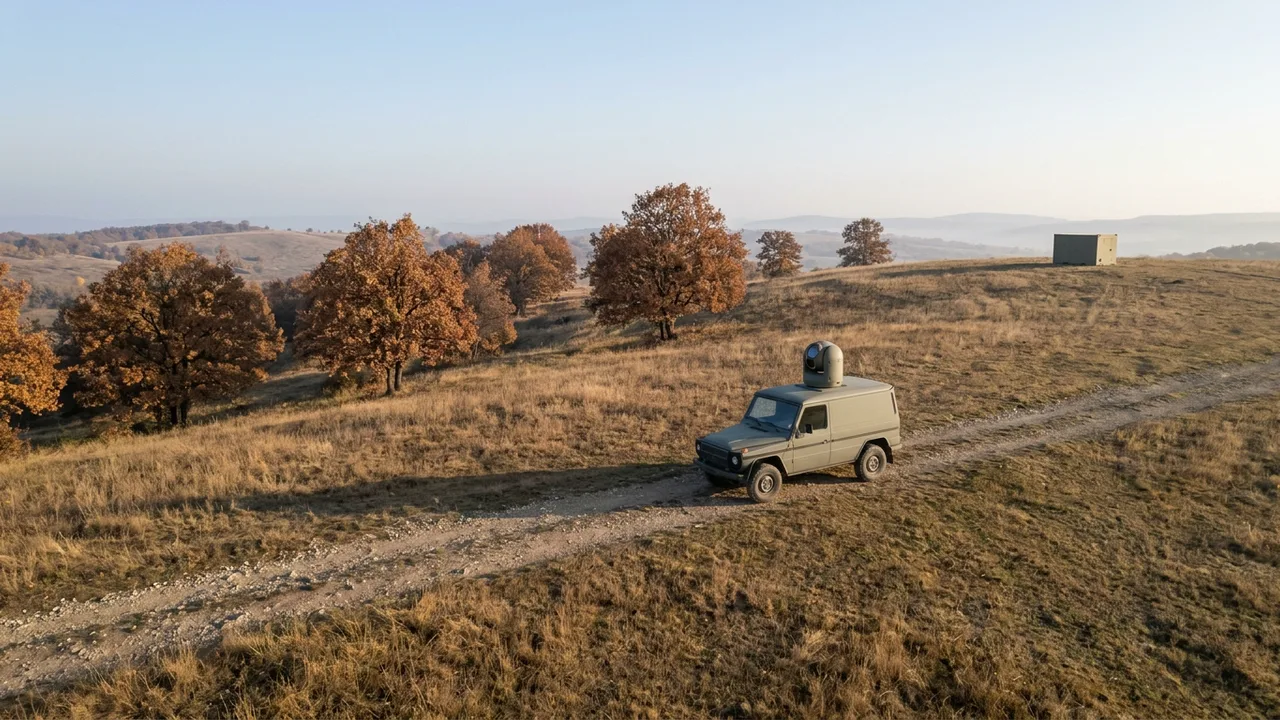
On October 14, three drones flew over a South Korean Army training ground. The next day, Hanwha Systems announced that two laser weapons had hit all of them. One was Cheongwang, which is already in service as a laser air defense weapon. The other was a 30 kW-class laser built to ride on a combat vehicle.
The only official statement of the result is the company release. So what do the government documents say? This letter separates what the company said from what the government wrote. It also looks at what the 2027 defense budget proposal, released on September 3, about six weeks earlier, put down about laser air defense weapons.
This letter in brief
- Hanwha Systems said it demonstrated drone intercepts with Cheongwang and a 30 kW-class vehicle-mounted laser at an exercise run by the Army headquarters on October 14, and that all 3 drones sent in were hit.
- The company named who developed the two systems, gave Cheongwang's cost per shot and announced its 50 kW Laser Armored Vehicle, to be developed by 2027. The government's 2027 defense budget proposal from September lists more investment in Block-I and the start of R&D on a mobile Block-II.
- Which system hit how many drones, the drone types and range, and the vehicle carrying the laser were not disclosed.
What was announced
The first source is an October 15 press release from Hanwha Systems. It is in Korean, like the government documents below, so every Korean quote in this letter is translated by this site. The company said it finished a drone intercept demonstration "yesterday (the 14th)" at the "Army TIGER+ Future Warfare Integrated Combat Exercise," run by the Army headquarters. Two systems took part: "Cheongwang (Laser Air Defense Weapon Block-I)" and a "combat vehicle-mounted high-energy laser (HEL) gun."
In the company's description, the exercise is a "realistic, combat-style exercise" in which the Army trains with combat assets that use advanced defense technology. About 500 people attended, including the Army Chief of Staff, senior military officials and experts from industry, academia and research institutes.
The sentence on the result reads like this: the two systems "struck 100% of the 3 drones sent in, showing unrivaled intercept performance" in front of the observers. The number in that sentence is the count of drones sent in: three. "100%" and "unrivaled" are the company's own words.
Two media outlets picked up the release. Defence Industry Europe, which covers the European defense industry, ran the story on the 15th. Citing Hanwha Systems, it reported that every one of the three target drones was destroyed by Cheongwang and the vehicle-borne 30 kW-class laser. The US outlet Defense News carried the same news on the 16th and also listed what Hanwha did not say.
What is publicly known
The last column of the table shows who said each thing: the company, the government or the media.
| Item | What was announced | Who said it |
|---|---|---|
| Cheongwang development | Developed by the Agency for Defense Development (ADD), with Hanwha Systems as prototype contractor | Hanwha Systems. The June DAPA release also says ADD led the laser source localization work, with Hanwha Systems as prototype contractor |
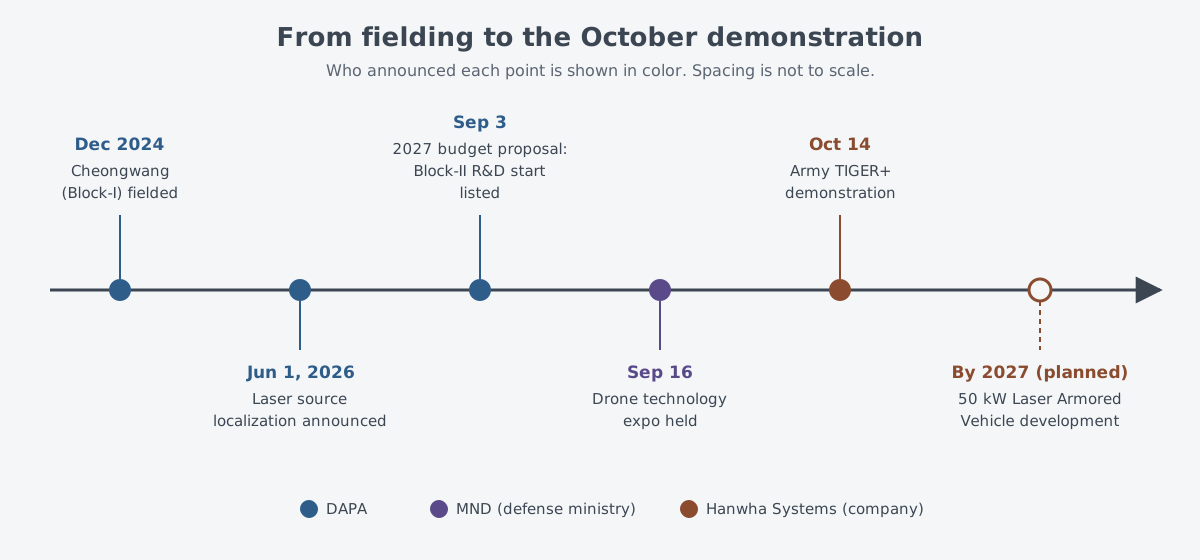
| Cheongwang fielding | Fielded in December 2024, described as "the world's first" laser air defense weapon to be fielded | DAPA (June 1) |
| 30 kW-class laser gun | A 30 kW-class mobile laser weapon system; the Korea Research Institute for Defense Technology Planning and Advancement (KRIT) manages the program and Hanwha Systems led development | Hanwha Systems |
| Design direction of the laser gun | Main components made smaller and lighter for vehicle mounting; "phase-change-based cooling technology" applied | Hanwha Systems |
| Cheongwang cost per shot | About 2,000 won | Hanwha Systems. A July 2024 government policy briefing also gave 2,000 won |
| September drone technology expo | Cheongwang made a "100% intercept" of 4 drones and 2 unmanned aircraft in a row | Hanwha Systems. The defense ministry release does not include this result |
| 50 kW Laser Armored Vehicle | Under development for overseas customers; development planned by 2027 | Hanwha Systems. Defense News reported that a model was shown at the MSPO show in Poland in September |
| 2027 defense budget proposal | More investment in Block-I laser air defense weapons; new start of R&D on a mobile Block-II | DAPA (September 3) |
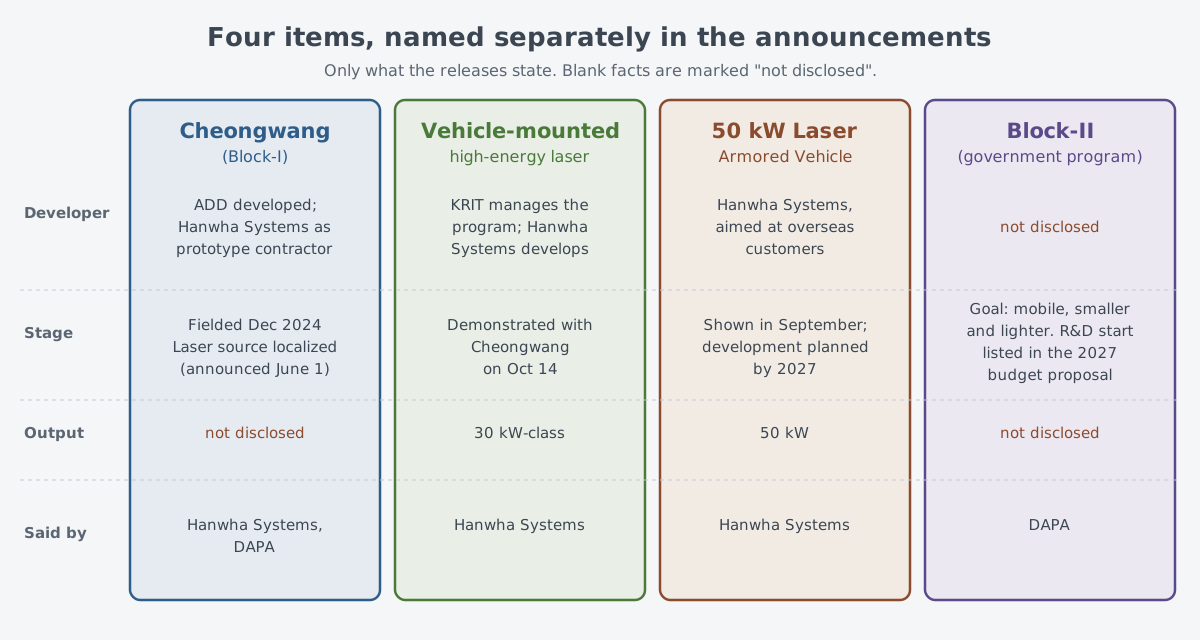
Four names here look alike and are easy to mix up. They are Cheongwang (Block-I), the 30 kW-class vehicle-mounted laser gun, the 50 kW Laser Armored Vehicle, and the mobile Block-II in the government budget proposal. The announcements treat these four as different things.
The 30 kW-class laser gun is presented as a project whose program KRIT manages. The 50 kW vehicle is presented as something the company is developing for overseas customers. Block-II is the name of a government program in the DAPA budget document. None of the announcements says which of these, if any, leads to Block-II.
It also matters whose words are whose. "The world's first operationally deployed laser weapon" comes from the company release. DAPA's June release also said Cheongwang was fielded as "the world's first" laser air defense weapon. Both are the announcers' own descriptions.
The company laser business head's phrase "key game changer" for laser weapons, and the cost slogan "extreme cost-effectiveness," are also the company's words.
The technology, explained
Start with "30 kW-class." The kilowatt (kW) is a unit of power, and power is the energy delivered each second. What the company gave is a power class for this laser gun. The release does not say whether that number is the power in the beam, or under what conditions it was measured.
A number with "class" attached is safer to read as a rough range than as an exact value. That one number also does not tell you how tightly the beam is focused or how many seconds it shines. How to read numbers like this is covered in Power, energy and intensity: W, J and W/cm² and How to read laser weapon news.
For Cheongwang, these sources give no power number at all. DAPA describes Cheongwang as a weapon system that fires a "fiber-based high-power laser" at drones and unmanned aircraft.
What a fiber laser, which grows light inside a thin glass fiber, looks like is explained in What is a fiber laser? Growing light inside a thin glass fiber. How Cheongwang's laser source is put together is not in the public material.
What the company singled out for the 30 kW-class laser gun is its "phase-change-based cooling technology." The release gives only the name and the purpose, which is handling the heat produced during high-power operation. It does not describe how the cooling works.
Not all the electricity fed into a laser becomes light, and the rest turns into heat. Why that heat is a major problem for laser weapons in general is covered in Cooling and thermal management: where the heat that did not become light goes.
Last comes cost. The company said one Cheongwang shot costs about 2,000 won. This is not a new figure. A July 2024 government policy briefing introduced the laser air defense weapon and said that, since it needs no separate ammunition, "the cost of one shot is only 2,000 won".
Hanwha did not say what the figure includes. A cost per shot usually means what it takes to fire once more with a system you already have. So the price of buying the system and the development cost are left out. How such per-shot figures are compared is covered in The cost of drone defense.
What is new
The government announcement to compare with is DAPA's press release of June 1. DAPA said it localized Cheongwang's key component, the laser source, at the end of May. The domestic laser source completed its defense standard in May and is set to go into Cheongwang production units from then on.
The localization rate of the laser air defense weapon, by value, rose from 76% to 90%. The details of that announcement are in Laser weapon programs that have been made public.
The same release said DAPA would keep improving power and precision and making the system smaller and lighter, through the Block-II system development program and other work. Three months later, on September 3, that plan showed up in a budget document. The 2027 defense budget proposal release said the government will expand investment in Block-I laser air defense weapons and "newly start R&D on the mobile laser air defense weapon Block-II". The goal for Block-II is a laser air defense weapon that is smaller and lighter, mobile, and better performing.
There are budget numbers too. The whole proposal is 73.2777 trillion won, and the budget for strengthening drone and counter-drone capability would rise 18.8% under the proposal, from 678.8 billion won to 806.1 billion won. Under future defense technology, "securing high-power-laser-based hard-kill technology" appears as a new item of 12.1 billion won. Hard-kill means defeating a target by physically damaging it.
That 12.1 billion won is a technology item, and the document gives no separate amount for Block-I or Block-II. These figures are what the government submitted to the National Assembly. It is worth keeping in mind that they are not a final budget.
Two things are new in this news. First, the start of R&D on a mobile Block-II is now written into the government budget proposal. Second, the company put a 30 kW-class vehicle-mounted laser and a 50 kW armored vehicle forward alongside Cheongwang, which is already in service. The laser business head said the company will "actively target the global market" with Cheongwang and the 50 kW Laser Armored Vehicle.
Limits and open questions
Defense News listed four gaps in what Hanwha said. Nothing was given on which system hit which drone, what type the drones were, which vehicle the newer laser sits on, or how far either weapon reaches. The company release does not give these either. So the figure of 3 drones can only be read as a total for the two systems together.
Government confirmation is missing too. No separate release from the defense ministry, the Army or DAPA on the October 14 demonstration results was found.
The September drone technology expo is a similar case. The defense ministry release says the expo was held on September 16 at the Seungjin training ground in Pocheon. In technology demonstrations joined by ADD and the Army, a "laser counter-drone system" was shown among other systems. The name Cheongwang and the result of "4 drones and 2 unmanned aircraft" intercepted appear only in the company release.
Many specifications are blank. The only published specification for the 50 kW Laser Armored Vehicle is its power. For the 30 kW-class laser gun, the vehicle that carries it and how its cooling works are unknown, and Cheongwang's power figure is not in these sources either.
The strengths and limits of laser weapons in general are set out in Strengths and limits of laser weapons. That article covers laser weapons as a whole and is not an assessment of Cheongwang or this laser gun.
What to watch next
- 50 kW Laser Armored Vehicle: the company said it plans to develop it by 2027.
- Mobile Block-II: the start of R&D is written into the 2027 defense budget proposal. It went to the National Assembly in September and becomes final only after review there.
What to read next
- Laser weapon programs that have been made public: to compare Cheongwang, from fielding to laser source localization, with other countries' official announcements in one table.
- How to read laser weapon news: "kW-class", "range" and "cost per shot": to read "30 kW-class" and "about 2,000 won" in this news more closely.
- The US Army E-HEL laser contract and the directed-energy pilot at US bases: what another country's counter-drone laser news disclosed and what it left blank.
- Dutch defence ministry signs letter of intent with EOS to develop and possibly build a counter-drone laser weapon: to compare how a government and a company described the same news differently.