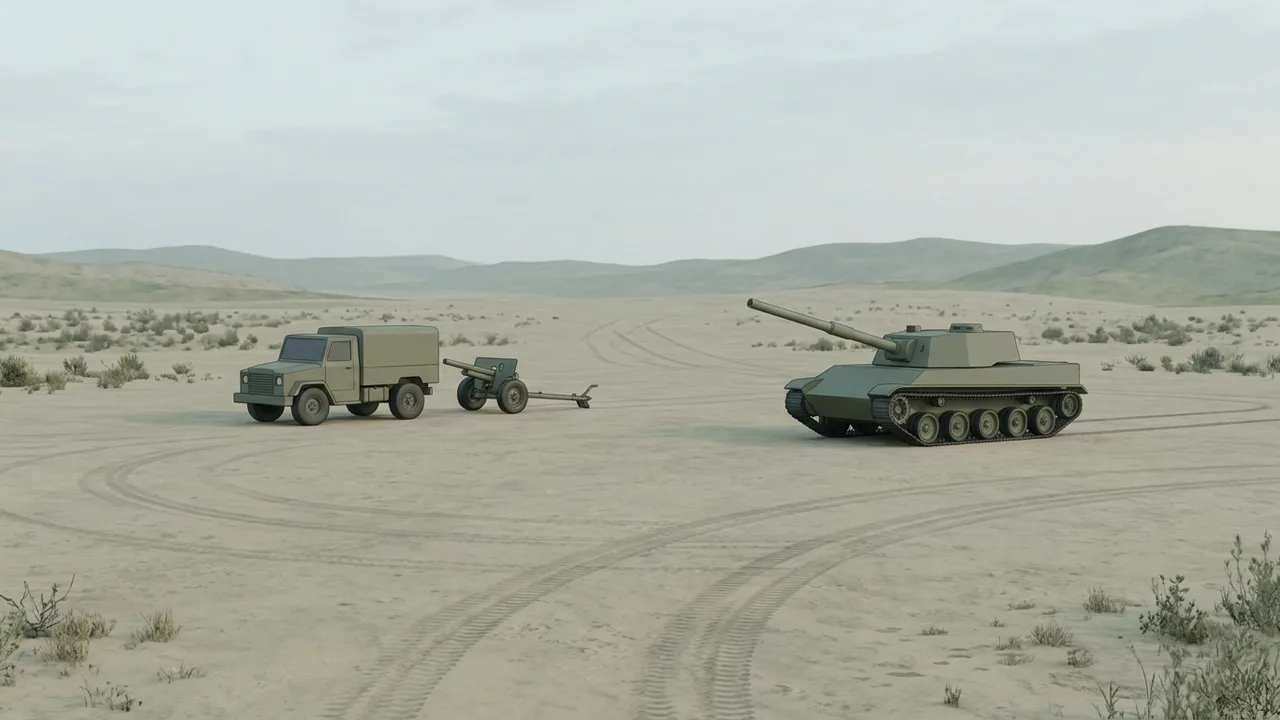
Picture a big gun and two images come to mind: a truck pulling a gun on wheels, or a tank-like vehicle with a turret on top. Both are howitzers. The difference is whether the gun moves under its own power.
Why does that matter so much? A gun that can drive itself sets up and leaves more easily, and its crew can sit behind armor. In return it pays in weight, power and cost. This article compares towed and self-propelled howitzers, then looks at the idea of "shoot and scoot" and at the public record of U.S. Army self-propelled howitzer programs.
Towed guns and guns that drive themselves
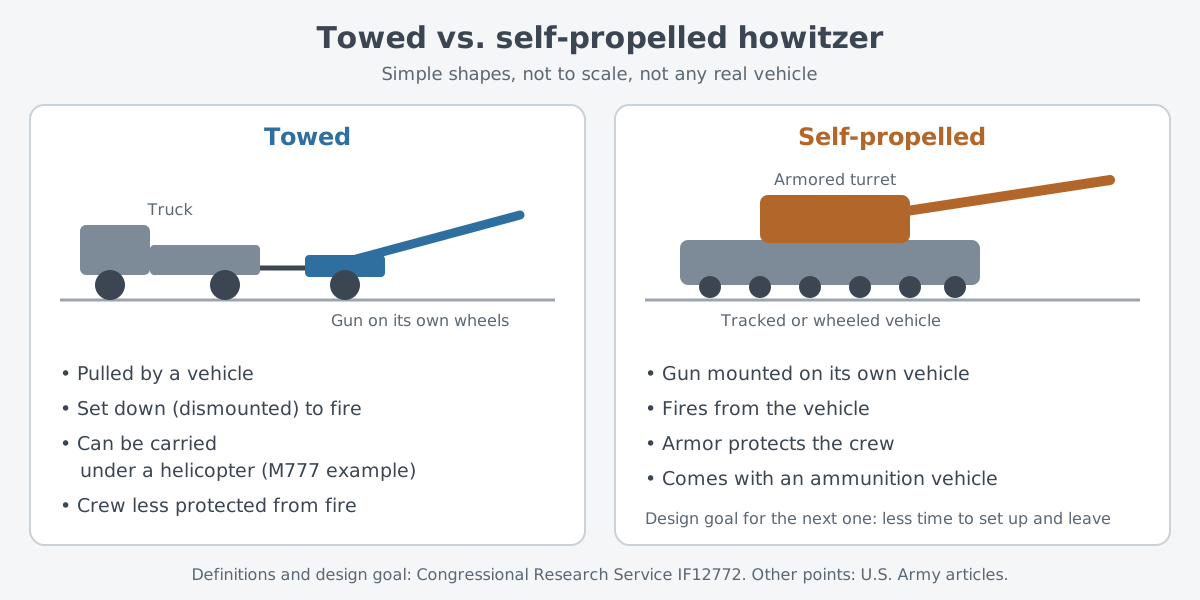
The Congressional Research Service (CRS) splits U.S. Army artillery into two types. A self-propelled howitzer sits on a vehicle that runs on tracks or wheels. A towed howitzer is pulled by a vehicle and then set down before it fires. The split is less about the gun itself and more about how it travels and where it fires from.
The usual job of these guns is indirect fire. That means firing at a target beyond the line of sight, using coordinates passed on from outside, such as from a forward observer or a surveillance drone. Self-propelled howitzers such as the Army's M109A7 are indirect fire systems of exactly this kind.
Towed howitzers: pulled, then set down to fire
A towed howitzer cannot drive. A truck or similar vehicle pulls it, and once it reaches a firing spot the gun has to be set down. On the other hand, the vehicle does not have to be on the ground.
On March 22, 2016, a U.S. Army artillery squadron in Germany trained to lift, carry and set down M777 towed howitzers under CH-47 Chinook helicopters. Moving artillery usually takes big, strong equipment, and when helicopters do the job, that equipment also has to fly.
The weak spot is crew protection. In a 2011 Army article, the officer then managing the Army's self-propelled howitzer systems spoke about crews at a forward operating base. He said the new PIM howitzer, later the M109A7, could protect gun crews supporting light infantry there from indirect fire, something towed artillery cannot do.
Self-propelled howitzers: a gun on a vehicle
In a self-propelled howitzer, the gun and the vehicle are one machine. It fires from the vehicle without being set down. The Army's M109 family was first fielded in 1963, and over the next 50 years it gave the Army an armored weapon that could move easily and support combat units.
Being a vehicle also ties it to the units it travels with. The M109A7 is built to give armored brigade combat teams an indirect fire system that can keep up with Abrams tanks and Bradley fighting vehicles in combat. In other words, the guns can move along with the tanks.
An Army budget document for fiscal year 2025, quoted by CRS, spells out what the Army wants from a new self-propelled howitzer.
The next-generation howitzer cuts the time needed to set up in a firing position and to leave it. It also improves crew survivability and cross-country mobility. It is also meant to give far more fire support than towed howitzers can offer.
The difference resembles that between a camping trailer and a motorhome. A trailer is hitched to a car, pulled to a site and parked, while a motorhome is house and vehicle in one and can leave right away.
In practice there are many differences. A self-propelled howitzer joins gun and vehicle for protection and time, not comfort. In return it carries extra loads, such as the weight of armor and a separate ammunition vehicle.
Shoot and scoot: the cost of staying put
When a gun fires, the other side looks for it. The other side can use counter-battery radar to locate a gun while it fires, then shoot back, which makes mobility key to the gun's survival. That is the starting point of a 2018 paper on shoot-and-scoot co-written by a Naval Postgraduate School (NPS) professor.
Staying put has its own gains. Firing several rounds from the same spot gives a high rate of fire, and aim gets better as the crew adjusts to earlier rounds. But the more a gun fires from one spot, the greater the risk that its location is found. So guns move from time to time to avoid counter-battery fire, and this is called shoot-and-scoot.
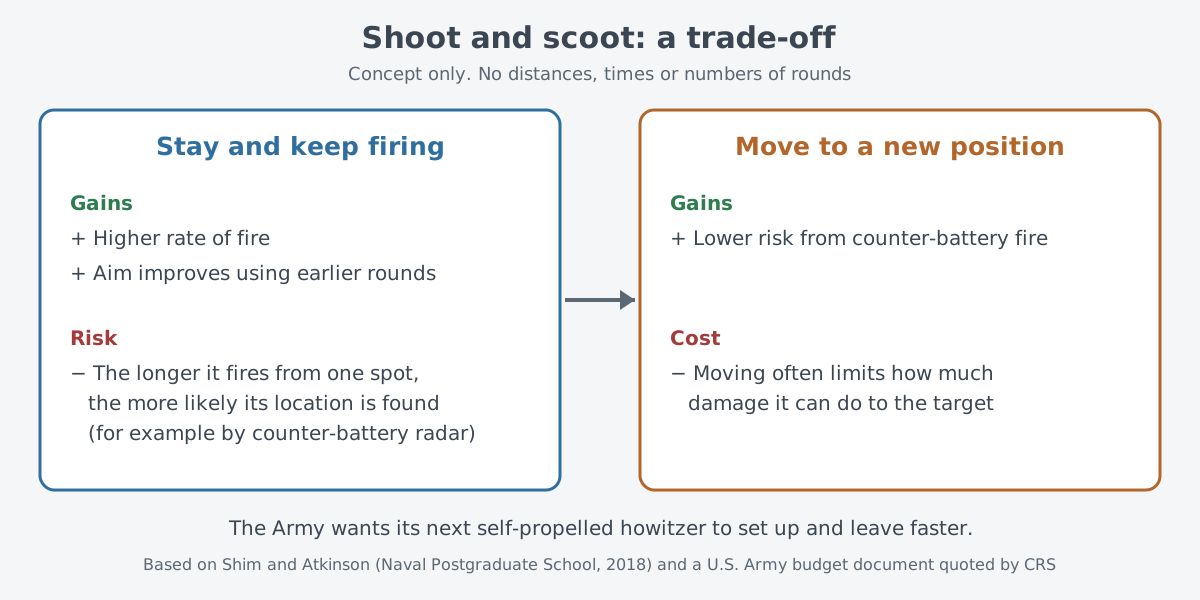
The trade-off is clear. Moving often lowers the risk to the gun, but it also limits how much damage the gun can do. During the later 1900s, guns became more mobile and the means to detect them improved, so moving mattered more. The paper notes that a 1996 U.S. Army field manual already accepted that changing position weighs survivability against responsiveness.
The self-propelled howitzer story touches this balance too. One of the things the Army wants from its next self-propelled howitzer is less time to set up in a firing position and to leave it.
The U.S. Army's self-propelled howitzer story
The M109 family has served since the 1960s, with many upgrades along the way. Meanwhile, the Army made three attempts at a new self-propelled howitzer, and according to CRS none of those efforts reached the end. In order, they were:
- 1994: development of the Crusader, a 155 mm self-propelled howitzer, begins; canceled in May 2002
- 1999–2009: the Non-Line-of-Sight Cannon (NLOS-C), planned within the Future Combat System (FCS) program, which ended with its cancellation in 2009
- 2018–2024: Extended Range Cannon Artillery (ERCA); the program ended in April 2024
- After that: the Self-Propelled Howitzer Modernization (SPH-M) effort, the fourth attempt, which replaced ERCA. It supports armored brigade combat teams made up of Abrams tanks and Bradley infantry fighting vehicles
The existing vehicle took the path of upgrades instead. The M109A7 entered low-rate initial production in 2014. The gun stayed the same, but the vehicle got a new chassis, engine, transmission, steering system and suspension. These parts are shared with the Bradley fighting vehicle, which raises commonality and lowers the logistics burden and cost.
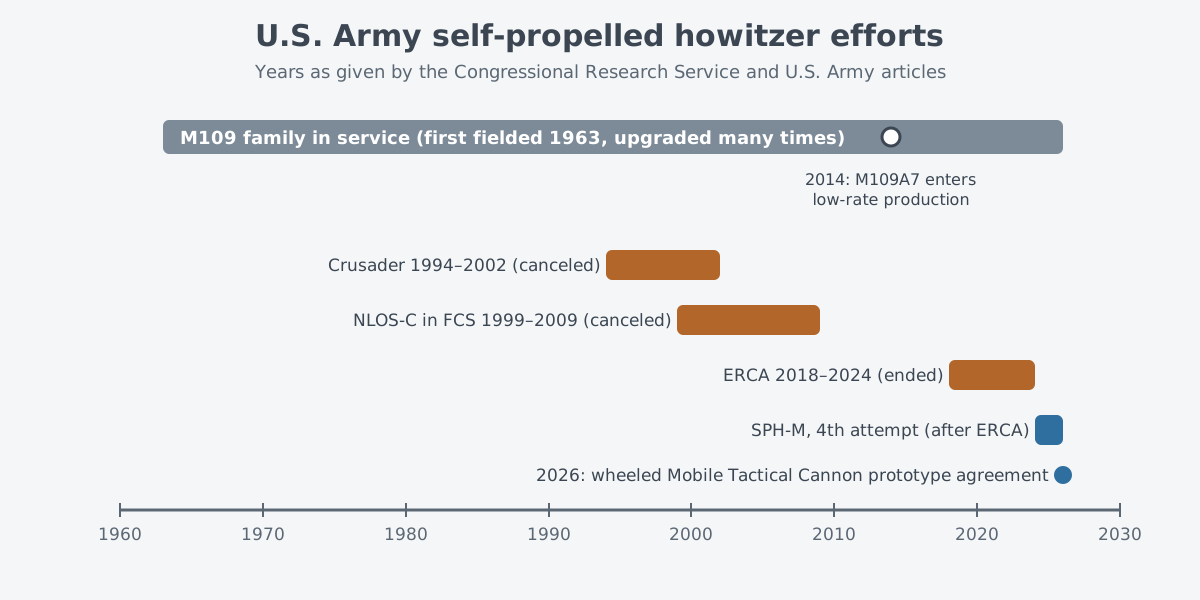
Wheeled self-propelled howitzers have also arrived. In 2026 the Army announced that it had signed with Hanwha Defense USA to develop Mobile Tactical Cannon (MTC) prototypes. The deal covers as many as 18 self-propelled howitzers on wheels for prototyping, testing and soldier experiments. Should the Army approve fielding, MTC is to take the place of M777 towed howitzers in some units.
The prototype was later unveiled under the name XM1776. Hanwha Defense USA describes the XM1776 as an American version of its K9 Mobile Howitzer. How the order numbers changed is covered in the XM1776 news article.
What mobility costs
Putting a gun on a vehicle adds to what the vehicle must carry. A 2014 Army article said decades of upgrades had pushed the M109 family to its limit in space, weight and power-cooling (SWaP-C). An Army report to Congress, quoted in a 2011 article, said the existing vehicles exceeded their weight and power capacity and had no room to grow in mobility and protection.
The M109A7 also got a new on-board power system that runs at 600 volts. It is designed to take in new technologies and future requirements. The Army officer managing the program described the upgrade as "buying back" space, weight and power-cooling.
A self-propelled howitzer does not travel alone. The M109A7 entered production together with its companion vehicle, the M992A3 tracked ammunition carrier. When the gun moves, its ammunition has to move too.
Building a new gun brings other problems as well. In the ERCA prototypes, the gun tube wore too much after firing fairly few rounds. Together with maximum range, this became one of the main performance risks. CRS notes that Congress might compare SPH-M purchase and sustainment costs with the cost of continuing upgrades to the M109 Paladin.
Where this meets lasers: size, weight and power
The SWaP-C idea in the howitzer story also comes up with laser weapons. The glossary entry is size, weight and power (SWaP); the howitzer articles add cooling to it. What fits on one vehicle, and how much electricity and cooling that vehicle can supply, shapes the weapon. On that point, the two fields share the same concern.
What changes when a laser weapon goes on a vehicle, ship or aircraft is covered in Weight and platforms: fitting on a vehicle, ship or aircraft.
What to read next
- Weight and platforms: fitting on a vehicle, ship or aircraft: how size, weight and power affect the choice of platform for a laser weapon.
- Counter-battery radar: what a projectile reveals: an upcoming article on the other side of shoot-and-scoot, the radar that looks for the gun.
- Fire-control systems: linking sensors and weapons: how a target found by a sensor is passed to a weapon.