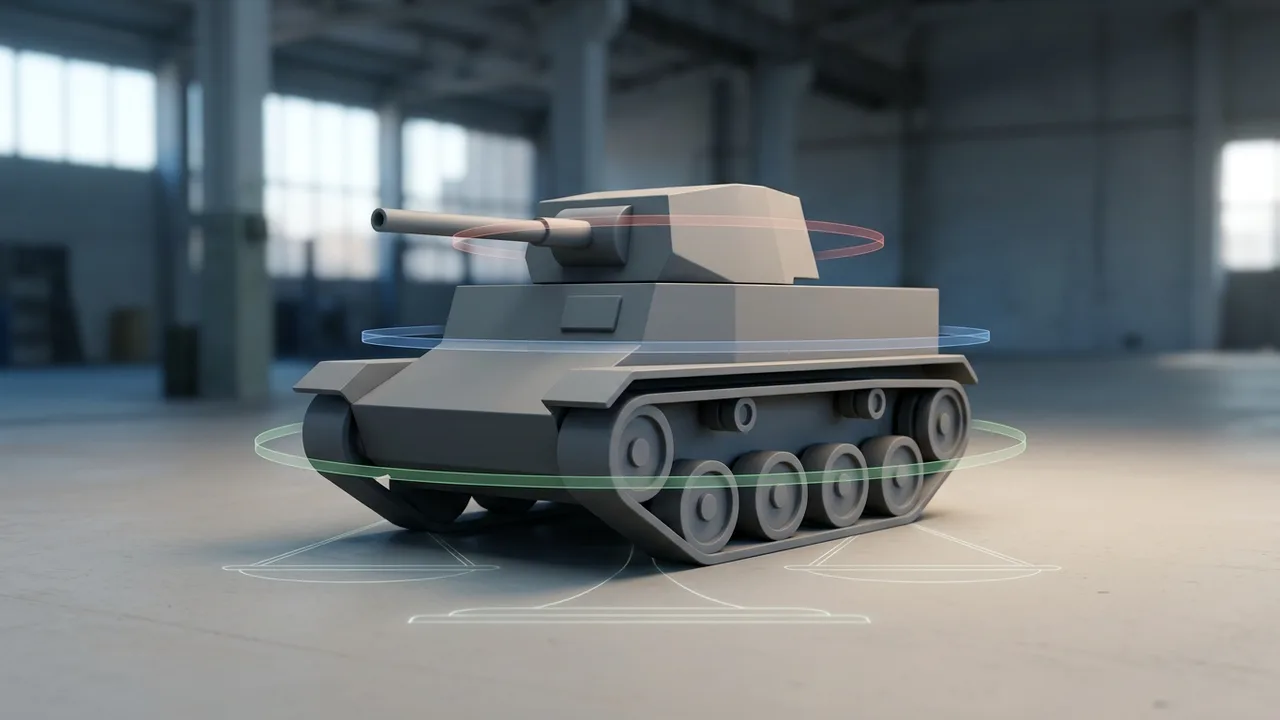
Talk about tanks often starts with gun size. It feels natural to assume that a bigger gun makes a stronger tank. Yet when you open an official document that defines a tank, the gun turns out to be only one condition among several.
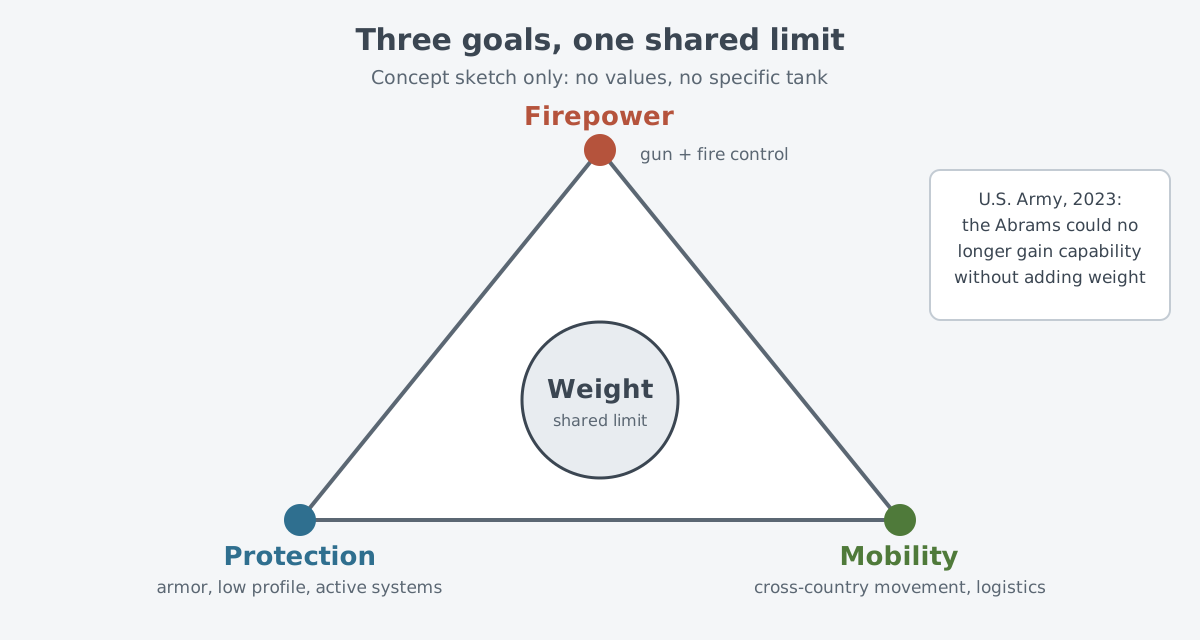
A main battle tank (MBT) has to fit three abilities into one vehicle: hitting hard, staying alive and moving well. The three pull against each other, and weight sits in the middle as a shared limit. So what does a bigger gun cost?
What a main battle tank is
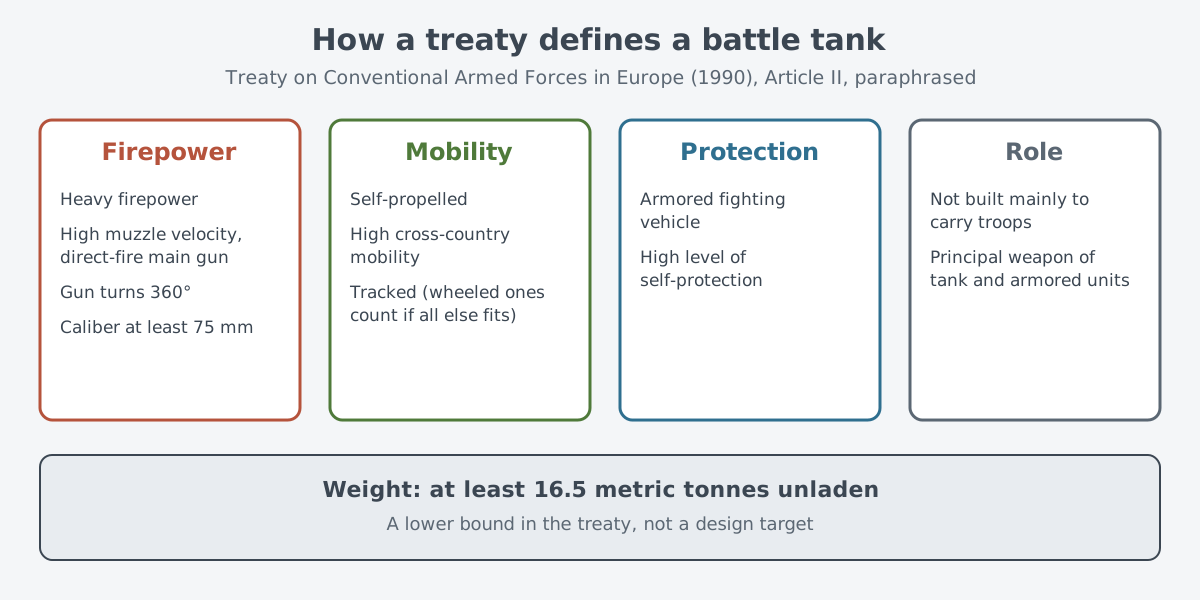
The Treaty on Conventional Armed Forces in Europe (CFE) was signed on November 19, 1990. It defined a "battle tank" in a single paragraph so the parties could tell which weapons fell under its numerical limits.
Three ideas appear together in that paragraph. There is heavy firepower, mainly from a direct-fire main gun with high muzzle velocity, used against armored and other targets. There is high cross-country mobility, and there is strong self-protection.
The vehicle must be a self-propelled armored fighting vehicle, and it must not be built mainly to carry troops. The treaty adds that such vehicles are the principal weapon system of tank and other armored units in ground forces.
The treaty also set numbers for counting. A battle tank is a tracked armored fighting vehicle weighing 16.5 metric tonnes or more when empty. Its gun turns through 360° and has a caliber of 75 mm or more. A newly fielded wheeled vehicle that meets every other condition counts too.
These numbers mark the lower edge of what gets counted as a tank. They are not a measure of a good tank.
Korean sources use the same term. The K1 is a main battle tank developed for Korea's terrain and operating conditions. It was adopted as Korean military equipment at a weapon system review on December 19, 1988. On the U.S. side, the Abrams tank is the primary major weapon system of the Army's armored brigade combat teams.
Firepower: the gun and fire control
The main gun is the heart of firepower. The treaty does not just say "gun." It says a direct-fire main gun with high muzzle velocity. So the definition covers how the gun fires, not only how big it is.
Even so, firepower is more than the gun. Devices that see, aim and calculate work together with it. The K1's fire control system is made up of parts such as the gunner's sight, the commander's sight and a ballistic computer. It can observe by day and by night.
A gun cannot hit a target that nobody can see, however large it is. The link that passes a target from sensors to weapons is the fire-control system.
Protection: more than one way to be protected
Protection brings thick armor to mind first. Armor is indeed the base of protection, and its concepts get their own article, "Composite and reactive armor: the blocks on a tank." Public sources show, though, that armor is not the only way a tank is protected.
One way is to be harder to hit. The Abrams is a full-tracked vehicle with a low profile. Kookbang Ilbo, the Korean defense daily, says the K1's low height is regarded as a design feature that lowers the chance of being hit by enemy rounds.
Another way works outside the armor. A 2014 Korean government briefing on defense acquisition decisions included a question-and-answer session. Asked what would follow if an active protection system were fitted to the K2, an official described such a system as equipment fitted to raise a tank's protection.
How protection is added also matters. Major General Glenn Dean spoke to this in a 2023 U.S. Army announcement. He said the war in Ukraine had shown a critical need for integrated protection for soldiers, designed in from the inside rather than bolted on. In that announcement, the remark sits right next to the problem of weight.
Mobility: a tank must move to matter
According to The Tank Museum in the United Kingdom, tanks first went into battle at dawn on September 15, 1916. The first tanks moved very slowly, but they could force their way past barbed wire and get over most trenches. Crossing ground was a skill tanks showed from the very first.
Mobility is still part of the modern definition. High cross-country mobility is one of the treaty conditions seen above. The means by which the Abrams reaches and defeats the enemy are also mobility, firepower and shock effect.
Mobility is not only about the engine and tracks. The U.S. Army's 2023 tank plan includes the goals of a smaller sustainment footprint and greater operational and tactical mobility. In other words, the Army saw a lighter support burden as a way to make the whole armored brigade combat team more mobile.
A hiking backpack is a useful comparison. More water and clothing make you better prepared, but a heavier pack slows your steps and forces more rest stops. The real case differs in one way. A tank's weight affects not only how that one vehicle moves but also the size of the supply and support effort behind it.
The balance of the three and how it changed over time
The idea of putting firepower, protection and mobility into one vehicle is old. The Centurion, which the British Army was testing in the spring of 1945, grew out of experience in the North African desert fighting of 1940–1942. In that desert, a balance of firepower, armor and speed was essential.
The Centurion started as a heavy cruiser design and became the first "Universal Tank," says Chris Copson, a researcher at the museum. That means a tank able to take on many different roles in battle. The Centurion inspired today's main battle tanks, and its first combat came in 1950, during the Korean War.
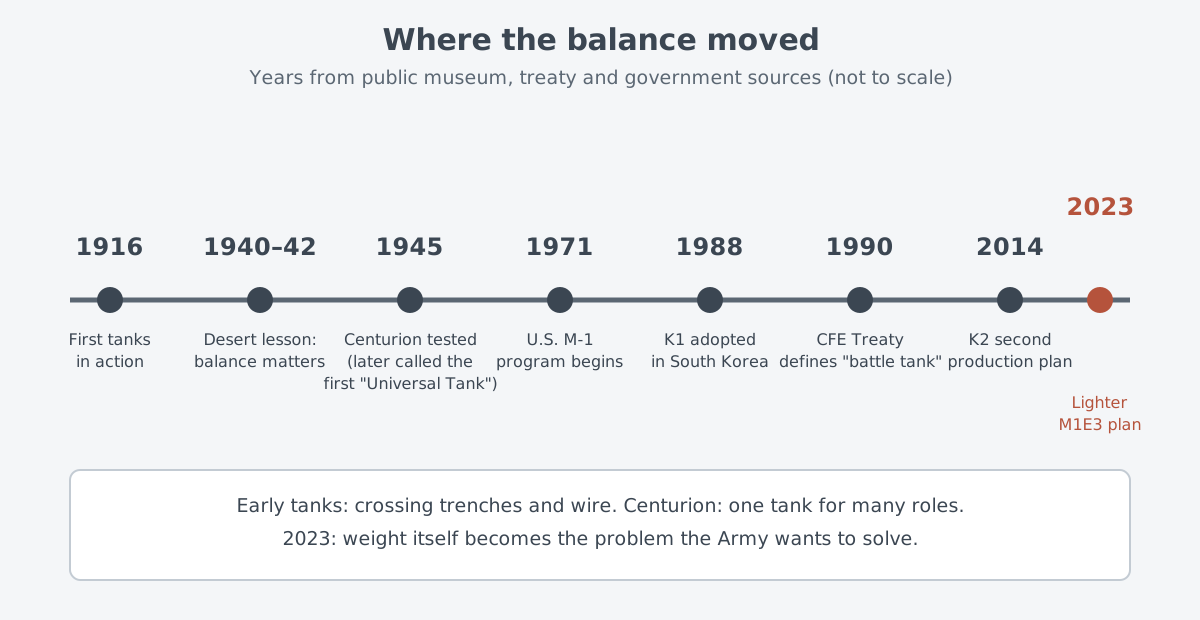
Korean and U.S. official sources also speak of all three together. On November 19, 2014, a Korean government briefing on the results of the 84th meeting of Korea's defense acquisition committee covered the second K2 production program. It described the program as acquiring an advanced main battle tank with "improved mobility, firepower and protection" suited to the future battlefield. The U.S. Abrams, too, is a tank designed to fight through its mobility, survivability and firepower.
Trying to grow all three, however, runs into weight. The Abrams program began in December 1971 and has gone through several upgrades since.
On September 6, 2023, the U.S. Army announced that it would wrap up the M1A2 SEPv4 upgrade and develop the M1E3 instead. Dean gave the reason: the Abrams "can no longer grow its capabilities without adding weight," and the Army needs a smaller logistical footprint.
The stated goal is a tank that is both more survivable and lighter. The Army also said it would follow modular open systems architecture standards so that upgrades can come faster and with fewer resources.
The Congressional Research Service (CRS) notes that the Army has not released formal requirements. Citing press reports, it says the Army sees a lighter vehicle and a hybrid electric drive as essential features and puts them first to cut logistics needs. The date for initial operational capability (IOC) differs by source. The 2023 Army announcement put it in the early 2030s, and the CRS paper updated in 2024 gives 2030.
Among the questions CRS raises for Congress is whether the new tank will include active defense features against anti-tank guided missiles and loitering munitions. In other words, how to build protection into a new tank remains an open design question.
A main battle tank's performance is not decided by gun size alone. The treaty definition and the official Korean and U.S. descriptions all tie firepower, protection and mobility together.
And for the Abrams, the U.S. Army judged that the tank had reached a point where it could not gain capability without adding weight. The view that weight binds a whole system also carries over to the story of weight and platforms for laser weapons on vehicles, ships and aircraft.
What to read next
- Composite and reactive armor: the blocks on a tank: breaks armor, the base of protection, into its main concepts.
- Active protection systems: defending beyond the armor: looks at ways to protect a tank outside its armor.
- Weight and platforms: fitting on a vehicle, ship or aircraft: looks at how weight binds a system, from the laser weapon side.