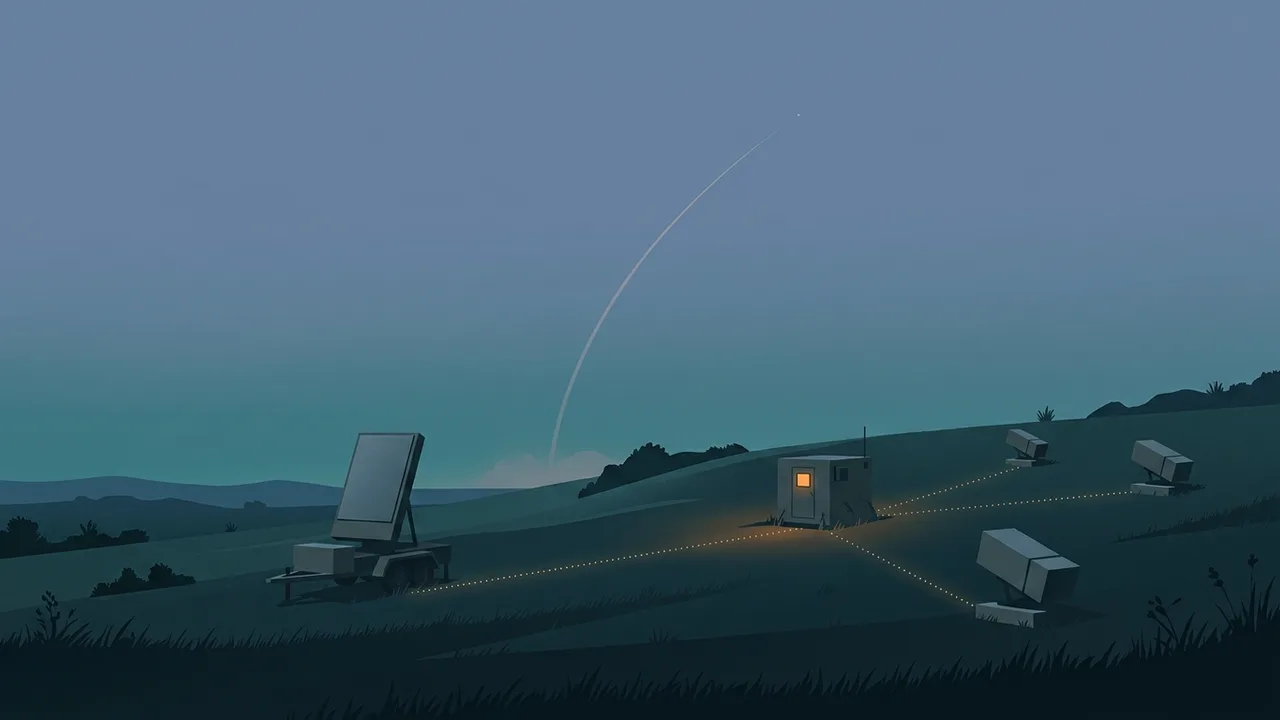
Say "air defense missile" and most people picture a single round leaping off a launcher in a burst of flame. Yet before that round leaves, many machines and people are already at work. Who watches the sky, who decides whether to fire, and who steers the missile once it is on its way?
A surface-to-air missile is a system whose parts answer those questions together. Each part has its own job, and the link between the ground and the missile does not break once the missile is in the sky. The U.S. Patriot and Korea's Cheongung are much easier to read with that layout in mind.
A bigger picture than one missile
The U.S. Congressional Research Service (CRS) describes the U.S. Army's Patriot as a mobile, ground-based system. It is built to find, follow and engage aircraft, drones, cruise missiles, and ballistic missiles of the tactical or shorter-range kind. Those three verbs, find, follow and engage, walk through what the system does, one step after another.
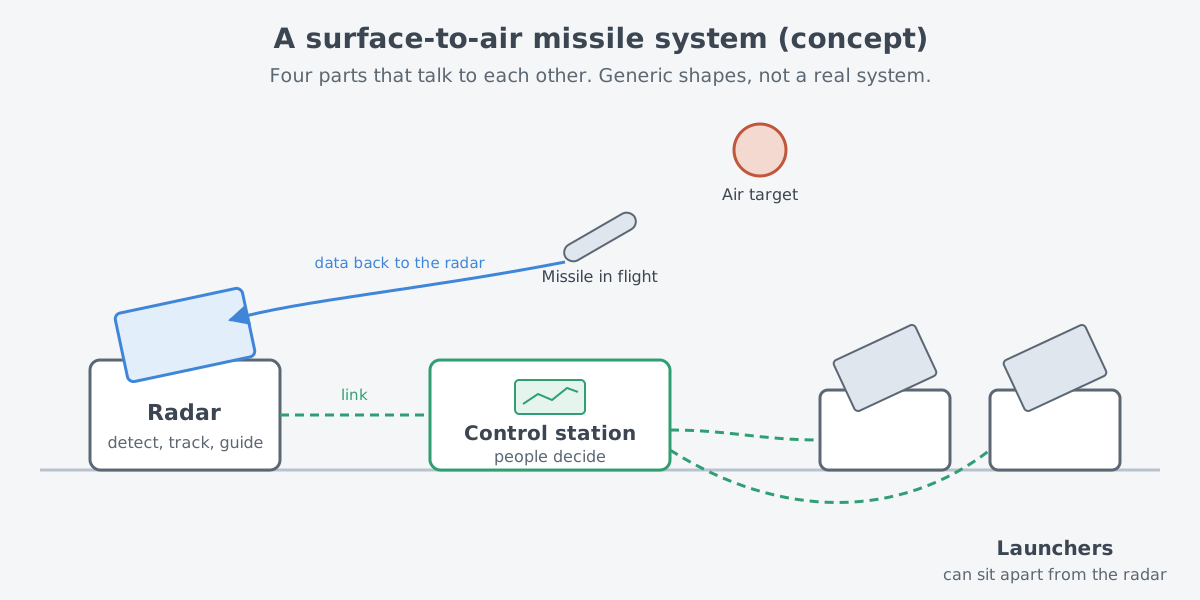
Usually four parts share that work. Patriot is made up of a radar, a control station for engagements (the ECS), launchers and the missiles themselves. Korea's Cheongung has the same kind of layout: an engagement control station, a multifunction radar, launchers and missiles.
A local fire station helps to picture it. A smoke detector notices the fire, a dispatch room decides to send help, and a fire engine drives out, yet they act as one. A real air defense system differs in one big way. After the missile leaves the launcher, the radar keeps following it and helps lead it to the target.
The radar: the eye on the sky
In the system, the radar is the part that watches the sky. Patriot's radar is a multifunction phased array set that operators run from the control station. Even the name centers on the radar. Patriot is short for "Phased Array Tracking Radar to Intercept on Target."
Cheongung's radar went the same way. In Cheongung, one multifunction phased array radar handles detection, identification, tracking and the engagement itself. Everything from searching the sky to the engagement falls to a single radar.
The basic idea of how radar measures distance and motion from returning radio waves is covered in Radar: measuring distance and motion with radio waves.
The engagement control station: people decide
The engagement control station takes what the radar sees and makes the decisions. In a Patriot unit, this station is the only part with a crew on board. It is built to stay in contact with the launchers, with other Patriot units and with higher headquarters.
So how do the machine and the people split the work? In a Janes description quoted by CRS, the semiautomatic mode has the system sort and identify tracks on its own. It asks each track for a friend-or-foe reply and offers recommendations to the operators. After that, a human operator makes the call on whether to go ahead.
A fully automatic mode, in which the system does everything by itself, still exists as a feature. CRS notes, however, that the Army no longer uses it because of past friendly-fire incidents. The machine may sort tracks quickly, but the final yes or no stays with a person.
Launchers and missiles
A launcher does not have to sit next to the radar or the control station. Patriot launchers, too, can be placed away from both. Because the parts are linked by communications, that kind of layout works.
Launch methods also differ between systems. Cheongung pushes the missile up into the air from a vertical launcher, then turns it in the air toward the direction it needs to go, a method called cold launch. Why a missile might pop out before igniting is explained in Cold launch: why some missiles pop out before igniting.
A missile in the sky is still tied to the system. After launch, a Patriot interceptor sends data back toward the radar, and the radar follows the missile and helps guide it to the target. The Cheongung missile uses active RF homing in its final phase, which means the missile lights up the target with its own radio waves and follows the reflection.
How a missile fired from the ground reaches its target
Judgment comes before the launch button. The weapon control system first works out whether the target can be engaged. If it can, the system calculates how to launch, readies the missile, fires it and boosts it up to flight speed.
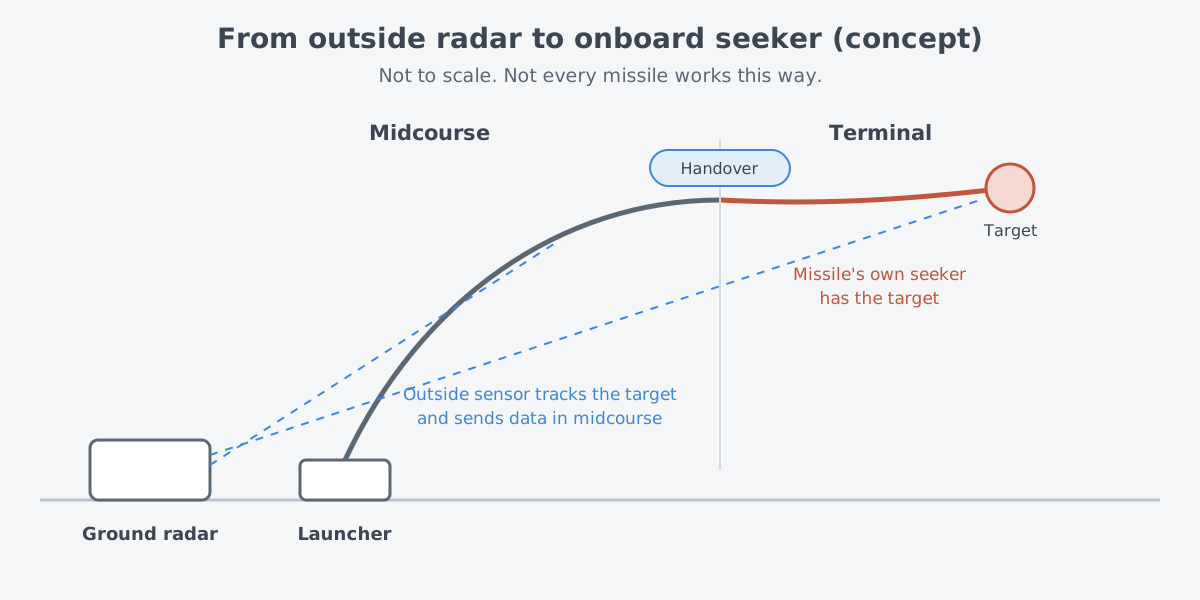
The flight after that is usually split into phases. The boost phase mostly relies on inertial guidance, and during midcourse the missile gets information from outside. The terminal phase comes last and is generally the most critical.
If an outside sensor keeps track of the target in this middle stretch, the missile's own sensor no longer has to aim at and find the target from far away. Even so, a ground radar alone cannot carry the missile all the way. Sensors generally lose accuracy as the distance grows.
So midcourse guidance has a different goal. Its job is not to bring the missile right up to the target. It is to bring the missile into a good position, where its own sensor can pick up the target and the handover to terminal homing can happen. After that handover, the seeker at the front of the missile takes charge of the target.
Public examples: Patriot and Cheongung
Work on Patriot began in the 1960s, and its first battalion stood up in May 1982. The original aim was protection against high-performance aircraft.
In an Army account quoted by CRS, in January 1991 Patriot intercepted an Iraqi SCUD missile launched toward Saudi Arabia. The Army describes this as Patriot's first combat use, and as the first case of air defense bringing down an enemy tactical ballistic missile.
From the 1960s the Korean Air Force had brought in and operated the Hawk, a medium-range surface-to-air missile. Cheongung was developed in Korea to replace it and is the country's first domestically developed medium-range surface-to-air missile.
ADD finished developing Cheongung in 2011, and the system was fielded from 2015. The last units were delivered to the military in April 2020. ADD describes Cheongung as a Korean medium-range surface-to-air missile system that protects key national and industrial sites from air attack.
Guarding the sky in layers
No single air defense system covers the whole sky. In a description by MDAA (Missile Defense Advocacy Alliance) cited by CRS, Patriot can work on its own but is mainly meant for point defense, protecting one particular place. Paired with systems like THAAD, it can form a defense of several overlapping layers.
Surface-to-air missiles come in many forms too. The CRS primer on precision-guided munitions gives three surface-to-air examples. Stinger is a "fire-and-forget" missile built to intercept low-flying planes and helicopters, cruise missiles and drones, and the Army first fielded it in 1981.
ESSM is an anti-air missile launched from ships, first deployed by the Navy in 2004. Missiles fired from ships also sit in the primer's surface-to-air group. Here the "surface" in surface-to-air takes in the sea as well as the land.
The third example, SM-6, takes pieces from the SM-2 Block IV and adds guidance borrowed from a medium-range missile built for air-to-air combat. Missiles fired from aircraft and missiles fired from the ground or from ships can share the same guidance system.
Missiles are not the only way to guard the sky. High-energy lasers (HEL) and air defense guns come up as well. How the three share the work continues in Lasers, interceptor missiles and guns: how they share the work. A laser weapon, too, is not just a laser but several parts working as one system, so it has much in common with the air defense systems in this article.
What to read next
- Lasers, interceptor missiles and guns: how they share the work: covers how the three means of air defense divide their roles.
- A laser weapon is more than a laser: the system at a glance: splits a laser weapon into the laser source, beam director, power, cooling and command and control, in one system diagram.
- Radar: measuring distance and motion with radio waves: explains the basic principle of the radar, the system's eye.
- Air-to-air missiles: what the missile sees: covers the kinds of seekers that work in the terminal phase.