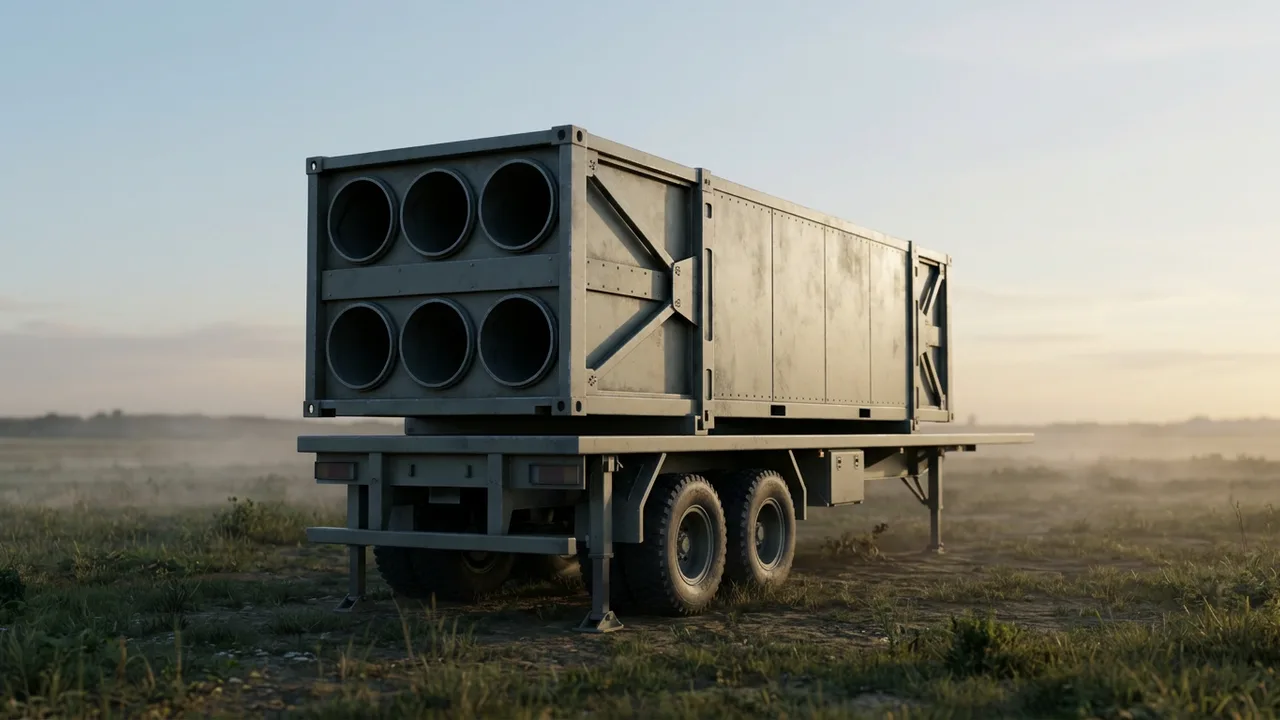
Say "artillery" and most people picture a long barrel firing one shell at a time. Yet some weapons put a square box on a truck or a tracked vehicle, with many launch tubes packed side by side. Rockets rise from that one box, one after another.
That weapon is a multiple rocket launcher. Why bundle many tubes from the start, instead of reloading one tube quickly? This article looks at the reason, and at the changes that run from the 1941 Katyusha to guided rockets that find their way with satellite navigation, using public sources.
What a multiple rocket launcher is
Artillery weapons can be sorted into guns and rockets. Some rockets are fired one at a time, while others come from several tubes packed into one box. The second kind is a multiple rocket launcher.
The abbreviation MLRS comes up often in this field. MLRS (Multiple Launch Rocket System) is the name of one particular system, built jointly by the United States and its European allies. Yet Hanwha Aerospace, the maker of Chunmoo, calls Chunmoo "a Korean multiple launch rocket system." Because the same English name is also used for the general idea, it pays to check from context whether it means the U.S. M270 launcher and its rockets.
Set it beside a gun, and you can see what it gains and what it gives up. A multiple rocket launcher falls behind a field gun in accuracy. In return, it can pour many rockets onto one place at once, and quickly.
Why bundle many tubes together
The U.S. Army's Redstone Arsenal history page states the purpose of MLRS as "a large volume of firepower in a very short time." It was designed to add to the guns of divisions and corps, not to replace them. The M270 launcher carries 12 rockets and can fire them singly or in quick succession.
Why was such a weapon needed at that time? Several U.S. Army studies in the 1960s and early 1970s saw a multiple rocket launcher as a way to offset an opponent's advantage in firepower. With rockets taking on that role, the artillery's guns could be used to support nearby friendly troops.
Think of filling a bucket by opening many taps at once instead of one. The real thing differs in one way. A tap keeps running, but a launch tube is empty after one shot and has to be refilled. How that refilling is done leads to the story of the pod, later in this article.
MLRS was designed from the start to strike area targets. With it, the field artillery could bring far more fire onto a single target quickly than before. It did so with fewer people than any other field artillery weapon in the Army.
From Katyusha to the M270
In 1941 the Soviet Union sent the BM-13 multiple rocket launcher into the war with Germany. That weapon became known as the Katyusha.
The U.S. Army also used multiple rocket launchers in World War II. Those launchers were still in its inventory in the 1960s. Studies in the 1960s and early 1970s pointed to the need for a conventional area fire support weapon, and work on a new system followed. Its first name was the General Support Rocket System (GSRS).
On November 16, 1979, the system was renamed MLRS to match the name the European allies already used. Five countries produce MLRS together: the United States, Germany, Britain, France and Italy. Its M270 launcher is a tracked vehicle derived from the Bradley Fighting Vehicle.
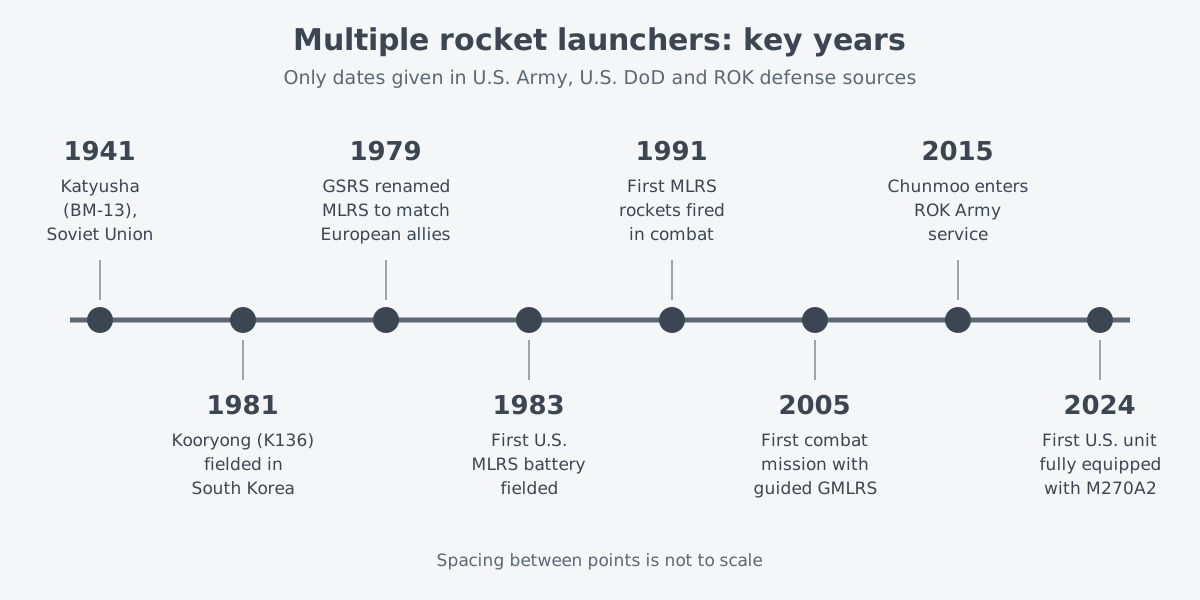
On March 31, 1983, the first MLRS battery entered service at Fort Riley, Kansas. In June 1984, fielding of MLRS to the U.S. 2nd Infantry Division in Korea was completed. MLRS rockets were first fired in combat on February 13, 1991.
The M270 is still being upgraded. Lockheed Martin first delivered the improved M270A2 in 2022. The upgrade brings new engines, newer fire control hardware and software, and an improved, enlarged armored cab. By December 16, 2024, the 41st Field Artillery Brigade in Germany had switched entirely to the M270A2, the first Army unit to do so.
Pods: swapping the tubes as one unit
MLRS is not reloaded one rocket at a time. A box with the rockets already inside is called a launch pod, and the whole box is loaded at once. On March 30, 1979, the first GSRS rocket was fired from a "six-pack" pod on a self-propelled launcher loader.
The guided GMLRS rocket also travels in a launch pod container of six rockets and is fired straight from it. It is a bit like swapping the magazine of a rifle. The difference is that the pod is both the box that holds the rockets and the bundle of launch tubes.
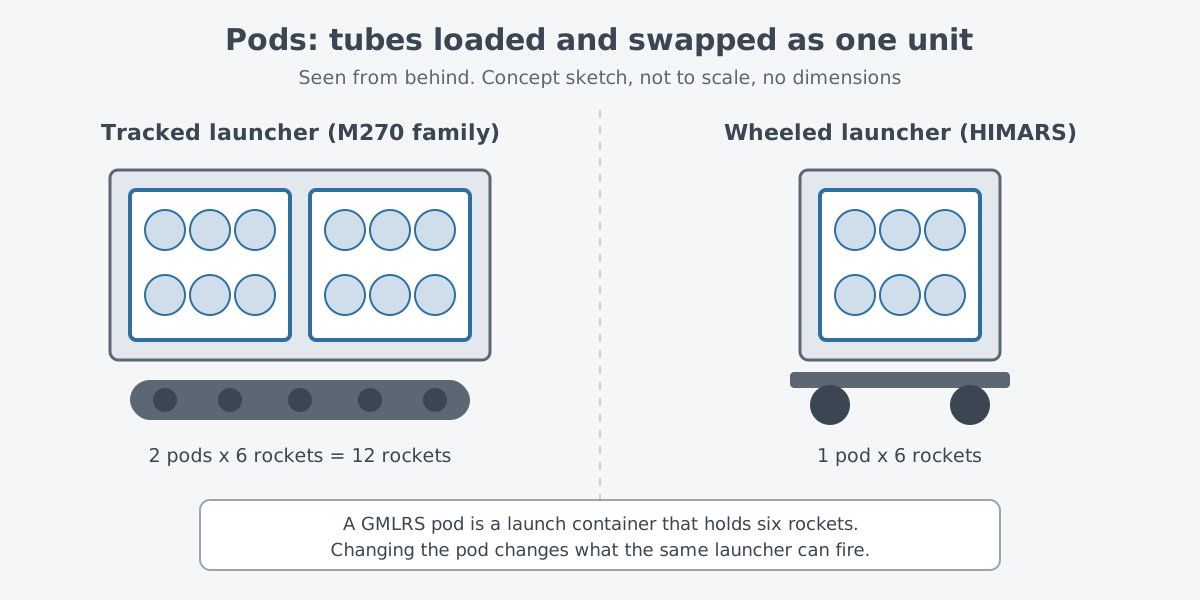
Launchers differ in how many pods they carry. The tracked M270 carries two six-rocket pods, 12 rockets in all.
HIMARS puts MLRS firepower on a wheeled chassis. It carries one pod of six GMLRS rockets, or a single missile, on the Army's 5-ton Family of Medium Tactical Vehicles (FMTV) truck. Its maker says HIMARS can fire the whole MLRS family of munitions.
Put a different pod on the same launcher, and it fires something different. Korea's Chunmoo follows the same idea. Its maker, Hanwha Aerospace, says one launcher can take short-, medium- and long-range guided missiles and switch missions just by changing the pod.
From unguided to guided rockets
The original MLRS fired free-flight artillery rockets. Once a rocket leaves the tube, it cannot correct its own path, so it is an unguided rocket. As noted earlier, multiple rocket launchers had the weakness of being less accurate than field guns.
The change meant to fix that limit is the guided MLRS, or GMLRS. GMLRS is a modified rocket meant to improve both the range and the accuracy of the extended-range rocket. It is a solid-propellant rocket fired from the M270A1 and from HIMARS.
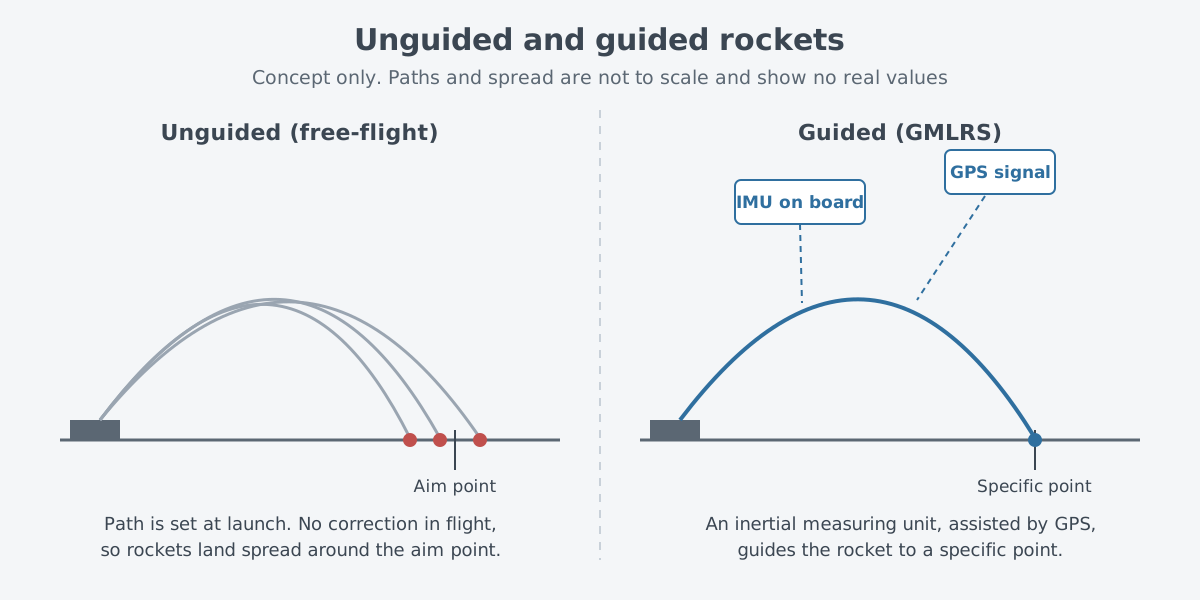
The rocket finds its way by mixing two methods. An inertial measuring unit (IMU) inside the rocket tracks its motion, and the Global Positioning System (GPS) assists it. A U.S. DoD acquisition report says this guides the rocket "to a specific point." Why the two kinds of navigation are combined is covered in Inertial and satellite navigation.
Guided rockets were first used in combat in September 2005. That first combat fire mission used the Unitary version of GMLRS.
The warheads changed too, and three GMLRS versions were fielded. The Dual-Purpose Improved Conventional Munition (DPICM) version carries many small submunitions for area targets or targets whose location is not precisely known. The Unitary version is for point targets, and the third is the Alternative Warhead (AW). The DPICM version was developed jointly by five nations: the United States, the United Kingdom, France, Germany and Italy.
The AW version uses no submunitions and replaces DPICM for area targets or targets whose location is not precisely known. The reason is unexploded ordnance. The DoD Director, Operational Test and Evaluation (DOT&E) found that AW has no submunitions that could cause unintended harm to civilians and infrastructure through unexploded cluster munitions. The acquisition report adds that AW removes the probability of unexploded ordnance and meets the requirements of the November 30, 2017, DoD Policy on Cluster Munitions.
Korea's rocket launchers: Kooryong and Chunmoo
South Korea's work on multiple rocket launchers began in 1974, when the Agency for Defense Development (ADD) surveyed data on a U.S. rocket system. The result, the 130 mm Kooryong (K136) multiple rocket launcher, was fielded with corps-level field units in 1981.
Its successor is Chunmoo. Chunmoo was developed with domestic technology over the five years from 2009 to 2013, at a cost of about 131.4 billion won. After a roll-out ceremony on August 4, 2015, it began entering service. At the time, the ROK defense ministry's newspaper expected Chunmoo to replace the artillery's 227 mm MLRS and the 130 mm Kooryong.
A Chunmoo set is made of a launcher (K239L) and an ammunition carrier (K239T). The launcher can reload its own pods. Korea's government news service describes the shift: rockets for suppressing wide areas used to be the main munition, and now precision-strike tactical surface-to-surface guided weapons are included too. Chunmoo was designed to be more precise than the older systems and to fire missiles of several calibers.
The path from Kooryong to Chunmoo looks much like the U.S. path from MLRS to GMLRS. Both started with weapons that fire a lot quickly, then moved toward swapping munitions by the pod and raising accuracy with guidance.
Where this meets lasers
Rockets are weapons to fire, and also things to stop. The name Katyusha comes back half a century later in the history of laser weapons.
In 1996 the United States and Israel began a joint program to develop the Tactical High Energy Laser (THEL). Its aim was a laser system that could bring down Katyusha rockets as well as artillery and mortar shells. Which laser it used and how the program ended continues in A history of laser weapons.
What to read next
- Inertial and satellite navigation: knowing where you are: the two kinds of navigation that guided rockets use.
- Solid and liquid rockets: what the fuel form changes: the basics of the motor that pushes an artillery rocket.
- A history of laser weapons: from chemical to electric lasers: the THEL program that set out to shoot down rockets with a laser.
- Counter-battery radar: what a projectile reveals: the idea of watching shells and rockets in flight with radar.