Every year at the end of January, the optics conference SPIE Photonics West meets in San Francisco. Its laser part, LASE, includes a conference called Solid State Lasers. It covers lasers that amplify light inside a block of crystal or glass. News about power records comes more often from the fiber laser side, so what were crystal lasers doing in the meantime?
This article answers that question by following about 260 talks at this conference from 2022 to 2027. It looks in turn at crystal materials, shapes that remove heat, new wavelengths, ruggedized and space lasers, very short pulses, and the AI design talks that first appeared in 2027. The data come from manuscripts in the proceedings and from public abstracts, so talks given without a written paper are not included.
How a solid-state laser differs from a fiber laser
Both kinds of laser use a light-amplifying material, the gain medium, with ions such as ytterbium (Yb) or neodymium (Nd) added to it. The difference is the shape. A fiber laser guides light a long way through the narrow core of a thin glass fiber. In a solid-state laser, light makes a short pass through one crystal rod or plate.
That difference sets the strengths and weaknesses. A long, thin fiber has a large surface for its volume, so heat leaves easily, and the core holds the beam shape. But when strong light stays trapped in a narrow core for a long way, nonlinear effects grow, and they limit how much energy one pulse can carry. The article on nonlinear limits in fiber lasers covers this in detail.
Among the talks chosen here, the large pulse energies come from crystals. The joule-class pulse results in this article (11980-14, 12.3020136, 12.3039277) all came from bulk gain media, not fibers. The weak point of a bulk medium is heat. When the middle of the block gets hotter than the edge, the crystal itself bends light like a lens, an effect called thermal lensing.
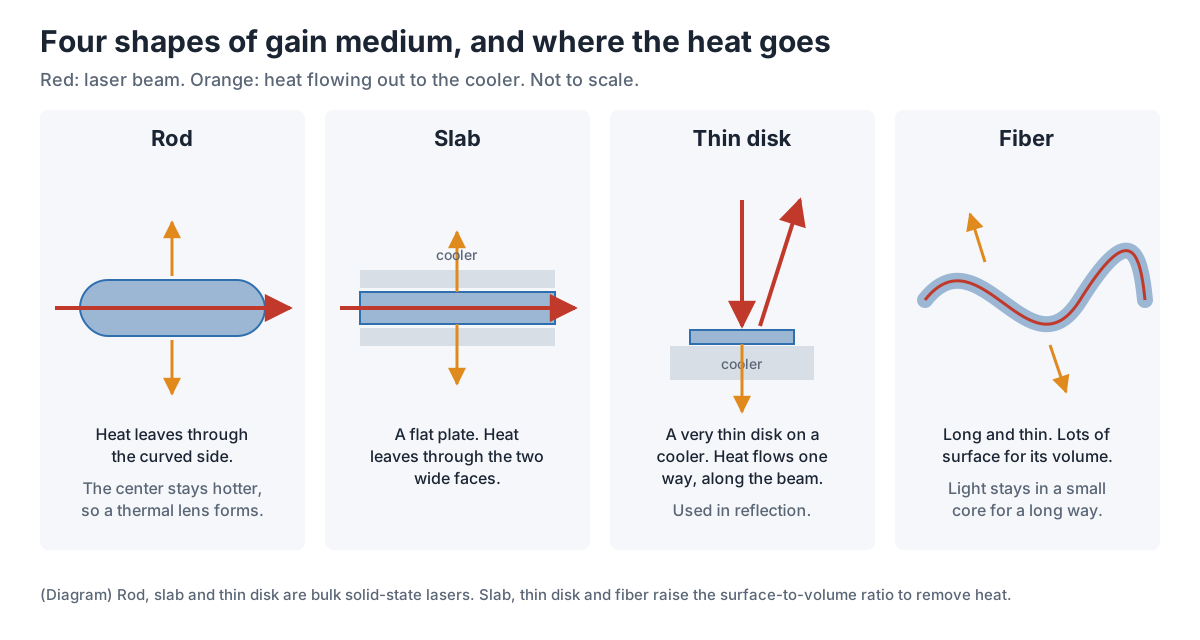
So the history of solid-state lasers is also a search for shapes that shed heat. Keller's textbook Ultrafast Lasers sums it up this way. Gain media were reshaped toward a high surface-to-volume ratio, and fiber, thin disk and slab designs all passed 1 kW of average power.
The fiber is one more shape on the same path. The same book points out that most ultrafast lasers today are diode-pumped solid-state lasers.
Some research mixes the two. A crystal fiber is a crystal drawn thin like a fiber. A 2023 talk from the U.S. Naval Research Laboratory (PC12399-4) covered fibers with single-crystal cores. Their threshold for transverse mode instability (TMI) could be 10 times higher than in glass fibers, but losses and hard fabrication have held them back.
Modeling and growth work with the U.S. Air Force Research Laboratory followed in 2024 (12.3003374) and 2027 (14438-25). The article on thermal limits and TMI in fibers explains what TMI is.
Six years of topic shares
The chart below shows what percent of each year's talks carried each topic tag. The talk counts are 40 in 2022, 47 in 2023, 56 in 2024, 49 in 2025, 27 in 2026 and 40 in 2027. One talk can carry several tags, so the shares in one year add up to more than 100%.
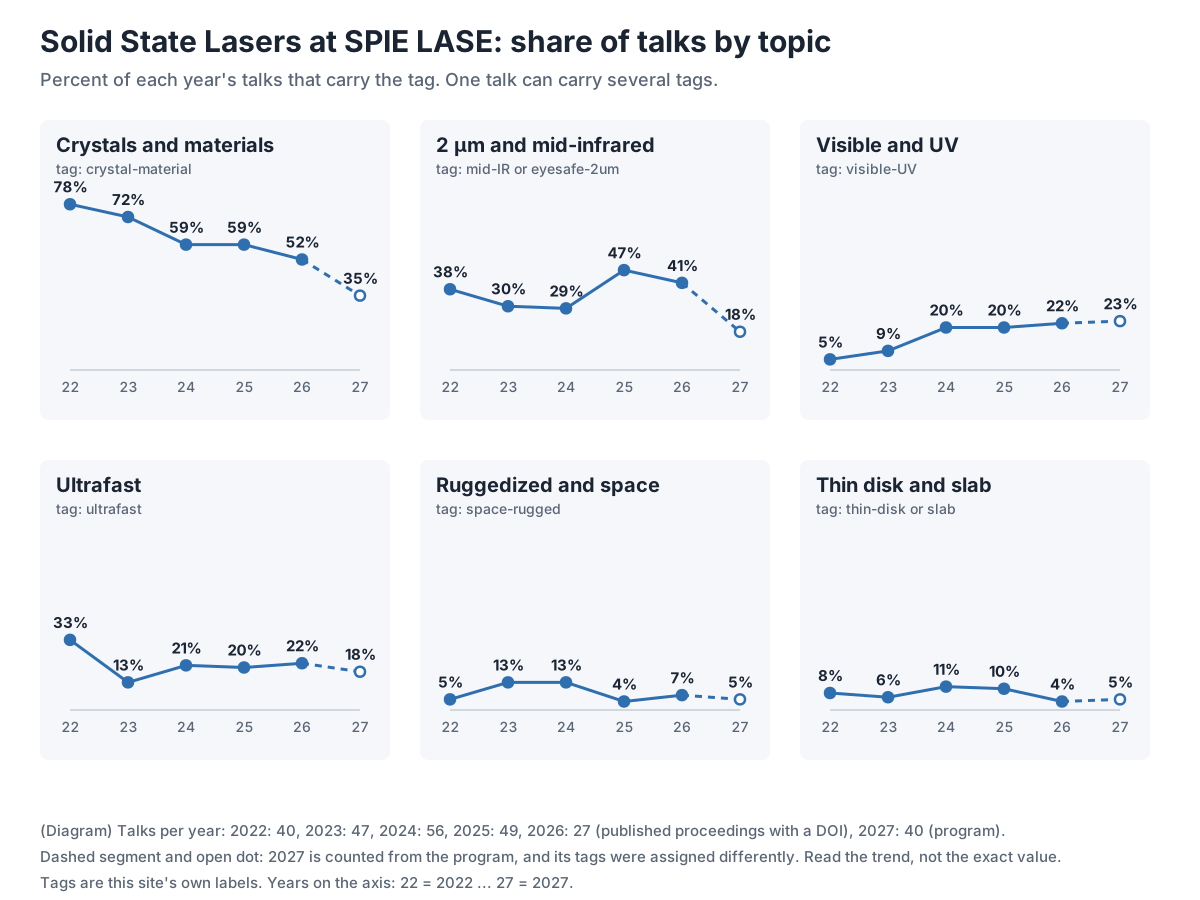
Two lines stand out. The crystals and materials tag fell from 78% in 2022 to 52% in 2026, while visible and UV rose from 5% to 22%. But the biggest drop for crystals, from 72% to 59%, came between 2023 and 2024, when the tagging method also changed. Fewer talks growing new crystals is one possible reading, but it is hard to separate from the change in method.
The 2027 values use different data and a different method again, so they are drawn dashed. The chart is less a six-year trend line than a separate snapshot of the conference each year.
Visible and UV also made its biggest jump in 2024, the year the method changed. But it held in the 20% range for three years after that and got its own session in 2027. Those facts are a firmer signal than the shares.
Crystals and materials: from Yb:CALGO to Faraday crystals
One crystal shows up through all six years: Yb:CALGO. It is CaGdAlO₄ doped with ytterbium, and at this conference it appears almost always in femtosecond laser talks. Following how this one crystal was used each year shows the trend.
In 2022 the University of Manitoba stretched its laser cavity with a White cell, three mirrors that send the light back and forth many times. Lowering the repetition rate to 13.85 MHz packed more energy into each pulse, and the 73 fs pulses reached a peak power of 744 kW (11980-38). The next year the same university reported 8.2 MHz, 126 fs and 416 kW peak, and called it the lowest repetition rate Yb laser at the 100 fs level (PC12399-9).
A 2024 talk from Chungnam National University used mode-locking without a saturable absorber in a Yb:CALGO oscillator. It reached 50 fs pulses, 8.6 W of output and 2.5 MW peak (12.3005218).
Then in 2027 the tone changes. Crystal growth of Yb:CALGO from Northrop Grumman SYNOPTICS (14438-24) and laser-grade Yb:CALGO from CRYTUR in the Czech Republic (14438-39) appear side by side. With two talks from crystal suppliers side by side, interest may be shifting from records toward production.
One thing to weigh when choosing a crystal is an absorption line that takes in pump light well. Diode light has a narrow spectrum, so it can be tuned right onto a crystal's absorption line, which improves pump absorption and cuts heating.
Er:YAG, which emits at 2.94 µm, also comes up often. In 2024 Fibertek built an Er:YAG laser for a differential absorption lidar that measures methane and water vapor. Made for the NASA Langley HALO aircraft platform, it delivers 3 mJ at both 1645 nm and 823 nm (12.3002925). In 2027 a high-energy Er:YAG amplifier from Cutting Edge Optronics (14438-8) shares a session with a 2940 nm Yb,Er:YAG crystal that adds Yb to absorb more pump light (14438-10).
Not every crystal makes light. In 2027 Northrop Grumman SYNOPTICS presented KTF and TGG crystals for the Faraday rotator (14438-21). This is the key part of an optical isolator, which blocks light from coming back.
As power rises, passive crystals like these must also handle heat, so they join the materials session. The article on isolators and fiber components explains how an isolator works.
Thin disks and slabs: shapes that remove heat
The thin-disk laser was introduced to solve the heat problems of rods and slabs. One side of a very thin crystal disk sits on a cooler, so heat flows out in one direction, along the beam. With little temperature difference across the disk, thermal lensing drops sharply. The catch is weak absorption in a single pass, so the pump light is sent through the disk many times.
TRUMPF scaled this shape up for industry. Its 2022 talk described a multipass thin-disk amplifier giving pulses above 100 mJ at kilowatt-level average power. The talk said its mechanical and thermal stability suits harsh industrial settings (PC11980-3). In 2024 the amplifier came in an industrial package, giving 10 mJ compressed pulses or 40 mJ without compression in the kW range (12.3001463).
On the slab side, the leading example is DiPOLE from the UK, an amplifier built from several cryogenically cooled ceramic Yb:YAG slabs. A 2023 talk covered a 10 J design that raises the repetition rate from 10 Hz to 100 Hz, and its thermal management (PC12399-24). In 2024 the Rutherford Appleton Laboratory reported 10 J at 100 Hz, or 1 kW average, at 25.4% optical-to-optical efficiency. Energy variation stayed under 1% rms over one hour (12.3020136).
The first session of 2027 includes a commissioning update on EPAC, a 10 Hz petawatt-class user facility built by the same laboratory (14438-2).
In the chart, the thin disk and slab tag stays between 4% and 11% each year. By talk count it is a small branch, but it supports industrial kW systems and large research facilities. Removing heat from laser systems in general continues in the article on cooling and thermal management.
2 µm and the mid-infrared
After the Yb and Nd lasers near 1 µm, the next big branch is 2 µm and the longer mid-infrared. In 2027 the conference gave it a session of its own, "Mid-IR and Eyesafe Lasers." Ions such as thulium (Tm), holmium (Ho) and erbium (Er), and crystals such as Cr:ZnSe, cover this band.
Energy records came from here. In 2022 Lawrence Livermore National Laboratory (LLNL) reported the first multi-joule diode-pumped Tm:YLF amplifier. It raised 1880 nm pulses to as much as 3.9 J, and reached 38 J with a free-running seed (11980-14). In 2024 the same laboratory compressed 1.6 J pulses to under 300 fs and showed a heat removal rate above 20 W/cm² in a helium-gas-cooled amplifier head (12.3003283).
Thin disks reached 2 µm too. In 2022 Ruhr University Bochum and ETH Zurich ran a continuous-wave Ho:YAG thin-disk oscillator at 112 W and obtained ultrashort pulses at 40.5 W average with mode-locking (PC11980-10). At a longer wavelength, the University of Alabama at Birmingham and MegaWatt Lasers reached 300 mJ in 15 ns pulses from a 2.8 µm Cr:Er:YSGG laser in 2023 (PC12399-57).
In 2025 MegaWatt Lasers merged the output of four lasers into one beam path in turn, reaching 200 W at 2.13 µm (40 Hz). The talk named medical and remote sensing uses (12.3049547).
In 2027 Class 5 Photonics presents a tabletop source that pumps a 5 µm source with a 100 mJ Ho:YLF amplifier to make X-rays (14438-3). Here the 2 µm laser is no longer the end point but a pump for longer wavelengths. The article why wavelength matters explains why uses split by wavelength.
In the chart, this branch peaks at 47% in 2025 and falls to 18% in 2027. The 2025 value comes from automatic tagging by keywords in titles and abstracts, and the 2027 value from reading the abstracts, so the two are hard to compare directly. A whole session of its own is the clearer signal.
Converting to UV and deep UV
Passing laser light through a nonlinear crystal can double or triple its frequency and shorten the wavelength. Most UV talks at this conference combine a laser in the 1 µm range with a conversion crystal. In the chart, visible and UV rose from 5% in 2022 to 23% in 2027. Its biggest jump came in 2024, the year the tagging method changed.
Early talks aimed at small, low-cost sources. In 2022 one talk pumped a microchip laser with several low-cost, air-cooled diodes joined by a fiber combiner. Converted to 355 nm, it became a UV microlaser billed at 6 MW peak power in its title, with under 6 MW in the abstract (11980-16). In 2023 NASA Goddard Space Flight Center presented a 266 nm solid-state laser for the mass spectrometer on Dragonfly, the lander that will explore Saturn's moon Titan (12399-28).
After that, lifetime and power took the stage. In 2024 Oxide Corporation of Japan reported a continuous-wave 213 nm source with up to 270 mW. Its lifetime topped 3,000 hours when the crystal spot was shifted during use (12.3002230). In 2025 Northrop Grumman converted 9.1 J pulses at 1053 nm with 78% efficiency into 7 J at 527 nm (10 Hz) (12.3039277).
In 2026 a 266 nm picosecond source made from Yb fiber laser light reached 12 W average, with no crystal damage over a 400-hour test at 8 W (12.3077857).
The 213 nm and 266 nm talks both reported how long the conversion crystal lasts, alongside the power. For short-wavelength sources, crystal lifetime matters as much as output.
In 2027 a separate "UV and Visible Lasers" session appears. Coherent shows a watt-level 213 nm source (14438-15) and a deep-UV source below 240 nm with more than 1.5 W (14438-20). OXIDE shows a 193 nm, 500 mW source (14438-19), and HiLASE aims at 193 nm from a 772 nm alexandrite thin disk (14438-17).
Since 2024, talks have kept showing operating tests of hundreds of hours alongside power, so this branch may be moving from lab demonstrations toward industrial sources. The article on industrial laser uses shows how lasers are used in factories.
Ruggedized and space lasers
A laser on a lab table and a laser on an aircraft or satellite face different tests. Temperatures swing widely, there is vibration, and in space there is radiation as well. The ruggedized and space tag jumped from 5% in 2022 to 13% in 2023.
Two 2023 talks show this well. L3Harris built small 1.54 µm Q-switched transmitters from phosphate glass with different erbium-to-ytterbium ratios, and said they work from −40 °C to 85 °C without active cooling. These range-finding transmitters give 3 mJ at 5 Hz or 1 mJ at 100 Hz (12399-15).
Laser Zentrum Hannover noted that alexandrite crystals and coatings for Earth observation satellites had not gone beyond technology readiness level 4. It described a plan to qualify them to level 6 with radiation and thermal cycling tests (12399-25).
Some reports come from lasers already working in space. In 2024 a talk covered the status and lessons of the transmitters for GEDI, a forest-measuring lidar on the International Space Station. The first flight transmitter was 10 mJ-class (12.3003703).
In 2025 another talk tested Er:Yb glass, common in lidar and range finding, from −20 °C to 60 °C. Its weak points are low thermal conductivity and strong thermal lensing (12.3041039).
In 2027 a session named "Ruggedized and Space Qualified Lasers" appears. Yet its talks mix a MEMS-VCSEL, compact self-injection-locked lasers, a theory paper on superconducting rings and a review of lasers for oil and gas. It is a good example of how reading the trend from session names alone can mislead. Making equipment survive the outside world continues in the articles on environmental durability and laser ranging and lidar.
High-power femtosecond lasers
Femtosecond pulses are so short that even modest energy gives a high instant intensity. The problem was average power. Keller's textbook gives one reason average power climbed so far: Yb-doped materials have a small quantum defect, so only a small share of the pump energy is lost as heat.
At the conference, making pulses shorter and making them stronger went together. In 2022 a device placed a gas-filled multipass cell (more than 90% throughput) after an industrial 330 W, 400 fs laser. It tuned 300 W, 1 mJ pulses from 2 ps down to 30 fs (PC11980-1). In 2024 Helmut Schmidt University compressed thin-disk oscillator pulses in two multipass cells to 7.2 fs at 146 W average (12.3025383).
The talk called it the highest average power among few-cycle sources without an amplifier.
The ultrafast tag fell from 33% in 2022 to 13% in 2023, then held near 20%. Industrial reports continue, such as the Light Conversion talk in the first session of 2027 on high-power femtosecond sources in both infrared and UV (14438-4). How short pulses are made is covered in Q-switching and mode-locking, and their uses in ultrashort pulse processing.
New in 2027: AI-assisted design
Machine learning has been showing up a little at a time since 2023. At DESY in Germany, the pump-probe laser of the FLASH free-electron laser runs in 10 Hz bursts, so fast feedback is not possible. The team combined classic control and machine learning to steady the beam pointing (PC12399-6). In 2025 a talk built a digital twin of a high-power laser system, with a machine learning model 250 times faster than the usual numerical simulation (12.3042388).
In 2026 a talk automated the solid-state laser design process with neural networks to cut the design cycle sharply (12.3081638). Then the very first talk of the 2027 Solid State Lasers conference (14438-1) is "What role can AI large language models (LLMs) play in laser design?" from Endeavour Laser Technologies. In this site's summary of the abstract, a language model writes code to build a model of a Q-switched laser. The conclusion is that physics simulation and experiment must still do the checking.
These are about one talk a year, so the chart does not plot them. Still, the first slot of the conference is worth noticing. The article why simulate lasers looks at the role of computation in laser development.
Limits of this data
Every number in this article is a value stated in a talk abstract. Test conditions, the basis for efficiency and the scope of the word "record" all differ from talk to talk. Lining up numbers from different talks to rank them is a mistake.
Even one laser gives very different numbers depending on what is measured. The 2024 Yb:CALGO oscillator had 8.6 W average and 2.5 MW peak.
Topic shares were counted with this site's own tags. For 2022–2026 they cover only manuscripts and recorded talks with a DOI, and for 2027 the public abstracts in the program. Talks given without a paper and unpublished research are not included.
The tagging method also differs by year. Tags for 2022–2023 were assigned automatically and then corrected by hand. Tags for 2024–2026 came automatically from keywords in titles and abstracts, and tags for 2027 came from reading the abstracts.
In 2026 only 27 talks had a DOI, so one or two talks can swing a share widely. The chart is best used to see each year on its own, not to read year-to-year differences as a trend.
What to read next
- What is a fiber laser: the basic structure of the fiber side compared here.
- Reading technology trends in conference abstracts: how to read paper numbers, invited talks, proceedings and DOIs.
- Reading a high-power fiber laser review paper: how to read a review that gathers one field, as opposed to a conference abstract.