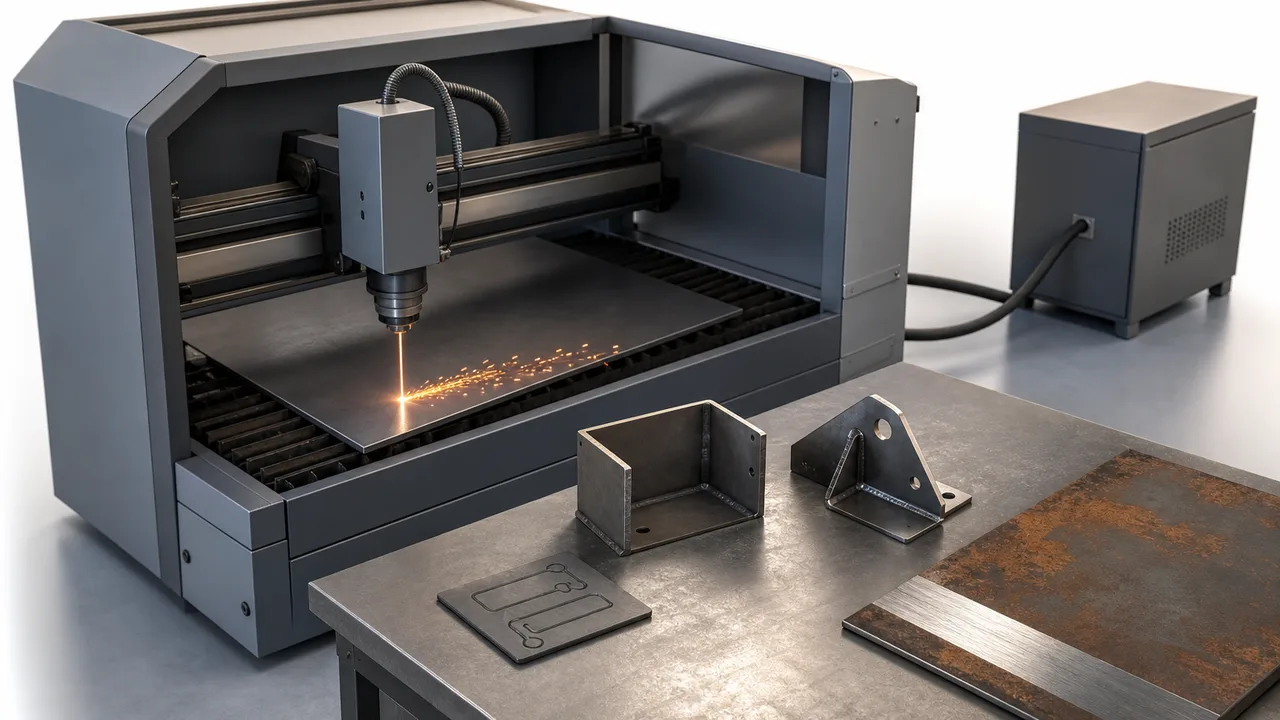
A sheet of steel goes into a laser machine and comes out as parts cut to shape. On another machine in the same plant, a laser joins car parts, and a third machine puts a barcode on every part. There is even equipment that sweeps a laser over a rusty surface to bring back clean metal.
This article sorts the work lasers do in a factory into four jobs. It looks at what cutting, welding, marking and cleaning each do to the material, and at the big picture of which lasers are used for each job.
Four jobs a laser does in a factory
The four jobs leave different results. Cutting splits material in two, and welding joins two pieces into one. Marking leaves a sign on the surface, and cleaning strips off only the top layer.
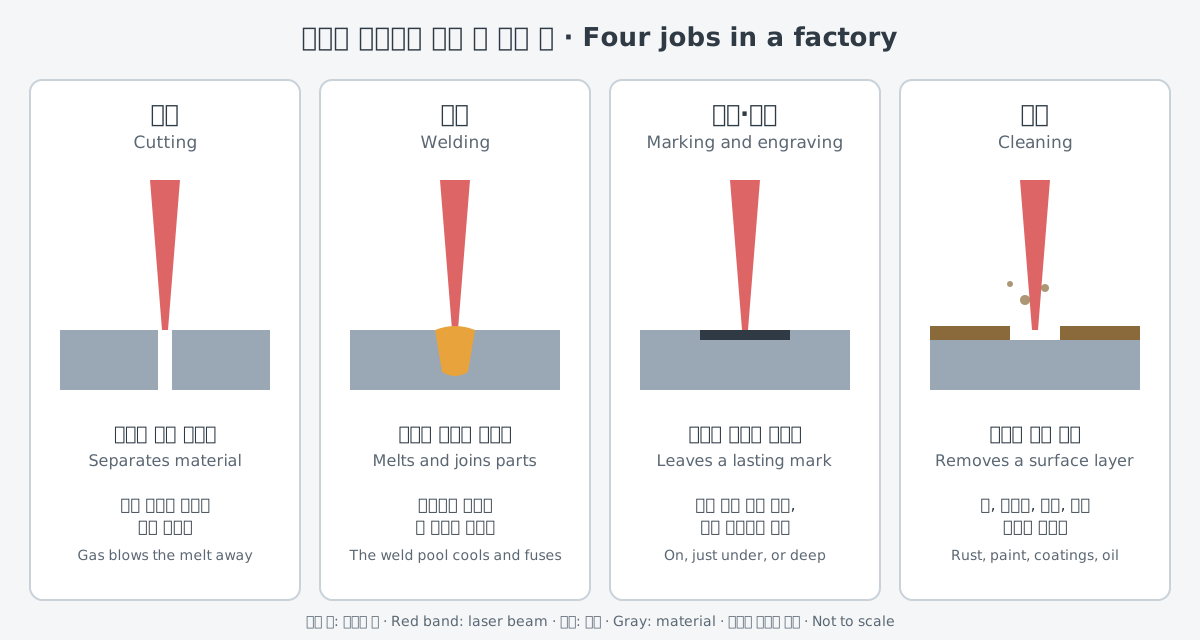
The four jobs share one trait: the laser does its work without touching the material. A knife or a drill wears down with use, but light does not. So laser machining has no tool wear, and it can machine many different materials.
The common principle: turning light into heat
Focus sunlight to a point with a magnifying glass, and paper starts to scorch. A factory laser follows the same broad idea. It gathers light into a small spot to heat material, melt it and sometimes vaporize it.
The real thing differs in an important way. A magnifying glass only gathers sunlight. Laser processing also chooses the pulse length to control how far the heat spreads into the surroundings.
Welding moves the beam's energy into the part as heat to melt it, and marking moves heat energy into the material to make a mark. Laser machining is usually split into two groups. Macroprocessing, which works on thick metal, relies on thermal mechanisms such as heating and melting, while microprocessing, which makes small features, combines thermal and non-thermal mechanisms.
Heat is not all good. Heat that spreads around the worked spot can leave thermal damage in the nearby material, and that surrounding region is called the heat-affected zone (HAZ).
Very short pulses ease this problem. A short pulse packs its energy into a very short time, so it reaches very high peak intensity. Ursula Keller's textbook Ultrafast Lasers notes that industrial material processing has traditionally used nanosecond pulses but is moving toward picosecond and femtosecond pulses for higher precision and less thermal damage.
The reason is speed. The target area is removed faster than heat can move into the surrounding material. The heat-affected zone around the removed material then becomes very small, and this kind of processing is called cold ablation. How light turns into heat inside a material is the subject of the article on laser material processing.
Cutting
Laser cutting is a non-contact thermal separation process that cuts through material with a focused beam. The focused beam burns, melts or vaporizes the material, and a gas jet blows the molten material away to leave an edge.
Metal is not the only thing that gets cut. In industry, lasers also cut plastic, wood, ceramics, wax, fabrics and paper. IPG Photonics counts laser cutting as one of the largest industrial uses of high-power lasers.
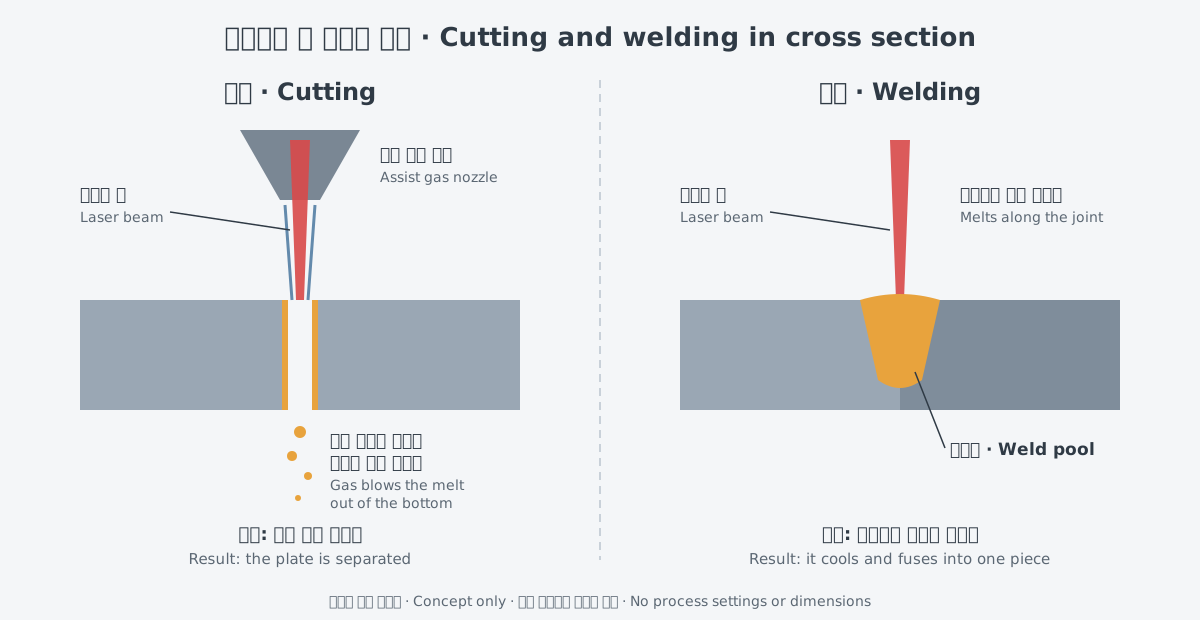
In cutting, the gas is no side player. A 2019 review in the journal Materials (Riveiro and colleagues) calls assist gas central to laser fusion cutting. The review sorts process parameters into two groups. Parameters such as the laser beam go into melting the material, and parameters tied to the assist gas go into clearing the molten material away.
Sometimes the gas helps with the melting too. This happens when it can react with the material and give off heat.
How the gas is blown in also changes the result. The British welding research institute TWI (The Welding Institute) developed a high-velocity nozzle, starting from the dross and oxide left when stainless steel is cut with ordinary low-pressure oxygen. The cause there is the high viscosity of the chromium oxides. In this nozzle, the gas blows the molten metal away as soon as the laser melts it; together with its cooling effect, this stops sideways heat transfer.
Gas-assisted cutting has a long history. TWI presents the invention of gas-assisted laser cutting in 1967 as its own work.
Welding
Welding also melts material with light, but the result is the opposite, because it leaves the molten material in place instead of blowing it away. Laser welding moves the beam's energy into the material as heat and melts it. The molten pool, called the weld pool, then cools and fuses the two parts into one. It can be done with or without filler material.
One strength given for laser welding is that it puts heat into a narrow place. The laser beam can be controlled more precisely, so laser welding can leave a smaller heat-affected zone than traditional welding that relies on electrical discharges. Directing heat precisely also reduces distortion in sensitive parts.
Where is it used? Industries that build vehicles, such as automotive, shipbuilding and aerospace, are increasingly replacing bolted assemblies with welds. A laser weld is a permanent connection, so it saves weight and lowers the risk of nuts and bolts loosening or breaking over time.
Welding plastic has a clever twist. Diode laser wavelengths are absorbed only by colored plastics. So a clear part and a colored part are stacked, and the beam passes through the clear part to melt only the colored one and join the two.
Marking and engraving
Putting a barcode, letters or numbers on a part with a laser is called marking. Laser marking is a non-contact process that uses a focused beam of light to leave a long-lasting or permanent mark on a surface.
The mark is made with heat. Heat energy moves into the material, and controlled burning or ablation creates a visible mark on or just under the surface. It can also mark beneath the surface or cut deep, which is called engraving. It can mark metals as well as plastics, ceramics and glass.
The point of a mark is tracking. Marks serve labeling, product tracking, machine vision and regulatory compliance, and marking has spread widely in industries such as automotive, electronics, aerospace, semiconductors and medical devices. Compared with inkjet printing, marking with a fiber laser needs no consumable ink, and because it changes the surface itself, the mark lasts, in IPG's account.
Cleaning and surface treatment
Cleaning with a laser sounds odd at first. Laser cleaning is also called "laser material removal," because a scanned beam removes only the unwanted material on a surface.
The process uses laser thermal shock. It peels off, vaporizes, sublimates or burns away the unwanted material without harming the base material underneath. What it removes are coatings, paints, rust and oil, and it also prepares surfaces before welding or coating.
Sparing the base material comes with a condition. The laser parameters must be carefully optimized so that the underlying surface is not damaged. In return, IPG points out that in most cases no abrasives or chemical solvents are needed.
Which lasers are used
Each job needs different light, and three things matter. The first is how strong the light is. The second is whether it comes from a continuous-wave laser (CW) that shines steadily or a pulsed laser that delivers bursts. The third is beam quality, which describes how small a spot the beam can be focused to.
Cutting and joining thick metal needs strong light without a break. Metal cutting, welding and additive manufacturing need high-power infrared lasers with kW-class output, and most of them are CW lasers. Some are quasi-CW lasers, which pulse on a millisecond scale to raise the peak power for the same average power.
The demand on beam quality also changes from job to job. It can be compared in terms of brightness, given as the beam parameter product (BPP). Metal cutting needs higher brightness (a lower BPP), while metal welding can work with lower brightness.
In fine work, pulses take center stage. Shorter wavelengths and shorter pulses help raise machining quality. Ultrashort pulses in the picosecond and femtosecond range vaporize material in an instant and send very little heat into it, so the heat-affected zone becomes negligible.
The laser types themselves have changed over time. The carbon dioxide (CO₂) laser used to be the workhorse of metal cutting. Cost-effective disk lasers and fiber lasers then pushed CO₂ lasers out of many uses, and fiber and disk lasers are typically used for laser welding and remote welding.
CO₂ lasers still keep a place. Organic materials such as plastic and wood strongly absorb light at 10.6 µm, the CO₂ laser wavelength, so Newport sees no alternative to the CO₂ laser for them. It is an example of how much a material absorbs a wavelength shapes the choice of laser.
The table gathers the examples these sources give. Each cell is an example from that source, not a claim that only that laser does the job.
| Job | Laser named in the source | How the light is delivered | Source |
|---|---|---|---|
| Metal cutting | Fiber and disk lasers (CO₂ was the old workhorse) | kW class, mostly CW | Newport |
| Cutting plastic and wood | CO₂ laser (10.6 µm) | Not given | Newport |
| Metal welding | Fiber and disk lasers | Mostly CW, some quasi-CW | Newport |
| Plastic welding | Diode lasers | Not given | Newport, IPG |
| Marking | Fiber lasers | Marking is among the uses of nanosecond pulsed products | IPG |
| Cleaning | Fiber lasers | Cleaning is among the uses of CW products | IPG |
| Micromachining | Short-pulse lasers | Picosecond and femtosecond pulses | Newport, Keller |
| Heat treatment and hardening | Diode lasers | Not given | IPG |
The uses the makers list fit the same picture. For its industrial CW fiber lasers, IPG lists cutting, welding, cleaning, surface processing, cladding and 3D printing. For its nanosecond pulsed fiber lasers, it lists ablation, marking, micromachining and hole drilling. Its diode lasers serve jobs such as heat treatment, metal hardening and plastic welding, which do not need the tighter focus of fiber lasers.
nLIGHT also lists uses from precision cutting and welding to microfabrication and additive manufacturing. Blue lasers are used too, for welding highly reflective materials such as pure copper. BWT gives the reason: copper absorbs blue light much more efficiently than infrared light. The official websites of these three companies are collected on the laser makers page.
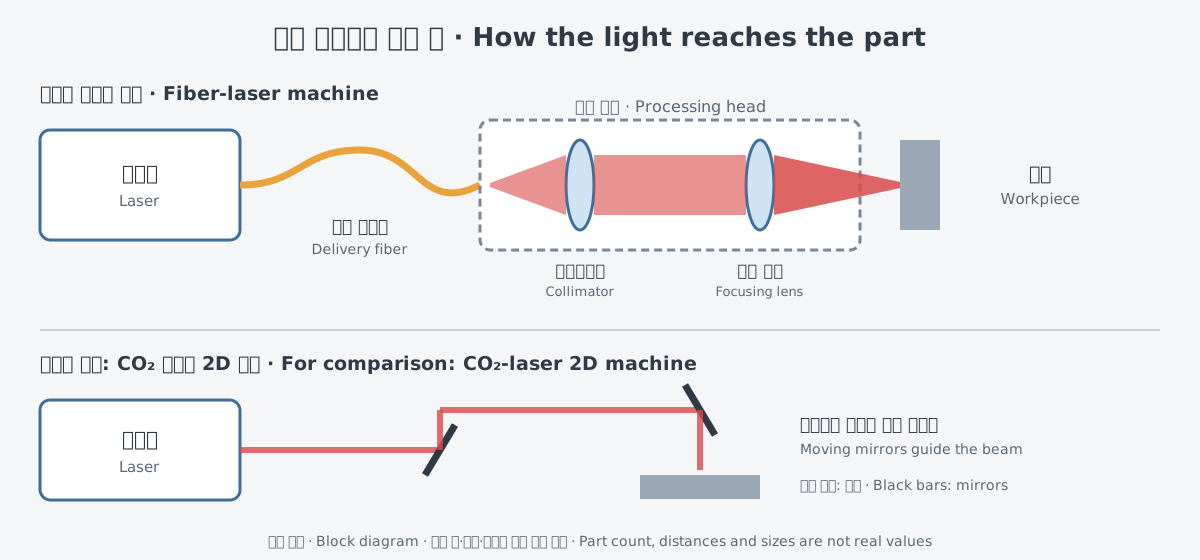
How does the light get from the laser to the part? In a fiber-laser machine, the fiber core guides the beam to the cutting head. There, a collimator and a focusing lens bring the light to a focus on the workpiece. In a CO₂-laser 2D machine, at least two moving mirrors are needed to send the beam to any point on the workpiece.
There are also uses beyond the four jobs. Additive manufacturing (3D printing), which melts or fuses metal powder to build up parts, is usually called selective laser melting or laser sintering. Ultrafast lasers are also used for precise processing such as wafer dicing and for low-damage tissue ablation in corrective eye surgery.
What to read next
- "How a laser processes material: absorption, heating and melting": how light turns into heat inside a material, and why the result differs with the material and the wavelength.
- Laser types at a glance: gas, solid-state, fiber, semiconductor: a table of where the CO₂, disk, fiber and diode lasers in this article belong.