The red dot from a laser pointer is easy to see. But not all light is visible. What separates the light you can see from the light you cannot is wavelength.
Wavelength is the length over which a wave repeats once, and for light it is tied to color. It is measured in nm (nanometers) and μm (micrometers), and 1 μm is 1000 nm. A change in wavelength changes whether the eye can see the light, where the eye absorbs it, and how well it passes through air. Absorption is a material taking in the energy of light.
Wavelength and color: visible light is a narrow band
Visible light is a narrow band of wavelengths. NASA writes that the human eye can detect roughly 380–700 nm, with violet the shortest and red the longest. The OpenStax university physics textbook (University Physics) gives about 400–750 nm for the same band. Other sources use still other values, so the edges of visible light differ from source to source.
This means 380–400 nm and 700–750 nm count as visible in some sources and not in others. Light with a shorter wavelength than visible light is ultraviolet (UV), and light with a longer wavelength is infrared (IR). OpenStax writes that the frequency range of infrared extends up to the lower limit of the frequencies of visible light, just below red. Infrared lies just outside the red end of visible light.
Light you cannot see: infrared and ultraviolet
NASA describes infrared as the region just beyond visible light and says it is divided into near-infrared, mid-infrared and far-infrared. The OSHA Technical Manual defines infrared as invisible electromagnetic radiation with wavelengths of 0.7–1000 μm. The same manual splits this range into IR-A (0.7–1.4 μm), IR-B (1.4–3.0 μm) and IR-C (3.0–1000 μm).
The edges differ even inside that manual. Its summary table of effects on the eye gives IR-A as 0.780–1.400 μm, so it starts at a different value from the glossary's 0.7 μm.
Here is where typical laser wavelengths fall on this band. Because 1064 nm is 1.064 μm, it falls within the OSHA glossary definition of IR-A.
| Laser | Wavelength | Band | Basis |
|---|---|---|---|
| Helium-neon (He-Ne) | 633 nm | Red, visible | Wording of the standards advice listed by NIST (National Institute of Standards and Technology) |
| Nd:YAG (a laser that uses a crystal as its medium) | 1064 nm | Inside IR-A (0.7–1.4 μm) | OSHA glossary |
| Carbon dioxide (CO₂) | 10.6 μm (10600 nm) | Inside IR-C (3.0–1000 μm). This is the OSHA glossary's division; names and edges differ by source | OSHA glossary |
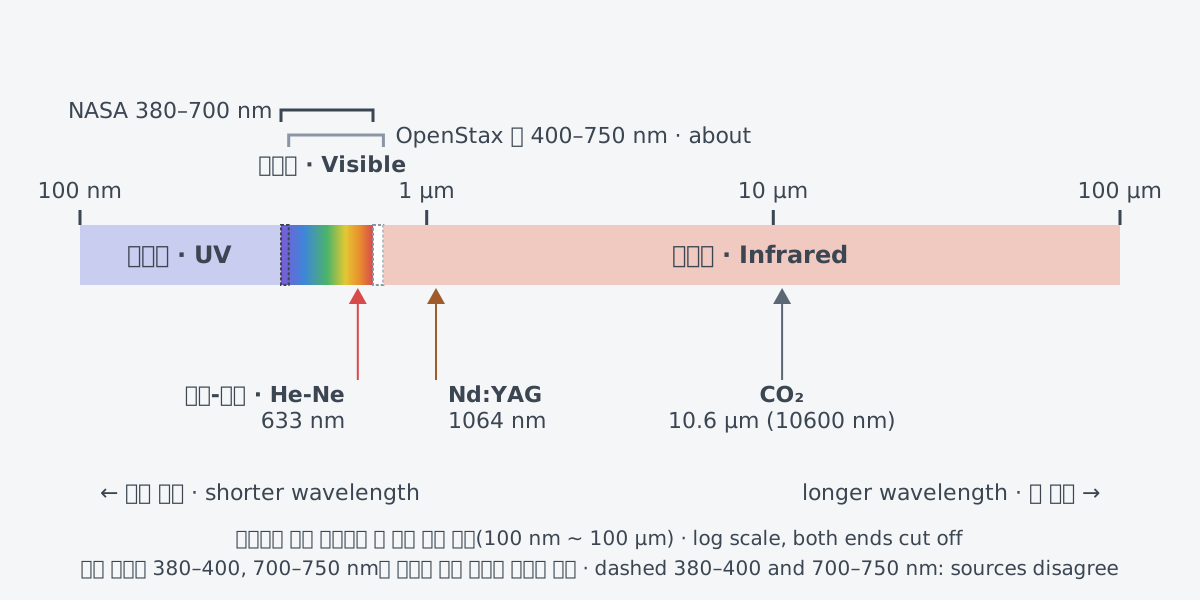
In the diagram, the NASA range of visible light is colored in and the OpenStax range is shown beside it in brackets. The 380–400 nm and 700–750 nm bands, where the two disagree, have a dashed outline.
Wavelength and the eye: how far light gets in
Where light is absorbed in the eye depends on wavelength. This section follows the 2013 guidelines on laser exposure limits from ICNIRP. The limits in those guidelines apply to wavelengths from 180 nm to 1 mm.
For ultraviolet, ICNIRP writes that the shorter part is absorbed in the cornea and conjunctiva, and the longer part is absorbed largely in the lens. In the visible and near-infrared region, the risk of retinal injury is of particular concern, and ICNIRP gives this range as 400–1400 nm. The 1064 nm line in the table above is invisible, yet it lies inside this range. The ICNIRP guidelines say that most of the light reaching the retina is absorbed by the pigmented epithelium and the choroid beneath it.
The eye's media are transparent and the eye focuses light. So in this region the retina is much more susceptible to damage than any other part of the body. For a point source, light from a single point, ICNIRP states that the intensity (irradiance, the power per unit area) rises about 100,000 times from the cornea to the retina.
The picture changes at longer wavelengths. ICNIRP says that at 1150–1400 nm both retinal damage and damage to the anterior segment of the eye must be considered. Above 1400 nm, the exposure limits in these guidelines are set by damage to the anterior segment. Take the 10.6 μm carbon dioxide laser as an example: its light is absorbed in a very thin layer at the front of the cornea.
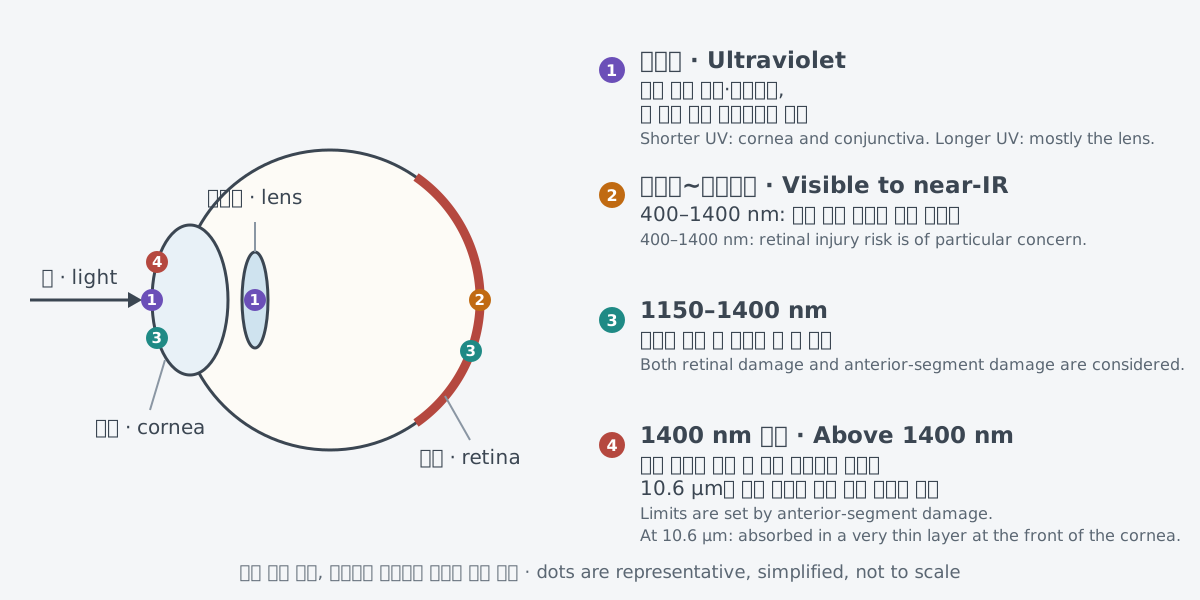
The numbers also differ a little between sources. One paper (Schulmeister and Stuck, 2024) says that at 1200–1400 nm the dominant hazard shifts from the retina to the cornea. The paper quotes a footnote of IEC 60825-1, a laser product safety standard. The footnote warns that at 1250–1400 nm the limits that protect the retina may not adequately protect the anterior parts of the eye.
None of this means that any wavelength is safe. The need to consider the anterior parts of the eye from 1150 nm upward, described above, is one example. Among the official sources this article checked, none says that a particular wavelength is safe.
Wavelength and materials: absorbed or passed through
The eye is not the only case. Absorption depends on the pairing of a substance and a wavelength.
According to the OpenStax textbook, ozone absorbs most UV-B and all UV-C. UV-B and UV-C are names for parts of the ultraviolet. Infrared is absorbed by water and carbon dioxide molecules in the atmosphere.
The eye from the last section is another example. OSHA defines the ultraviolet, visible and infrared radiation in the region of transmittance of the human eye as 0.35–1.4 μm (350–1400 nm). Yet ICNIRP says that light from a 10.6 μm carbon dioxide laser is absorbed in a very thin layer at the front of the cornea. In the same eye, light of one wavelength may travel deep while another stops at the front.
Absorption in other materials continues in the article on laser processing.
Wavelength and air
Air, too, is more or less transparent depending on wavelength. Some radiation, such as visible light, largely passes through the atmosphere. NASA calls the wavelength regions that pass through "atmospheric windows," and NOAA uses the same term. NOAA says most of the Sun's energy comes from visible light and the near infrared.
Visible light penetrates the atmosphere effectively except when clouds block it. The absorption by ozone, water and carbon dioxide molecules in the previous section is an example of the atmosphere blocking light. The atmosphere passes some wavelengths and blocks others.
What to read next
The next article is "Power, energy and intensity: W, J and W/cm²," which covers the figures that are often mixed up. Eye hazards continue in "Laser safety," absorption in materials in "How a laser processes material," and light in air in "Light through air."