An optical fiber is a thin strand of glass that carries light to faraway places. A fiber laser is a laser that gives that light-carrying strand a second job: making the light grow. The manufacturer Newport (MKS) defines it as "a laser where the optical fiber is itself the gain medium."
A laser needs three things: a gain medium that makes light grow, pumping that puts energy in, and a resonator that feeds the light back. Where is each of the three in a single thin strand of glass?
Once the three parts are found, the next subject is ytterbium (Yb), an element mixed into the glass, and its wavelength. The wavelength numbers differ a little from source to source, and the advantages claimed for fiber lasers come with conditions.
What a fiber laser looks like
An optical fiber is, to begin with, a thing for sending light far. According to the Nobel Foundation's press release for the 2009 physics prize, Charles K. Kao made a discovery in 1966 that led to a breakthrough in fiber optics. He carefully calculated how to transmit light over long distances through optical glass fibers.
In most cases, the gain medium of a fiber laser is a fiber doped with rare-earth ions. Doping turns the fiber from a passive transmission medium into an active medium with gain. A slide deck from a 2013 Photonics Media webinar, hosted on the Coherent website, shows several continuous-wave (CW) and pulsed fiber lasers as examples. Every one of those examples uses a rare-earth-doped fiber as its gain medium.
The diagram below shows the simplest layout. Light from a pump laser diode enters the fiber. A fiber Bragg grating (FBG) sits inside each end of the doped fiber that serves as the gain medium, and the light leaves from one end. A real device has more parts, and the diagram is not to scale.
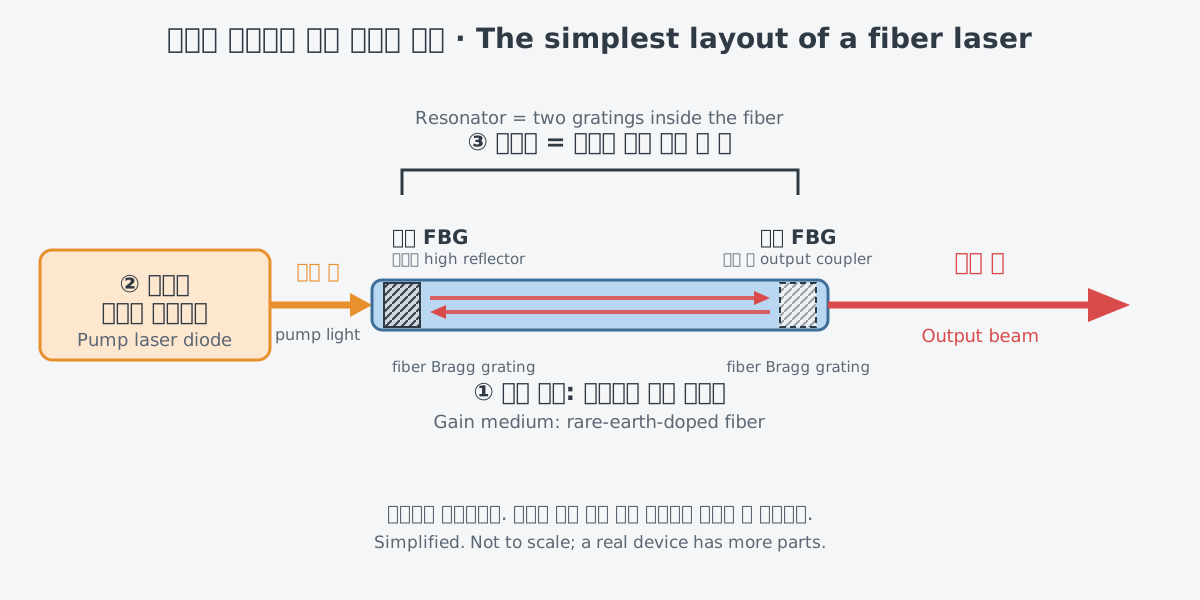
The history of the fiber laser goes back to 1961. According to the IEEE Milestone record, Elias Snitzer and colleagues built and operated the world's first optical fiber laser in the former American Optical complex in Southbridge, Massachusetts. Three years later the same team demonstrated the first optical fiber amplifier.
Where the three parts are: gain medium, pump, resonator
Here is where the three parts of a laser turn up in a fiber laser.
| Part | What it does | In a fiber laser |
|---|---|---|
| ① Gain medium | Makes passing light grow | A fiber doped with rare-earth ions ("in most cases") |
| ② Pumping | Puts energy in from outside to lift atoms to the upper level | Optical pumping with light from laser diodes or other fiber lasers ("virtually all" fiber lasers) |
| ③ Resonator | Sends light back so it passes through the gain medium many times | A design built with fiber Bragg gratings (preferred at high power) |
In the gain medium, the ions mixed into the glass correspond to the atoms that rise to the upper level and then give off light. Pumping means putting pump light into the fiber. Virtually all fiber lasers are optically pumped by laser diodes or other fiber lasers.
To see where the pump light travels, look at the cross-section of a fiber. In a generic fiber design, the core in the middle and the cladding around it are both glass. The core carries the light and signal, and the cladding helps define the optical characteristics of the fiber.
Some laser diodes have lower-quality spatial modes. Double-clad fibers are often used to couple the light of such diodes into the fiber efficiently. As the name says, the cladding has two layers, an inner one and an outer one. The laser light travels in the core and the pump light travels in the inner cladding.
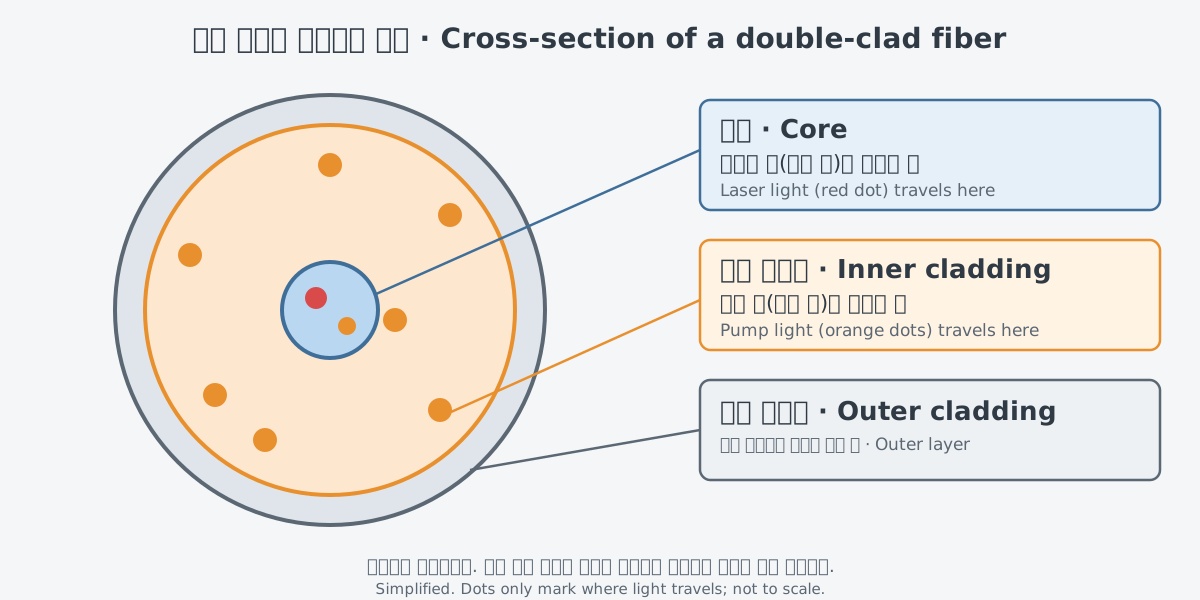
The resonator is where the fiber Bragg gratings from the first diagram come in. Optical parts that sit in open air outside the fiber are called free-space optics. The Coherent-hosted deck reports that such parts have proved unreliable inside the laser cavity at the high power levels where fiber lasers now operate. For that reason, it says, monolithic designs that form the cavity with fiber Bragg gratings are now preferred.
The two gratings are called the high reflector and the output coupler. When the gratings are in the core of a double-clad fiber, the pump light passes straight down the fiber unaffected by them.
What is added to the glass: ytterbium as an example
Ytterbium is not the only rare-earth element put into fibers. Newport names ytterbium, erbium (Er) and thulium (Tm) as the most common dopant ions. Depending on the source, neodymium, praseodymium and holmium are on the list as well.
There is a reason for picking ytterbium as the example here. The abstract of a 2010 review paper (Richardson, Nilsson and Clarkson) calls lasers based on ytterbium-doped fiber (YDF) "the current fiber gain medium of choice." That 2010 abstract also rates them by far the most developed in terms of high-power performance. The University of New Mexico lecture slides likewise present high-power fiber lasers as mainly ytterbium silica fiber lasers.
Look up the wavelength of a ytterbium fiber laser and the numbers differ a little from source to source. Some values are for the pump light and some are for the laser light, and what each value describes also differs from source to source.
| Source | Which light | Value stated | What the value describes |
|---|---|---|---|
| University of New Mexico slides | Pump light | 940–980 nm | Diode pumping wavelength given on its high-power fiber laser slide |
| RP Photonics Encyclopedia | Pump light | 975 nm | Pump light in its ytterbium example |
| University of New Mexico slides | Laser light | 1020–1050 nm | Output wavelength of ytterbium silica fiber lasers given on the same slide |
| Newport table | Laser light | 1030 nm | Nominal value for ytterbium glass (Yb-glass) fiber |
| IPG Photonics | Laser light | 1007–1070 nm | Summary of wavelengths in its own high-power continuous-wave (CW) product line |
| Coherent website slide deck | Laser light | 1030–1100 nm | Range in which lasing and amplification occur in ytterbium-doped fiber |
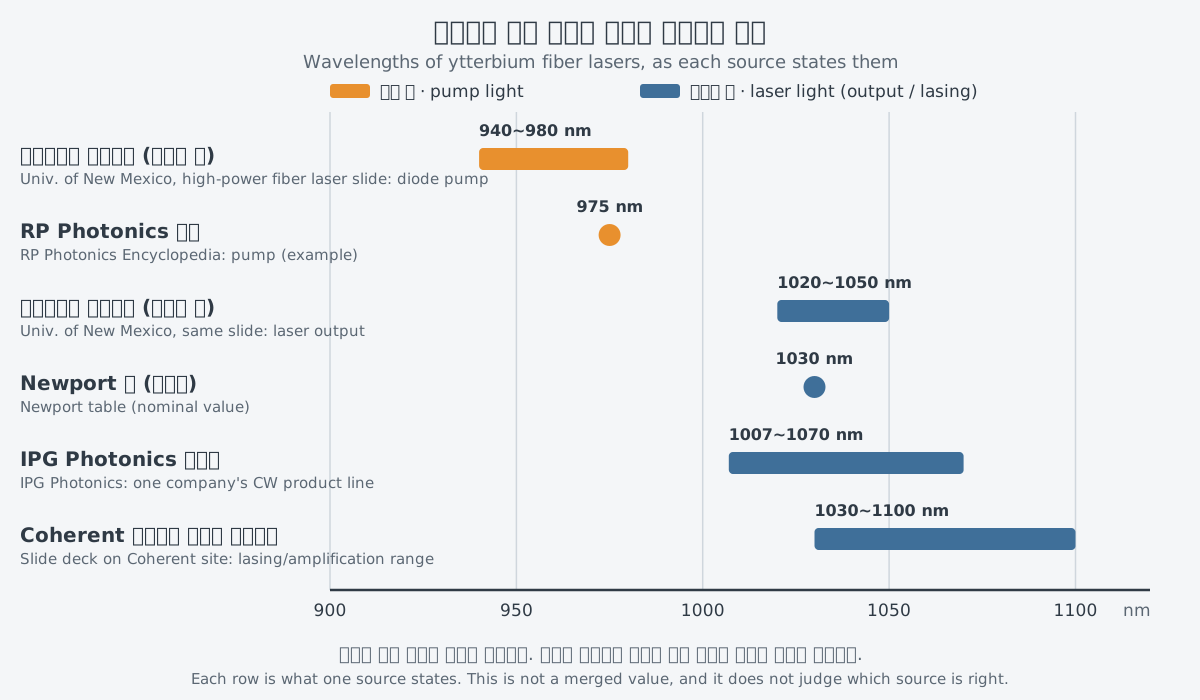
In the table, every pump-light value is shorter than every laser-light value. According to the Coherent-hosted deck, the wavelength within the 1030–1100 nm range at which lasing and amplification occur depends on the inversion, the ratio of high-energy to lower-energy ions.
Erbium sits in a different wavelength band from ytterbium. In the Newport table, erbium glass fiber is 1530–1560 nm.
How it differs from other lasers
What puts fiber lasers in a group of their own is the shape of the gain medium. A long, thin fiber guides light over long distances while confining it narrowly. Because of this unique property, fiber lasers are usually treated separately from "bulk" solid-state lasers.
The shape also ties in with heat, because heat is the nuisance when the output power of a laser is raised. A lump of dough rolled into a ball stays hot inside for a long time, while the same dough stretched into a long strip has more surface and cools faster. A remedy named for heat in lasers is the same idea, a larger surface-to-volume ratio, and fibers and disks are its examples.
The dough lends only one idea: more surface makes it easier to shed heat. In a real fiber the heat is generated in the core, and the analogy does not show how that heat flows out.
The abstract of the 2010 review paper attributes success in the high-power arena largely to the fiber's geometry, meaning its long, thin shape. Its claim is that this geometry makes diode pump light easier to convert efficiently into laser output and gives "considerable resilience" to the effects of heat generated in the core. Resilience is the claim, not that the heat problem is gone.
The abstract also looks back over the decade up to that point. Output power from rare-earth-doped fiber sources rose dramatically, it says, through the use of cladding-pumped fiber architectures. It rates the devices that use this architecture as outstanding in output power, beam quality (M²), overall efficiency, and flexibility in operating wavelength.
A compact, rugged build is another point made for fiber lasers, but it comes with a condition. It holds when the whole resonator is built only from fiber components, an all-fiber setup. The pairing of high output power with high beam quality is likewise something fiber lasers often have, not something they always have.
Where it is used
In industry, fiber lasers cut and weld steel. The IEEE Milestone record says such fiber lasers have since become powerful industrial tools. Processing work does not end with cutting and welding. The fields that the manufacturer IPG Photonics presents for its own fiber lasers and systems also include cleaning, and heating and drying.
There are uses outside processing as well. The Newport table of laser types lists ultrashort pulse research and LIDAR alongside materials processing as uses of ytterbium glass fiber. The official websites of companies are listed on the makers page.
What to read next
- "How a fiber guides light: core and cladding": covers how the core and cladding guide light.
- "Why fiber lasers became so widely used: from the lab to the factory": compares the efficiency, heat and beam quality that sources list as advantages of fiber lasers with other lasers, with their conditions.