Turn up the power and light starts making new light
Picture a fiber amplifier fed with light of a single wavelength, while the pump is turned up step by step. At first, the output rises smoothly along with the pump. Then, past a certain power, light at wavelengths that were never put in starts to appear, and some of it even heads back toward the input.
The new light is made when the original light gets scattered inside the glass. The original light hands part of its energy to the glass and turns into light at a slightly lower frequency. Two kinds of scattering stand out: stimulated Brillouin scattering (SBS), which involves sound waves, and stimulated Raman scattering (SRS), which involves vibrations of the glass molecules.
The previous article, "Double-clad fibers and how pump light gets in," stopped at one point. Packing high power into a small core makes the intensity very high, and nonlinear optical effects then appear easily. That article also noted that those effects hold back power scaling in a fiber laser.
This article picks up from there. How do the two kinds of scattering arise, how do they differ, why do they suddenly grow at a certain power, and what sets that "threshold"?
The abstract of a 2010 review paper names the key factors that limit fiber laser performance: in particular thermal management, optical nonlinearity, and damage. This article covers one branch of nonlinearity, the two kinds of scattering. Heat that shakes the beam is the topic of the next article.
When glass stops being linear: nonlinear effects in fiber
When light is weak, glass responds in a simple way. Put in twice the light and twice the light comes out, in plain proportion. When light gets very strong, the glass starts to respond differently depending on the light's own intensity. This is called a nonlinear effect.
Nonlinear effects in fiber fall into two broad classes. The first is the Kerr effect, in which the glass's refractive index changes with the light's intensity. Depending on the kind of input signal, it shows up as self-phase modulation, cross-phase modulation, or four-wave mixing.
The second is inelastic scattering. Here the light hands part of its energy to the glass as it scatters, and this can set off stimulated effects such as SBS and SRS. This second class is the subject of this article.
Glass is only weakly nonlinear to begin with. A 2020 review paper on Raman amplifiers and lasers notes that in silica glass, the third-order nonlinear coefficients are 100 times or more smaller than in many crystals and liquids. These coefficients describe how strongly the glass's response changes with the intensity of the light. Even so, nonlinear effects show up in optical fibers at relatively low power.
There are two reasons. A single-mode fiber has a core less than 10 μm across, so it squeezes light into a very small area, which greatly strengthens nonlinearity. On top of that, the glass has low loss, so the light and the glass can interact over a long distance.
A magnifying glass can gather sunlight until the same sunlight is strong enough to burn paper. A fiber core also gathers light into a small space. The difference is that a magnifying glass's focus ends at a single point, while a fiber keeps light squeezed like that over a very long distance.
Light bounced back by sound: stimulated Brillouin scattering (SBS)
Glass is never completely silent. It always carries very weak sound waves, stirred up by heat and far too faint to hear. In an optical fiber, these sound waves are always there, and they scatter a little of the passing signal light.
The scattered light has a slightly lower frequency than the original light. Scattered light that has shifted down in frequency, and so up in wavelength, is called Stokes light. This spontaneous Brillouin scattering, which happens on its own, provides the first seed for SBS.
The seed grows through feedback. Where the signal light and the Stokes light overlap, they interfere and form a pattern of bright and dark bands, and this pattern moves along the fiber. The moving pattern drives the sound wave through electrostriction, in which the electric field of strong light squeezes and pulls the glass very slightly. A stronger sound wave scatters more signal light into Stokes light, which in turn makes the sound wave stronger still.
Because the scattered light builds up the scattering itself, the process is called "stimulated" scattering. As a result, the Stokes light grows exponentially as it travels backward along the fiber. This is the process behind the description of SBS in the previous article: nonlinear backscattering of light by sound waves induced by optical forces.
There is a reason the direction is backward. How well SBS works is set by a condition called phase matching: the two light waves and the sound wave must stay in step as they travel along the fiber. This condition is easiest to meet for two light waves running in opposite directions with a sound wave between them. That is why the SBS Stokes light travels backward.
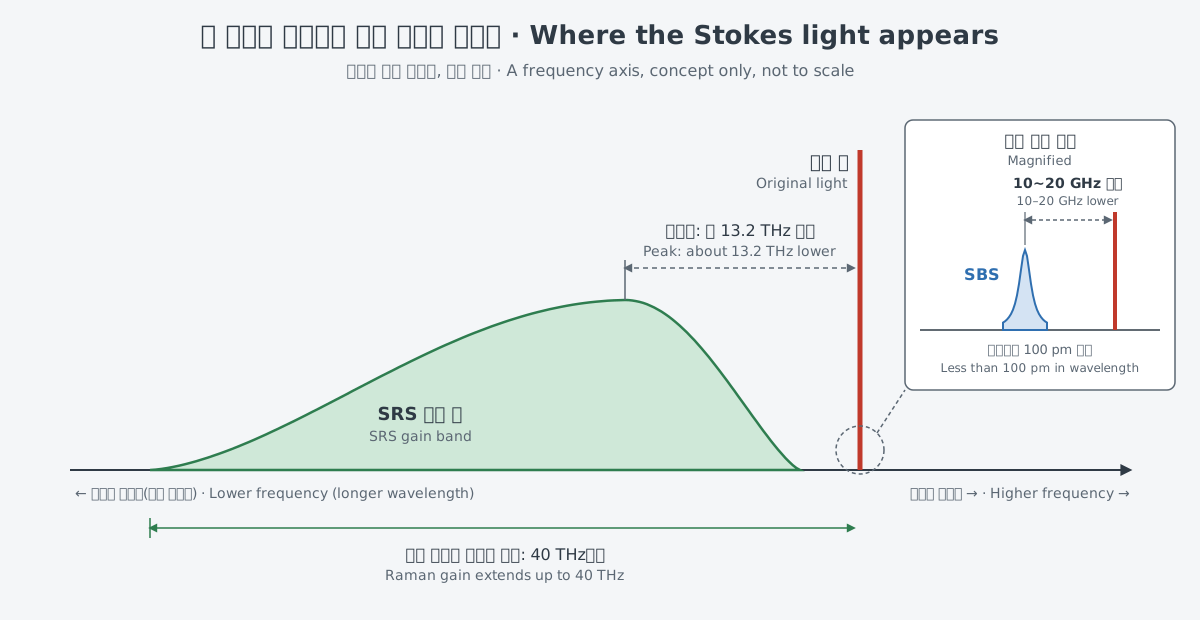
The frequency shift is tiny. A review chapter on single-frequency fiber amplifiers, posted on arXiv in 2026, gives the numbers. For silicate glass fibers working in the near infrared, the Stokes shift is only about 10–20 GHz, less than 100 pm in wavelength.
The Brillouin gain is also narrow. Its width is set by how fast the sound wave dies away, which is typically on the order of 10–100 MHz, and the gain width falls in the same range.
SBS is a particular headache in single-frequency fiber amplifiers. These amplifiers boost laser light with a very narrow linewidth, meaning the light's frequencies are spread over a very small range. In these amplifiers, SBS is the main nonlinear effect that limits power scaling, for two reasons.
First, the Brillouin gain is very narrow. The linewidth of a single-frequency laser is narrower still, so almost every frequency component of the laser light builds up SBS in step, all at once. The laser power therefore passes easily into the backward Stokes light.
Second, the frequency shift is very small. The Stokes light stays well inside the band where the rare-earth dopant amplifies light, so it draws energy not only from SBS but also from the population inversion. It therefore builds up faster than in a passive fiber with no gain.
The backward-growing light travels upstream to the parts that sit before the amplifier. It can cause catastrophic damage to them. Even without physical damage, the strong noise that SBS adds can badly degrade the signal's coherence.
The power these amplifiers have reached is still modest. The review chapter notes that, to date, single-frequency fiber amplifiers have barely reached 1 kW. That figure is for amplifiers that boost light with a very narrow linewidth.
Molecular vibrations shift light to longer wavelengths: stimulated Raman scattering (SRS)
Glass also has vibrations at much higher frequencies than sound: the vibrations of the molecules that make up the glass. Physicists call the vibration of a sound wave an acoustic phonon and a molecular vibration an optical phonon. Brillouin scattering pairs light with acoustic phonons, while Raman scattering pairs it with optical phonons.
In SRS, the strong light that gives up energy is called the pump. When the frequency difference between the pump and the Stokes light matches a molecular vibration frequency of the glass, energy moves from the pump to the Stokes light. It is a gain for the Stokes light and a loss for the pump. In long-distance telecom fibers, this shows up as light at other wavelengths being generated at the expense of the original signal's power.
The shape of the Raman gain across frequency depends mainly on the frequency difference between the two waves, not on their absolute frequencies. Silica glass is amorphous: its atoms are not lined up in order as in a crystal. Its molecular vibration frequencies therefore spread into bands that overlap, and the Raman gain spreads widely as well.
Going by the values in the Raman review, the Raman gain in silica fibers extends up to 40 THz. The gain peaks about 13.2 THz below the pump frequency, which corresponds to 100 nm in the telecom window near 1550 nm. At high enough power, lasing can occur at every frequency with enough Raman gain, but the gain peak sits at one particular shift.
The same shift can be applied to a 1 μm laser as a calculation. Light at 1064 nm has a frequency of about 281.8 THz. Subtract 13.2 THz and you get about 268.6 THz, or about 1116 nm in wavelength. It is a rough figure based only on the gain peak, but compared with the SBS shift of less than 100 pm, it lands more than 500 times farther away.
SRS hardly cares about direction. Raman gain does not depend on whether the pump and signal travel the same way or opposite ways, so Stokes light can build up both forward and backward. It is also fast: the response time of fused silica is estimated at less than 100 fs.
When the first Stokes light grows strong enough, it can create a second Stokes wave. Repeating this produces higher and higher Stokes orders, one after another. This is called cascaded SRS.
Up to here, a pump has been feeding a separate Stokes wave. In very short pulses, Raman gain acts even within a single pulse. Such pulses have a broad spectrum, so energy can move from the higher-frequency parts of a pulse to its lower-frequency parts. As a result, the pulse spectrum shifts toward the red as the pulse travels through the fiber.
SRS also holds back high-power fiber lasers. Nonlinear effects such as SBS, SRS, and self-phase modulation limit the output power and energy that fiber laser systems can deliver. When output drains from the original wavelength into longer wavelengths, there is that much less light at the wavelength that is wanted.
A 2021 open-access paper reports that SRS-induced mode distortion appears suddenly once a fiber laser's output passes a certain value (several hundred to several thousand watts). The beam quality degrades at the same time. This mode distortion has become a major limit on further scaling high-power fiber lasers with high beam quality. Beam instability, together with heat, continues in the next article.
How the two differ
The two kinds of scattering have things in common. Both become strong at high power, and in both the scattered light grows exponentially once the input power passes a certain threshold. Both produce Stokes light at a lower frequency than the original light.
The basic difference is what the light trades energy with. In Brillouin scattering the partner is low-frequency acoustic phonons. In Raman scattering it is high-frequency optical phonons. The other differences are collected in the table below.
| Item | Stimulated Brillouin scattering (SBS) | Stimulated Raman scattering (SRS) |
|---|---|---|
| What the light trades energy with | Sound waves (acoustic phonons) | Molecular vibrations (optical phonons) |
| Direction of the Stokes light in a fiber | Backward only | Both forward and backward |
| Frequency shift | About 10–20 GHz, less than 100 pm in wavelength (near infrared, silicate glass fiber) | Gain peak about 13.2 THz below, corresponding to 100 nm in the telecom window (silica fiber) |
| Width of the gain | Narrow, typically in the 10–100 MHz range | Broad, up to 40 THz |
| Problems covered here | Power limit in single-frequency amplifiers with very narrow linewidth, light coming back, noise | Power and energy limits, output draining to longer wavelengths, mode distortion |
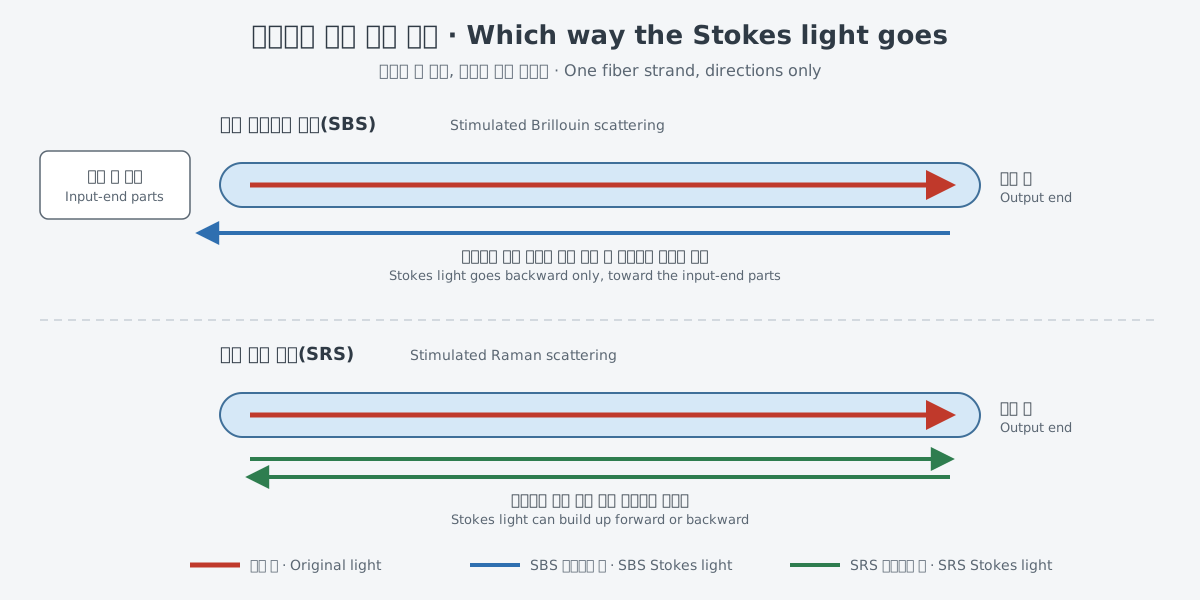
The difference in direction shapes the problems each one causes. In optical fibers, SBS happens only in the backward direction, so its Stokes light heads back toward the input. In an amplifier, this light can put the parts at the front end at risk of damage. SRS Stokes light can also build up in the forward direction, so unwanted longer-wavelength light can come out of the output end along with the laser light.
What sets the "threshold"
Hold a microphone close to a speaker and things stay quiet at first, then a loud squeal suddenly takes off. The cause is feedback: sound from the speaker goes into the microphone and comes back out louder. In stimulated scattering, too, scattered light builds up the scattering, and the stronger scattering scatters still more light, so Stokes light that was barely there grows exponentially.
The real thing differs in one way. A squeal is a loop in which sound travels between a speaker and a microphone. In stimulated scattering, light and sound waves, or light and molecular vibrations, travel through the same fiber and build each other up.
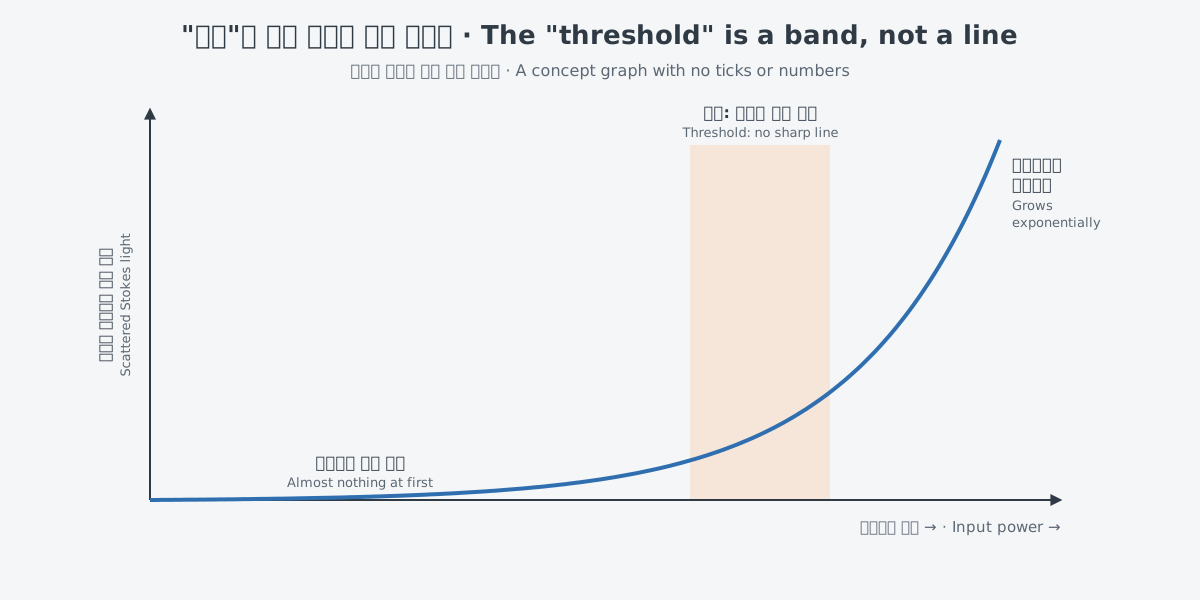
So although people call it a "threshold," it is not a fixed value like a switch. The Stokes power generally grows exponentially with pump power, so there is no strict SBS threshold. In amplifiers, intense Stokes pulses can do harm even while the average power coming back is still small. Studies therefore use different practical definitions, which makes it hard to compare published results directly.
Whatever the definition, the same factors move the threshold. In words, the relationship reads like this.
SBS threshold ∝ effective mode area ÷ (Brillouin gain coefficient × effective length)
The wider the effective mode area the light occupies, the higher the threshold. The larger the effective Brillouin gain coefficient, and the longer the effective fiber length the light travels, the lower the threshold. The effective length is a length that accounts for how the signal power changes along the amplifier.
SRS moves the same way. It comes on more easily when strong light is packed into a small area and travels a long distance. The Raman review notes that the researchers who first observed SRS in fibers all pointed this out. The fiber's shape confines high pump power over long distances, which makes SRS amplification and generation possible.
This relationship suggests enlarging the core to spread the light out. Indeed, increasing a fiber's mode-field diameter raises its nonlinear thresholds. A larger core area lowers the intensity for the same power. The large-mode-area fiber (LMA) from the previous article is one such fiber with an enlarged core.
There is a price. A large core typically supports higher-order modes as well, and when those modes interfere, the output beam turns speckled. In larger-core fibers, the output beam quality can also degrade quickly once transverse mode instability (TMI) sets in. Enlarging the core to avoid scattering leaves a different problem: controlling the modes.
A problem and a tool: Raman amplifiers and lasers
Scattering is not always a nuisance. Either kind of stimulated scattering can serve as a source of gain to amplify light inside a fiber. The Raman review, written with communications in mind, considers Raman amplification the more useful of the two, because of its relatively large frequency shift and broader gain bandwidth.
Not caring about direction becomes useful too. A Raman fiber amplifier can work with the pump light sent in the same direction as the signal, the opposite direction, or both.
Raman scattering also makes lasers. Fiber Raman lasers are seen as a very attractive option in the high-power fiber laser field. The reasons are their high output power, high efficiency, and broad gain bandwidth covering almost the entire near infrared. Raman lasers that shift the wavelength once are commonly pumped by a high-power ytterbium-doped fiber laser.
The history of SRS in optical fibers goes back to around 1970. According to the Raman review, SRS in a pulsed mode was first observed in 1970 in a liquid-core fiber, and it was observed in single-mode fiber in the early 1970s.
The name of the effect comes from a much earlier discovery. The 1930 Nobel Prize in Physics was awarded for work on the scattering of light and for the discovery of the effect named after the laureate. That effect is the Raman effect.
What to read next
- "Limits of a single fiber (2): heat and mode instability": how heat shakes beam quality, including the transverse mode instability that this article only named.