At the 2023 conference, one talk reported 5 kW of single-mode output from a single fiber. Four years later, a 2027 abstract carries a title claiming the same feat at 10 kW. The number doubled, but the problem researchers wrestled with changed a little from year to year.
This article follows the fiber laser conference inside LASE, the laser part of SPIE Photonics West, from 2022 to 2027. It traces where six threads went: the limits on one fiber's output, fiber design, merging many beams into one, the 2 µm band, short pulses and defense demand. Talk numbers are given so each claim can be looked up.
Six years, 431 talks
The Fiber Lasers conference had 65 talks in 2022, 62 in 2023, 86 in 2024, 65 in 2025, 68 in 2026 and 85 in 2027, or 431 in all. The count moved between 60 and 90 a year, with no steady rise or fall.
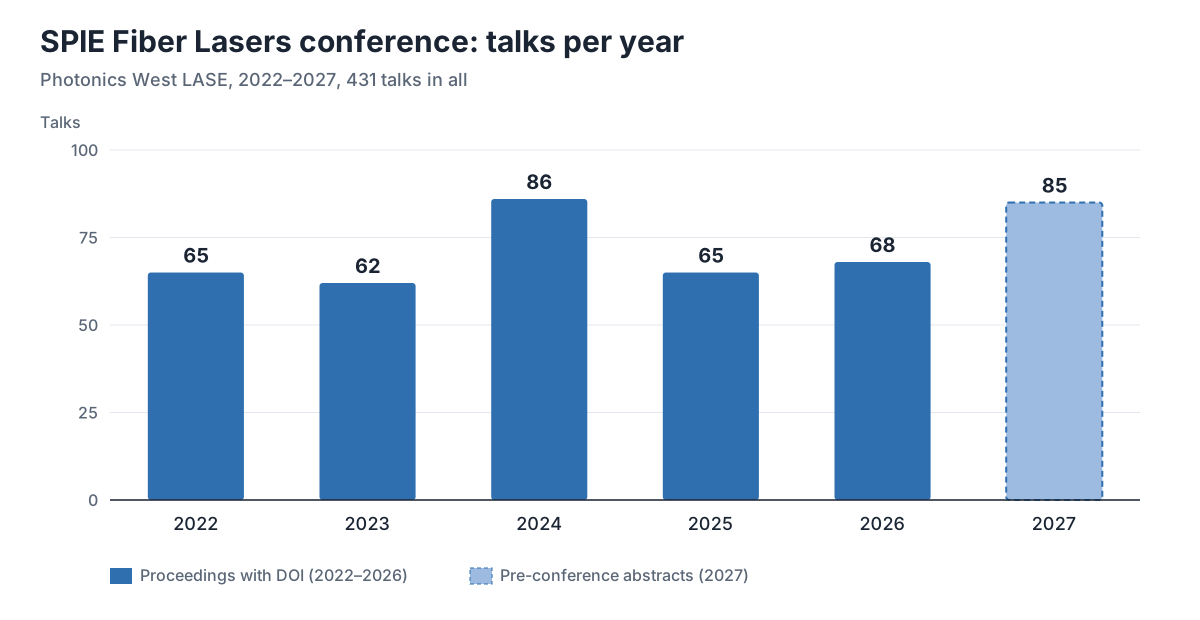
The data has limits. For 2022–2026, only talks with a DOI in the proceedings, as a paper or a recorded talk, were counted, so talks given only in person may be missing. The 2027 figures come from abstracts posted before the meeting and may change at the conference.
Topics were counted from words in the talk titles. A title containing "mode instability" or "TMI", for example, counts as a mode instability talk. This is rougher than sorting by reading every abstract, but it applies the same rule to all six years.
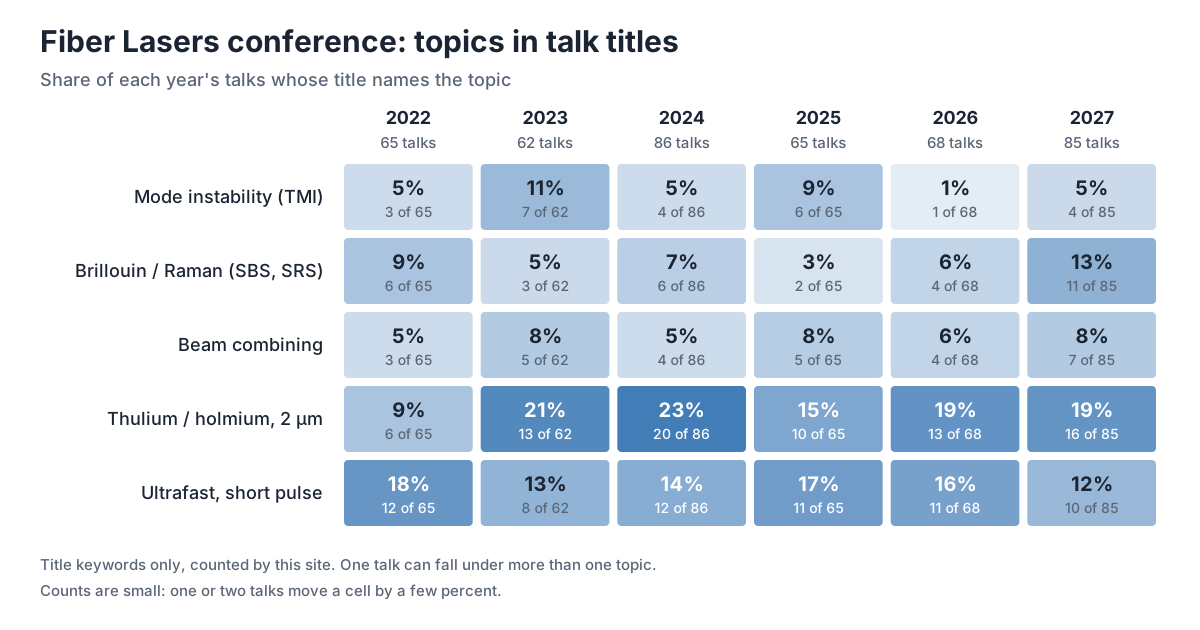
Keep in mind that each cell holds a small number. In a year with 65 talks, two more talks shift a share by about 3%. So the sections below follow where the content of the talks moved, not small ups and downs in the shares.
The wall in one fiber: heat first, then scattering
A fiber laser traps light in a thin core and amplifies it over a long length. Strong light traveling a narrow path for a long way runs into two kinds of wall. One is transverse mode instability (TMI), where heat makes the beam shape fluctuate.
The other is scattering, where light couples with vibrations in the glass and part of its energy moves to another wavelength. Stimulated Brillouin scattering (SBS) and stimulated Raman scattering (SRS) belong here. Scattering starts at lower power when the light in the core is more intense and when the fiber it travels together is longer. Both walls are explained step by step in Limits of a single fiber (2): heat and mode instability and Limits of a single fiber (1): nonlinear effects (SBS, SRS).
2023 could be called the year of TMI. Seven talks had TMI in the title, the most in the six years. They ranged from fitting models to measured data to polarization measurements and the link between core size and threshold.
That year, an ytterbium-doped fiber (YDF) with raised loss for higher-order modes gave 5 kW single-mode output without TMI. In that talk, the limit was pump power, not the fiber (12400-1).
The ways to delay TMI split into two. One is to make less heat. In 2024, OFS reached 5.2 kW single-mode without TMI using a fiber whose core glass had a lower thermo-optic coefficient (3003763).
In 2025, a laser placed the pump and laser wavelengths very close and cut the quantum defect to 1.7%. The energy gap between pump light and laser light becomes heat, and this talk shrank that gap (3036943).
The other way is to change how light moves inside the fiber. A 2024 calculation shaped the light sent into a multimode amplifier to get both a chosen output shape and a higher TMI threshold (3001019). In 2025, a method used two modes at slightly different frequencies to make a moving pattern and steer energy flow between modes (3042933). In a 2027 abstract, the UK Optoelectronics Research Centre (ORC) shows that changing only the launched mode delays TMI (14439-6).
Meanwhile, output kept climbing. IPG Photonics reported single-mode ytterbium fiber lasers pumped directly by diodes at 7.2 kW in 2025 and 8.2 kW in 2026 (3043583, 3078267). Its 2027 abstract claims 10 kW with a beam quality figure M² of 1.1 (14439-3).
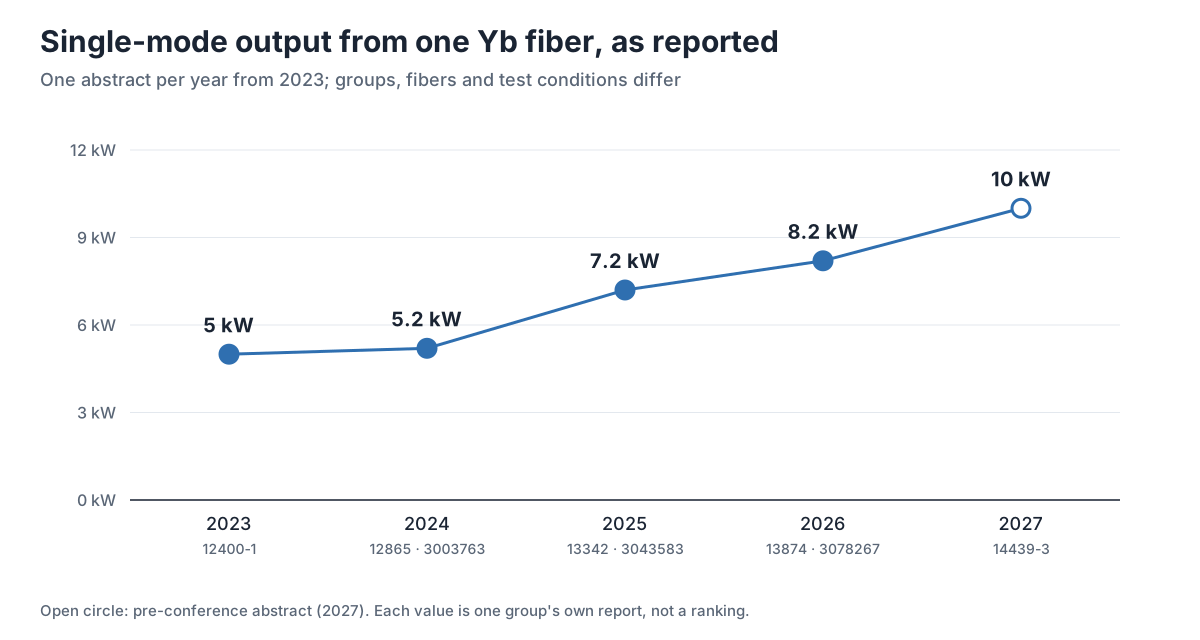
As the numbers rose, the values reported beside them changed. The 7.2 kW talk gave the ratio of SRS light to signal light as about -35 dB, and the 8.2 kW talk put "below -40 dB" in its title. Also in 2025, a narrow-linewidth amplifier that reached 5.04 kW named SRS and spectral broadening as the next limits (3043499).
By 2027 the shift is clearer. Eleven talks had Brillouin or Raman in the title, the most in the six years. Fujikura and Kawasaki Heavy Industries sent 10 kW-class light through more than 5 m of fiber using a photonic bandgap fiber that filters out light made by SRS (14439-2).
It also became clear that the two walls do not stand apart. Back in 2023, one talk examined the power threshold when Brillouin instability and TMI act together (12400-64). In a 2027 abstract, ORC reports that in very narrow-linewidth amplifiers, backward SBS can trigger TMI even at low power (14439-50). Read across six years, heat came first, and once output rose, scattering and delivery moved to the front alongside it.
Fiber design: add a layer, split the core, filter
Design talks did not converge on one direction. Lined up over six years, though, three paths stand out.
The first path refines glass and structure so one core can hold more. In 2023, YOFC passed 10 kW with a large-core ytterbium fiber with three cladding layers. It kept power loss under 1% over 500 hours at the 10 kW level (12400-4). That adds one more layer to the double-clad fiber, which has a layer for pump light.
The abstract does not say whether this output was single-mode. So it cannot be lined up with the single-mode 5 kW and 10 kW at the top. Calculations in 2023 and 2024 also suggested that fibers made from a crystal such as YAG, instead of silica, could raise SBS and TMI thresholds (12400-65, 2691020).
The second path splits the core into many. Groups at the University of Jena and Fraunhofer IOF tested rod-type fibers with 49 cores laid out 7x7. In 2023 they passed 1 kW average power with femtosecond pulses, and in 2024 they drew 100 mJ-class nanosecond pulses (12400-33, 3002542). In 2025, an ultrafast laser that merged the light of a 49-core fiber with matched phases reached 261 W average power and 1.75 mJ (3042785).
The third path uses the fiber structure to filter out unwanted light. Fujikura's photonic bandgap fiber, mentioned above, is an all-solid design that passes the signal and blocks Raman light (14439-71). Technologies Luqia built a narrow-linewidth amplifier with a polarization-maintaining fiber designed to block both SBS and TMI (14439-51).
Some groups choose multimode fiber on purpose. The University of Adelaide, Australia's Defence Science and Technology Group (DST) and others shaped the light entering a holmium multimode amplifier. A speckled output became one spot (2687927).
A Yale group got both a focused output and a higher SBS threshold from an amplifier with about 76 modes (3001018). In 2027, Baylor University presents machine learning that quickly predicts the mode properties of microstructured fibers (14439-69).
How a fiber traps light and how pump light gets in are shown in pictures in Double-clad fibers and how pump light gets in.
Beam combining: same count, shifted center
If one fiber has a limit, the remaining path is to merge light from many fibers. This is beam combining. The main kinds are coherent beam combining (CBC), which matches phases, and spectral beam combining (SBC), which overlaps slightly different wavelengths into one beam. Incoherent beam combining (IBC) simply gathers beams side by side without matching phase or wavelength.
Counting titles across five LASE conferences gives 10 beam-combining talks in 2022, 6 a year from 2023 to 2026, and 10 in 2027. The count barely changed, but where the talks appear did. In 2022, 7 of the 10 came from outside the fiber conference, mostly from the diode and components conferences. In 2027, 7 of the 10 sit inside the Fiber Lasers conference.
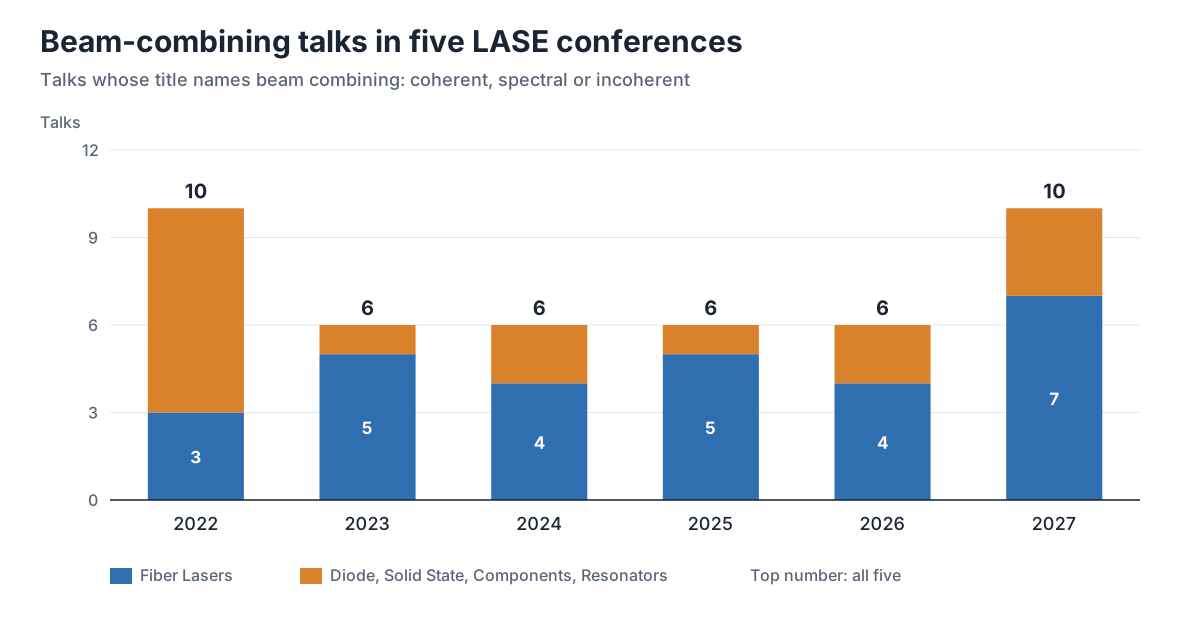
The abstracts alone cannot say why the talks gathered inside the fiber conference. In 2022, many of the talks outside it used wavelength combining to brighten diodes. Later, more talks asked how to tie and control many fiber amplifiers, and which approach suits a whole system. One reading is that combining shifted its weight from polishing light sources to framing high-power systems.
In 2022–2023, coherent combining was mostly about ultrafast pulses. A multicore fiber system from the Jena groups reached 507 W average power after combining and compression (11981-21). A system that combined thulium fiber amplifiers produced 188 W average power, 1.86 mJ and 84 fs pulses (12400-13). Talks using deep learning to read phases quickly from the interference pattern also appeared then (12400-11).
From 2024, larger-scale work joined in. Fraunhofer IOF spectrally combined three thulium fiber amplifiers, each above 800 W, to reach 1.91 kW, and a talk with Rheinmetall cited a 20 kW spectral combiner (3001640, 3001748). In 2025, ONERA in France combined seven fiber amplifiers using light returned from 1 km away, matching both the phase and the tilt of each beam (3043264).
In 2026, a weapon-system analysis reached the Fiber Lasers conference. Lockheed Martin compared fiber CBC and SBC for a 100 kW-class laser weapon by calculation, under the same conditions (3080121). In a 2027 abstract, the University of Michigan presents "coherent beam stacking," which it says lifts the efficiency of combining tiled beams to nearly 100% (14439-5). Fraunhofer IOF and the University of Jena aim to cut cost by controlling phase with analog circuits only (14439-59).
How the three kinds differ is in Why beam combining is needed, and its three approaches. What matching phases means is in Coherent beam combining: the principle, from published reviews.
The 2 µm band: thulium and holmium
Fibers doped with thulium (Tm) and holmium (Ho) emit light in the 2 µm band. Talks with thulium, holmium or 2 µm in the title rose from 6 in 2022 to 13 in 2023 and 20 in 2024. In 2024, close to one in four Fiber Lasers talks was in this band, and 10–16 a year followed after that.
Output in this band faced an old wall. The 2024 Fraunhofer IOF talk began by noting that thulium fiber amplifiers had stayed around 1 kW average power for more than a decade. It then reached 1.91 kW with the three-way spectral combining described above.
Single fibers moved too. In 2025, an all-fiber thulium laser delivered 680 W continuous-wave at 2036 nm (3040359).
In 2026, one thulium fiber laser reached a peak of 1142 W in quasi-continuous-wave operation and 770 W continuous-wave (3078840). The same year, in-band pumping, which feeds the thulium fiber light at a nearby wavelength, showed 627 W average power together with 5 mJ pulse energy (3080334).
The range of uses also stands out. In 2023, a high-stability 2 µm amplifier for a next-generation gravitational-wave detector appeared (12400-18). In 2027 there is a thulium laser meant for making extreme ultraviolet (EUV) light (14439-12). There is also a holmium fiber source giving 1.1 mJ single-frequency pulses at 2080 nm, aimed at coherent lidar (14439-18).
The wavelengths do not stop at 2 µm. A group at Université Laval reached up to 20 W in the 3–3.5 µm band with diode-pumped all-fiber lasers (14439-84). What changes from one wavelength to another is worth a look first in Why wavelength matters.
Pulses and ultrafast: always present
Talks with words such as femtosecond, picosecond, ultrafast or mode-locked in the title numbered 8–12 a year. Of the five topics, this one held most evenly at about ten talks a year. Its base is chirped pulse amplification (CPA), which stretches a pulse, amplifies it, then compresses it again.
The big question in this thread is growing average power and pulse energy at the same time. In 2023, the University of Jena and partners compressed the pulses of a thulium ultrafast laser further and got 132 W average power and 1.3 mJ at 1.87 µm. The pulses were shorter than two cycles of the light wave (12400-40).
Other work measures the limits. In 2025, Clemson University and the US Army Space and Missile Defense Command studied how much pulse energy a short-pulse single-mode fiber amplifier can deliver. Whatever the pulse or fiber length, the limit was damage called fiber fuse, which struck between 1.2 and 2 mJ (3038763).
In 2027 abstracts, the University of Michigan and Lawrence Berkeley National Laboratory claim record pulse energy from femtosecond fiber lasers. They use coherent combining in both space and time (14439-26). Coherent scaled a femtosecond fiber laser with an 18 GHz repetition rate to 361 W (14439-49). The two ways to make pulses are covered in Q-switching and mode locking.
Defense and high power: conditions over output
Most Fiber Lasers talks are about light sources and parts, not weapons. Still, talks that touch defense share a pattern. Alongside output numbers, they keep returning to how heat is removed, how fast the laser turns on and whether coolant water can be used.
In 2026, a thermal management talk had directed energy systems in mind. It compared single-phase cooling, two-phase cooling and thermal storage, and showed gains from two-phase cooling (3077838). Another talk, reviewing pump diode progress, pointed out that next-generation high-power lasers for directed energy are moving away from water cooling toward passive cooling (3082400).
In a 2027 abstract, Lockheed Martin Aculight laid out a simpler oscillator-amplifier design for the fiber channels of a 50 kW-class SBC directed energy source (14439-4). In the diode conference, TRUMPF Photonics presents pumps whose wavelength stays locked over wide temperature and current ranges, so counter-drone fiber lasers can turn on quickly (14442-3). In a high-energy laser (HEL), the source is only one part of the system. The rest continues in A laser weapon is more than a laser and Cooling and thermal management.
Public abstracts show direction, and no more. They do not spell out performance goals or operating conditions, and figures from companies are the companies' own numbers.
Reading the data
The talk counts here come from proceedings with a DOI and from pre-conference abstracts. Talks given without a manuscript may be missing, and numbers in 2027 abstracts may change at the meeting.
Topic shares are this site's own grouping by title words. A talk on a topic whose title lacks the words was not counted, so the shares may run low.
Output values in the figures and text come from different groups, fibers and test setups. They are not for ranking who is ahead. They only show which values were reported in which year.
What to read next
- High-power diode laser (pump LD) trends through a conference, 2022–2027: the pump diodes behind these output records, and what they chased over the same six years.
- Limits of a single fiber (2): heat and mode instability: why TMI caps output, from the physics up.
- Why beam combining is needed, and its three approaches: how the CBC, SBC and IBC in these talks differ.