A laser can make flashes far shorter than the ones you get by flicking a light bulb on and off with an electrical switch. Today, in the visible and near-infrared, a laser can directly emit pulses only a few femtoseconds (fs) long. A femtosecond is one quadrillionth of a second, and no electronic switch moves that fast.
So these pulses are not made by chopping the light with a switch outside the laser. Short pulses are made inside it. Light travels back and forth in the optical resonator, and changing the resonator's loss makes the laser emit its light as pulses. The two best-known methods are Q-switching and mode locking.
The two names usually appear together, but the ideas are very different. Q-switching stores energy and then releases it all at once. Mode locking gets the many waves that share the resonator in step. Different things set the pulse length and the pulse spacing in each case.
Start with what happens inside the resonator
A laser resonator is the space between two facing mirrors. Inside it sits the gain medium, which amplifies the light. One end mirror lets a little light through to the outside, and it is called the output coupler.
On every round trip the light gains strength in the gain medium. It also loses some: the share that leaves through the output coupler, plus other losses. In a continuous-wave laser (CW), which emits light without interruption, the gain equals the loss. The output then stays constant, and this condition is called the steady state.
Both ways of making short pulses upset this balance on purpose. The handle is the loss. Q-switching keeps the loss high for a long time and then lowers it in one step. Mode locking changes the loss again and again, once per round trip of the light.
Q-switching: store, then release
First the resonator is blocked. The loss is so high that light cannot build up. Meanwhile, the energy supplied by pumping accumulates in the gain medium.
The amount of energy stored in the medium is described by a quantity called the population inversion. While the resonator is blocked, stimulated emission cannot take place, so nothing turns this energy into light and carries it away. The inversion grows large.
Then the block is removed. The loss drops suddenly, and the stored inversion is now far above the level this resonator holds in the steady state. Gain greatly exceeds loss, so the light builds up very fast.
The growing light quickly uses up the stored energy. The output reaches its peak at the moment the falling gain equals the loss, and this peak is far above the steady-state output. After that the gain is smaller than the loss and the light dies away. The pulse ends when no usable energy is left, and the next pulse has to wait until pumping has stored energy again.
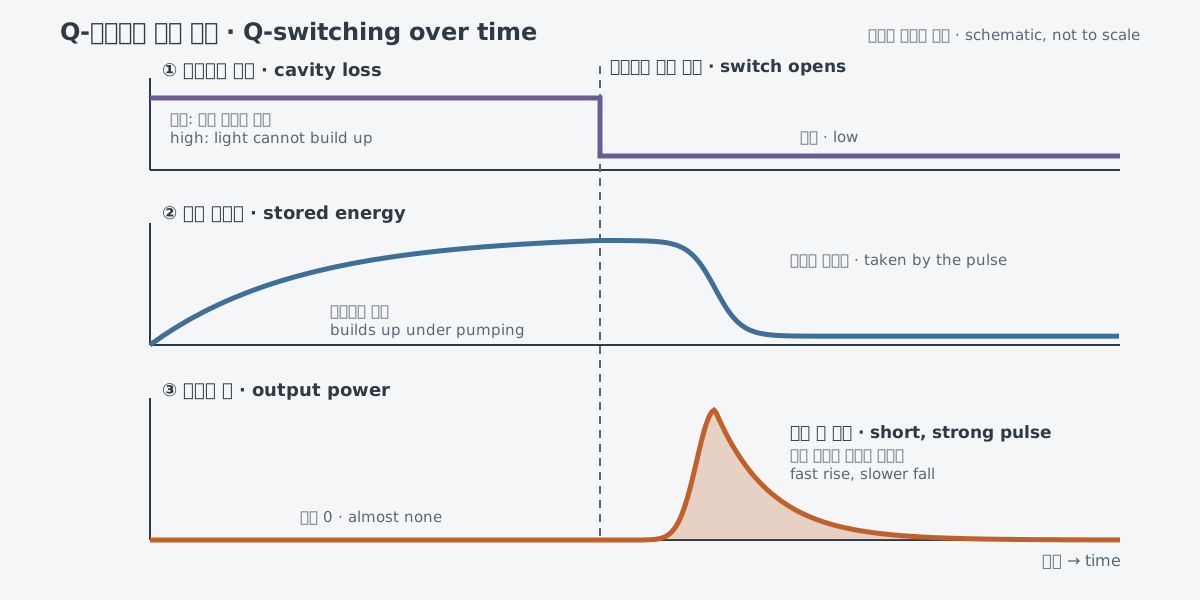
The Q in the name comes from the Q-factor of the resonator. High loss means low Q, and low loss means high Q. An optical switch that suddenly reduces the loss takes Q from a low value to a high one, which is why the method is called Q-switching.
A dam is a helpful picture. Close the gate, let the water collect, then open it all at once: for a moment the flow is far stronger than usual.
The real thing differs in two ways. Water behind a dam stays there, but the energy stored in a gain medium leaks away through spontaneous emission even while it waits. Also, unlike a dam, nothing pours out the instant the gate opens. As the diagram shows, the pulse appears only after the light has had time to grow.
Because of that leak, there is a limit to how much energy can be stored. Materials that stay excited for a long time are therefore well suited to strong Q-switched pulses.
How short is the pulse? The textbook Ultrafast Lasers by Ursula Keller gives the duration of a Q-switched pulse as typically in the microsecond to nanosecond range. A microsecond is one millionth of a second, and a nanosecond is one billionth. The pulse is usually lopsided: it rises fast and falls more slowly.
The time a pulse lasts is its pulse duration, and here it scales with the time light stays inside the resonator. A shorter resonator shortens that time, and the pulse with it. Microchip lasers, which use very short resonators, can produce pulses shorter than 100 ps, counted in picoseconds (ps) of one trillionth of a second each.
Q-switching was proposed soon after the laser appeared. The same textbook traces the idea to 1961. That year Hellwarth predicted that a laser can emit short pulses if the resonator loss is switched rapidly from a high value to a low one. The experimental proof followed a year later.
Mode locking: getting many waves in step
Mode locking is not a way of storing energy. It gathers the light circulating in the resonator into a short stretch of time.
The idea starts with the longitudinal mode. Light of just any frequency cannot survive in a resonator. Only those frequencies remain for which the wave, after one round trip between the mirrors, continues exactly as it started. Each allowed frequency is a longitudinal mode, also called an axial mode.
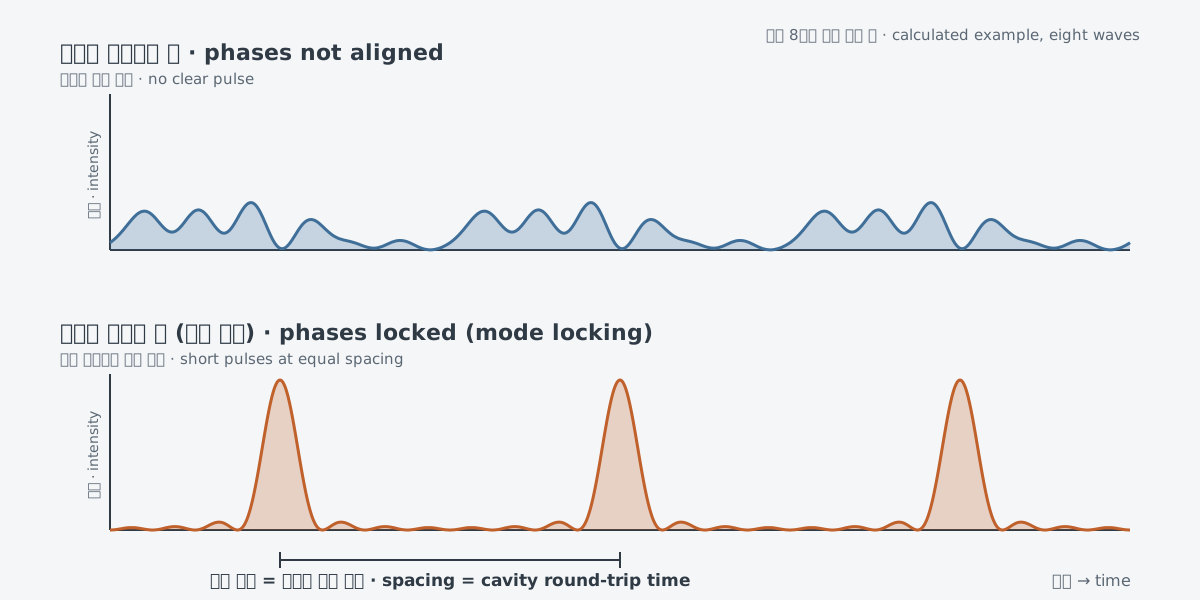
The longitudinal modes sit at equal spacing along the frequency axis, and a laser can emit light in several of them at once. That alone does not make a pulse. If the strengths and phases of the modes, that is, the timing of each wave's rise and fall, are arbitrary, their sum is just light that fluctuates irregularly.
If the phases of the modes line up instead, the same light gathers into a short pulse in time. Holding the phases together like this is mode locking. The diagram below is a calculated example that adds eight waves with equal frequency spacing, and the only difference between top and bottom is the phases.
Picture several lamps whose blink rates differ by equal steps. Started at random, their total brightness flickers unevenly. Started at the same instant, they all light up together at regular intervals.
A longitudinal mode, though, is not a lamp that turns on and off. It is a wave that continues without a break, and what gets aligned is the phase, not the moment of switching on.
The more modes are tied together, the better. To make a very short pulse, the laser should emit light in as many longitudinal modes as possible, and the phases of those modes must be locked.
In time, the picture is simpler. In the basic case, a mode-locked laser can be pictured as a single pulse traveling back and forth between the mirrors. Each time it reaches the output coupler, a small part leaves, and these parts line up as a pulse train. The spacing between neighboring pulses therefore equals the time the pulse takes for one round trip of the resonator.
A quick estimate gives a sense of scale. Suppose the space between the mirrors is empty, so the pulse travels at the speed of light in vacuum, 3 × 10⁸ m/s, and set the mirrors 1.5 m apart. The round trip is 3 m long, so the round-trip time is 3 m ÷ (3 × 10⁸ m/s) = 10 ns. One pulse leaves every 10 ns, so the repetition rate, the number of pulses per second, is 100 MHz, or one hundred million pulses per second.
The early papers on mode locking appeared in the mid-1960s. In its 2018 scientific background document, the Nobel Committee for Physics cites several papers for mode locking, and the first one listed is a 1964 paper on a helium–neon laser.
Active and passive: who works the gate
Both methods can change the loss in two ways. If an outside signal changes it, the method is active. If the light changes it by itself, the method is passive.
In active Q-switching, an optical switch lowers the loss suddenly. The switches in use include rotating mirrors or prisms, electrically controlled cells, and acousto-optic switches, which rely on sound waves.
On the mode-locking side, the active device is a modulator that raises and lowers the loss periodically. When that period exactly matches the round-trip time of the light, a pulse that passes the modulator at each moment of lowest loss loses the least. The laser moves into operation with such a pulse.
The pulse does not keep getting shorter forever. Each pass through the modulator tends to shorten it a little, but a shorter pulse contains a wider range of frequencies. The gain medium can amplify only a limited range of frequencies, so the pulse duration settles where shortening and lengthening balance.
The passive approach needs no outside signal. Put a saturable absorber in the resonator, and the light changes its own loss. This material absorbs weak light strongly and strong light less.
Used for Q-switching, the absorber itself becomes the gate. While the light is weak, absorption is high and so is the loss. As the light grows stronger, absorption falls and the loss drops. The pulse opens the gate by itself, so this can be a faster switch than one opened by an outside signal.
When the absorber locks the modes, the starting point is noise. Among the fluctuations of the light circulating in the resonator, one slightly stronger spike loses less in the absorber and grows more on the next round trip. As this repeats, the spike settles into a pulse. The weaker light that circulated with it loses more than it gains and dies out.
In general, passive mode locking gives much shorter pulses than active mode locking. A saturable absorber can recover very quickly, so the loss changes just as quickly. Modulation driven by an electronic signal is significantly slower.
The two methods side by side
| Item | Q-switching | Mode locking |
|---|---|---|
| What it does | Stores energy, then releases it at once | Aligns the phases of many longitudinal modes to gather light into short pulses |
| When the loss changes | Kept high for a long time, then lowered in one step | Repeated on every round trip of the light |
| Pulse duration | Always longer than the resonator round-trip time | Always shorter than the resonator round-trip time |
| Repetition rate | Always lower than the round-trip frequency; set by the switch or the absorber | Set by the round-trip time |
| Longitudinal modes | Ideally one | Always two or more |
The round-trip frequency is 1 divided by the round-trip time. The estimate above makes the difference clear. In a resonator with a 10 ns round-trip time and one pulse per round trip, mode-locked pulses are shorter than 10 ns and arrive at 100 MHz. If the same resonator is Q-switched, the pulses are longer than 10 ns and the repetition rate is below 100 MHz.
Why is a Q-switched pulse longer than the round-trip time? The answer lies in how the pulse forms. The light grows and then dies away over many trips through the resonator, and that whole stretch makes up a single pulse. In mode locking, a pulse that is already short travels back and forth inside the resonator.
Q-switched pulses are typically longer than mode-locked pulses. In passively Q-switched microchip lasers with very small resonators, however, pulse durations have become comparable to those of mode-locked lasers. Even so, mode locking is the technique generally used to obtain very short pulses from a laser.
Both have their difficulties. If a Q-switched laser emits light in several longitudinal modes, those modes are not phase-locked, and this usually raises the intensity noise of the pulse. In a mode-locked laser with a saturable absorber, Q-switching can set in as well under certain conditions. The heights of the short pulses then swing with a longer period, which is called Q-switched mode locking.
Despite these difficulties, one reason to make pulses short is intensity. In a short pulse, all the energy is packed into a very short time, so the momentary intensity becomes very high. The Nobel Committee for Physics wrote that producing a repetitive train of such intense, short pulses became possible thanks in particular to the inventions of Q-switching and mode locking.
A way to grow those pulses further followed. Chirped pulse amplification (CPA), which stretches a short pulse in time, amplifies it and then compresses it back to its original duration, was invented in 1985. Its first implementation also started from a pulse out of a mode-locked laser.
What to read next
- "Oscillators and amplifiers: making light, then growing it": it continues with how light made this way is amplified.
- "Continuous-wave and pulsed lasers": worth reading first if pulse duration, repetition rate and peak power are unfamiliar terms.