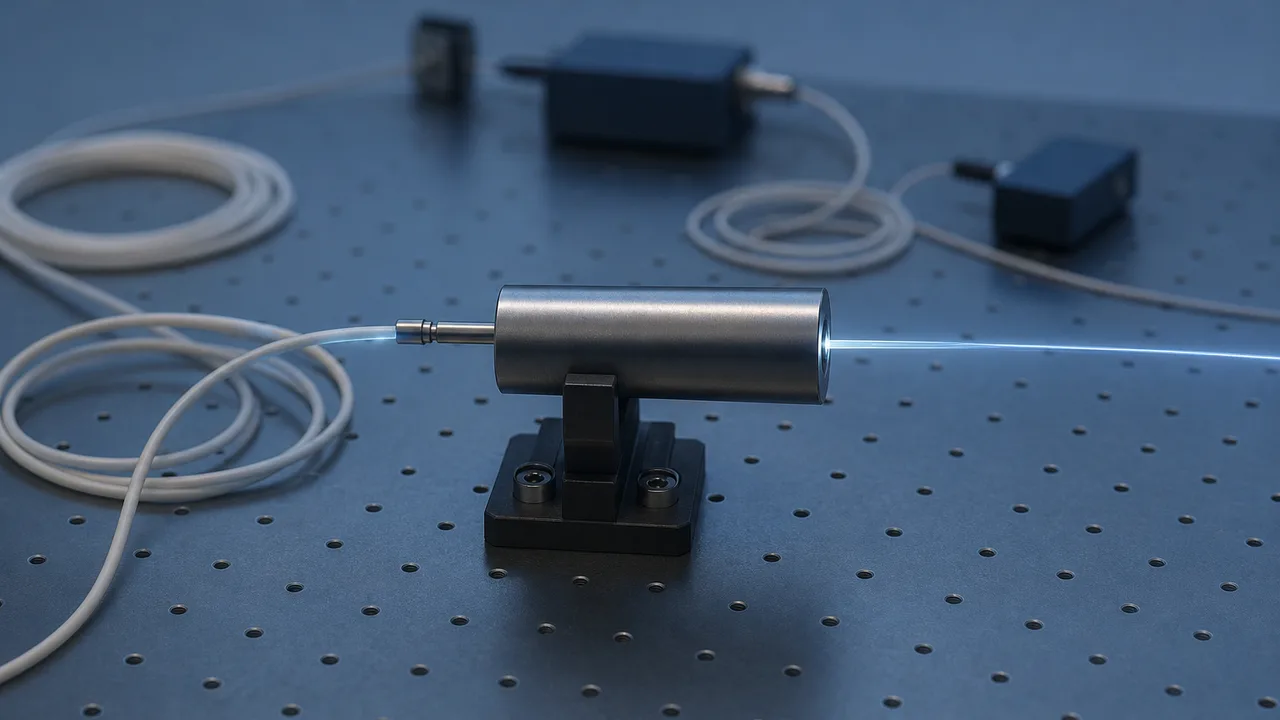
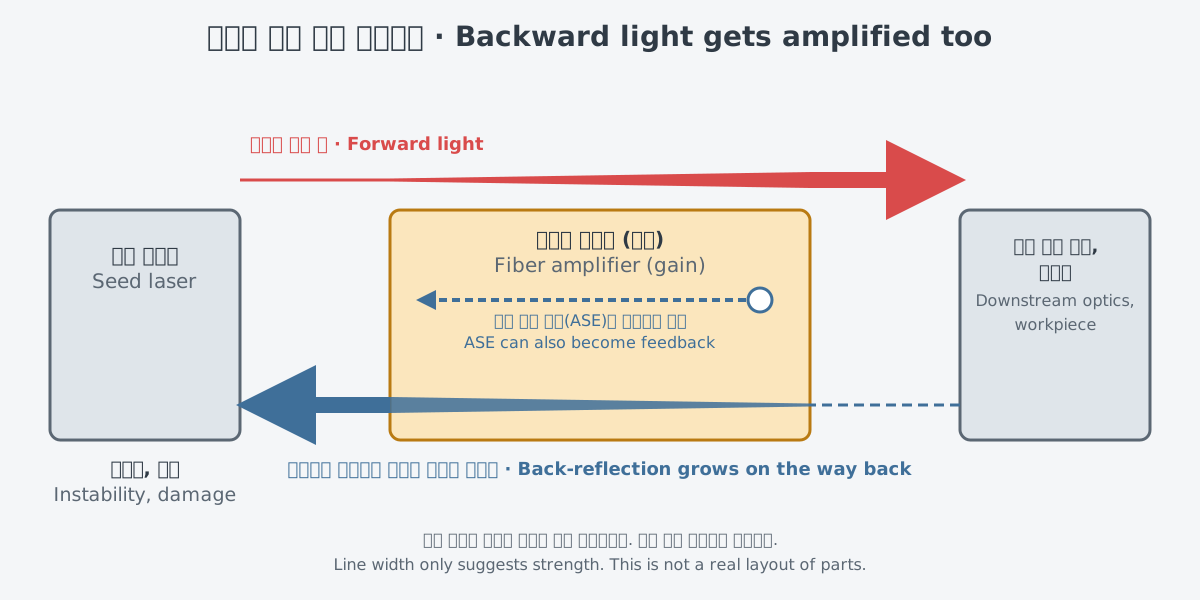
A welding laser shines on a bright sheet of metal. Part of the light bounces off the metal and runs back along its path toward the laser. That returning light does not simply scatter and vanish. Sometimes it unsettles the laser or damages it.
A fiber laser and its amplifier contain several parts that block this light, send light back on purpose, or keep the state of the light intact. Once it is clear why backward light is a problem, the reason for each part follows.
Where backward light comes from
The first source is reflection. Light comes back toward the laser from other optics inside the system and from the object the laser is shining on. A reflective piece of metal being welded by an industrial laser is a common example of such an object.
The second source is the amplifier itself. Excited atoms in an amplifier give off photons on their own, even with no light coming in, and those photons grow as they pass through the amplifier. This light is called amplified spontaneous emission (ASE).
In fiber lasers, these two are named together as causes of feedback light. One is back-reflection from downstream optics. The other is ASE from the amplifier stages.
The end face of a fiber can also send light back. A textbook experiment uses an isolator to avoid leftover reflections from the fiber face back into the laser cavity. Outside fibers, a measurement setup shows light shone straight onto a sample being partly reflected back into the source, which makes mode locking unstable.
If the returning light is strong enough, it can damage a laser. Even at much lower levels, it can cause unstable operation such as noise and power fluctuations.
Why fibers make it harder
Fiber is a high-gain medium. The gain is not reserved for forward light, so feedback light is also amplified by the high gain of the doped fiber. Light that slips into an oscillator or amplifier by accident can cause instability at best and damage at worst, and it can harm performance for good.
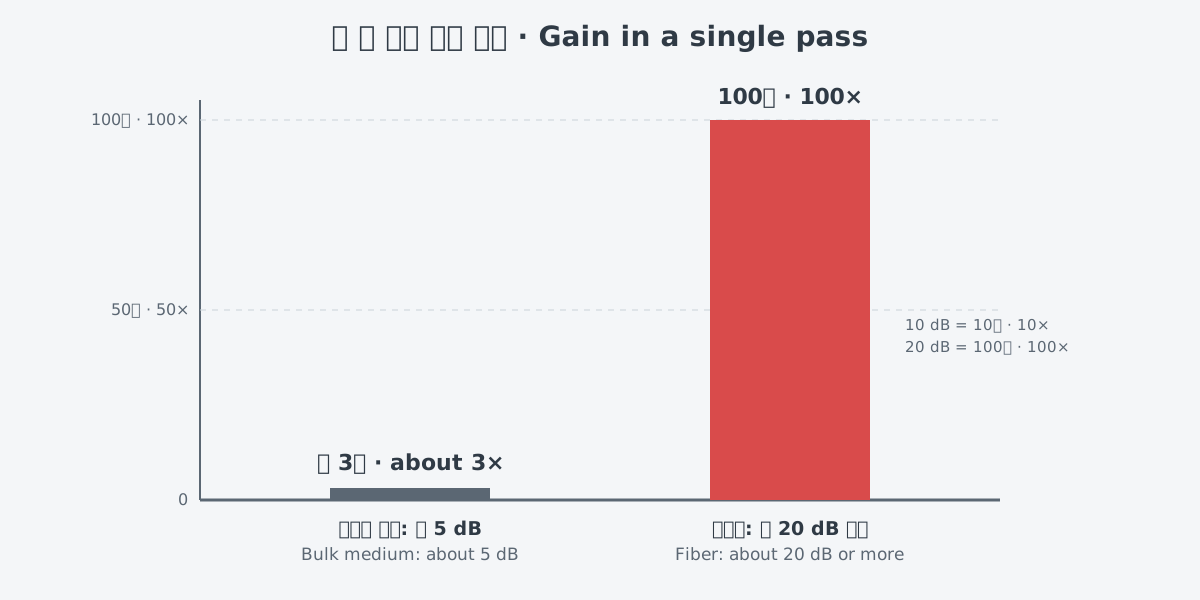
How large the gain is gets written in decibels (dB). A decibel value expresses a ratio on a logarithmic scale: 10 dB is 10 times and 20 dB is 100 times. According to a Newport application note on ultrafast fiber lasers, the small-signal gain for one pass through a fiber is typically about 20 dB or more. Bulk doped materials give a lower gain of about 5 dB.
Turning these into multiples makes the gap clearer. About 20 dB is roughly 100 times, and about 5 dB is about 3 times. Weak light that comes back can grow by that much in a single pass through a fiber amplifier.
The end of the fiber is another weak spot. On top of the high gain, the beam at the end of a fiber is smaller than in a bulk gain medium, so the end face sees a higher intensity. Together, these make fiber systems reach the damage threshold at lower optical powers.
For these reasons, the same note concludes that a way to keep feedback out of ultrafast fiber oscillators, and to protect the chain of amplifiers after them, is essential. That device is the isolator, covered next.
The optical isolator: a door that opens one way
An optical isolator is an optical part that passes light going forward almost untouched and blocks most light coming from the opposite direction. It is often placed at the output end of a laser or laser amplifier to protect it from back-reflected light. Among parts built around a Faraday rotator, the Faraday isolator is one of the most widely used.
At the heart of a Faraday isolator sits this Faraday rotator. It is a magneto-optic crystal placed in a magnetic field, and it rotates the polarization direction of light passing through it. Michael Faraday discovered this effect in 1845.
The rotator has one special property. It always rotates the polarization in the same direction, whichever way the light enters. A rotator set for 45° gives a total of 90° over a trip there and back. A half-wave plate is different: over the same round trip, the polarization returns to where it started, for a total of 0°.
Pairing the rotator's property with two polarizers makes an isolator. Forward light passes the first polarizer, turns 45° in the rotator, and leaves through a second polarizer set to that new direction. Returning light passes the second polarizer, turns another 45° the same way in the rotator, and arrives at right angles to where it started, so the first polarizer stops it. As a result, a Faraday isolator lets polarized light pass freely in one direction only.
The one-way door comparison gets the result right. But no door actually closes. Over the round trip, the polarization turns 90° and simply cannot pass the polarizer. To follow the polarization in both directions with a picture, see the isolator diagram in Polarization: the direction in which light vibrates.
Isolators have limits too
An isolator is not a part that solves everything once fitted. Its key measures are typically aperture size, wavelength range, forward transmission, and isolation, meaning how well it blocks returning light. When choosing one, the beam size and power going in, the power to pass to the next stage, and the isolation needed are also weighed.
At higher power, the rotator crystal becomes a problem. If the crystal absorbs even a little light, it heats up locally, and that heat limits performance. Coherent explains that as industrial lasers grew more powerful, the absorption and thermo-optic properties of a commonly used crystal became a growing drawback. At very high power, isolation performance, beam focus and beam quality degrade.
Short pulses bring a different problem. The rotator material is dispersive, so a pulse can get longer as it passes through an isolator. How much this matters depends on the starting pulse and the application.
The Newport note says that for pulses shorter than 100 fs, which have a broader bandwidth, the dispersion grows and becomes an important consideration in many applications. Ways of making short pulses are in Q-switching and mode locking.
Fiber Bragg gratings: mirrors that return one wavelength
Light going backwards is not always bad. A laser's resonator has to send light back on purpose so that it passes the gain medium many times. In a fiber laser, the main part that plays this mirror role is the fiber Bragg grating (FBG).
The simplest Bragg grating is a section of a single-mode fiber whose core refractive index has been changed periodically and permanently. This index pattern along the fiber produces a particular transmission and reflection spectrum. The grating therefore works as a filter that sends back one set wavelength and lets the rest pass.
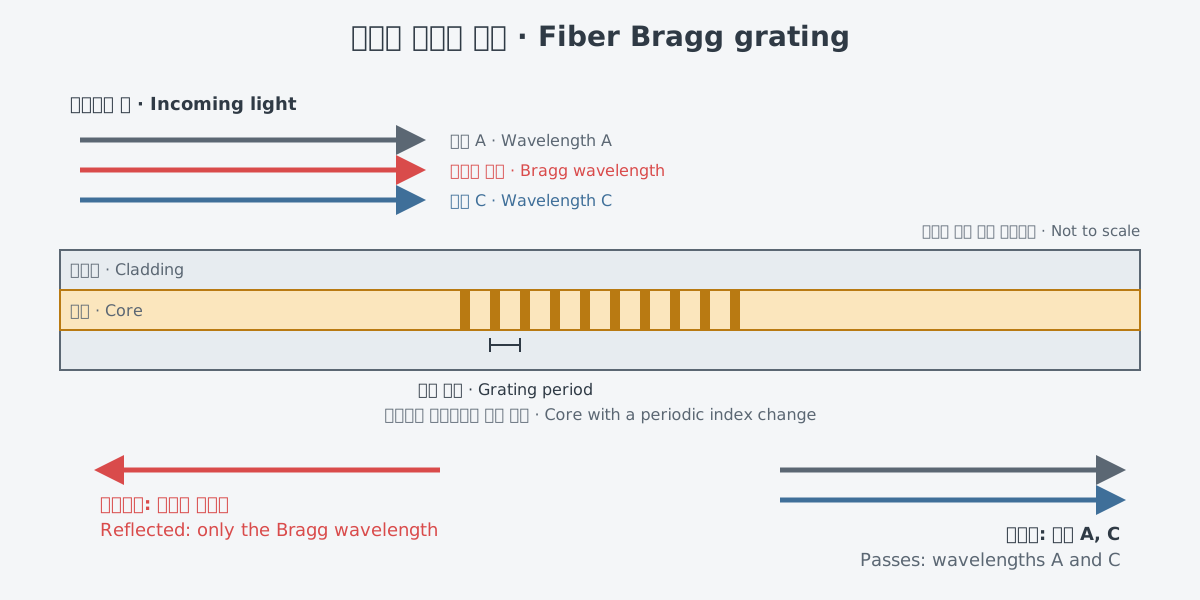
The wavelength sent back is called the Bragg wavelength. It is set by the grating period and by the effective refractive index that light in the fiber experiences. The grating period is typically of the same order as the operating wavelength.
The uses are broad. Gratings appear in wavelength division multiplexing, gain-flattening filters, dispersion compensation, fiber lasers, frequency stabilization of lasers, and acoustic, strain and temperature sensing. Exail, a grating maker, calls its laser gratings "wavelength selective mirrors" and presents them as a key part for building laser cavities.
There is a reason these gratings matter in high-power fiber lasers. Coherent's webinar slides say free-space optics inside the cavity proved unreliable at the high powers fiber lasers now reach. Monolithic designs that form the cavity with Bragg gratings are now preferred.
They also suit the double-clad fiber described in Double-clad fibers and how pump light gets in. With the grating written in the core, pump light passes along the fiber without being affected by it.
Polarization-maintaining fiber: keeping the direction of vibration
A polarization-maintaining fiber (PM fiber) is a fiber made to keep the polarization of linearly polarized light. Stress rods built into the fiber deliberately raise its birefringence, and that keeps the polarization in place. Birefringence is the property of having a different refractive index for different polarization directions.
These fibers are designed for uses that need a linearly polarized output. One manufacturer lists industrial, medical and defense laser systems among the uses of its large-mode-area PM fiber. In fiber amplifiers, too, PM fiber can be used to get a linearly polarized output.
Beam combining is a typical place where polarization must stay fixed. A 2016 review paper adds that when light from several amplifiers is combined coherently, the polarization at each amplifier's output must also be fixed, and PM fiber can guarantee this. One manufacturer's page on directed energy lasers says that combining several fiber sources of several kilowatts each can produce architectures delivering tens to hundreds of kilowatts. The principle of combining is laid out in Coherent beam combining: the principle, from published reviews.
The PM option is not limited to fiber. Pump combiners, cladding light strippers and end caps also come in separate PM versions.
Other parts that join the fiber chain
In high-power fiber lasers, a monolithic design that joins many fiber parts into one long path for light is preferred. Such a design needs no free-space optics or realignment, which helps reliability a great deal and cuts servicing. The main parts on that path, and what they are used for, are listed below.
- Pump combiner: a part that combines several fibers from the pump laser diodes into one output fiber. It is used to pump fiber lasers and amplifiers.
- Cladding light stripper: as the name says, a part that pulls out light traveling in the cladding. It is used in high-power lasers, amplifiers and beam delivery, and is made to keep beam quality and polarization. Some higher-power models are listed as needing a water-cooled heat sink.
- End cap: a part attached to the end of a fiber to hold that end very steadily. It is used for kW-class beam delivery and large-mode-area fiber amplifiers.
- Mode field adapter: a part that matches the size of the region light travels through when different fibers are joined. It goes into amplifiers and lasers that use large-mode-area fiber.
- Tap coupler and wavelength combiner (WDM): a part that splits off a share of the light, and a part that combines light of different wavelengths. They are used for jobs such as power monitoring, core pumping and wavelength filtering.
Backward light follows these parts too. One manufacturer's pump combiner description carries a warning. When pump light is sent in opposite to the signal, signal light in the cladding may damage the combiner and the laser diodes.
Some parts makers also say they test their parts under extreme conditions such as temperature changes, vibration and shock. Where the laser sits within a weapon system is covered in A laser weapon is more than a laser: the system at a glance.
What to read next
- "Limits of a single fiber (2): heat and mode instability": the heat problems the fiber itself runs into as power rises.
- "Double-clad fibers and how pump light gets in: separate paths for laser light and pump light": a closer look at the path pump combiners use to bring in pump light.
- "Coherent beam combining: the principle, from published reviews": why PM fiber is needed, seen from the combining side.
- "Measuring light: power meters, beam profilers, spectrum analyzers": the instruments that check whether parts are doing their job.