After a few articles on fiber lasers, many readers want to open the original papers. A search, though, returns dozens of long papers, and it is hard to know where to start. A review paper is a good first thing to pick up.
This note uses two openly available reviews of high-power fiber lasers as examples. It shows how to spot the skeleton of a review, what order to read it in and what to watch for. It does not summarize the papers; it is about how to open them.
How a review paper differs
A research paper reports the result of one experiment or calculation by one team. A review paper gathers what many teams have published on one field or one effect, and sets out what is known and what is still open. For someone new to the field, it works like a map.
The map comparison only goes so far. A real map shrinks the ground as it is, while a review reflects the authors' choices about what to draw large and what to draw small. The authors of the 2020 TMI review say so in their introduction. The review, they write, is ultimately written from their point of view, which might not always match the views of other scientists.
The two reviews used as examples
The first is an invited review by Richardson, Nilsson and Clarkson of the Optoelectronics Research Centre (ORC), University of Southampton. Titled "High power fiber lasers: current status and future perspectives," it appeared in 2010 in the Journal of the Optical Society of America B (JOSA B), volume 27, pages B63–B92. It surveys the whole field of high-power fiber lasers. On the journal's site anyone can read the abstract, but the full text needs a library or personal subscription.
The second is a review of transverse mode instability (TMI), titled "Transverse Mode Instability: A Review." Its authors are Jauregui, Stihler and Limpert of the Institute of Applied Physics (IAP), University of Jena. Its journal citation is Advances in Optics and Photonics, volume 12, pages 429–484 (2020), and the same manuscript sits on arXiv, where anyone can download it. Its first page carries a note on the Optical Society of America (OSA) open access publishing terms.
The two are different in kind. The first covers a whole field, while the second goes deep into a single effect, TMI. Looking at a broad review and a narrow one together shows how differently reviews can be built.
The ten years between them also show where the field went. The 2010 abstract names thermal management, optical nonlinearity and damage as the limits, and the name TMI does not appear in it. The 2020 review says TMI, first reported in 2010, became the strongest limit on scaling average power within a very short time. An effect first reported that year had grown big enough in ten years to fill a review of its own, which is why the second review covers just one effect.
Reading the skeleton from the abstract
An abstract is the table of contents of a paper squeezed into one paragraph. The abstract of the 2010 review starts with background. Output power rose dramatically over the past decade thanks to cladding-pumped designs, and that success is largely due to the shape of the fiber.
Next, the abstract states the order of the paper outright. First comes how ytterbium-doped fiber lasers perform, both continuous-wave and pulsed. Next comes the progress and the hurdles in moving to different rare-earth ions and the wavelengths they bring. At the end, it looks ahead to what the coming decade may bring in pump lasers, fiber design and fabrication, architectures and functionality.
Note the line set apart with the word "throughout." The abstract says it will identify, all the way through, the main things holding back performance in each mode of operation, above all handling heat, nonlinear optical effects and damage. Those three terms are the thread running through this review.
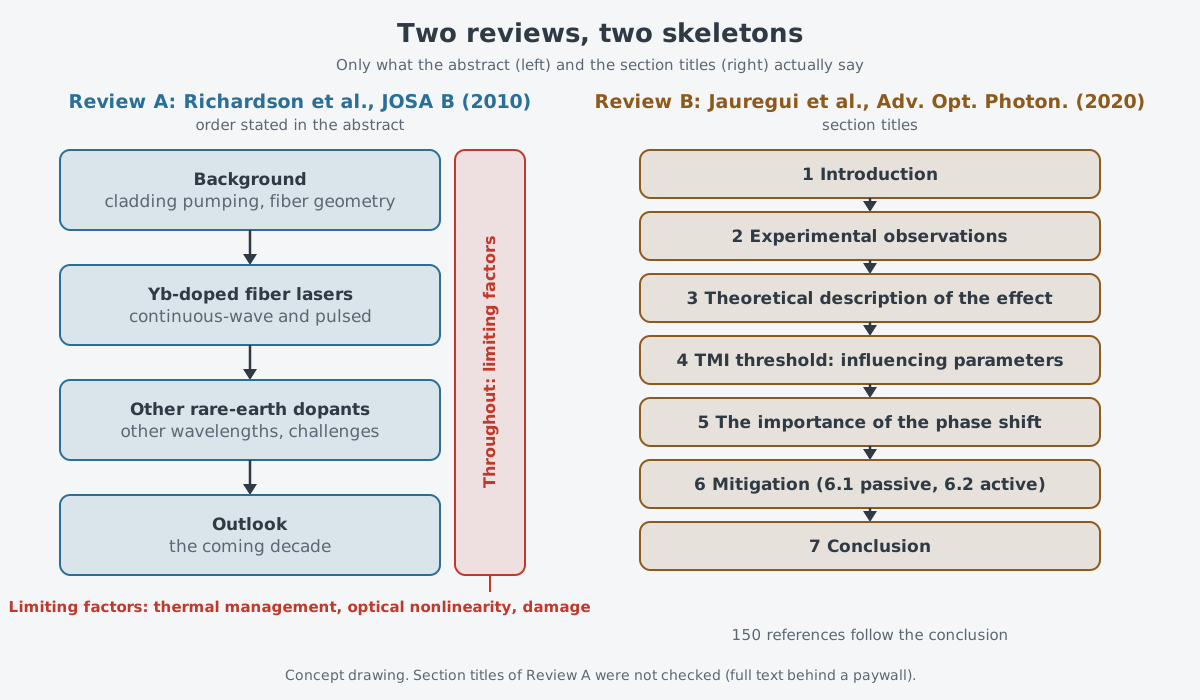
The abstract of the TMI review is shorter. It names three blocks: what experiments have seen, the physics behind the effect, and a selection of suggested ways to reduce it. The abstract alone tells you the review goes from "what was seen" to "why it happens" to "how to reduce it."
Following the contents: a review of one effect
The TMI review has seven sections. They are the introduction, experimental observations, theoretical description of the effect, the factors that shift the TMI threshold, why the phase shift matters, mitigation of TMI, and the conclusion. The mitigation section splits into two branches, passive and active strategies. After the conclusion, the references run to number 150.
The last paragraph of the introduction works as a guide. It announces that the following chapters will analyze the first experimental observation and its time behavior, explain the physical origin, show the link with photodarkening, and finally present mitigation strategies. In a manuscript without a separate table of contents, this paragraph does the job of one.
The conclusion says itself that it summarizes the research of the past decade. It gathers everything from the first observations to theory and demonstrated mitigation strategies, so when time is short you can read it right after the abstract. On mitigation, the conclusion leaves one point: strategies divide into passive ones that change the system and active ones that control it dynamically.
The introduction also gives some background beyond TMI. It names the nonlinear effects that most limit high peak-power pulses in an active fiber: Raman scattering, Brillouin scattering, self-focusing of the beam, and self-phase modulation (SPM). The principles of stimulated Brillouin scattering (SBS) and Raman scattering are in "Limits of a single fiber (1): nonlinear effects (SBS, SRS)". Reading that first makes the introduction much easier.
An order for reading
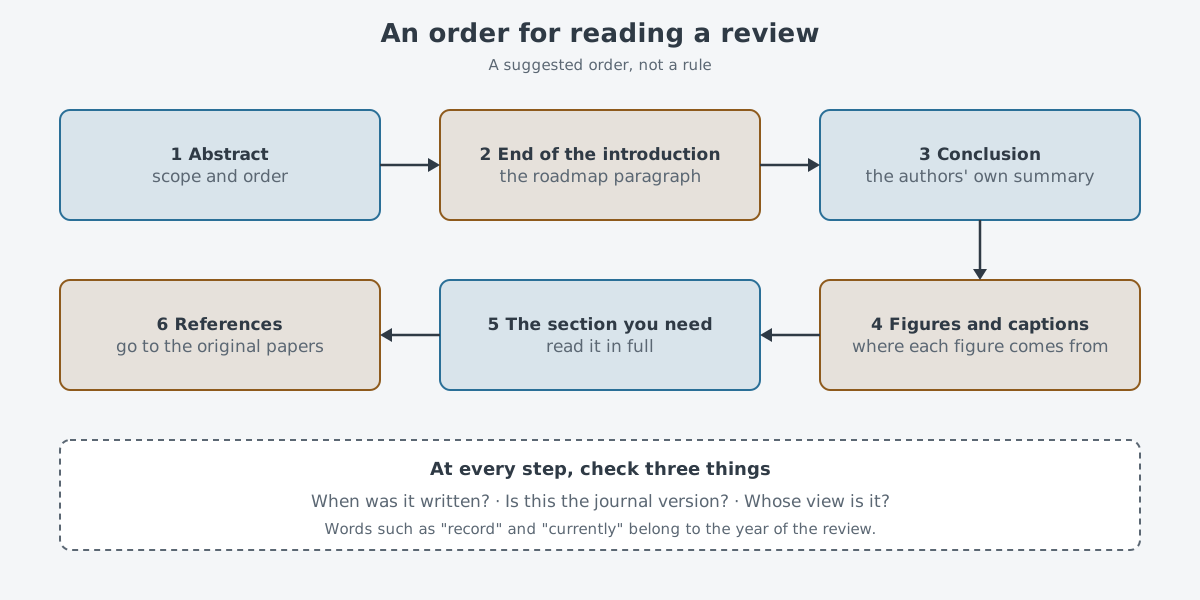
There is no need to read from start to finish. The order this site suggests is the abstract, the last paragraph of the introduction, the conclusion, the figures and captions, the section you need, and then the references. The first three alone usually tell you what the review is trying to say.
Read figures together with their captions. Figure 2 in the TMI review's introduction shows how the record average power of single-channel ytterbium fiber lasers rose over the years. Its caption says it is adapted from Nature Photonics 7, 861 (2013). Figures in a review can come from other papers like this, so citing a figure means tracking down the original paper.
When an important claim comes up in the section you are reading, follow its reference number to the original paper. A review is a guide to the original papers, not a replacement for them.
What to watch for
The first thing is timing. In its introduction, the 2020 TMI review says fiber lasers "currently" hold the record for the highest average power with a diffraction-limited beam. It gives 6 kW from a ytterbium-doped silica fiber, and adds that output from nearly diffraction-limited systems has been rising fast, with results near 5 kW. That "currently" and "recently" belong to 2020, and later records are not in the review.
The same goes for its judgments. Calling TMI the strongest limit is a 2020 judgment. The "coming decade" of the 2010 review is likewise a decade seen from 2010. When citing a review, adding the year, as in "according to a 2020 review," avoids confusion.
The second is the authors' viewpoint. The TMI review states that the research is still ongoing and that some questions are still under active debate. It says it tries to present the alternative theories at those points, so it is best not to pass on a single explanation as the only answer.
The third is the link between open versions and published versions. arXiv describes itself as a curated space open to anyone. Volunteer moderators check that postings fit the subject area and have scholarly value, but arXiv says it does not peer-review what it hosts.
When the arXiv page lists a journal citation and DOI, as it does for the TMI review, the same work also appeared in that journal. The open version and the published version can still differ in wording, figures or page numbers. That is why this note gives page numbers from the journal citation (429–484), and why numbers are best checked again in the published version before citing them.
The fourth is the conditions behind numbers. The TMI review says the average power at which TMI starts, the TMI threshold, usually lies anywhere between 100 W and several kW, depending on the system. The range is wide because systems differ, so lifting a single number out of it says something the source did not. The principle of how heat shakes the beam is in "Limits of a single fiber (2): heat and mode instability".
What to read next
- "Limits of a single fiber (2): heat and mode instability": the effect covered in the early sections of the TMI review, explained in plain words first.
- "Finding open sources: where to look for government reports, papers and standards": ways to find open papers and reports beyond reviews.