Behind the 2027 abstract claiming 10 kW from one fiber sits the same part as always. It is the semiconductor chip that takes electricity and gives out pump light, the pump diode. At the diode conference that year, nLIGHT and FBH in Germany look back at how the efficiency of high-power diodes rose over 25 years (14442-7).
This article follows the High-Power Diode Laser Technology conference at SPIE Photonics West from 2022 to 2027 and sorts what pump diodes chased into five threads. They are efficiency, brightness, wavelength stabilization, packaging and coupling, and reliability. It also looks at two demands that grew in recent years, laser fusion and defense.
How a pump diode makes light, and how chips, bars and arrays differ, is set out first in Pump diodes: the part that turns electricity into light.
Six years, 212 talks
The diode conference had 32 talks in 2022, 27 in 2023, 43 in 2024, 45 in 2025, 25 in 2026 and 40 in 2027, or 212 in all. The count rose in 2024–2025 and fell in 2026, and the data alone cannot say whether that means less research.
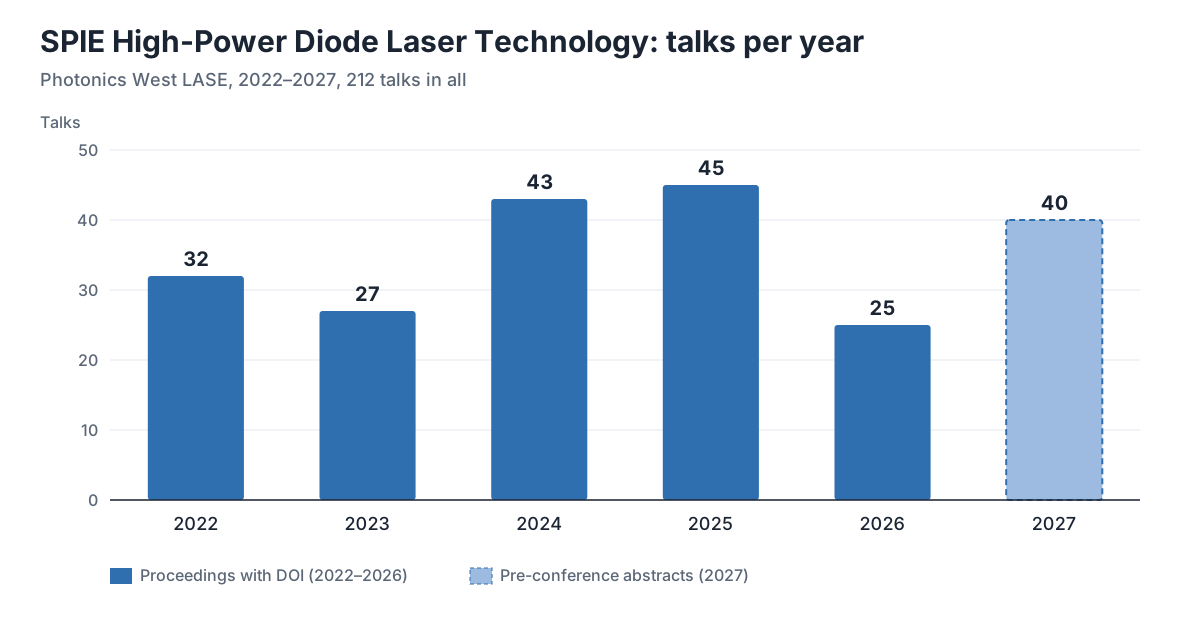
The data has limits. For 2022–2026, only talks with a DOI in the proceedings, as a paper or a recorded talk, were counted, so talks given only in person may be missing. The 2027 figures are pre-conference abstracts. Some pump module and combiner talks were taken from the Components and Packaging conference.
Themes were counted from words in the titles. A title with "efficiency" counts as efficiency, and one with VBG, DFB, DBR or "wavelength stabilized" counts as wavelength stabilization. With 25–45 talks a year, each cell holds only a few talks.
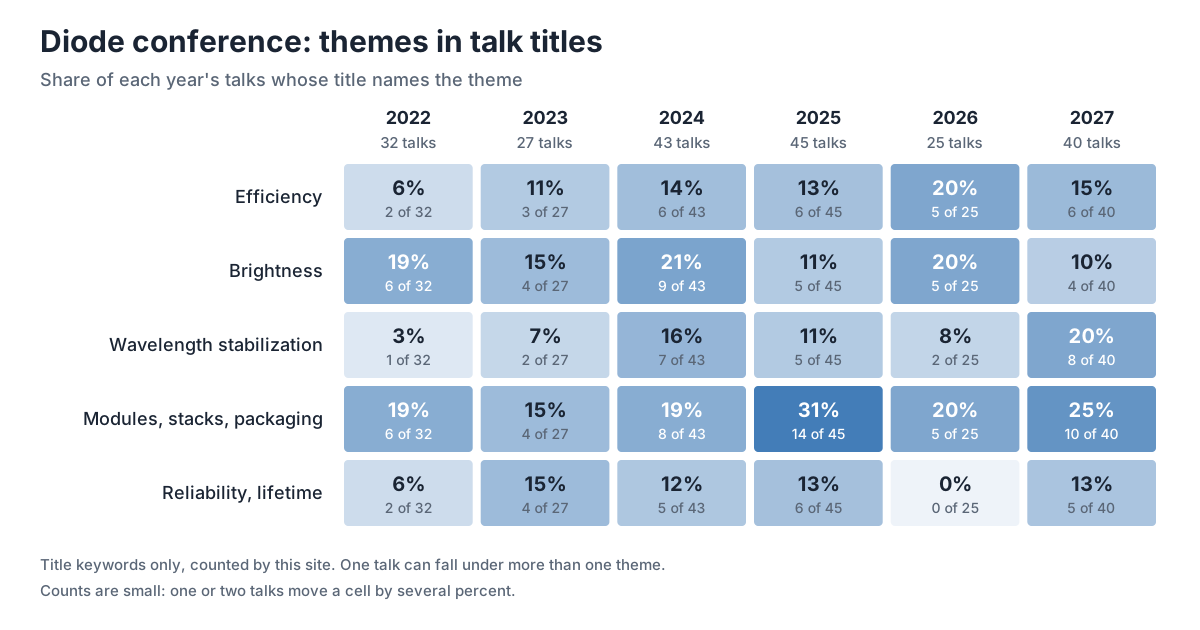
A few things stand out. Titles naming efficiency grew from 2 in 2022 to 5–6 a year from 2024. Wavelength stabilization jumped to 7–8 talks in 2024 and 2027. Reliability and lifetime had no talks at all in 2026, then came back with 5 in 2027 alongside the fusion session.
Where the five threads work
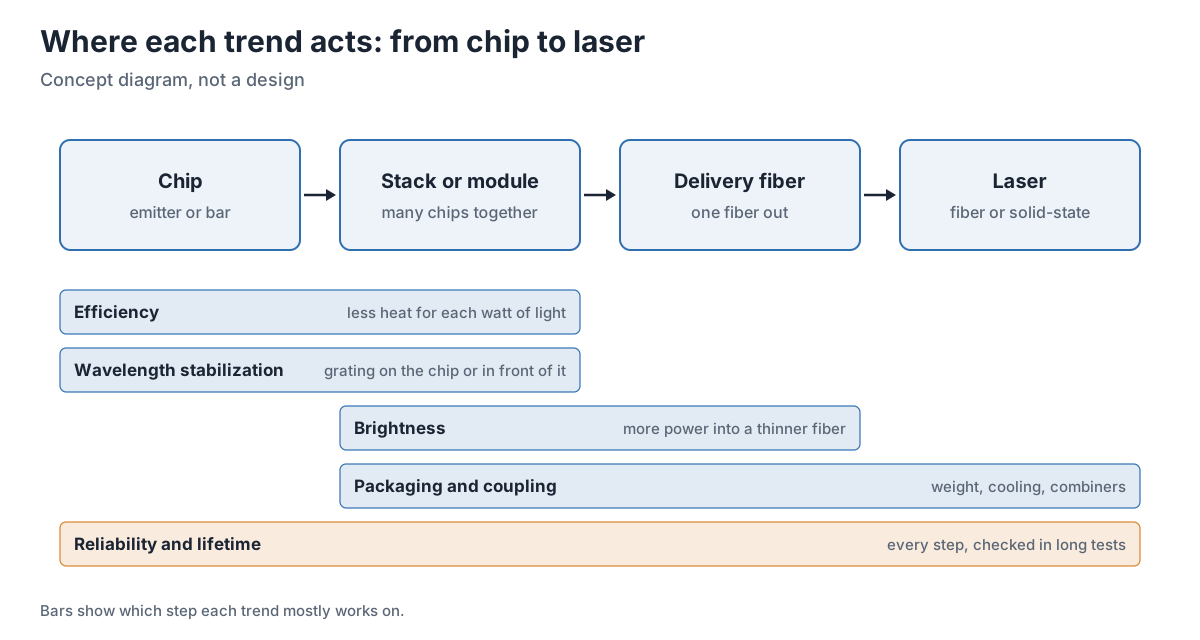
The five threads act at different steps on the path from diode chip to laser. Efficiency is mostly set inside the chip, and wavelength stabilization in the chip or a grating just in front of it. Brightness depends on how well the light of many chips fits into one fiber. Packaging and coupling link the module to the laser, and reliability spans every step.
Efficiency: chips that leave less heat
Wall-plug efficiency is the share of input electricity that comes out as light. The rest becomes heat inside the chip. In a high-power laser, that share carries through to the size and weight of the cooling system. Power and efficiency widens this link to the whole system.
Values near 70% show up several times in 2024 abstracts. China's Xi'an Institute of Optics and Precision Mechanics (XIOPM) and partners reported a 976 nm bar giving 113 W at 72.9% efficiency (3002642). An ultra-wide diode from FBH gave 59% at a 200 W peak, with a top efficiency of about 70% (3005647).
In 2025–2026 the contest became a matter of a few percent near that level. TRUMPF raised the efficiency of its 97x nm chips from 62% to 67% (3043830). In 2026, talks reported continuous-wave peak efficiency approaching 70%, above 70% for 78x–80x nm diodes and above 73% at 940 nm (3081054, 3081731, 3093190).
One way to raise output and efficiency together is to change the chip structure. A 2025 talk reached 95 W continuous-wave at 915 nm with a single-junction chip whose waveguide was widened sideways. Its double-junction chip, with two light-emitting junctions stacked vertically, gave 1.85 times the output of a single-junction chip of the same width at 755 nm (3044269). Another talk that year reported a double-junction chip giving 55 W continuous-wave at 60.3% efficiency (3041182).
The 2027 review by nLIGHT and FBH looks back over this path (14442-7). The abstracts cannot say how far efficiency will go. Still, the six years show that once values reached the 70% range, small gains replaced big jumps.
Brightness: more light into the same fiber
Pump light ends up in a single fiber. The more light that fits into a fiber of the same size and the same acceptance angle, the higher the brightness. A brighter pump makes it easier to feed light into a fiber laser. A double-clad fiber accepts even low-brightness diode light through its wide inner cladding, but putting more pump light into the same fiber still takes a brighter pump.
Brightness starts with the output of one chip. A single 9xx nm emitter gave 65 W and 74 W continuous-wave in 2024 (3003705, 3002642), and reached 95 W at 915 nm in 2025 (3044269). A 2026 review pointed out that single emitters now exceed the output of early diode bars (3082400).
Modules that gather many chips also grew. In 2022, BWT in China packed chip beams closely side by side to make 976 nm pumps of 420 W and 1000 W (11982-3). In 2023 it combined two wavelengths for 650 W (12402-13).
2024 brought an 1800 W module (3021538).
In 2025, IPG Photonics reported a 975 nm module above 1.5 kW (3038759), and another talk reported a 2800 W continuous-wave module (3042774). In a 2027 abstract, IPG presents a next-generation module above 1800 W (14442-10).
Bigger output can change how the laser is built. The talk on the 2800 W module aimed at pumping a 2 kW fiber laser from one module without a combiner (3042774). In the other direction, Fujikura presents a high-brightness module in 2027 that combines three wavelengths for 362.8 W, meant for single-mode ytterbium fiber lasers (14442-5).
Blue diodes, which use the light directly instead of as a pump, also grew. In 2022, Laserline built a blue laser above 2 kW to strip fouling from ships and underwater structures (11983-32). Nichia and Furukawa Electric reported a module above 500 W in 2024 and 5 kW for copper welding in 2025 (2691564, 3040494).
In 2026, another talk combined 16 blue modules by wavelength beam combining to pass 6.0 kW (3079494). Industrial uses of blue light connect to Where industrial lasers are used.
Wavelength stabilization: holding to a narrow absorption band
Why does the pump wavelength matter so much? An ytterbium-doped fiber (YDF) absorbs light near 976 nm well, but that absorption band is less than 5 nm wide and drops off sharply outside the peak (3008669). A diode's wavelength drifts with temperature and current, so without something holding it, absorption falls.
There are two ways to hold it. One is to fix the wavelength with a separate volume Bragg grating (VBG) in front of the chip. In 2024, Laserline reported a wavelength-stabilized diode above 4 kW at 969 nm, with no failures or degradation from returning light over 3,000 hours in its standard VBG setup (2692154). In 2025, BWT made a 3000 W pump locked by VBG at 969 nm, the wavelength the Yb:YAG crystal of a disk laser absorbs best (3039107).
The other is to write the grating into the chip itself. Distributed feedback (DFB) and distributed Bragg reflector (DBR) structures belong here. In 2024, FBH built a 500 W module from roughly 970 nm diodes locked by an on-chip grating (3002553). In 2025, nLIGHT reported an efficiency penalty of about 1% for chips that lock their own wavelength (3048015).
A 976 nm DFB chip in a 2026 talk gave 25.7 W continuous-wave at 68% efficiency, and its wavelength shifted with temperature by only about 0.06 nm/°C. A module built from these chips gave 650 W or more and held its wavelength over a 0–50 °C heatsink range (3095527). In 2027 abstracts, a DBR 940 nm bar from JENOPTIK and FBH (14442-1) and a 976 nm diode with reduced wavelength shift over temperature (14442-2) follow.
The external grating path kept moving too. In 2027, TRUMPF Photonics presents a 500 W VBG pump that stays locked over wide temperature and current ranges (14442-3). Leonardo measures, on a millisecond scale, how the wavelength of a VBG diode locks at switch-on (14442-4). Attalon targets brightness and reliability together in a wavelength-stabilized 976 nm pump (14442-6).
Some designs move the wavelength off the absorption peak on purpose. In 2023, BWT explained that pumping at 969 nm and 982 nm absorbs more weakly than 976 nm, so the active fiber makes less heat per length. That helps the transverse mode instability (TMI) threshold (12402-13). Here the choice of pump diode ties straight into the output limit of a fiber laser.
Packaging and coupling: from chip to one fiber
A good chip in a heavy, bulky module has fewer places to go. That is why output per unit weight comes up so often. BWT in 2022 put a 420 W module at about 500 g and a 1000 W module at about 400 g (11982-3). In 2024, Leonardo used a bar approach to fit a pump above 500 W into 0.36 g/W (3000081).
In 2025, a module built from double-junction chips gave more than 470 W at 0.2 g/W (3041182). nLIGHT packed 36 diodes into a 213 g module (3048015). These figures meet the SWaP demand, which weighs size, weight and power together.
The way heat is removed is changing as well. A 2026 review noted that single emitters now need to move to active cooling and that today's microchannel coolers are close to their limits. It added that next-generation high-power lasers for directed energy want passive cooling instead of water as the coolant (3082400). That year, a 793 nm pump for thulium lasers came as an air-cooled 400 W module (3080012).
Where module light enters the laser stands a combiner, a part that fuses several pump fibers and a signal fiber into one. OFS in 2023 found that a pump-signal combiner handled 6 kW and could go to 9 kW (12402-19). In 2026, a combiner from National Taipei University of Technology reached 98.5% coupling efficiency at 2.4 kW of pump power and projected handling above 4.5 kW (3078875).
How a module gathers chip light and sends it into a fiber continues in Pump modules: putting chip light into one fiber, which is in progress. The fiber side of that entrance is in Double-clad fibers and how pump light gets in.
Reliability and lifetime: measuring how long it lasts
If the pump diodes do not last, the laser built on them cannot last either. From 2022 to 2025, The Aerospace Corporation in the US gave a talk every year on how broad-area diodes wear out (11983-19, 12403-12, 3000500, 3038901). The 2024 talk started from the point that quantum-well designs have excellent output and efficiency but are prone to sudden catastrophic optical damage (COD).
Results from long running tests kept coming. In 2023, Fraunhofer ILT and RWTH Aachen presented pumps for the space-qualified MERLIN laser and wind lidar missions (12403-10). In 2024, an FBH diode at 1180 nm ran above 7 W continuous-wave for 3,000 hours without failure (2692352). One blue laser passed tests that included 7000 hours of accelerated aging (3005608).
In 2027 this thread grows to a new scale. Lawrence Livermore National Laboratory (LLNL), FBH, Fraunhofer ILT, Hamamatsu, Leonardo, asm-Osram, TRUMPF Photonics, Quantel and Coherent jointly present a lifetime test protocol for fusion diodes (14442-25). LLNL separately presents a way to measure how well diodes withstand returning light and a way to project how kW-class bar lifetime shrinks with power (14442-26, 14442-28). FBH aims to raise yield in mass production by finding defects with AI (14442-27).
New demand: laser fusion and defense
The big new customer at the diode conference is laser fusion. At its center are stacks of quasi-continuous-wave (QCW) diode bars, which switch on and off in short bursts. A 2024 talk presented a low-cost stack of 56 bars with more than 29 kW total peak power (3003308).
In 2025, Coherent reported double-junction bars for inertial fusion giving 1.8 kW at 870 nm and 2.7 kW at 940 nm (3035482). In 2026, Hamamatsu Photonics reached a 56 kW peak from a stack of 56 bars at 940 nm. A talk that year on a single 940 nm double-junction bar at 2000 W QCW named fusion as a use (3079642, 3093190). In 2027 abstracts, a Coherent stack above 50 kW at 875 nm (14454-1) and a cost-reduction path from Suzhou Everbright Photonics (14440-1) follow.
Defense needs run along different lines. In 2022, DILAS and Coherent presented defense pump modules at 793 nm for thulium and 976 nm for ytterbium, stressing that defense requirements differ from industrial products (11983-25). That year, a Freedom Photonics talk carried the title of high-temperature pump modules for directed energy (11982-13). Coherent wrote that 1.9–2.3 µm diodes open defense uses such as infrared countermeasures and pumping 2–4 µm solid-state lasers (11983-22).
In 2027, TRUMPF Photonics names fast switch-on of counter-drone fiber lasers as the goal of its pump (14442-3). Switch-on time and temperature range come ahead of output here, so the wavelength stabilization thread and defense needs meet in one place. The conditions of mounting on vehicles, ships and aircraft continue in Weight and platforms and Environmental durability.
Reading the data
The talk counts here come from proceedings with a DOI and from pre-conference abstracts. Talks given without a manuscript may be missing, and numbers in 2027 abstracts may change at the meeting.
Theme shares are this site's own grouping by title words. A talk on a theme whose title lacks the words was not counted, so the shares may run low.
Efficiency, output and weight values come from different chips, modules and test setups. Figures from companies are the companies' own numbers. They are not for ranking side by side; they only show which values were reported in which year.
What to read next
- Pump diodes: the part that turns electricity into light: the physics of the chip that the five threads act on, step by step.
- Pump modules: putting chip light into one fiber: inside the module that gathers light from many chips and sends it into a fiber.
- Fiber laser trends through a conference, 2022–2027: where the fiber lasers these pumps feed went over the same six years.