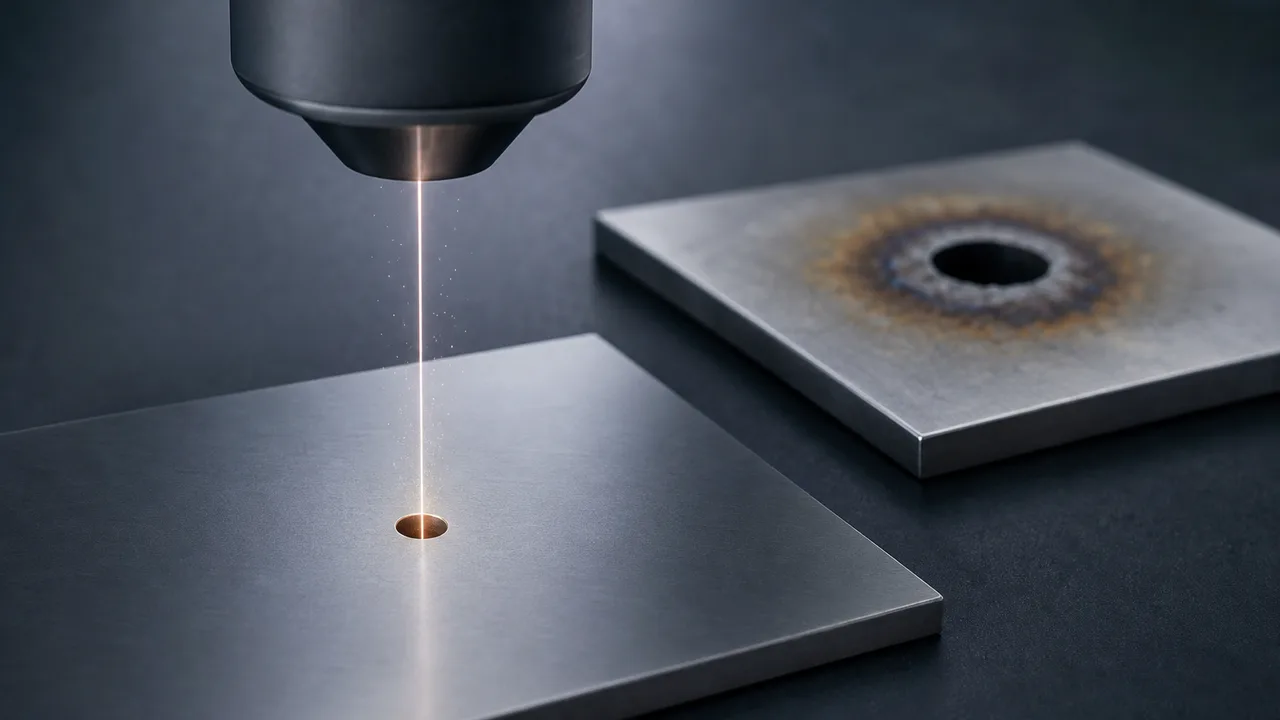
Picture a laser drilling a very small hole in a thin metal sheet. The goal is to remove only the spot the light hits. But the energy the light leaves behind turns into heat and spreads outward. The part around the removed material that this heat affects is called the heat-affected zone (HAZ).
Material processing has long used nanosecond pulses. It is now moving toward picosecond and femtosecond pulses, for higher precision and less heat damage. Why does a shorter pulse leave less heat behind?
The answer lies in comparing two times. One is how long it takes the lit material to break away. The other is how long the heat takes to move into the surroundings. If the first is faster, the processing is over before the heat spreads.
What "short" means: nanoseconds, picoseconds, femtoseconds
First, how is the length measured? The pulse duration is the time a pulse lasts. It is measured as the width of the part of the pulse where the intensity is at least half of its peak. This width is called the full width at half maximum (FWHM).
Here are the sizes of the units. A nanosecond (ns) is a billionth of a second, a picosecond (ps) is a trillionth, and a femtosecond (fs) is a quadrillionth. One nanosecond is a million femtoseconds.
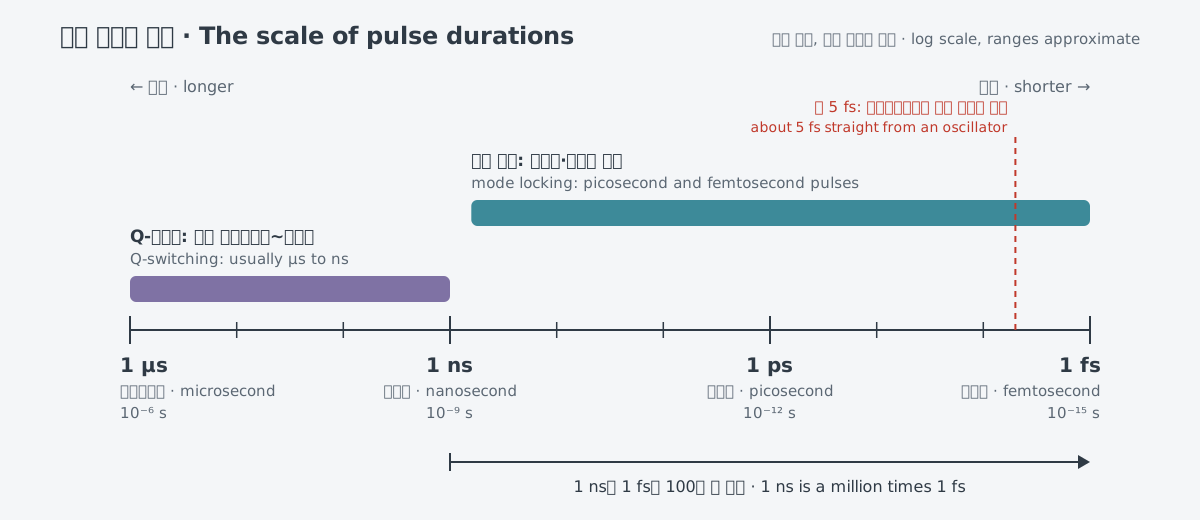
Different methods put pulses in different places on this scale. Pulses made by Q-switching usually fall between microseconds and nanoseconds. Picosecond and femtosecond pulses come from another method.
One reason short pulses are useful for processing is intensity. In a short pulse, all the energy is packed into a very short time, so the momentary intensity becomes very high. Ursula Keller's textbook Ultrafast Lasers lists material processing next to nonlinear optics among the applications where this matters.
Short pulses also come with a condition. Light of a single wavelength is a wave that goes on without end in time. To make a pulse that is confined in time, many waves with different wavelengths must be added together. The more varied the colors in the pulse, the broader its spectrum and the shorter the pulse can be.
Where short pulses come from: mode locking
The technique generally used to make ultrashort pulses from a laser is mode locking. The laser must emit in as many longitudinal modes of its cavity as possible, and the phases of those modes must be locked together. The article "Q-switching and mode locking: two ways to make short pulses" explains the principle with diagrams.
Modes can also be locked without an outside modulator. With a saturable absorber in the cavity, the absorber itself modulates the intensity each time a short pulse passes through. A laser mode-locked this way, called passive mode locking, gives a steady train of picosecond or femtosecond pulses.
How short can they get? In the visible and near-infrared, such an oscillator gives pulses of about 5 fs directly. Compressing the pulses further outside the laser brings them into the range of 3 fs.
There was a turning point that brought these lasers into factories. In 1992 the semiconductor saturable absorber mirror (SESAM) was invented. It made stable passive mode locking of diode-pumped solid-state lasers possible. After that, ultrafast lasers could move from complicated lab setups to reliable turnkey systems for industry.
Making short pulses stronger: chirped pulse amplification
A pulse from an oscillator is short, but its energy is small. More energy means an amplifier, and this step was stuck for a long time. By the mid-1980s, raising the intensity of a short pulse any further would destroy the amplifying material.
The answer came in 1985. Donna Strickland and Gérard Mourou invented chirped pulse amplification (CPA). The two shared half of the 2018 Nobel Prize in Physics for this method.
CPA works in three steps. First, the short pulse is stretched in time by several orders of magnitude. Because the pulse is longer, its peak power drops, so it can be amplified without damaging the amplifier material. Finally, the pulse is compressed back to its original length, which gives a very high peak power.
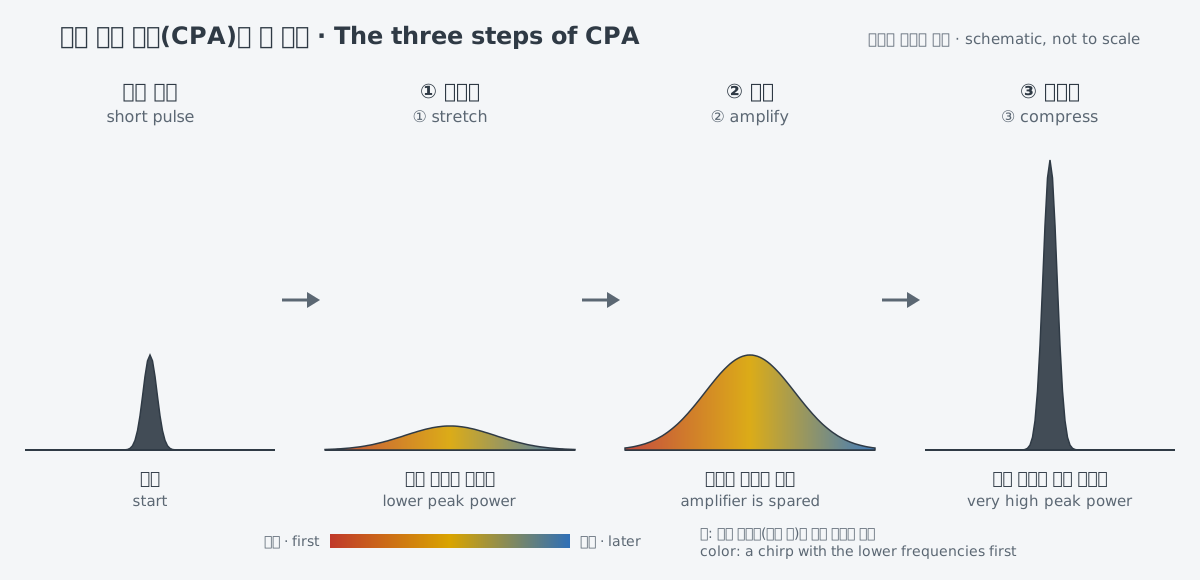
A stretched pulse is called a chirped pulse. Its frequency components are spread out so that they arrive at different times. When the lower frequencies come first, as in the diagram, it is called a positive chirp. A pulse spread out this way is longer than a pulse with the same bandwidth that is not chirped.
Think of people in a line passing through a narrow door. If they all push at once, the door frame suffers, so the line is stretched out and people go through one after another. Once past the door, they close up again.
In reality the line is made of frequency components, not people. The stretching and compressing are done by optical parts such as diffraction gratings, which send each frequency component in a different direction.
High-power ultrafast lasers today still follow this pattern. Some pulses from a low-power oscillator are picked out and stretched. They then pass through several amplifier stages and are compressed again. The Nobel Committee for Physics explains that CPA made it possible to build compact, user-friendly ultrashort-pulse lasers suited to industry and medicine.
Why less heat is left behind
Where laser light is absorbed, heat appears, and the heat moves into the surrounding material. With a long pulse, there is time for heat to spread sideways while light is still arriving. As a result, a wide heat-affected zone is left around the removed spot.
With a very short pulse, the order changes. The lit material breaks away faster than heat can move into the surroundings. The heat-affected zone around the removed spot is kept to a minimum, and the features come out more precise and sharper. Ultrafast lasers can make features with micrometer precision.
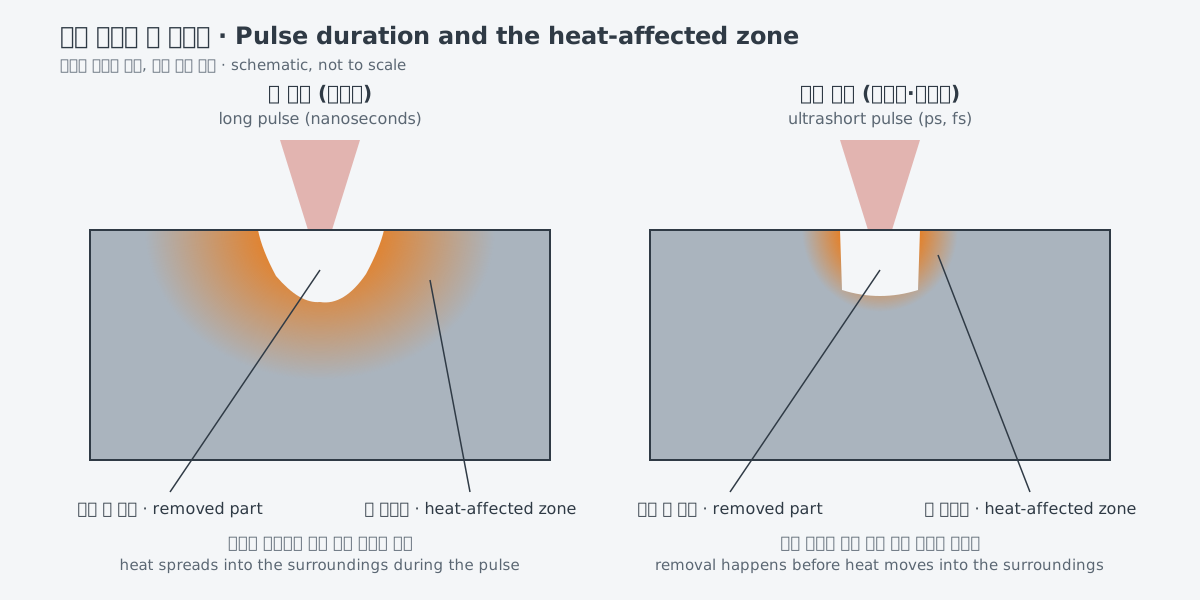
This is why ultrashort-pulse processing is often called cold ablation. Ablation means removing material with light. The Nobel Committee for Physics also explains that intense, ultrashort pulses deposit very little heat energy in the material, so damage outside the intended volume is negligible. As an example of matching the intensity to the job, the committee mentions lower intensity for heat treating and higher intensity for removing material.
An iron gives a rough comparison. Hold a hot iron on cloth for a long time and the area around it scorches too; touch it very briefly and only the touched spot is affected. Real processing differs in two ways. The touched material is actually removed, and despite the name, the heat does not drop to zero.
An application note from the laser equipment maker Newport traces cold ablation to the high peak intensity of ultrafast lasers. It sees this as the reason these lasers machine very small, precise patterns in tough materials well. It says the structures are left with less heat-affected zone, and in some cases the material properties do not change.
Where it is used
The uses range from factories to hospitals. The examples in Keller's textbook include very hard, difficult materials such as ceramics and carbides, and the scribing and dicing of semiconductor wafers. Thin films such as organic light-emitting diode (OLED) materials for displays, and new kinds of photovoltaic devices, are on the list as well.
Ultrashort pulses can cut or drill holes in many materials very precisely, even in living tissue. Femtosecond lasers drill the deep, narrow holes needed for stents, which widen and support blood vessels. The technique is also used to store data in tiny holes drilled deep into a storage medium.
Eye surgery is a well-known example. Femtosecond lasers are in clinical use worldwide for refractive surgery that treats nearsightedness and astigmatism. Many kinds of corrective eye surgery use ultrafast lasers to remove tissue precisely and with little damage.
Some processing changes the inside of a material. Writing optical waveguides, paths that guide light, inside a block of glass with a femtosecond pulsed laser has emerged as a useful microfabrication technique in both research and industry.
The Institute of Applied Physics (IAP) at Friedrich Schiller University Jena in Germany works on the design, fabrication and application of optical and photonic elements. The department list on the institute's official page includes Fiber & Waveguide Lasers and Ultrafast Optics. The link to the official page is on the research groups page.
Difficulties and limits
First, the heat does not disappear. The sources use words like "minimized", "very little" and "in some cases does not change". To get the result one wants, the laser's wavelength, repetition rate, average power and pulse duration have to be chosen for the material.
Second, raising both the repetition rate and the pulse energy means the laser must handle a high average power. Ultrafast lasers with both a high repetition rate and a high pulse energy are valuable for industrial uses such as materials processing. The product of these two is the average power.
average power = pulse energy × repetition rate
When the pulse energy and the repetition rate are both large, the average power is high too. Ytterbium-doped solid-state and fiber lasers have reached average powers well above 1 kW, even with pulses shorter than a picosecond.
Third, heat is also a problem inside the laser. In ultrafast lasers with average powers of several hundred watts, it matters to remove heat well without letting it distort the beam. Less heat may be left in the workpiece, but the laser's own heat is a separate problem to solve.
Fourth, pulse energy and repetition rate tend to trade off. The amplifier can only handle so much average power, so raising the pulse energy usually means lowering the repetition rate. Low-energy oscillators run in the 100 MHz range, and high-energy amplifiers run in the 1 kHz range or even lower.
What to read next
- "How a laser processes material: absorption, heating and melting": continues with the basic process by which light becomes heat and melts material.
- "Q-switching and mode locking: two ways to make short pulses": looks more closely at how the pulses in this article are made.
- "Continuous-wave and pulsed lasers": read this first if pulse duration, repetition rate and peak power are new terms.