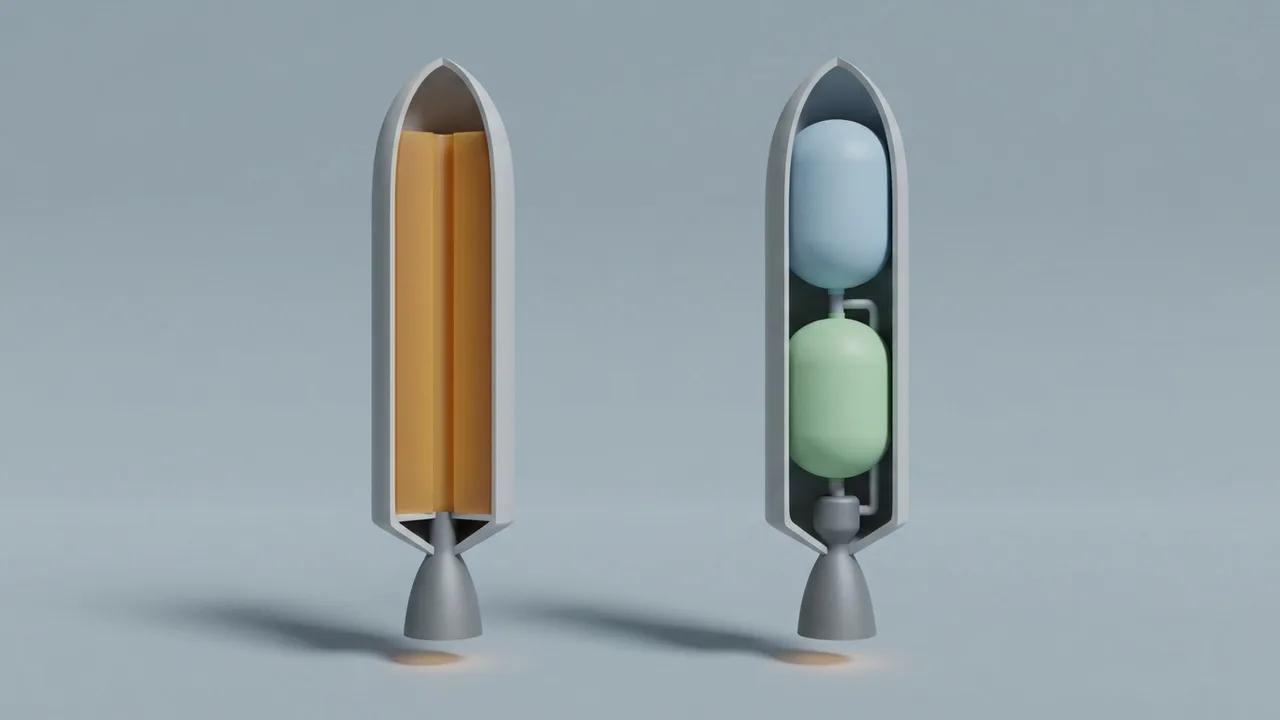
A model rocket on a school field and a launcher that sends people to the Moon are very different in size, yet they move the same way. Each burns the propellant it carries, throws the gas backward and is pushed forward in return. The real split is in what form that propellant takes. Is it a solid block packed into a case, or a liquid held in tanks?
That split matters well beyond a textbook label. The propellant form decides whether the engine can be shut off and lit again. It also affects how long the rocket can sit in storage and how fast it can be made ready.
Why a rocket needs no air
A rocket gets its thrust by burning propellant and forcing the hot products of that burning out through the engine. Propellant is fuel plus oxidizer. Fuel needs oxygen to burn, so a rocket carries its own oxygen source, the oxidizer, from the start.
That is why a rocket still works in space, with no air around it. A jet engine is different. It is an "air-breather" that draws in outside air to burn its fuel, so it cannot work in space, and that also caps how high a jet plane can go.
The hot exhaust speeds up as it passes through the nozzle at the end of the engine. As the gas is pushed backward, the rocket is pushed forward. This is Newton's third law, action and reaction. So far, solid and liquid rockets work alike; what differs is how the fuel and oxidizer are stored.
Solid rockets: propellant packed in a case
A solid rocket mixes fuel and oxidizer ahead of time into a solid propellant and packs it into a cylinder. A hole running through the middle of the cylinder acts as the combustion chamber. Once lit, the propellant burns on its surface, and the flame front works its way into the solid.
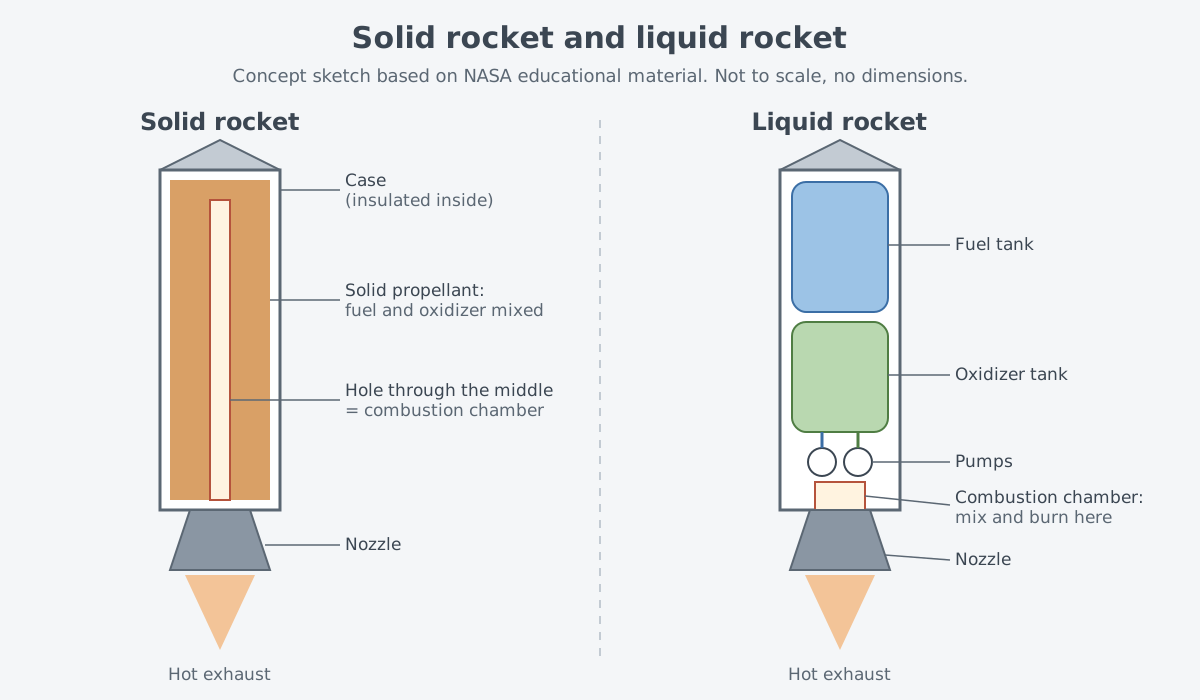
The layout is simple: a case or tube full of propellant makes up almost the whole body. The burning propellant gets hot enough to melt a thin metal case, so the inner wall of the case is insulated. How much gas comes off depends on how large the burning surface is. Designers use the shape of the central hole to set how thrust changes over time.
Making it bigger does not change the basic plan. NASA's educator guide describes the Space Shuttle's solid rocket boosters as very large tubes packed with propellant, closed at one end with a hole at the other. You find solid rocket engines in model rockets, in missiles fired from aircraft at air or ground targets, and in the boosters of satellite launchers.
Liquid rockets: two tanks and pumps
A liquid rocket keeps fuel and oxidizer apart. There are usually two large tanks inside the body, one with fuel and one with oxidizer. When the engine starts, high-speed pumps drive both liquids into the combustion chamber, where they mix and burn.
The burning makes large amounts of hot, high-pressure exhaust, which leaves through the nozzle. Liquid rockets are a twentieth-century invention and are far more complex than solid ones. NASA Glenn Research Center's guide notes that the details of mixing and burning fuel and oxidizer without the flame going out are "very complex."
Even so, they have been used widely. The Space Shuttle had them, as did many uncrewed rockets that carry satellites to orbit and a number of fast experimental planes after World War II.
What changes: control, storage, readiness
The biggest difference is how the fire can be handled. A liquid rocket can change its thrust by adjusting the flow into the combustion chamber, and the engine can be stopped and started again later. A solid rocket is very hard to stop once it is lit, and its thrust control is limited.
Picture a gas stove next to a candle. You turn a knob on the stove to raise, lower or shut off the flame, but once a candle is lit there is not much more you can do. Real rockets differ from this picture. Both kinds carry oxidizer and need no outside air, and a solid rocket has its thrust pattern set in advance by the shape of its hole.
The liquid design's advantages come at a price. Its engine is very complex and can fail, and its structure weighs more than that of a similar solid rocket. Burn time differs too. A National Research Council (NRC) report explains that solid-propellant rocket motors burn for a much shorter time than liquid-fuel ones.
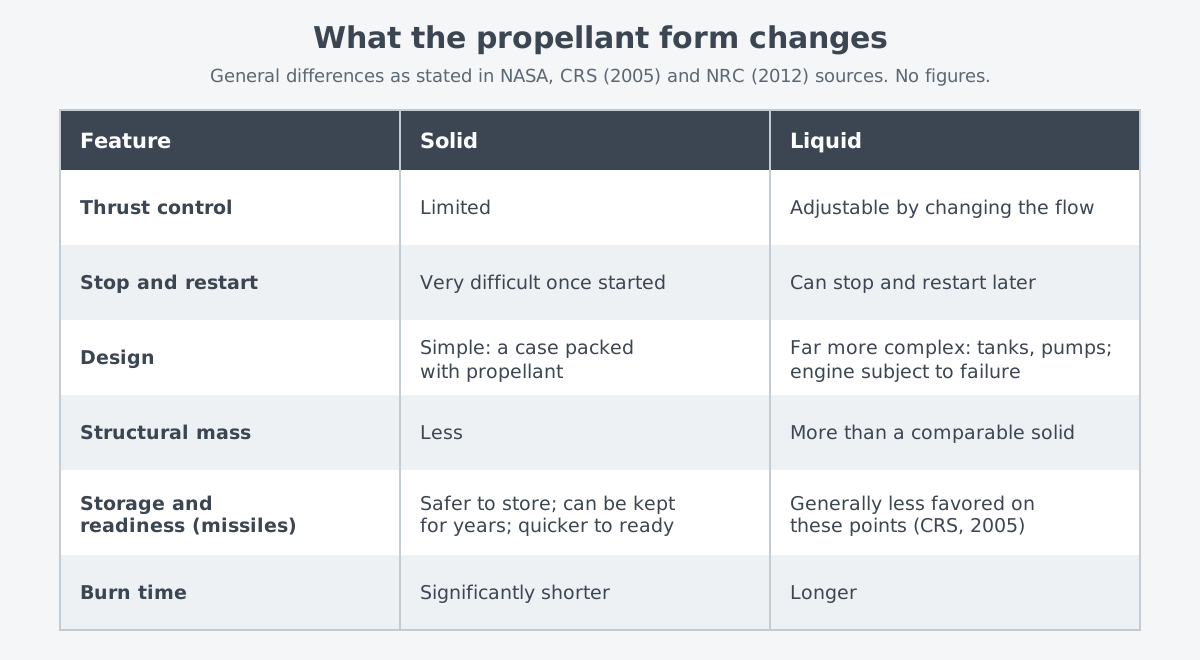
For missiles, storage and readiness carry a lot of weight. A 2005 Congressional Research Service (CRS) report says solid propellants are generally favored. They are safer to keep, and a missile that uses them is easier and faster to get ready than one filled with liquid propellant. The same document adds that, unlike liquid-propellant missiles, solid-propellant missiles can stay stored for years and need less maintenance.
That does not mean one type always wins. A throttleable liquid and a simple solid are good at different jobs, which is why some launchers carry both.
Launchers that use both
A common way to combine them is parallel staging. Several small first-stage rockets are strapped to a central rocket, and all engines are lit together at launch. When the strapped-on rockets run out of propellant, they are dropped. The central rocket keeps burning.
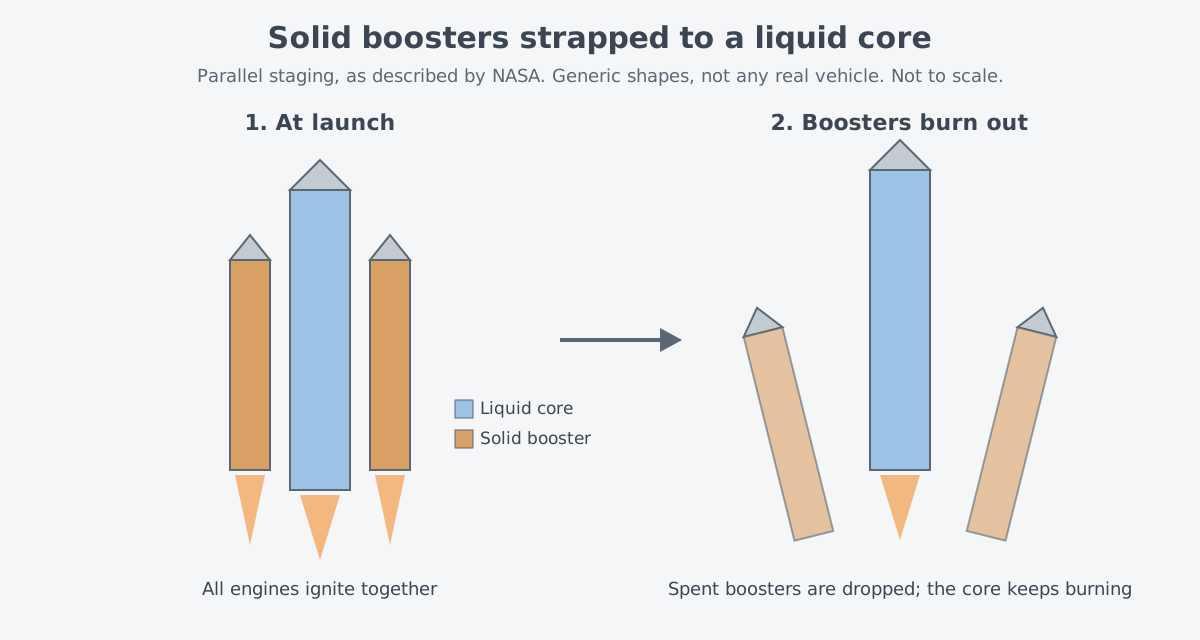
The Space Shuttle used this method. The Titan III had a liquid-fueled two-stage Titan II at its center, with two solid rockets strapped on for launch.
The first version of NASA's new SLS launcher, Block 1, uses the same pairing. Two five-segment solid rocket boosters work alongside four RS-25 engines that run on liquid propellant. According to NASA, the two boosters supply more than 75% of all the thrust SLS produces at liftoff. Why rockets split into stages at all is the subject of "ICBMs: what they share with space launch vehicles."
Where this meets lasers: carrying your energy
A rocket flies without air because it carries all of its fuel and oxidizer. The trade-off is that making, storing and moving those chemicals always comes along with it. Choosing solid or liquid is partly a choice of what form that load takes.
Laser weapons faced a similar fork. A 2018 CRS report sums it up. Chemical lasers carry a large logistics burden and use hazardous chemicals. Solid-state lasers are smaller and need only electricity, but at weapons grade they produce a lot of heat.
Dropping the chemical load, in effect, put more weight on thermal management. The move from chemical to electric lasers is traced in A history of laser weapons.
What to read next
- Cold launch: why some missiles pop out before igniting: how a missile can be pushed out before its rocket motor lights.
- Ballistic missiles: why they climb high and come down: the path a missile follows after its rocket engine shuts off.
- Cooling and thermal management: where the heat that did not become light goes: how electric lasers deal with leftover heat.