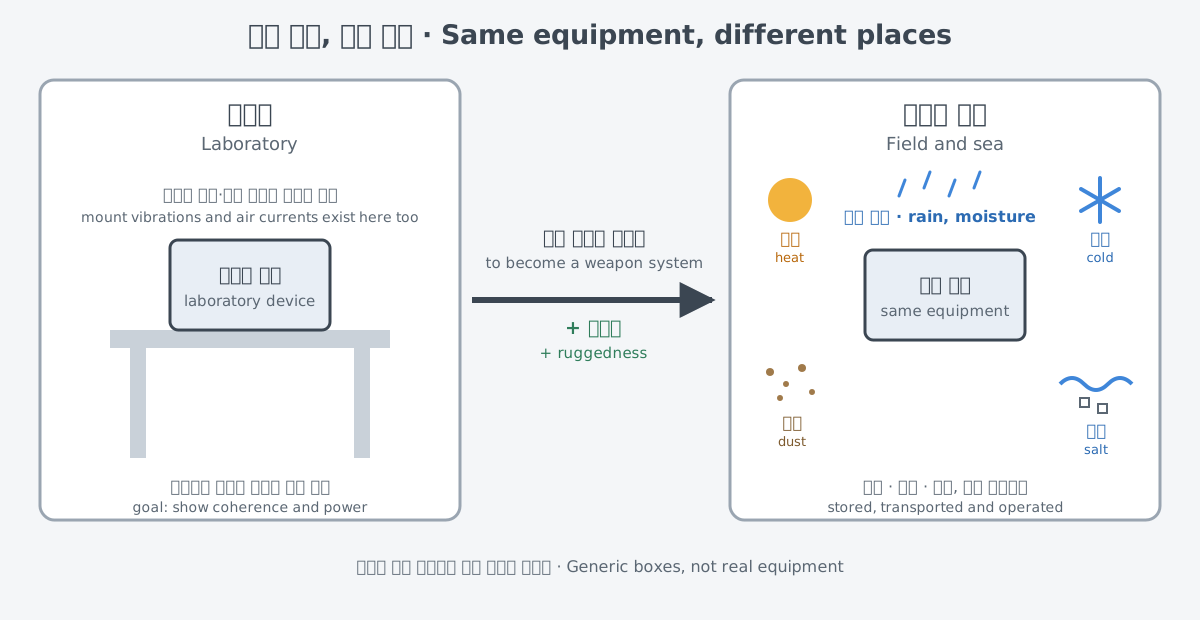
In 2009, a U.S. solid-state laser program met its primary objective. The goal was to show coherence and power, and it did. What the program left behind, though, was a laboratory device not suited to the difficult conditions that weapon systems face.
A 2014 U.S. Army article names one of the challenges in a single line. The lasers were not rugged enough for Army weapon systems. However good the output, a laser that cannot hold up outdoors does not become a weapon.
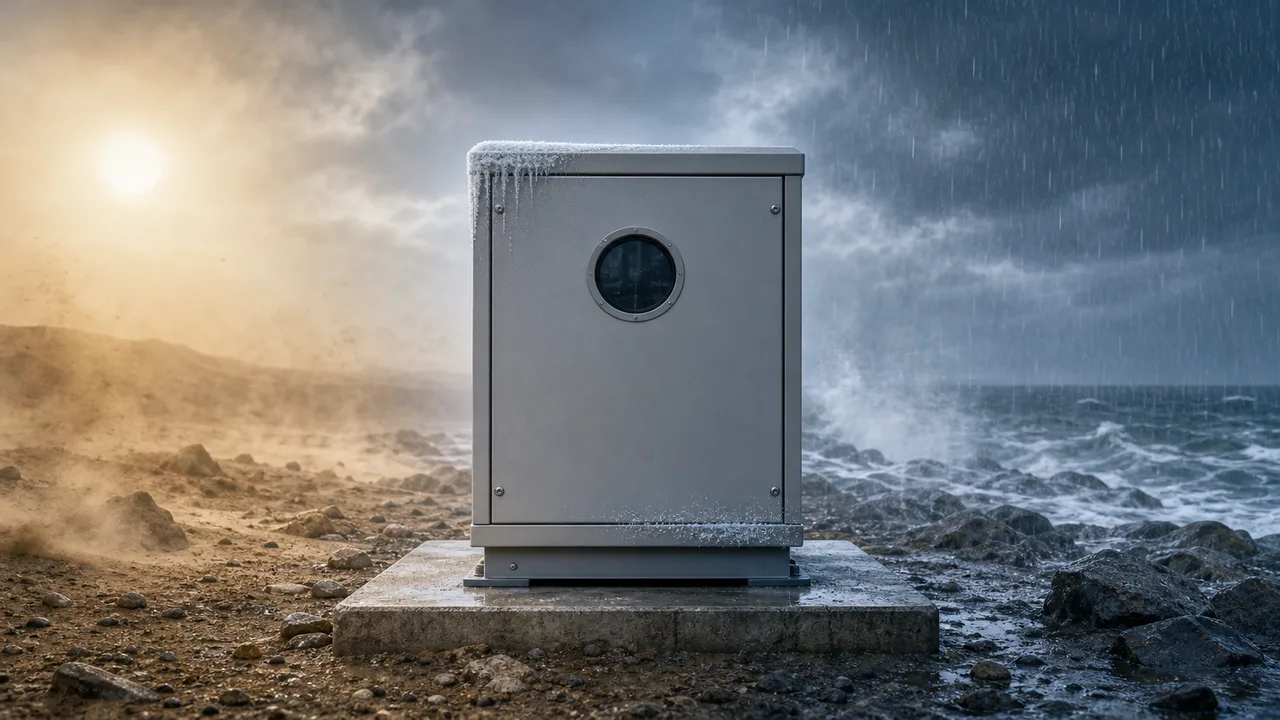
So what does laser equipment have to endure outside? Heat and cold, rain and moisture, dust, and the salt of the sea. This article looks at what each of the four does to optics and equipment, and then at the environmental testing that checks this before the equipment goes out.
How the field differs from the lab
Even in a quiet lab, a laser feels its surroundings. An ultrafast laser textbook gives one measurement example with a mode-locked Ti:sapphire laser. Its timing jitter grew at low frequencies because of environmental disturbances such as mount vibrations and air currents. Timing jitter is how much the arrival time of the pulses wanders.
Turning a lab device into a useful machine was not easy in industry either. The invention of the semiconductor saturable absorber mirror (SESAM) in 1992 let ultrafast lasers move from complicated laboratory devices to reliable turnkey systems in industrial applications. A SESAM is, as the name says, a saturable absorber mirror made from a semiconductor; what a saturable absorber does is covered in Q-switching and mode locking.
Weapons go to rougher places. Military weapon systems must be stored, transported and operated in many settings around the world, whether desert, arctic, tropic or marine. That means they face their environment not only in use but also in storage and in transit.
The solid-state laser above went part of that way. After refurbishment, it was moved to White Sands Missile Range in New Mexico. Officials said the challenge was to place a laser designed for the laboratory at a relatively remote location in the desert.
A program called RELI (Robust Electric Laser Initiative) took up the problem. Its products were to be technologies with the size, weight and ruggedness suitable for growing into high-energy laser (HEL) weapons for several services. Ruggedness had joined power on the list of goals.
Heat and cold
Any list of environments that cause failures includes temperature. In a 2014 article, the U.S. Army Redstone Test Center, which tests missile systems, named temperature, vibration and humidity as the top three environments that lead to equipment failure. It also warned that a lack of rigorous enough testing could put people and the mission at great risk.
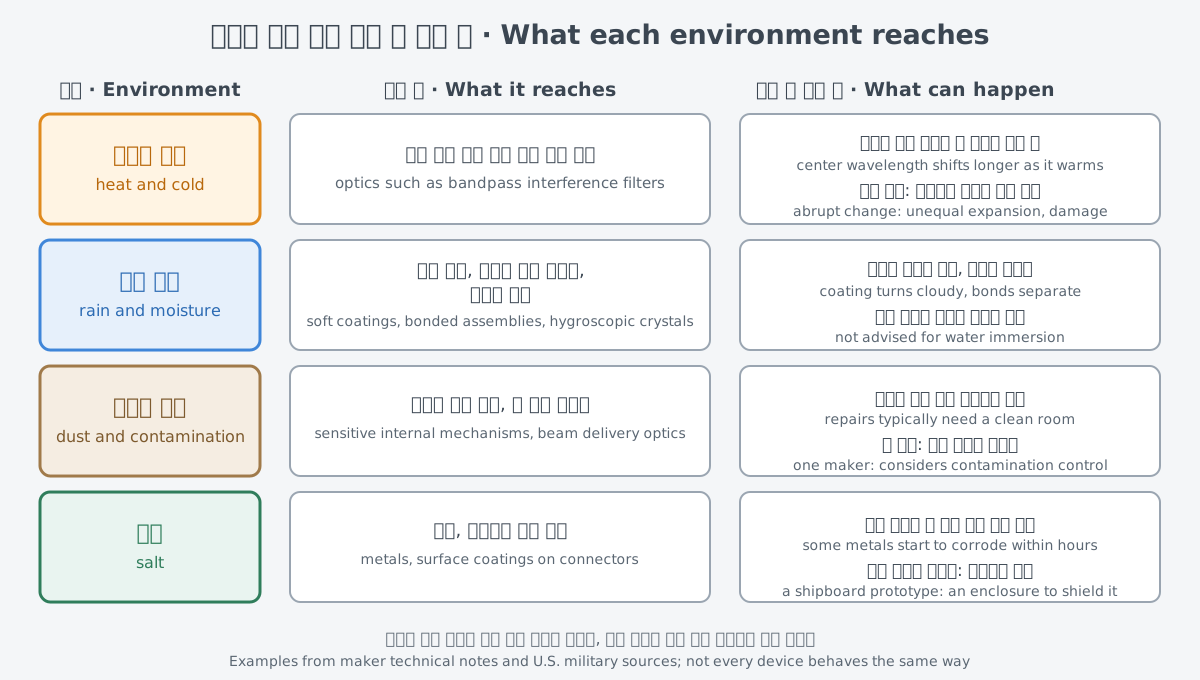
Some optics change their behavior with temperature. A bandpass interference filter, which passes light only in a set wavelength range, is one example. As the temperature rises, the filter's center wavelength shifts toward longer wavelengths.
Sometimes how fast the temperature changes matters more than how hot it gets. A filter maker specifies a temperature range for safe operation, but that range assumes a gradual change. An abrupt change can cause physical and spectral damage, because the many elements in a filter assembly may have different expansion coefficients.
It is a little like the cracking you can sometimes get when hot water is suddenly poured into a cold glass. The difference is that a filter is not a single lump of glass but an assembly of several elements, and each one may expand by a different amount.
Test facilities ask about temperature all the time. At one U.S. Army test facility for communications equipment, requests for high and low temperature and humidity tests come in regularly because of fluctuating harsh climates. For a band reject filter meant for a mine-resistant vehicle, no environmental data existed, and the engineers were unsure whether it would work in the extreme temperatures on the vehicle. Only after a chamber test could the project manager decide whether to install it.
Rain and moisture
Water is a tricky opponent for an optical coating. An optical coating is a thin layer on an optic's surface that changes its reflection or transmission, covered in detail in Mirrors, lenses and coatings. Most evaporation materials used in soft coatings are somewhat prone to breaking down when exposed to water. That is why soft coatings need protection from a humid environment.
A coating that moisture has entered looks different. As it discolors, a surface that was highly reflective typically turns cloudy. The spectral performance, however, begins to degrade at a much slower pace than the appearance.
In an optical assembly made by bonding several elements together, the bond is the weak link. The main cause of failure in such assemblies is the bond between elements coming apart, and it starts as a feathered pattern where moisture has crept in. Cyclic high humidity at high temperatures is listed as an environmental factor that damages the bond.
There are ways to fight back. A moisture barrier between the humid air and the coating extends the life of the part. Even so, Newport says it does not guarantee lifetime against humidity; it guarantees that the product meets well-defined military specifications. One of the documents it names for those humidity requirements is MIL-STD-810, which comes up again below.
Some optical crystals take up moisture. Calcium fluoride (CaF2) and magnesium fluoride (MgF2) are mildly hygroscopic. Under normal operating conditions no pitting is expected, but they are not recommended for water immersion.
Dust and contamination
Sand and dust have their own entry in the list of environmental test methods covered below. For laser weapons, the place where repairs happen gives a clue. The Congressional Research Service (CRS) judges that directed-energy weapons (DEW) may be harder to maintain than traditional weapons, and it quotes the Government Accountability Office (GAO). The internal mechanisms of directed-energy weapons are sensitive and typically require a specialized clean room for repairs.
Companies that handle light also treat contamination as an environmental condition. FiberBridge, which makes high-power laser components and systems, writes that for its beam delivery optics it considers application-specific environmental conditions such as temperature stability, contamination control and mechanical robustness.
For equipment that carries light through optical fiber, the connector ends need care too. One reference book on fiber optic measurement gives an appendix to fiber optic connectors and their care, with separate sections on care and on cleaning procedures.
Rain, fog, sand, dust and salt particles do not only trouble the equipment. Floating in the air, they absorb and scatter laser light. CRS judges that lasers might not work well, or at all, in rain or fog, which keeps them from being an all-weather solution. That is a problem of the light's path, not of the equipment, and it is the subject of "Light through air: absorption, scattering, turbulence, thermal blooming."
Salt: the burden of the sea
A car built for cold northern climates must resist road salt. Newport opens its explanation of optical filter lifetime with that example. At sea the difference is that salt water, not salt spread on a road, reaches the equipment.
Salt water goes to work on metal quickly. Some metals can begin to corrode after only a few hours of salt-water exposure, which is why the salt fog test is popular at the Army's communications equipment test facility. When a new power cable went through this test, the surface coating on its connectors was slightly deteriorated in appearance. The cable itself stayed watertight, though, and the testers judged that the function and electrical characteristics of the connectors were not harmed.
For a shipboard laser program, the sea appears in the contract work itself. A March 2020 U.S. Department of Defense contract announcement lists the key work for a laser weapon prototype on a littoral combat ship. That work includes building a structure and an enclosure to protect the equipment from the ship's motion and the maritime environment. An enclosure is the outer box that houses the equipment.
The U.S. Navy's list of laser efforts also included one whose name means a toughened high-energy laser: the Ruggedized High Energy Laser (RHEL). All the public report says about it is that the effort is now completed.
In 2014 the U.S. Navy put a prototype, the Laser Weapon System (LaWS), on the ship USS Ponce in the Persian Gulf. It was the first time LaWS was deployed and operated aboard a naval vessel in the Persian Gulf. Sailors worked with it daily for several months. The Office of Naval Research (ONR) announced that they reported it performed flawlessly, including in adverse weather with high winds, heat and humidity.
The sailors said it exceeded expectations for both reliability and maintainability. Still, this is what one prototype showed in one sea over several months. It cannot simply be carried over to other seas, other systems or longer periods.
Environmental testing: enduring it in advance
Whether equipment can take these environments has to be known before it is sent out. The Army communications equipment test facility, Newport and FiberBridge in this article all name the same document: MIL-STD-810. Its title in ASSIST, the U.S. defense standards database, is "Environmental Engineering Considerations and Laboratory Tests."
Its scope describes it as planning and engineering direction for considering the influences that environmental stresses have on materiel throughout all phases of its service life. The version listed as active in ASSIST is Revision H, Change 1, dated May 18, 2022, and the preparing activity is the U.S. Army Test and Evaluation Command (ATEC).
One point stands out. The document states that it does not impose design or test specifications. Instead, it describes a tailoring process that leads to realistic designs and test methods based on the performance requirements of the system. Not every item gets the same tests; the tests are chosen to match the environments that item will face.
The names of the test methods alone cover all four topics of this article. An outside MIL-STD-810 training course held in January 2023 is listed on the website of DSIAC, the U.S. Defense Systems Information Analysis Center. Its announcement names methods such as high temperature, low temperature, temperature shock, solar radiation, rain, humidity, fungus, salt fog, sand and dust, immersion, and icing and freezing rain. Vibration and shock are on the same list.
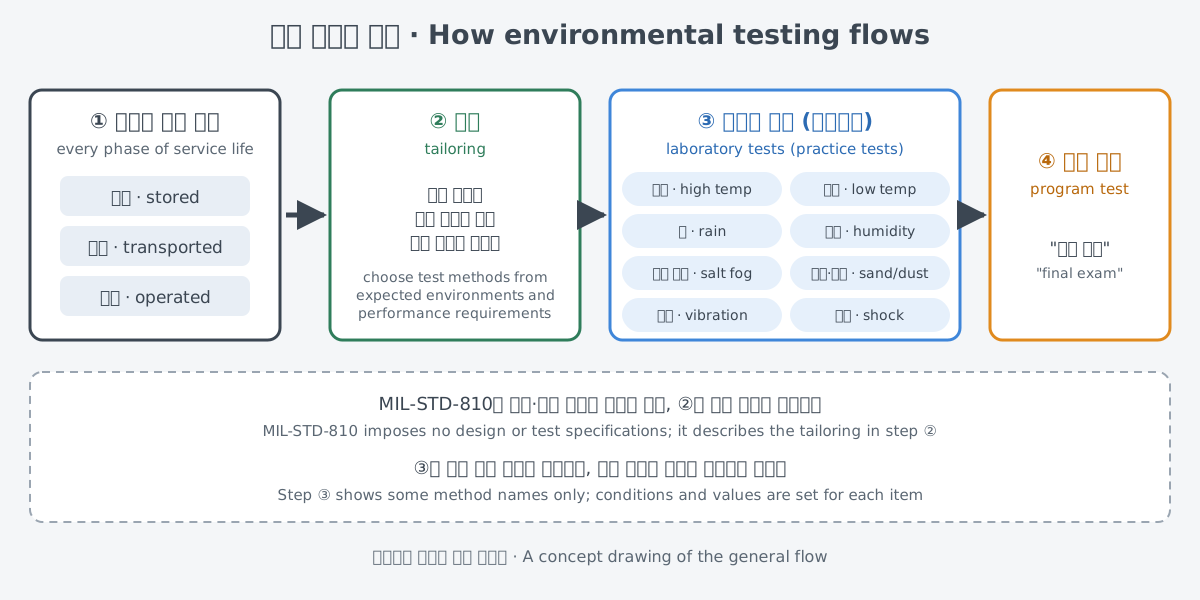
Why do lab tests come first? The chief of the division that runs the Army communications equipment test facility compared it to studying for exams. A program's official test is its final exam, so it makes sense to take a few practice tests in a lab first. He added that recreating the harshest conditions in a lab speeds up testing at a fraction of the cost.
Some failures get caught in those practice tests. Most hard coatings are built to resist handling damage and to withstand long exposure to adverse environments, but when they do fail, the coating cracks, crazes, peels or blisters. Such failures generally show up when environmental reliability testing is completed before the product ships.
Some companies offer environmental testing as a service. FiberBridge says it provides environmental testing services for customers in sectors that include space and defense, with procedures that follow industry standards such as the Telcordia Generic Requirements and MIL-STD-810H.
The difficulties that remain
Part of making equipment withstand its environment lies outside the maker's choice. The factors that make bonded optical assemblies come apart fall into process, material and environmental groups, and of these only the environmental factors are beyond the manufacturer's control. Processes and materials can be refined in the factory; the weather where the equipment will sit cannot.
Protection also needs room on the platform. As A laser weapon is more than a laser showed, every part of a system has to fit within the platform's size, weight and power (SWaP). A structure added to protect the equipment, such as an enclosure, is also a part that has to be carried on the platform.
Maintenance remains a task as well. The clean-room point above was the basis CRS gave for judging that directed-energy weapons may be harder to maintain than traditional weapons. An enclosure can keep the outside out, but repairing the sensitive mechanisms inside is a separate job.
What to read next
- "Light through air: absorption, scattering, turbulence, thermal blooming": what rain, fog and dust do to the beam rather than to the equipment.
- "Vibration and shock: protecting optics on a moving platform": vibration and shock, which sit on the same test list.
- Mirrors, lenses and coatings: optics for strong light: what a coating is and what it must endure under strong light.