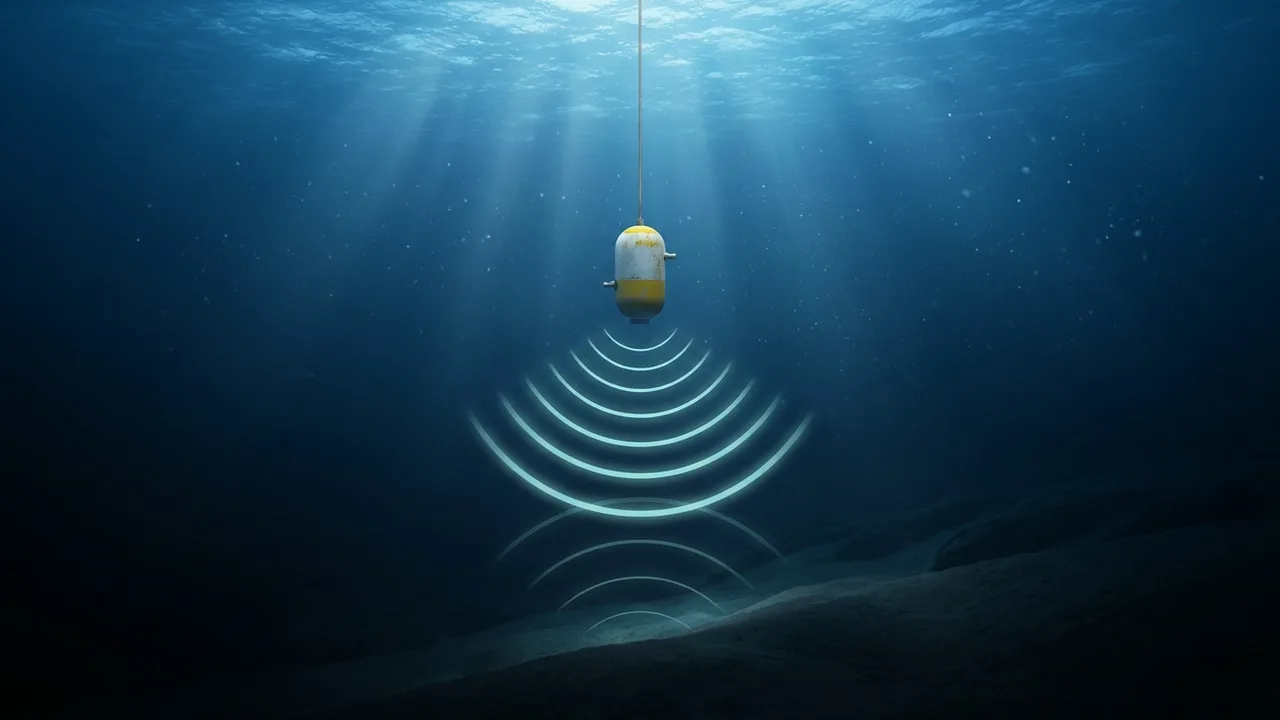
Underwater documentary footage turns blue-green only a short way below the surface, and deeper down the screen goes black. Seeing with the eyes stops working a short way down.
So what do ships and scientists use to "see" in the deep ocean? Sound. Sonar is short for Sound Navigation and Ranging, and it is a tool that explores the water with sound. This article looks at why sound is chosen over light and radio, how sound measures distance, and how a sonar that makes sound differs from one that only listens.
Why light and radio do not go far underwater
The sea looks blue for a reason. Water absorbs the red end of the light spectrum, and the blue end is what reaches the eye. The water works a little like a filter.
Light also fails to get very deep. NOAA explains that some light can still be sensed at a depth of 1,000 m, yet below 200 m meaningful light is rare. Most of the ocean is completely dark.
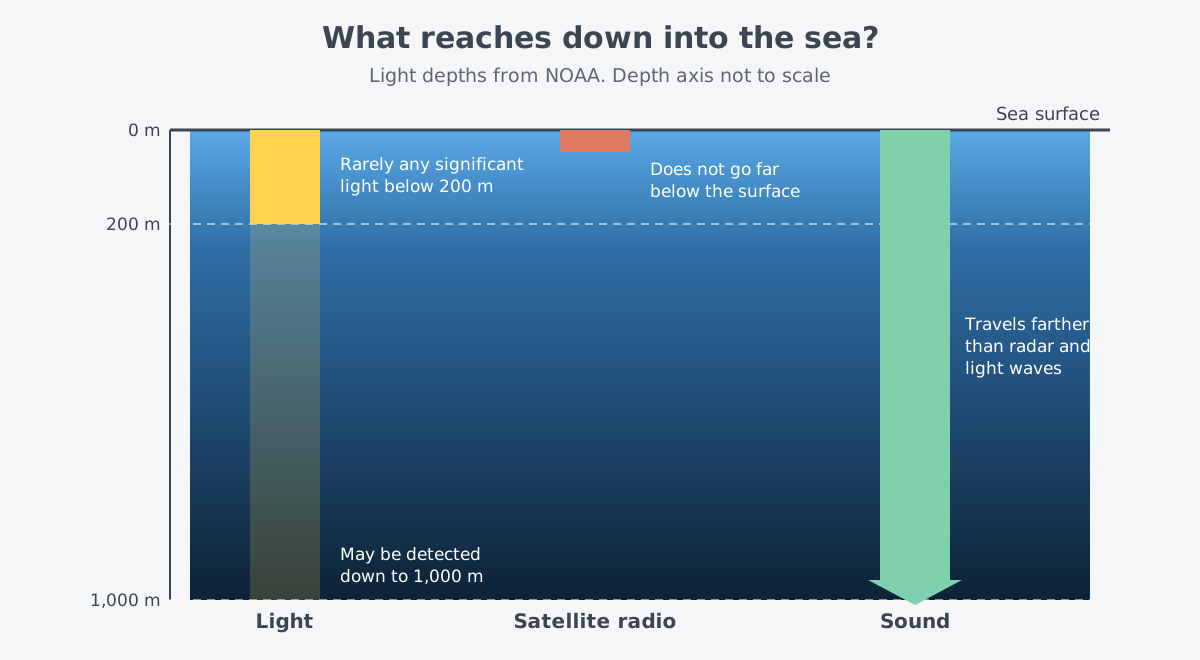
Radio has a similar problem. The radio waves that satellites use do not reach far below the ocean surface. Signals for satellite navigation do not get to the deep sea either. That is why ocean researchers follow deep-diving submersibles by sound.
Sound is different. It travels farther in water than radar waves or light, which is why sonar is used to explore and map the ocean.
How fast sound moves in water
In seawater, sound moves at about 1,500 m per second on average. That is more than four times as fast as in air.
The value is not the same everywhere. Sound speed changes with water temperature, pressure and salinity, and a rise in any of the three makes sound faster. Within the upper 1,000 m, temperature can change a lot with depth, so temperature is the main driver of speed changes in that layer.
Because the speed varies from place to place, it matters for the distance calculation later in this article. A distance worked out with the average speed is only an estimate.
Active sonar: send a sound, time the echo
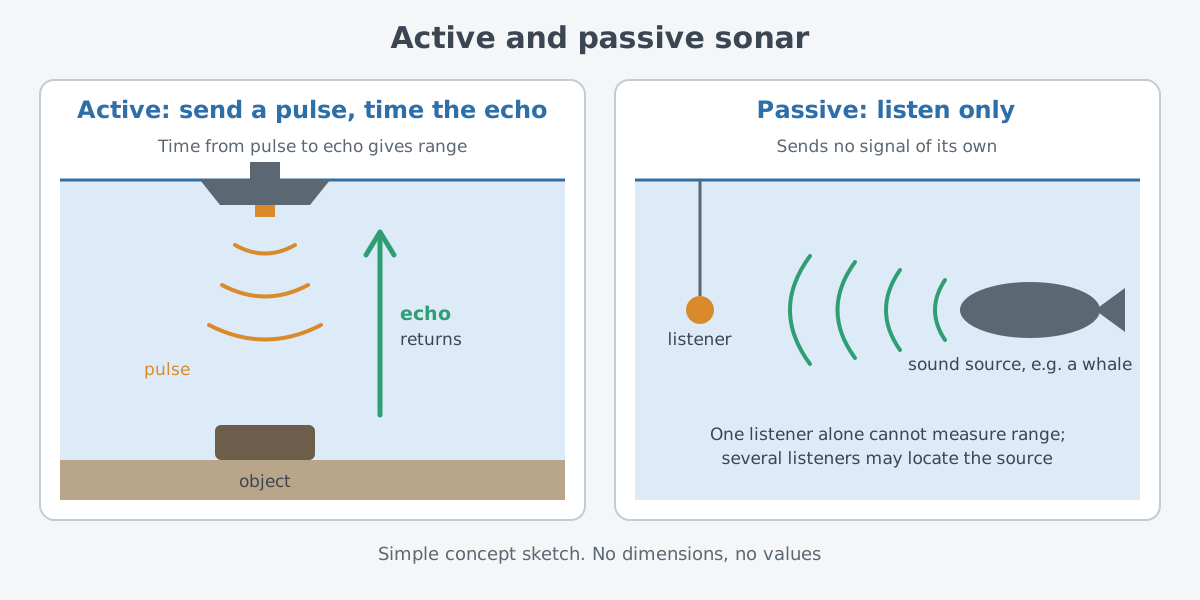
Active sonar makes its own sound. In active sonar, the part that sends the sound is called a transducer, and it sends a short burst of sound out through the water. When something is in the way, the sound bounces off it and returns as an echo.
A transducer that can also receive picks up the echo and measures the time from sending the pulse to receiving it. According to NOAA, that time reveals the object's range and direction. Some sonars use one transducer; others group several into what is called a transducer array. Arrays are fitted not only to ships but also to remotely operated vehicles and autonomous underwater vehicles.
It resembles shouting in the mountains and hearing an echo. The real thing differs in a few ways. The sound travels through water instead of air, so it moves much faster, and a transducer times it instead of an ear.
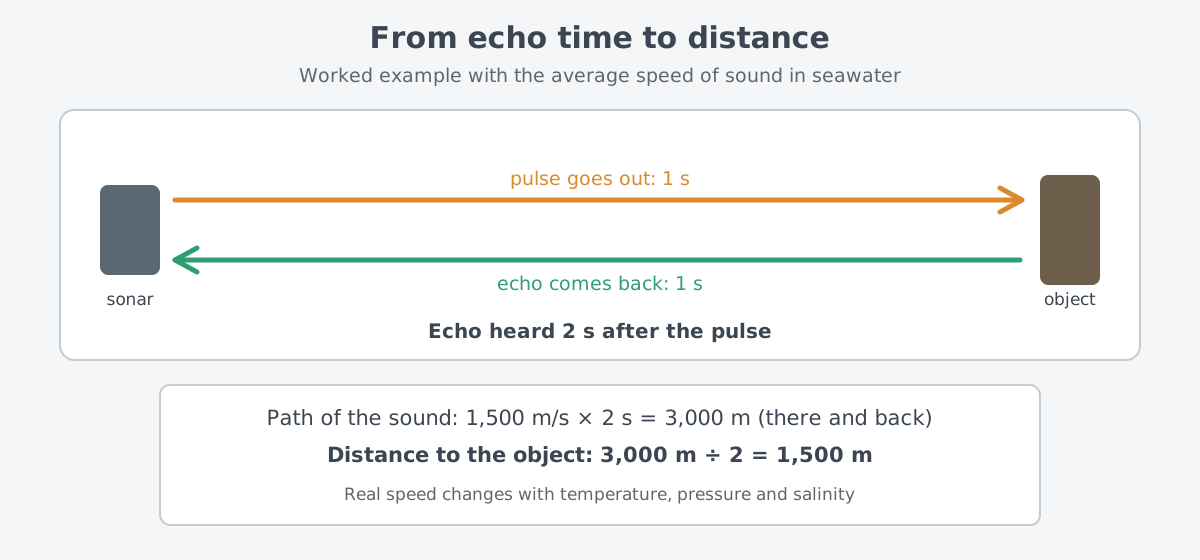
The distance takes one multiplication and one division. Say the echo is heard 2 seconds after the pulse. At the average speed of 1,500 m/s, the sound has moved 3,000 m in 2 seconds. That path went out and came back, so the object is half that distance away: 1,500 m.
Passive sonar: listening without making a sound
Passive sonar makes no sound of its own. It only picks up sound coming toward it. It is used mainly to hear noise from objects such as submarines and ships, and sounds from marine animals such as whales.
Staying silent is the advantage. NOAA describes it as a benefit both for warships that want to stay hidden and for scientific work that focuses on quietly listening to the ocean.
The limit is just as clear. A single passive sonar cannot measure how far away a sound source is. Using several devices together may make it possible to locate the source by triangulation.
One example of a listening device is the hydrophone. It is used alone or in groups, and it can trail behind a ship or be mounted on a fixed structure.
A history that began with icebergs
As the 1800s gave way to the 1900s, several inventors worked on protecting ships from hazards. One result was warning signals sent by bells hung in the water. The story before sonar is tied to safe navigation in this way.
A few months after the Titanic sank in April 1912, an inventor joined a company and began work there on active sonar, which sends sound and receives the echo. A history article in Acoustics Today, the magazine of the Acoustical Society of America, says sea trials began in 1914 and showed underwater communication and iceberg detection. Experiments on finding submarines followed in 1917, and commercial depth sounders came into use from 1924.
World War I opened another path. Crystals such as quartz expand and contract when a voltage is applied, and they produce an electric charge when sound hits them. This piezoelectric effect was used to develop ultrasonic sonar, but the war ended before it reached the fleet. In the United Kingdom, early sonar was called "asdic."
The same article sums up naval warfare and its threats as the biggest driver of underwater acoustics research. Work that started in World War I made great progress in World War II and the years that followed.
Sonar that maps the sea
Scientists use sonar mostly for mapping the sea. According to NOAA, they use it to make nautical charts and find underwater dangers to ships. They also search for and identify objects like sunken ships, and chart the shape of the seabed.
The multibeam, side-scan and synthetic aperture sonars used for this work are all active sonars. Each is good at something different. Some show a small area in great detail; others give up detail to cover a far wider area, such as one with a seamount.
People are not the only users of underwater sound. Many marine animals use it to sense their surroundings, communicate and find food. Ocean scientists also rely on sound to find how deep the sea is, to follow things moving underwater and to spot shifts in water temperature.
Where this meets lasers: the same round trip
Sonar works out distance with the same steps as radar. Send a signal, time how long it takes to come back, multiply by the speed and divide by two. Radar uses radio waves; sonar uses sound.
Lasers use the same steps. Laser range finding and lidar send pulses of light and measure distance from the return time. The details are in Measuring with lasers: range finding and lidar basics.
Even with the same principle, the choice of wave depends on what it has to pass through. In the sea, sound goes farther than light and radio, so sound is used. Light passing through air is also absorbed and scattered, a story that continues in Light through air: absorption, scattering, turbulence, thermal blooming.
What to read next
- Radar: measuring distance and motion with radio waves: the same round-trip principle with radio waves.
- Measuring with lasers: range finding and lidar basics: measuring distance with pulses of light.
- Inertial and satellite navigation: knowing where you are: finding position where satellite radio does not reach.