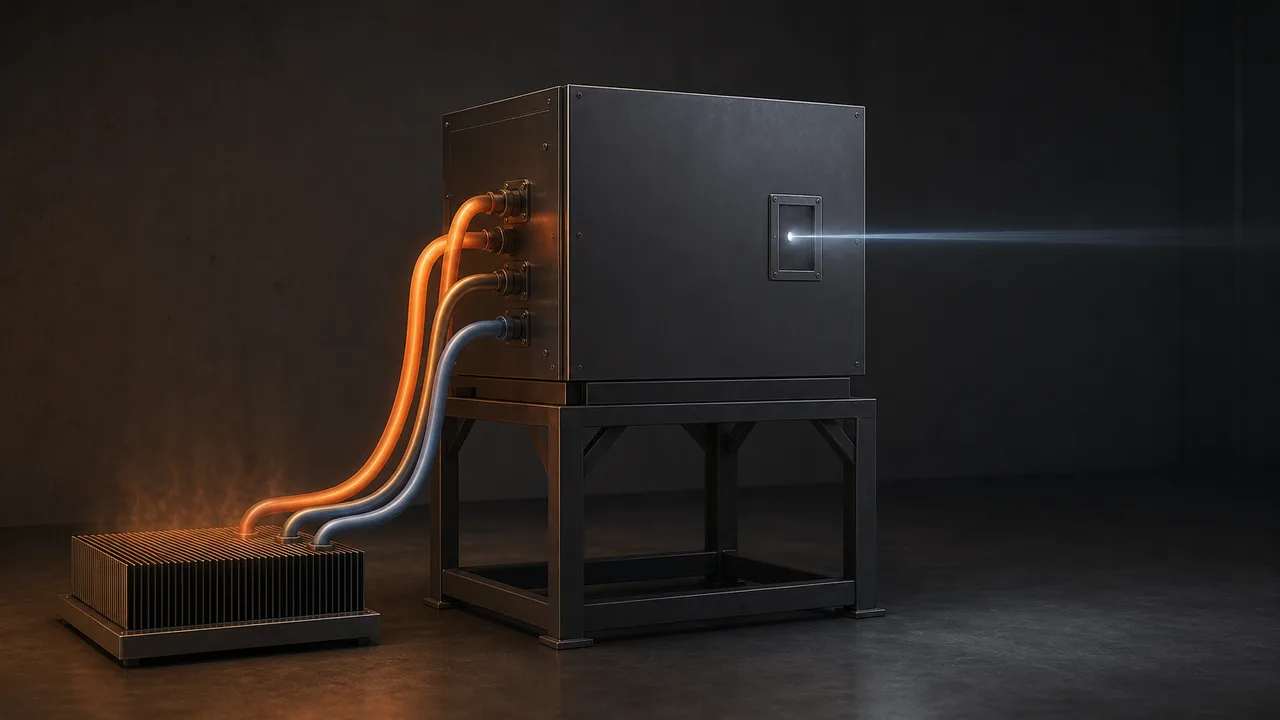
A solid-state laser needs only electricity to operate. Unlike a chemical laser, it carries no hazardous chemicals. Yet a 2018 Congressional Research Service (CRS) report adds in the same sentence that weapons-grade solid-state lasers generate a significant amount of heat. It also says practical cooling technologies could further advance their military utility.
Where does that heat come from? Not all the electricity put into a laser becomes light, and heat is made along the way. That heat blurs the beam and ties down both the platform that carries the system and how long it can keep firing. This article starts where electricity splits into light and heat, and follows that heat until it leaves the vehicle or ship.
Official sources list thermal management as a block of its own, next to the laser. An analysis quoted in the same report lists what is needed beyond the actual lasers: target tracking, laser pointing, thermal management and beam control systems. All of these are needed to place as much laser energy as possible on a target at operational distances. The whole system is drawn in A laser weapon is more than a laser.
Not all the electricity becomes light
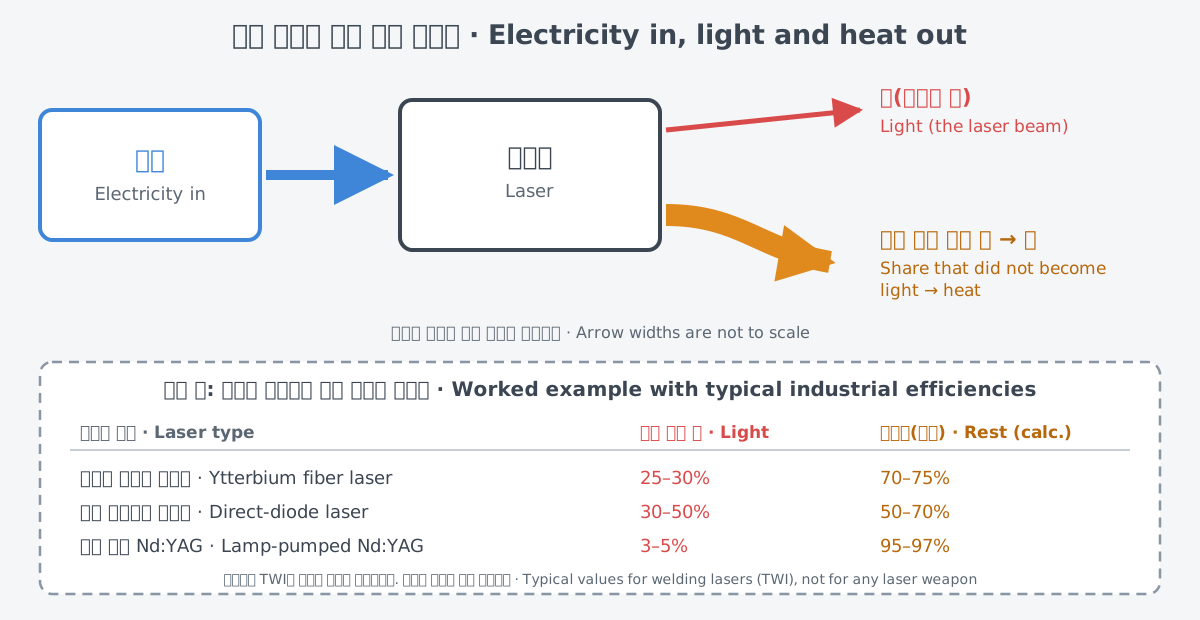
The share of electricity a laser turns into light is its wall-plug efficiency (WPE). The name compares the light that comes out with the electricity drawn from the wall plug.
This efficiency is lower than many people expect. Typical industrial values from TWI, a UK welding institute, are 25–30% for ytterbium fiber lasers, 30–50% for direct-diode lasers and 3–5% for lamp-pumped Nd:YAG lasers. Efficiency by laser type is covered further in Power and efficiency: the share of electricity that becomes light sets the size of the system.
Read those values backward and you see what is left over. The share that does not come out as light is one minus the efficiency.
share not emitted as light = 1 − wall-plug efficiency
The calculation gives 70–75% of the electricity not leaving as light for an ytterbium fiber laser, and 95–97% for a lamp-pumped Nd:YAG laser. These come from typical values for industrial welding lasers. They are not values for any laser weapon.
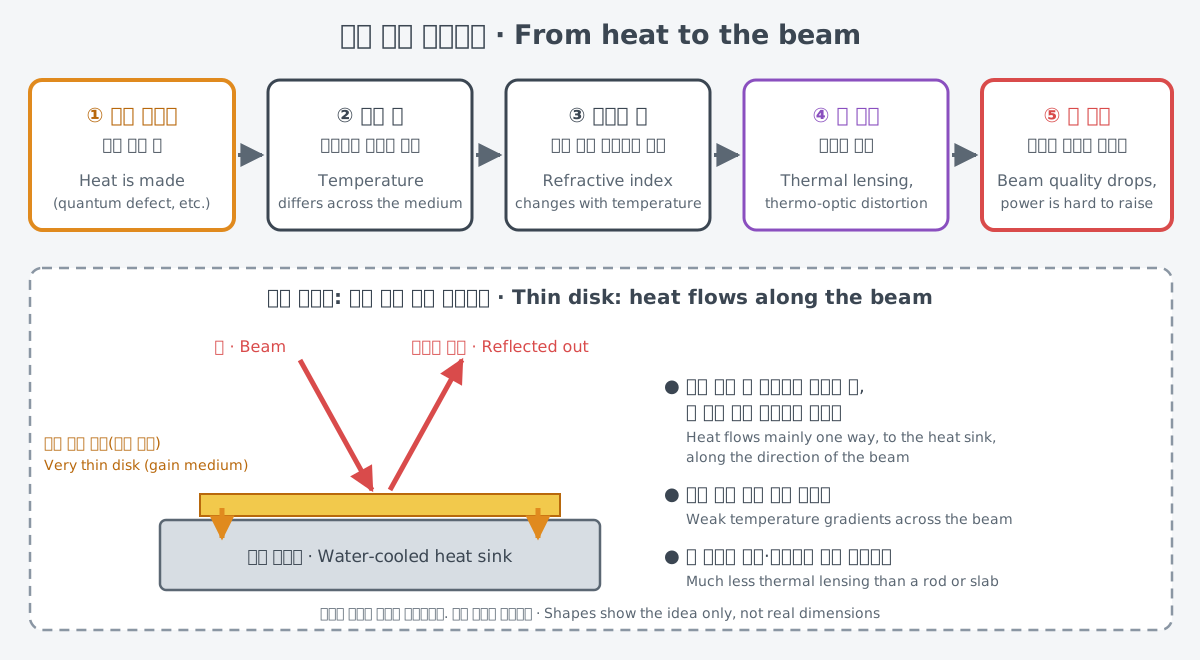
Heat is made in the share that does not become light. A 2014 article in MIT's Lincoln Laboratory Journal says heat from the less-than-perfect electrical-to-optical conversion causes thermo-optical distortions in the gain medium. It calls these the main obstacle to scaling power while keeping a diffraction-limited beam. For any class of laser, there is a power level that is hard to exceed without degrading beam quality, though technological advances have eased some thermo-optical effects.
Where heat starts inside the laser: the quantum defect
Many solid-state and fiber lasers use electricity to make pump light, then send that light into a gain medium to get laser light. The energy of the light the medium takes in is not the same as the energy of the light it gives out. The pump energy minus the lasing energy is called the quantum defect.
A pump photon usually carries more energy than a photon the laser emits, and the difference stays in the medium as heat. A fiber doped with light-amplifying ions is called an active fiber. A 2020 review paper on high-power fiber lasers names the quantum defect as the most important of its several heat sources. It comes with laser operation itself, so it cannot be avoided.
There are other heat sources as well. Linear ground absorption is, in most cases today, extremely low, so its share of the total heat load is usually negligible. In ytterbium-doped fibers, color centers formed by an effect called photodarkening absorb light and add to the heat load.
A medium with a small quantum defect makes less heat for that reason. Working out the quantum defect from the pump and laser wavelengths is shown in Limits of a single fiber (2): heat and mode instability.
The quantum defect is the heat made where pump light turns into laser light. Not every loss on the way from electricity to light happens at this one step.
Heat blurs the beam: thermal lensing and thermo-optic distortion
Heat is a problem less because things get hot than because it changes the path light takes. The refractive index of a medium changes with temperature. When temperature differs inside the medium, the refractive index differs from place to place, and the shape of a beam passing through it changes.
One textbook example shows the process. A certain Er:Yb glass conducts heat rather poorly, and its refractive index falls as temperature rises. As a result, the pump creates a negative thermal lens in the medium.
It is as if an unwanted lens appeared by itself in the beam's path. The difference is that it is not a lens ground from glass, but a temperature difference inside the medium that shows up as a difference in refractive index.
A thermal lens can also shape the beam's transverse mode, the pattern in which light settles across its cross section. In a short-cavity microchip laser, that mode is set mainly by the thermal lens, thermal expansion and gain guiding. The lens also narrows the range of power you can work with. In a lamp-pumped Nd:YAG laser, thermal lensing allows the pump power to be set only within a limited range.
Sources call this kind of distortion that heat causes in the gain medium thermo-optic distortion. The earlier diagnosis, that there is a power level hard to exceed while keeping beam quality, comes from this distortion.
In fiber lasers, heat also shows up in another form, transverse mode instability (TMI). Above a certain average power the beam suddenly starts to fluctuate, and how that happens is explained in Limits of a single fiber (2).
Shapes that shed heat
Laser makers have wrestled with this problem for a long time. In early lasers, raising the average power distorted the output beam and strongly reduced its spatial coherence. To solve this, the gain medium was reshaped to have more surface for its volume, and the slab, the thin disk and the fiber came out of that effort.
The yardstick for choosing a shape is the surface-to-volume ratio. The larger it is, the easier the heat is to remove. In ultrafast laser systems with average powers of several hundred watts, though, removing heat is not enough. The key is to remove it without introducing thermo-optic distortions, so removing heat and keeping the beam clean are tied into one problem.
The thin-disk laser is a good example. The gain medium is made as a very thin disk, and its reflective side is mounted directly on a water-cooled heat sink. The disk then cools very effectively, and heat flows mainly toward the heat sink. That direction is the same as the direction of the beam.
The temperature gradients across the beam become weak. As a result, thermal lensing is strongly reduced compared with a rod or slab shape. The heat is not gone. The design chooses the direction in which heat flows, so the temperature difference across the beam shrinks.
Choosing the medium is another way. A crystal called Yb:CALGO has high thermal conductivity and a low quantum defect, which reduces unwanted thermal lensing. A medium that makes less heat, and lets the heat it does make escape easily, blurs the beam less.
Heat at the system level: the job ends outside the platform
Moving heat well inside the laser does not finish the job. In the end, that heat has to leave the vehicle or ship that carries the laser weapon, and this ties down both the platform and the time spent engaging.
The "deep magazine" often cited as a strength of laser weapons also comes with a condition. A list of strengths and limits in the 2018 CRS report says high-energy laser weapons can engage repeatedly over a long period. They are constrained only by the availability of power and the need to vent beam generation by-products such as heat and chemicals. Instead of ammunition, electricity and heat set the count.
Heat also ties down the platform: depending on the laser type, power requirements and by-products such as heat can significantly constrain which platform can carry the weapon. For the U.S. Army, a named challenge was mounting lasers on ground combat and tactical wheeled vehicles that are already limited in size and power. How to sufficiently cool high-energy laser systems was also on a list of constraints and challenges that some experts raised. A 2014 U.S. Army test system also had a separate thermal subsystem alongside its beam control and power subsystems.
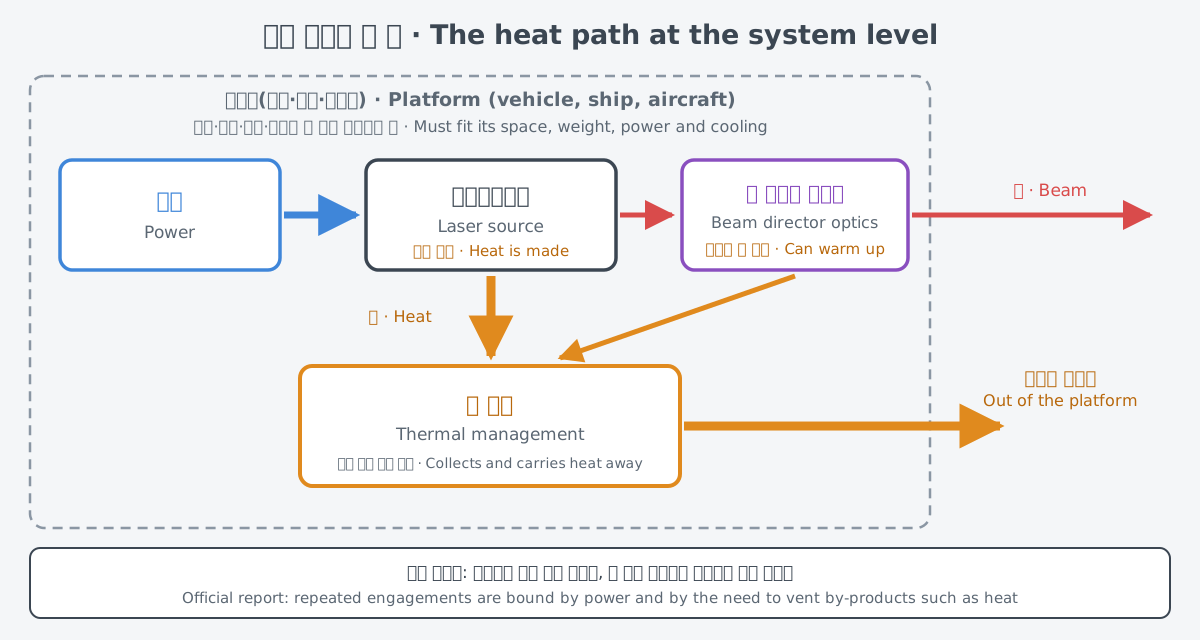
Cooling is also linked to range. The 2024 edition of a CRS report finds that size, weight and power (SWaP) and cooling requirements can limit the range and beam quality of directed-energy weapons. Rain, fog, obscurants and other atmospheric conditions can do the same, which in turn can reduce their effectiveness. The same report lists as a question for Congress whether, and how, Department of Defense maturation efforts are reducing the SWaP and cooling requirements.
Ships face a similar picture: in a January 2024 press report, a U.S. Navy admiral in charge of laser weapon development said directed energy requires space, weight, power and cooling. That can be a challenge on current surface combatants. Ship power is covered further in Power and efficiency.
Heat outside the laser
Heat does not stay inside the laser source. The optics that carry the beam can warm up too. A manufacturer's page on industrial powder bed fusion machines says the focus spot can shift by up to several millimeters as the optical train of the laser system heats up. It also lists thermal effects caused by the laser's energy, along with vibration and shock, among the causes of degradation.
This is about factory equipment, so it cannot be carried over to laser weapons as it is. It does show that the laser source is not the only place where heat needs thought.
Thermal blooming, which has a similar name, is heat in a different place. A laser that keeps firing in the same direction for some time can heat the air it passes through. The heated air can then defocus the beam and reduce its ability to disable the target. This heat forms in the air along the beam, not inside the laser, and CRS notes it generally becomes more of a concern as beam power rises.
The heat that did not become light remains a problem to solve together with power, beam quality and the platform.
What to read next
- Power and efficiency: the share of electricity that becomes light sets the size of the system. It continues the story of how efficiency sets both the power and the cooling burden.
- Weight and platforms: fitting on a vehicle, ship or aircraft. It looks at why each platform sets different conditions.
- Power supplies and chillers: the equipment behind a laser. It looks at the equipment that carries heat away.
- Light through air: absorption, scattering, turbulence, thermal blooming. It looks at why the air along the path weakens a beam.