The talk abstracts for a laser conference held at the end of January 2027 could be read the autumn before. That is because the conference program posts titles and abstracts ahead of the talks. Few sources show where a field is moving as quickly as conference abstracts.
But an abstract is short, and its authors put their best numbers first.
This note uses LASE, the laser part of SPIE Photonics West that this site's conference articles rely on. It explains how a conference is organized, what to look for in an abstract, and how to compare numbers. A review paper that gathers a whole field is read differently. That is covered in Reading a high-power fiber laser review paper.
SPIE Photonics West and LASE
SPIE is a professional society for optics and photonics, and Photonics West is the large event SPIE holds in San Francisco. The 2027 event runs from January 30 to February 4. One event holds several subject groups such as BiOS, OPTO, LASE and Quantum West, and LASE is the group for lasers.
LASE covers lasers of many kinds, from fiber and diode lasers to solid-state ones, along with resonators, beam steering, laser processing and nonlinear optics. LASE has 18 conferences in 2027. This site's conference articles look mainly at the fiber laser, solid-state laser, high-power diode, components and packaging, and resonator and beam control conferences.
Conference numbers, sessions and talk numbers
Each conference inside LASE has a number. The full name of the 2027 solid-state laser conference is "Solid State Lasers XXXVI: Technology and Devices," and its number is 14438. The Roman numeral XXXVI at the end means it is the 36th meeting.
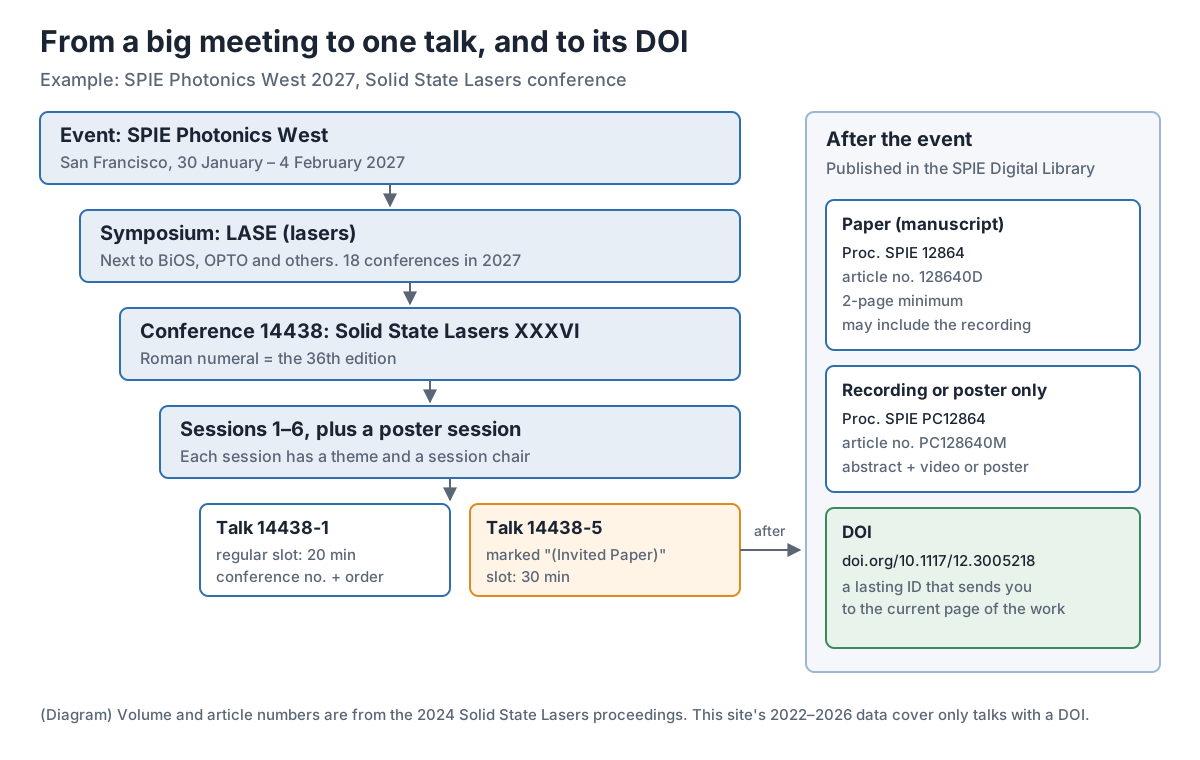
A conference is split into topic sessions. Conference 14438 has six sessions, on pulsed lasers, mid-infrared and eye-safe bands, new concepts, UV and visible, materials and characterization, and ruggedized and space lasers, plus a Tuesday poster session. Each session has a session chair, and talk numbers take the form "conference number-order." Talk 14438-1 is the first talk of this conference, in a 20-minute slot.
Session names show what the conference sees as important that year. But names and contents do not always match. The 2027 ruggedized and space session also held a semiconductor VCSEL talk and a theory talk on superconducting rings. That is why reading a trend calls for talk titles and abstracts, not session names.
The invited-talk mark
In the program, some titles end with "(Invited Paper)." This marks an invited paper. In conference 14438, three of 40 talks were invited (14438-5, 14438-11, 14438-23), and all three had 30-minute slots instead of the regular 20 minutes.
An invited talk can be read as a sign that the conference committee is watching that topic. It is not a guarantee of a better result. SPIE's public guidance pages do not say who picks invited talks or how, so it is safest not to read more into the label than the label itself.
Proceedings and DOIs
After the conference, talks go into the SPIE Digital Library. According to SPIE's manuscript guidelines, manuscripts, presentations and posters are officially published there after the event, and chairs and editors review the manuscripts. A manuscript must be at least 2 pages. Talk recordings go into the proceedings in the same library.
So the proceedings mix two kinds of entry. A talk with a manuscript gets a plain volume number such as "SPIE 12864." A recording or poster alone goes into a volume with a PC prefix, such as "SPIE PC12864."
At the 2024 solid-state laser conference, the 146 W thin-disk oscillator talk was the first kind (article 128640D). A Yb:CALGO oscillator poster from that year was the second kind (article PC128640M). A PC entry holds only the abstract and the video or poster, so it rarely gives the detailed conditions a manuscript would.
Each talk gets a DOI (Digital Object Identifier). The DOI Foundation describes a DOI as a lasting digital identifier for an object, and says the DOI System looks up the string and sends you to the object. Opening "https://doi.org/10.1117/12.3005218" brings up that talk's SPIE Digital Library page. The DOI stays the same even if the web address changes, so this site lists each talk with both its talk number and its DOI.
Five things to check in an abstract
An abstract is usually one paragraph. Before hunting for numbers, asking "what kind of number is this?" prevents most misreadings. The diagram below sums up five checks, with real examples from solid-state laser abstracts.
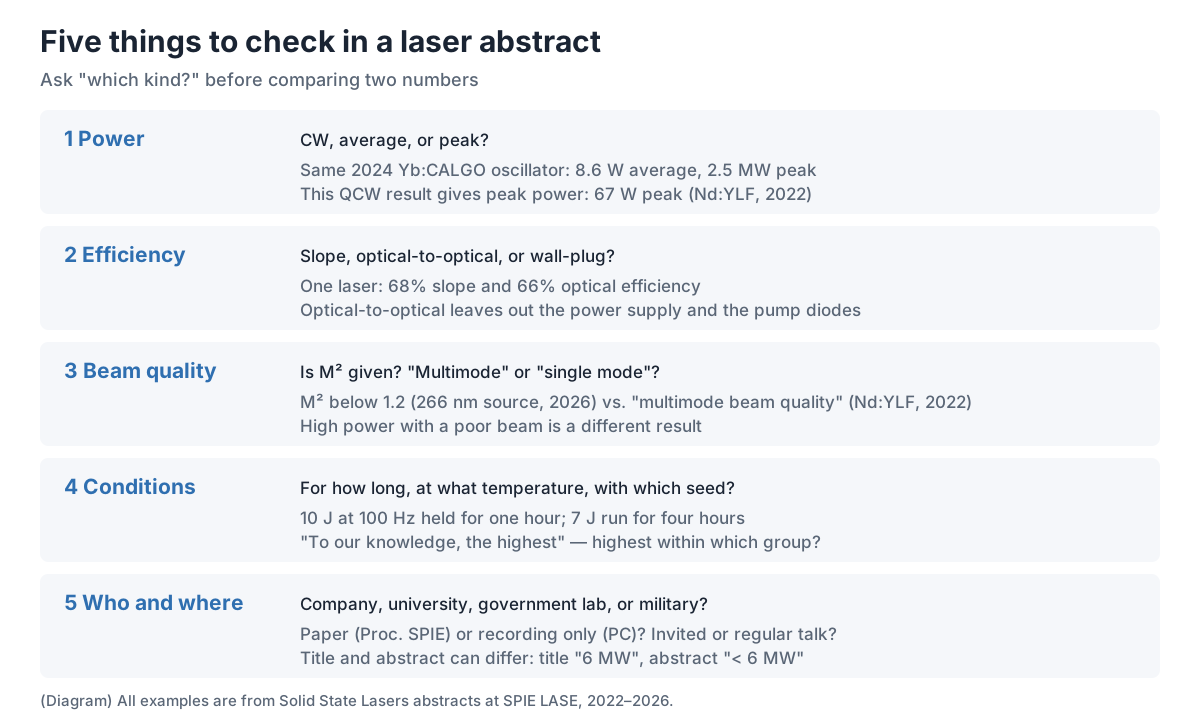
Power. Output from a continuous-wave laser, the average power of a pulsed laser and the peak power of one pulse are different things. One Yb:CALGO oscillator from 2024 had 8.6 W average and 2.5 MW peak. It is the same laser, yet the two numbers differ by a factor of nearly 300,000. The article on power, energy and intensity explains how they relate.
Efficiency. A 2022 Nd:YLF laser abstract gave both a 68% slope efficiency and a 66% optical efficiency. Slope efficiency is how fast output grows as pump power rises, while optical efficiency is output divided by all the pump light put in.
The 25.4% optical-to-optical efficiency in the 2024 DiPOLE abstract is the share of pump light turned into laser light. It is not the wall-plug efficiency, which counts from electricity to light. The article on power and efficiency covers the kinds of efficiency in detail.
Beam quality. High power with a scattered beam is a different result. The 2026 abstract for a 266 nm source gave M² below 1.2, while the Nd:YLF abstract above only said "multimode beam quality." First check whether beam quality is given as a number. The article Beam quality M² explains what M² means.
Conditions. How long and under what conditions a value was measured sets its weight. The DiPOLE abstract held 10 J at 100 Hz for one hour and ran at 7 J for four hours. The 266 nm source was tested for 400 hours at 8 W.
The Nd:YLF result above was 67 W peak in QCW operation, where the laser runs in long pulses. A number without such conditions is hard to set beside another talk's.
Here is one abstract run through all five checks. In the 2024 DiPOLE abstract, power is 10 J pulses at 100 Hz, or 1 kW average. Efficiency is 25.4% optical-to-optical, and no electricity-to-light figure is given. The abstract gives no beam quality number, and the condition is variation within 1% rms over one hour.
The affiliation is the Rutherford Appleton Laboratory in the UK, and the PC12864 volume means it is a recorded talk. Once the boxes are filled, the empty ones show what this abstract alone cannot tell you.
Who and where. Look at whether the affiliation is a company or a university, whether there is a manuscript or only a recording, and whether the talk was invited. The affiliation is a clue to where the work is headed. The affiliation type alone does not decide how much a result counts.
What affiliations show about a conference
Grouping the 40 talks at the 2027 solid-state laser conference by first affiliation, companies lead with 23 talks. Universities have 9, government and public labs 7, and military labs 1. The government and public group counts national labs together with public-interest institutes such as Laser Zentrum Hannover.
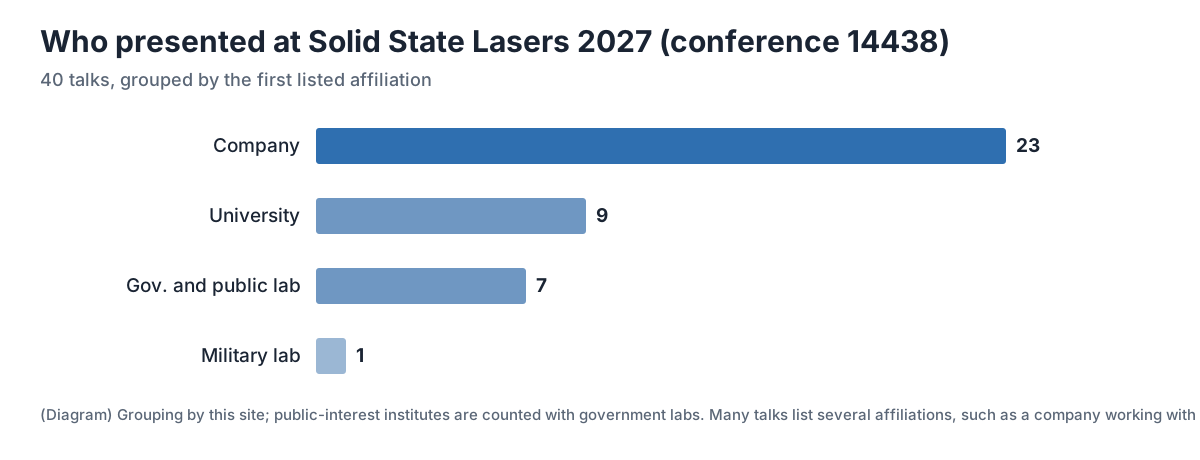
These numbers can be read as a sign that this conference leans heavily on industry. Crystal makers (Northrop Grumman SYNOPTICS, CRYTUR) and UV source makers (Coherent, OXIDE) gave several talks in the materials and UV sessions.
Many talks list several affiliations, though. Talks 14438-7 and 14438-9 came jointly from the laser company MegaWatt Lasers and the Naval Undersea Warfare Ctr. Keyport, but counted by first affiliation they appear as company talks.
Care when comparing numbers
The most common mistake is to line up numbers from different talks in one row. Test conditions differ, and even the same word can mean different things. A fair comparison needs at least the same kind of power, the same kind of efficiency, the beam quality and the test time.
"The highest to our knowledge" also needs its scope read.
The 146 W thin-disk oscillator abstract said it was the highest among few-cycle sources without an amplifier. The Nd:YLF abstract said its efficiency was the highest for Nd:YLF pumped near 800 nm. The "first" in the Yb:CALGO abstract means first among femtosecond lasers run with a White cell configuration. All of these are records with conditions attached.
Titles and abstracts can also differ. A 2022 UV microlaser put "6 MW" in its title and "less than 6 MW" in its abstract. Reading a trend from titles alone misses gaps like this.
Finally, the program keeps changing until the meeting. The 2027 solid-state laser conference page said post-deadline abstracts would be accepted through December 7.
Comparing several years has three more traps. The first is the data basis. A program before the event and the proceedings after it hold different sets of talks, so compare only years counted from the same kind of source.
The second is how topics are sorted. Mixing years tagged by hand with years tagged automatically by keywords can make a change of method look like a trend.
The third is the count. When a year has few talks, one or two talks can shift a share a lot. The same three checks come first when reading the chart in the companion article "Solid-state laser trends at SPIE, 2022–2027."
This site's conference data are based on manuscripts in the proceedings and public abstracts, so talks given without a paper are missing. Conference abstracts are a quick window on a trend, and firm conclusions need the manuscripts and later papers too.
The same habit helps with news stories. That topic is covered in How to read laser weapon news.
What to read next
- Solid-state laser trends at SPIE, 2022–2027: six years of the solid-state laser conference, read with the methods in this note.
- Reading a high-power fiber laser review paper: the step after conference abstracts, reading a review that gathers a field.
- Beam quality M²: a closer look at what an M² value in an abstract means.