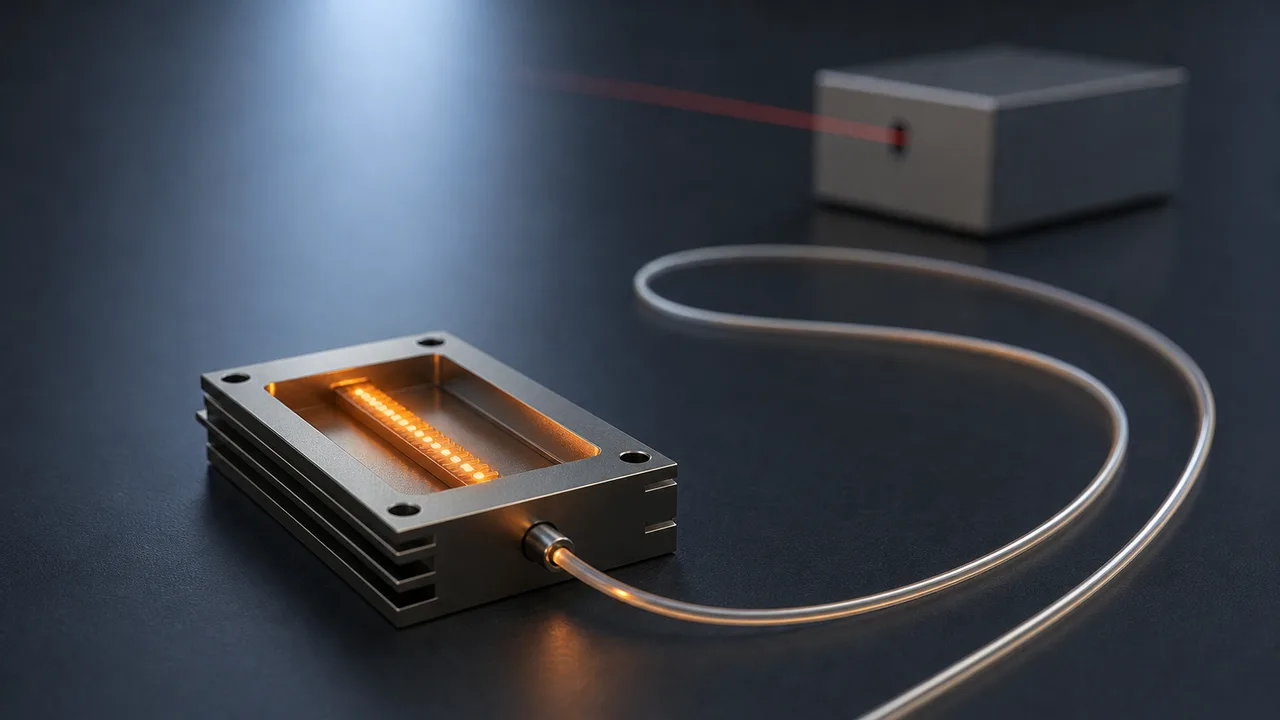
Whether it is a fiber laser or a solid-state laser built around a crystal, the energy in the beam comes from the electrical outlet in the end. Yet electricity does not turn straight into a laser beam. In many lasers, a small semiconductor part sits in between and first turns electricity into light.
That part is the pump diode. This article looks at how a pump diode makes light, why many of them are used together, and why the wavelength has to be chosen. At the end, it turns to the problems of heat and lifetime, and to what defense laser companies say about these parts in public.
A laser's fuel is light
A laser has three parts. The gain medium makes light grow, pumping puts energy into that medium, and the optical resonator feeds the light back. "The three parts of a laser: gain medium, pump and resonator" explains each of them.
A solid-state laser is pumped with light to create a population inversion. The pump source can be a flashlamp or another laser source such as a laser diode (LD). Virtually all fiber lasers are pumped with light from laser diodes or other fiber lasers.
For these lasers, pump light works much like fuel in a car. The laser can only give out light in return for what goes in. There is one real difference, though. A car takes the same fuel every time, but pump light must be at a wavelength the gain medium absorbs well.
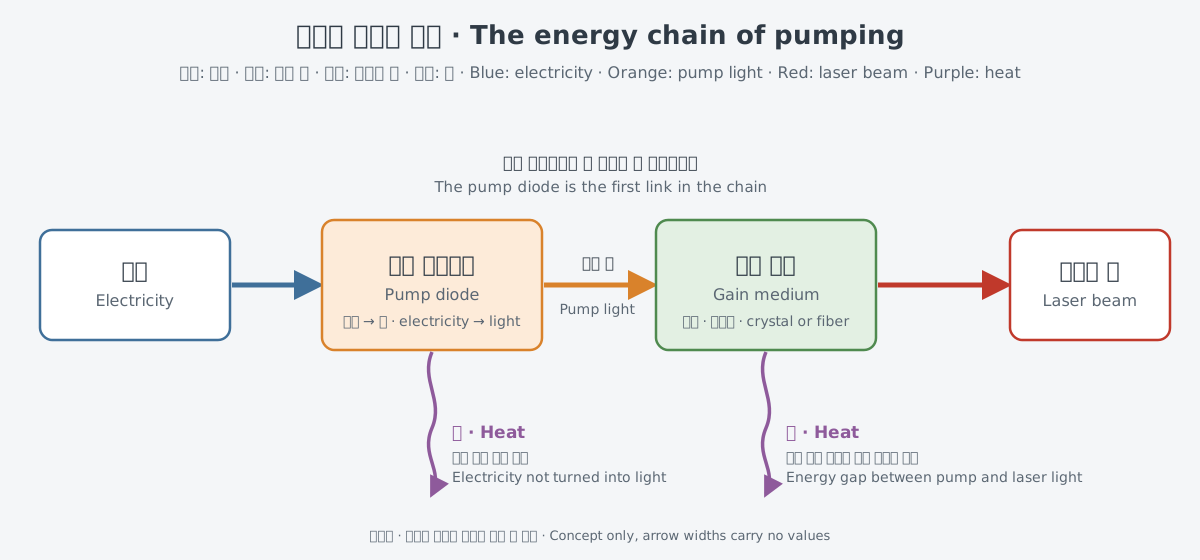
The pump diode is the first link in this chain. Part of the energy escapes as heat both where electricity becomes light and where that light becomes laser light. Knowing the pump diode also shows where the heat in a laser comes from.
How a laser diode makes light
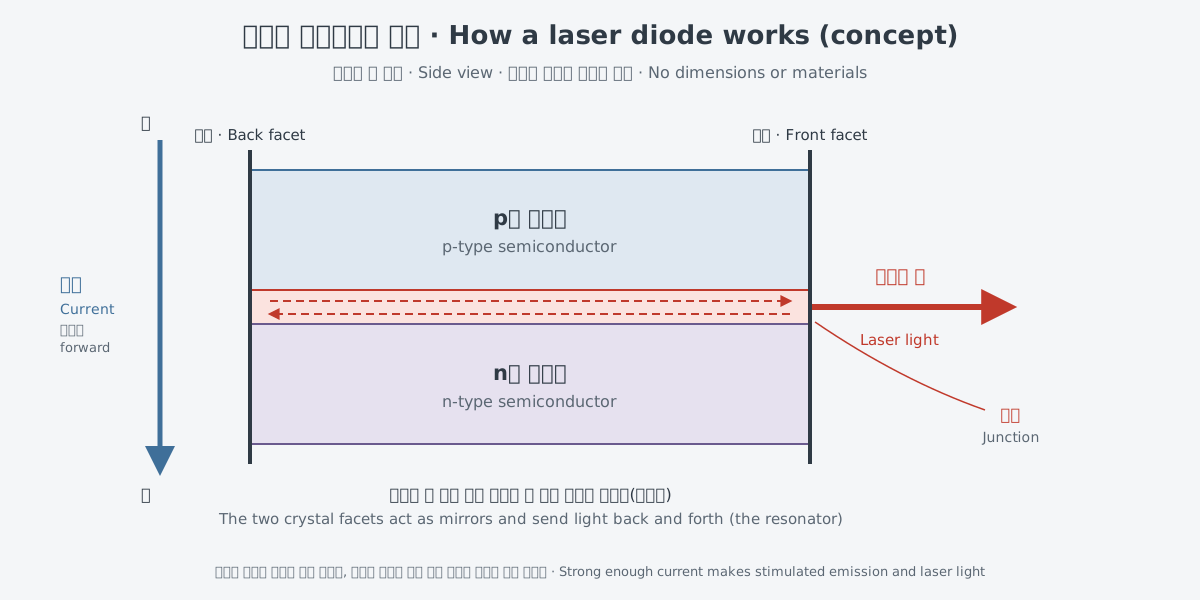
A pump diode is a laser diode used as a pump source. "Laser diode" is another name for a semiconductor laser. The name comes from the way it works like a diode, with current flowing in the forward direction of a semiconductor junction.
The junction is where a p-type and an n-type semiconductor meet. When charge carriers are pushed into this junction region, they recombine and light can come out. When the current is strong enough, a population inversion forms and stimulated emission takes place.
Inside the semiconductor, a conventional diode laser makes light when electrons drop from the conduction band to the valence band. The energy gap between the two bands is called the bandgap. A semiconductor gain medium lets designers choose the emitted wavelength quite freely by engineering this bandgap.
So where is the resonator? The refractive index of a semiconductor is very different from that of air. Because of this, the facets of the semiconductor crystal can reflect enough light to act as the resonator on their own.
Newport lists the strengths of laser diodes over other lasers: high power and efficiency, small size, and an easy fit with electronic parts. It credits electrical pumping, a compact design and mature semiconductor manufacturing. Laser diodes are used in optical data storage and fiber-optic communication, and they also serve as pump sources for solid-state lasers.
From one to many: emitters, bars and arrays
The spot on a laser diode chip where light comes out is called an emitter. A chip with one emitter is a single emitter, and a long chip with a row of emitters is a laser bar. A figure caption in an ultrafast laser textbook shows separate semiconductor lasers placed side by side in one array, and it notes they can also be stacked vertically.
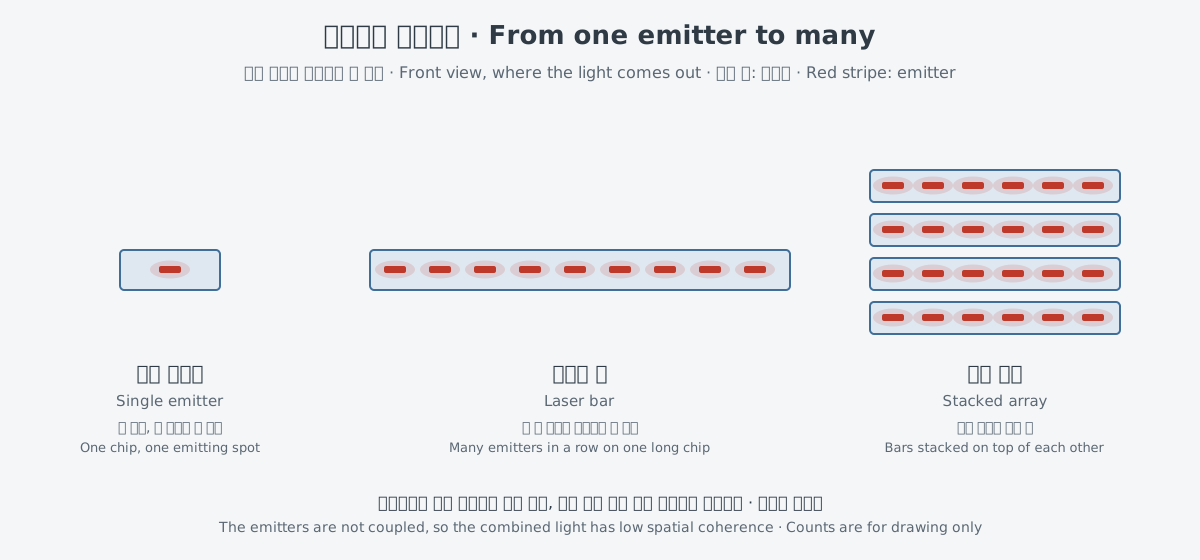
Diode-pumped solid-state lasers are typically pumped by such high-power semiconductor diode arrays or bars. The individual diode lasers in an array or bar are not coupled to each other. As a result, the spatial coherence of the light they give out is much lower. Even so, the light from these arrays is much brighter than a normal flashlamp.
Brightness here means power per unit area. The brightness of diode arrays has improved steadily since the 1980s.
Some diode lasers gather the light of many single emitters into a fiber. nLIGHT, for one, says its semiconductor lasers rest on single-emitter diodes and high-brightness fiber coupling.
Matching the wavelength to the absorption line
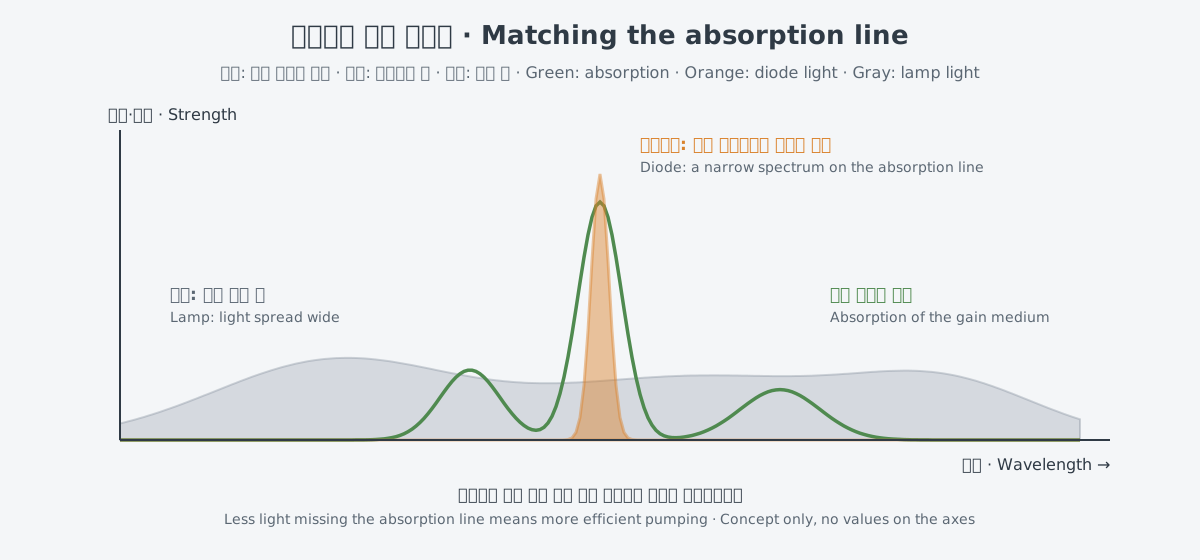
A gain medium does not take in just any light. Its atoms or ions absorb well only at certain wavelengths, and such a narrow spot is called an absorption line. Pump light that misses the line goes unused.
A diode array has a much narrower spectrum than a typical flashlamp. That lets it be tuned straight onto an absorption line of a solid-state laser, so the pump light is absorbed more efficiently and heating effects drop. The closer the pump energy is to the laser energy, the stronger this effect.
The difference between the two energies is called the quantum defect. A pump photon usually carries more energy, and in an active fiber this difference is the most important source of heat. Picking the pump wavelength therefore sets both absorption and heat.
So pump diodes come in wavelengths matched to what they pump, such as 793 nm for thulium fiber lasers, 1532 nm for erbium and 808 nm for solid-state lasers. Some modules carry 915 nm or 976 nm in their names and are labeled for laser pumping.
Does the wavelength stay put once it is chosen? Products sold as wavelength stabilized address that question. As nLIGHT puts it, a wavelength-stabilized spectrum stays locked over a broad range of temperatures and currents, giving consistent, efficient absorption for pumping. This also implies that, without stabilization, the wavelength can change with temperature and current.
Turning rough light into a good beam
Light from diode arrays may be brighter than a flashlamp, but its beam quality is low. This is where an important advantage of diode-pumped solid-state lasers comes in. They can turn fairly low-cost, low-beam-quality pump power from diode arrays and bars into a near-diffraction-limited output beam with good efficiency.
Picture rain falling all over a roof being gathered and sent out through one tap. The real process is different. The gain medium does not just collect pump light and pass it on; it uses the energy of the pump light to make new, orderly light by stimulated emission.
Fiber lasers show the same pattern. The abstract of a 2010 review paper by Richardson, Nilsson and Clarkson credits the success of high-power fiber lasers largely to the fiber's geometry, its long, thin shape. That shape allows efficient conversion of relatively low-brightness diode pump light into high-brightness laser output.
To couple diode light with lower-quality spatial modes into a fiber efficiently, a double-clad fiber is often used. IPG says its side-pumping method couples the light of many pump diodes into the cladding of a gain fiber. FiberBridge Photonics also lists a side-pump combiner for 1 µm, 1.5 µm and 2 µm among its components.
"Double-clad fibers and how pump light gets in" covers in detail how the pump light enters the fiber.
Heat and lifetime: the hard parts
Laser diodes are fairly efficient, but they cannot turn all of their electricity into light. TWI, a UK welding institute, gives a typical wall-plug efficiency of 30–50% for direct-diode lasers, which use diode light directly. That is not the value for a single pump diode. Still, it means that even a laser that uses diode light directly can lose more than half of its electrical input.
Power that does not become light turns into heat, and that heat has to be removed. Single-emitter pumps may be cooled with water or air, while stacked bars may use microchannel coolers.
Diodes do not last forever either. TWI notes that in some solid-state lasers, lamps are typically changed every 1000 hours and diodes typically every 10000 hours. Diodes outlast lamps, but they are still parts that are replaced on a schedule.
Across fiber lasers as a whole, heat becomes an even bigger issue. The same 2010 review abstract names thermal management, optical nonlinearity and damage as key factors limiting fiber laser performance. The equipment that powers pump diodes and carries their heat away is the topic of the next article.
Pump diodes in defense lasers
Pump diodes also show up in the descriptions of companies that work on defense lasers. One of them, nLIGHT, says it has long supplied aerospace and defense customers with high-power laser technology used in countermeasures, high-energy lasers (HEL), LiDAR and navigation. Its range includes a high-brightness, wavelength-stabilized 976 nm product listed for directed energy.
These descriptions are what the companies say about themselves. They do not show which company's diodes have gone into which real weapon system.
What to read next
- "Power supplies and chillers: the equipment behind a laser": looks at the equipment that powers pump diodes and removes their heat.
- "Double-clad fibers and how pump light gets in": follows the path pump light from the diodes takes into a fiber.