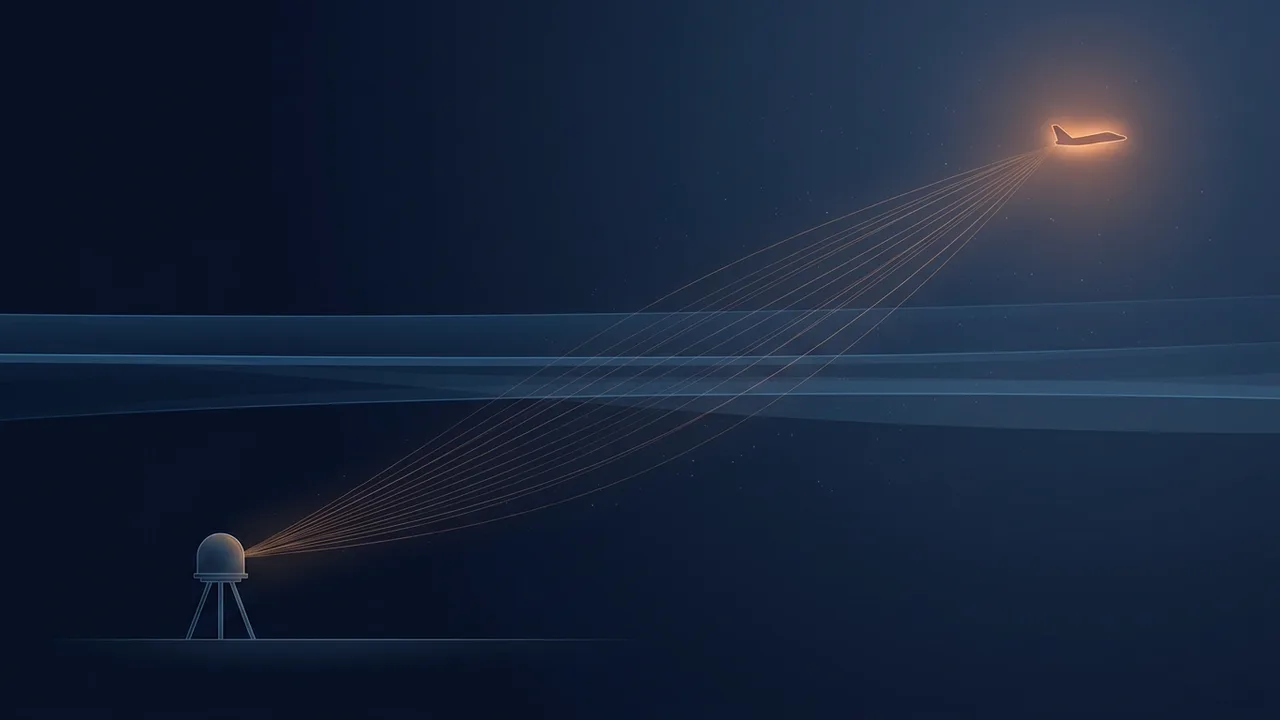
An aircraft appears on a cockpit display, yet nothing was sent out to find it, so how was it found? The answer is heat. An aircraft in flight is warmer than its surroundings, and warm objects give off infrared, a kind of light the eye cannot see. A sensor that collects that light to find and follow aircraft is called infrared search and track (IRST).
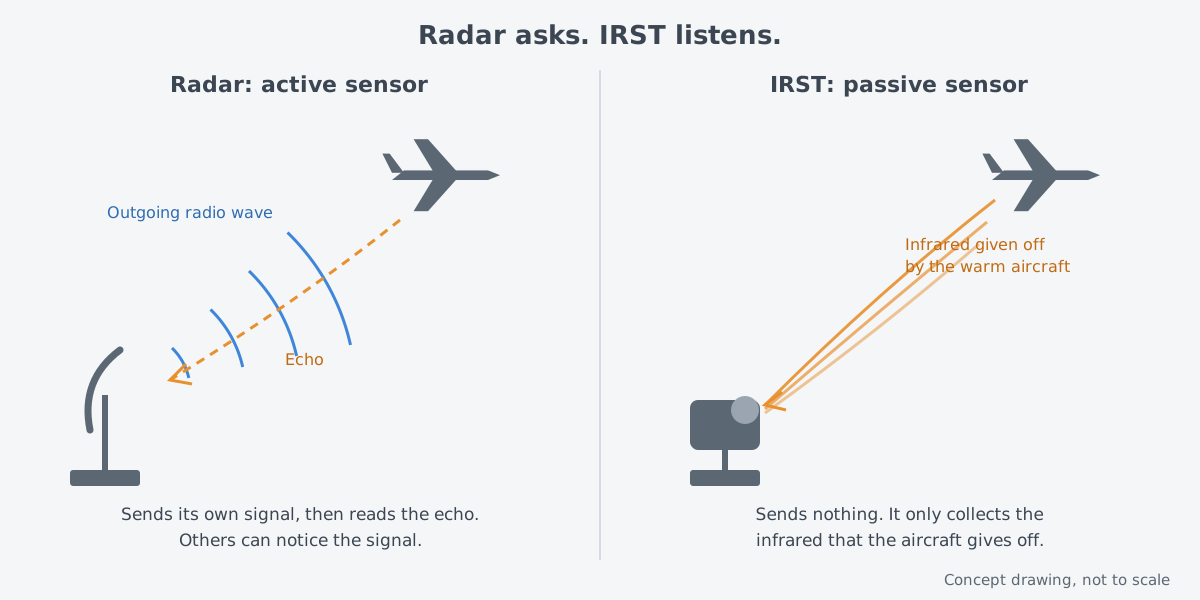
Radar sends out radio waves and reads the echoes that come back. IRST sends nothing and only receives. Almost everything IRST does well, and everything it struggles with, follows from that one difference.
Sensors that ask and sensors that listen
Sensors fall into two broad groups. Active instruments send out energy and gather data from changes in the returning signal. Passive instruments detect energy that the natural environment gives off. Radar is an active sensor, and IRST is a passive one.
If radar is the one asking, IRST is the one listening. A passive system sends no signal of its own and only listens to what others give off. How radar works is summed up in "Radar: measuring distance and motion with radio waves".
Every object gives off infrared
Infrared belongs to the electromagnetic spectrum. People cannot see it, but they can sense it as heat.
It was found by accident. In 1800, William Herschel placed thermometers in each color of visible light and compared their temperatures. Just past the red end, where no color showed at all, the reading was even warmer. Light the eye could not see was there.
This kind of light is not limited to special objects. Any object whose temperature is above absolute zero (-273°C) always reflects, absorbs and gives off energy. The hotter an object gets, the stronger its radiation and the higher its frequency.
Very hot objects such as a fire also give off visible light. Objects that are not that hot, such as people, give off only infrared. Night-vision goggles and infrared cameras collect this infrared and let us "see" warm people and animals. How the color of light relates to wavelength is summed up in "Light basics: waves, wavelength, frequency and photons".
Infrared has its own sections. NASA splits it into three bands: near, mid and far, and explains that Earth scientists call the 8–15 µm range thermal infrared. Those wavelengths are the best for studying the heat that our planet sends out.
Why an aircraft stands out: temperature contrast
What matters to an infrared sensor is less the temperature itself than the difference. The warmer an object is compared with its surroundings, the easier it is to find with infrared sensors. Even at the same temperature, an object can be easier or harder to spot depending on how warm its background is.
Imagine looking for a person in a dark room without a flashlight. Your eyes see nothing, but a camera that sees heat shows the person glowing. The person is warmer than the room.
The comparison has limits. A person in a room is close and looks large, while an aircraft in the sky is far away and shows up only as a tiny dot. The real task of the sensor is to pick out that small dot in a wide sky.
According to the Congressional Research Service (CRS), U.S. forces have long followed enemy aircraft and ground vehicles by their infrared signatures and used them to steer missiles. IRST pods carried by aircraft are one example. The maker Lockheed Martin describes its IRST as seeing an aircraft's heat signature, or "skin."
Good at direction, weak at distance
Infrared sensors are strong at measuring direction precisely. A 1999 article in the Johns Hopkins Applied Physics Laboratory (APL) Technical Digest looked at passive infrared imaging systems built for naval defense. It wrote that they estimate a target's angle very accurately but give no range. Even compared with radar, an infrared sensor measures a target's angle far better.
It cannot tell the distance because it only receives. The FAA's airport surveillance radar finds the distance to an aircraft by timing how long its reflection takes to come back. IRST sends nothing, so there is nothing to time.
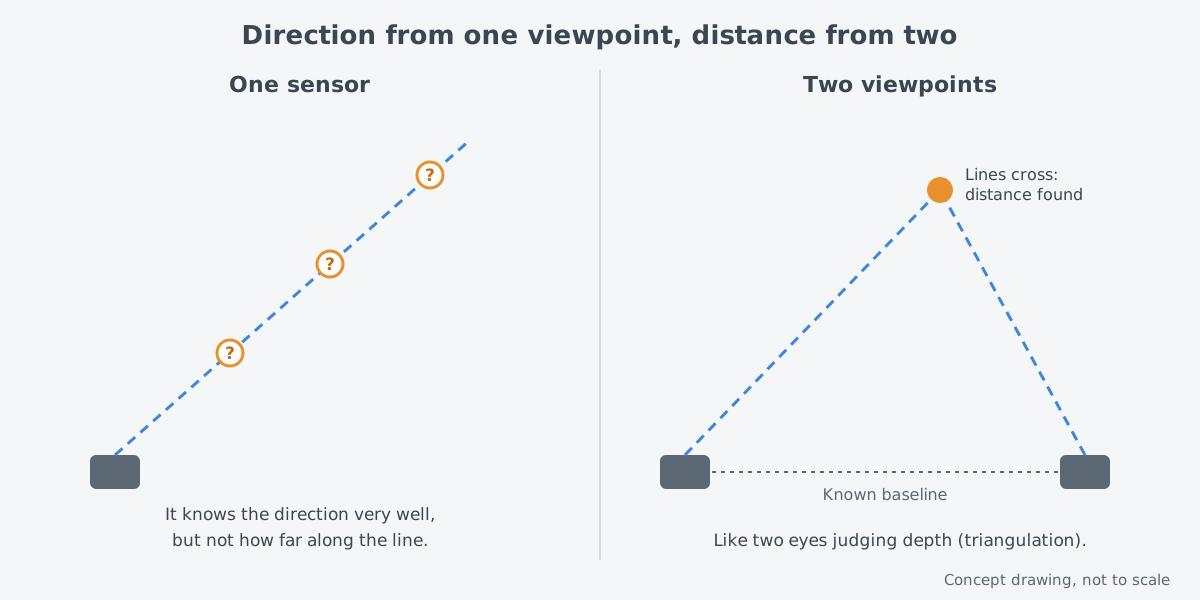
There is still a way to get the distance. If two separate places look at the same target, the point where their two direction lines meet is where the target is. Two infrared imaging sensors on a known baseline can find the range by triangulation, and they still need to send out no energy.
Our two eyes do something similar. They see the same object from slightly different spots, and the brain judges distance from the difference. In practice, the accuracy of the distance depends on three things: how far away the target is, how long the baseline is, and how large each sensor's angle error is.
Limits set by the air
Some infrared is absorbed on its way through the air, because the gases in the atmosphere absorb certain wavelengths and let others through. Ranges soaked up by gases such as water vapor, ozone and carbon dioxide are called absorption bands. The ranges where the air is clear enough for radiation to pass easily are called atmospheric "windows." Part of the mid-infrared and all of the far-infrared can barely get through the atmosphere.
Beyond the air itself, there is one more condition. A remote sensing instrument gathers radiant energy only when nothing blocks its line of sight to the object that reflects sunlight or gives off heat.
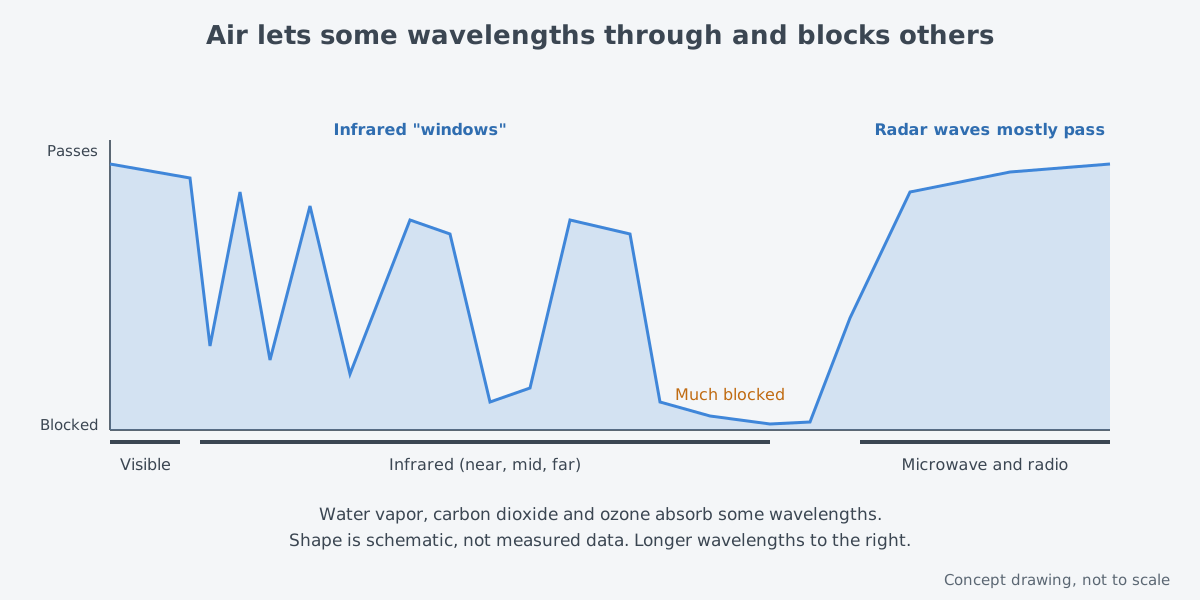
Radio waves are different. Most microwave radiation crosses the air with little loss, which lets radar waves get all the way to the ground. That is also why synthetic aperture radar can make high-resolution images by night or day, whatever the weather. How light weakens in air is covered in more detail in "Light through air: absorption, scattering, turbulence, thermal blooming".
A sensor used alongside radar
IRST does not push radar aside. APL wrote that infrared systems used as one of the sensors on a ship bring added benefits to defending the ship itself and the area around it. Combining an infrared sensor's precise angle with a range that is already known can also give a target's height very accurately. Radar and infrared sensors fill each other's gaps.
Aircraft use it more widely too. In a 2021 report, CRS explained that IRST pods are used to identify enemy aircraft, especially as aircraft designs move toward smaller radar cross-sections that make radar detection harder. The same report noted that at that time the U.S. Navy was paying to develop an IRST pod for its F-18E/F Super Hornet fighters. The U.S. Air Force had been buying IRST capability for the F-15C Eagle.
Where lasers meet it: infrared and tracking
Infrared is a familiar word on the laser weapon side as well. Which wavelengths pass well through air, and how invisible light is divided up, are questions that come up often in the laser articles. That story continues in "Why wavelength matters: visible and invisible light".
What happens after finding is similar too. IRST, as its name says, searches and then tracks. A laser weapon also has to find its target and follow it precisely before it can hold its light on one spot. That is the subject of "Gimbals, pointing and tracking: holding the beam on one spot".
What to read next
- "Why wavelength matters: visible and invisible light": invisible light, infrared included, sorted by wavelength.
- "Gimbals, pointing and tracking: holding the beam on one spot": the hardware that follows a found target, seen from the laser weapon side.
- "Measuring with lasers: range finding and lidar basics": the active way of measuring distance by sending light and timing its return.